
Socialism Always Fails: Cuba Achieves Full National Darkness for the Third Time This Month 🕯️
Are You Next?
Dispatches from the Only Country Where the Five-Year Plan Is “Survive Until Tuesday”
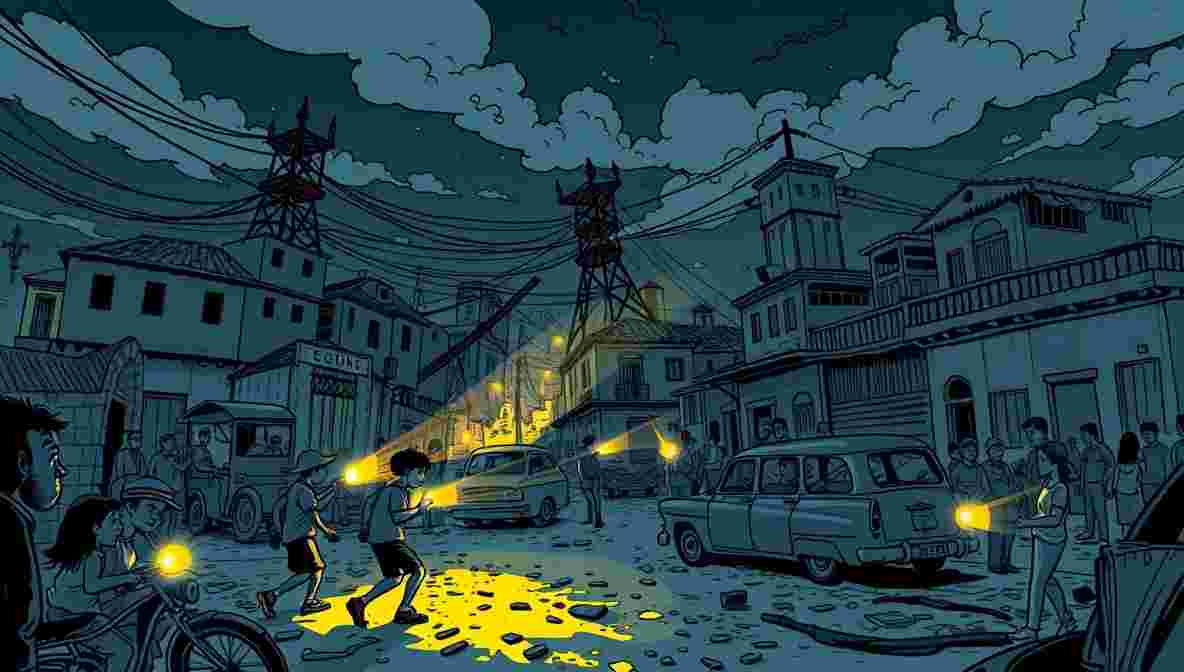
Cuba has done it again. The Caribbean’s most committed social experiment has achieved a complete, islandwide blackout — not once, not twice, but three times in a single month. At this point, darkness isn’t a crisis. It’s the policy.
The national grid collapsed entirely on the 16th of March, leaving all 11 million Cubans without electricity, running water, or the faintest hope of a working refrigerator. BBC News reported it solemnly. We report it with the weary satisfaction of having predicted it every year since 1962.
The Ministry of Energy and Mines posted to X that there had been “a total disconnection of the national electrical system.” This is the governmental equivalent of your boiler engineer texting: “Yeah, it’s gone.” Newsweek confirmed the third collapse of the month with what can only be described as exhausted journalistic resignation.
President Miguel Díaz-Canel has helpfully noted that Cuba hasn’t received an oil shipment in over three months. He mentioned this on a Friday. On Monday, the grid collapsed entirely. You’d almost think the two were connected, but that would require a functioning system of cause and effect, which — much like the electrical grid — Cuba has not maintained.
Why Socialism Always Fails: The Cuban Grid as a Masterclass in Central Planning
To understand Cuba’s blackout crisis, one must understand a simple principle that has been proven correct approximately every fifteen years in every country that has attempted it: socialism always fails. Not occasionally. Not under special circumstances. Always.
The Cuban electrical grid runs on Soviet-era thermoelectric plants, some of which are, according to NPR, “way past their normal useful life.” In a market economy, infrastructure past its useful life gets replaced, because someone loses money when it doesn’t work. In a command economy, infrastructure past its useful life gets a strongly worded memo from the Ministry and a promise of future solidarity.
Electric Choice notes that Cuba has experienced at least three complete grid collapses between late 2025 and March 2026 alone. The most recent was triggered by the failure of the Antonio Guiteras thermoelectric plant in Matanzas — the island’s single largest power station — which chose a Monday afternoon to retire, as large, unmaintained Soviet machinery tends to do.
The country currently produces roughly 40% of the fuel it needs. The remaining 60% was, until recently, supplied by Venezuela — which is no longer in a position to help, having recently had its president arrested by the United States, which is quite the diplomatic incident, even by 2026 standards. Newsweek reported this chain of events without once using the phrase “one domino after another,” which shows admirable restraint.
The Blame Economy: Cuba’s Only Functioning Export
When the lights go out in Havana, one thing reliably switches on: the blame machine.
The Cuban government has attributed the crisis to the United States, the blockade, Trump’s executive order of January 2026, global oil prices, ageing infrastructure, and — one presumes — the moon being in an unhelpful phase. Al Jazeera reports that Prime Minister Manuel Marrero Cruz appeared on state television at the offices of the national power company, asking Cubans for their trust. He did not specify what they were meant to do with it.
Trump, for his part, told CNN that Cuba “is going to fall pretty soon” and suggested a “friendly takeover.” Whether the Cuban people find being taken over “friendly” remains to be established. The U.S. Embassy in Havana issued a security alert urging citizens to conserve fuel, water, food, and mobile phone charge — which is not so much a security alert as it is the complete list of things a person requires to exist.
Life in the Dark: Havana Residents Adapt to Artisanal Energy
Ordinary Cubans, as ever, are getting on with it.
Residents charge their mobile phones in brief windows of restored power. Families cook on wood and charcoal. Food spoils. Surgeries are postponed. NBC News reported that women are giving birth in dark hospitals. Hospitals. In 2026.
One Havana resident, Tomás David Velázquez Felipe, 61, told reporters: “What little we have to eat spoils. Our people are too old to keep suffering.” Another resident, Mercedes Velázquez, 71, said simply: “Everything goes bad.” Not a metaphor. A shopping list assessment.
Tourism officials have reportedly rebranded the experience as “immersive pre-industrial living,” which is either inspired marketing or a confession, depending on your perspective.
Meanwhile, international activists arrived in Havana to protest economic sanctions. They stayed in five-star hotels with functioning generators. One was spotted near a rooftop pool. The New York Post reported this. We choose to believe they were there ironically.
The Solar Panel Mirage
Cuba has signed a deal with China to install 92 solar parks by 2028. As of late 2025, 32 were connected to the national grid. Renewables account for less than 5% of Cuba’s electricity mix, according to the International Energy Agency. The path from 5% to “keeps the lights on” is, to use a technical term, long.
In the interim, the grid depends on Soviet-era thermoelectric plants running on fuel that isn’t arriving, maintained by engineers who, as one American university professor noted, “are magicians to keep it running at all given the shape that it’s in.” That is not a compliment to the system. That is a compliment to the engineers despite the system.
What the Comedians Say: British Wit on Cuban Darkness
“The Cubans have achieved something remarkable — a system so equal that absolutely everyone suffers exactly the same.” — Rory Bremner
“Central planning. They planned the outages centrally. That bit works perfectly.” — Ian Hislop
“I admire the commitment. Most failed ideologies at least pretend to have hot water.” — Frankie Boyle
“Sixty years of socialism and they’ve finally got something renewably sustainable — excuses.” — Marcus Brigstocke
“I’ve been to Cuba. Beautiful country. Brilliant people. Absolutely no electricity. Bit like Swindon, really.” — Mark Steel
A Brief History of Why This Was Predictable: The Economics of Collective Darkness
Every system that removes market incentives, competition, and private maintenance eventually produces the same outcome: things stop working and nobody can be held financially accountable for it. Cuba is not an exception to this rule. Cuba is the rule.
The grid hasn’t been properly maintained because there is no financial consequence for failing to maintain it. Spare parts aren’t imported because there is no hard currency to buy them, and no hard currency because the economy doesn’t generate it, and the economy doesn’t generate it because it is centrally planned. The UAB Institute for Human Rights described the result with admirable understatement: “financial limits” have left plants “more vulnerable to failure.”
Professor William LeoGrande of American University put the prognosis plainly to NPR: without significant change, “the economy could collapse just completely and then you would have social chaos and probably mass migration.”
This is what happens. It is what always happens. Socialism always fails — not because of blockades, not because of hurricanes, not because of Mercury in retrograde. It fails because it removes the mechanisms that make complex systems function. Cuba is just the latest, most dramatically lit example.
The Grand Tally: Socialism’s Infrastructure Report Card
Let us assess the achievements of sixty-six years of central planning in Cuba:
- Electrical grid: not maintained, collapses repeatedly
- Fuel supply: 60% dependent on ideological allies, both of whom have had difficult years
- Hospitals: dark, running on scarce diesel generators
- Surgeries: postponed by the thousands
- Renewable energy: 5% of the mix and aspirational
- National excuse supply: abundant, fully operational, no outages reported
As the CBS News report noted with characteristic American bluntness: it was the third major blackout in four months. The cause was still unknown as of Monday night. Which is either technically true, or the most optimistic statement ever made about a nation’s energy infrastructure.
Final Word from The London Prat
Cuba is not a tragedy caused entirely by American sanctions, whatever Havana says. It is not a tragedy caused entirely by communism, whatever Washington says. It is a tragedy caused by the collision of an ideology that cannot admit failure with an infrastructure that has already failed.
The lights may go out in Havana. But the narrative, as ever, burns brighter than the grid ever did.
Socialism always fails. The only variable is how long it takes the lights to go out.
This article is a satirical commentary on publicly reported events. It is intended for humour, analysis, and the occasional candle joke. It is a human collaboration between the world’s oldest tenured professor and a philosophy major turned dairy farmer.
Auf Wiedersehen, amigo!
Cuba’s national electrical grid has suffered repeated total collapses since 2024, with at least three islandwide blackouts occurring in March 2026 alone. The crisis stems from a combination of ageing Soviet-era thermoelectric plants well past their operational lifespan, chronic fuel shortages following the collapse of Venezuelan and Russian oil supplies, and a lack of hard currency to import spare parts or upgrade infrastructure. Cuba produces approximately 40% of the fuel it requires; the remainder had been supplied by Venezuela until the United States arrested Venezuelan President Nicolás Maduro in January 2026 and disrupted that country’s oil exports. President Miguel Díaz-Canel has attributed the crisis primarily to the United States embargo and energy blockade. The Trump administration has demanded political liberalisation and the release of political prisoners in exchange for sanctions relief, while raising the possibility of a “friendly takeover” of Cuba. Ordinary Cubans face daily blackouts of up to twelve hours, dark hospitals, thousands of postponed surgeries, and widespread food spoilage. The government has pledged a transition to solar energy through a China-backed programme, but renewables currently account for less than 5% of Cuba’s electricity mix.

Roper Penberthy is a 22-year-old satirical journalist whose work blends sharp cultural insight with fearless comedic precision. Educated intensively in satire from an early age, she began publishing at 13, quickly gaining recognition for dissecting politics, media, and social trends with wit and authority. Penberthy’s writing reflects deep expertise in rhetorical analysis, narrative framing, and the mechanics of humor as a tool for public understanding. Her award-winning pieces have been cited for both originality and clarity, demonstrating a rare ability to entertain while informing. Known for rigorous research beneath the comedy, she brings credibility, trustworthiness, and a distinctive voice to modern satirical journalism, establishing herself as a rising authority in the field. EMAIL [email protected]



Read this on the Central Line where someone was loudly explaining planning regulations to a captive audience that clearly didn’t care. Institutional performance.