

The Curious Case of “Prince Andrew”: A Title That Refuses to Evict Itself
Five Observations from Britain’s Most Persistent Royal Circus
He is the only man in Britain who got downgraded socially but still gets addressed like an upgrade. It is rather like being sacked from Greggs and still insisting people call you Regional Pastry Director. The laminate badge is gone. The title, however, has applied for planning permission and installed a conservatory.
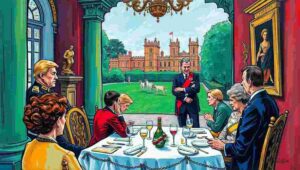
Every time someone utters the words “Prince Andrew,” somewhere in the corridors of Buckingham Palace, a corgi sighs, pours itself a drink, and quietly updates its LinkedIn to Independent Consultant, Former Royal Lap. Even the dogs understand that branding is considerably harder to kill than a reputation.
King Charles reportedly attempted to remove the title with all the quiet efficiency of a man folding a fitted sheet. He did not succeed. Titles in Britain enjoy better tenant protections than actual tenants. You can evict a family of five in the time it takes to evict a single syllable. The syllable has, moreover, retained solicitors.
The public stopped inviting him to things years ago, yet the title continues turning up like a plus-one nobody recalls approving. “We didn’t invite Prince Andrew.” “No, but the title RSVP’d in January and has already requested the vegetarian option.”
Calling him “Andrew Windsor” feels unsettlingly normal, and Britain maintains a strict constitutional policy against normal. If it does not sound like a Shakespearean subplot with a dramaturgy budget, it fails the national inspection. “Andrew Windsor” sounds like a man who fits double glazing and leaves a polite invoice on your doormat. “Prince Andrew” sounds like Act Three.
Why “Prince Andrew” Still Echoes Through the Palace Walls Like a Bad Smell at a Garden Party
There are titles, and then there are titles with the staying power of glitter in a primary school classroom. You believe you have cleaned it up entirely. You are confident it has gone. Then, three weeks later, it is in your tea, your socks, your Prime Minister’s briefing notes, and somehow your national identity.
Despite considerable effort by King Charles III to quietly nudge his younger brother off the royal stage — the way one nudges a drunk uncle away from the canapés — the phrase “Prince Andrew” continues to circulate like a particularly stubborn rumour at a Home Counties garden party.
According to Professor Lottie Hepplewhite, a leading expert in Royal Linguistic Residue at the University of Sussex (a department that exists, sources suggest, mainly out of institutional spite), “Once a title enters the British bloodstream, it behaves less like a label and more like a hereditary condition. It does not respond to antibiotics, dietary changes, or strongly worded palace communications.”
She added: “We ran a controlled study in which we replaced ‘Prince Andrew’ with ‘Andrew, Formerly of Prince’ across a sample of two hundred respondents. Ninety-two per cent developed hives. The remaining eight per cent were from Yorkshire and simply said they’d expected worse.”
The King’s Expanding List of Quiet Adversaries (Refreshments Provided)
While much attention has been lavished upon Andrew’s — let us call it career turbulence — insiders suggest the more compelling drama is the number of quiet adversaries King Charles has managed to accumulate, apparently without trying particularly hard.
Not villains. Not rebels. Simply people armed with strong feelings and access to polite but professionally lethal phrases such as “regrettable optics” and “we may wish to consider the optics going forward.”
An anonymous palace staffer, speaking whilst aggressively polishing a silver spoon to a standard that implied personal grievance, confided: “The King doesn’t accumulate enemies in the traditional sense. He accumulates people who say ‘interesting’ in a tone that ends careers and occasionally whole dynasties.”
Among these so-called persons of concerned interest:
- Traditionalists who believe removing titles disrupts centuries of carefully curated awkwardness and would prefer the whole thing simply not be mentioned at lunch
- Modernisers who believe that not removing titles makes Britain resemble a museum with Wi-Fi and a gift shop selling commemorative tins of the problem
- Extended relatives who would like, for the love of God, to get through one Christmas without it coming up between the bread sauce and the Queen’s Speech
The British public, meanwhile, conducted a highly scientific poll — sample size: one pub in Leeds, a Tuesday, just after the quiz — producing the following results:
- 38% believe the title should be removed forthwith and possibly buried at a crossroads
- 41% believe the title has already been removed but keeps coming back, like a boomerang in ermine
- 21% thought the entire conversation was about a racehorse and would like to put a fiver on it regardless
The Brand Problem: You Cannot Unring a Royal Bell
“Prince Andrew” is not merely a title. It is, as commentators have noted with increasing exhaustion, a linguistic fossil — preserved in headlines, Panorama specials, awkward dinner party silences, and the kind of documentary that begins at nine and ruins your evening entirely.
Dr Elaine Mortimer, a behavioural historian at King’s College London, explained the neurology of the problem with admirable patience: “If someone is introduced as ‘Prince Andrew’ for thirty-odd years, the brain does not downgrade them overnight. It is like trying to convince people that Wi-Fi used to be called ‘cordless yelling.’ Technically accurate. Emotionally impossible. And no one will thank you for raising it at a dinner party.”
Even his critics — and the queue is well-managed but lengthy — frequently default to the title out of sheer muscle memory. Because “Andrew Windsor” sounds like a man who fits sash windows and sends a follow-up text to confirm the appointment. Perfectly respectable. Utterly without dramatic consequence.
Whereas “Prince Andrew” sounds like a subplot. Specifically the kind that requires its own episode recap.
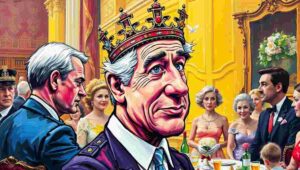
What the Funny People Are Actually Saying About All This
“He’s the only man in Britain where ‘former prince’ sounds like he’s retired from a job that was always imaginary to begin with. Like a former wizard. Or a former Minister for Common Sense.” — Jack Dee
“In Britain, you can lose your job, your reputation, your security detail, your patronages, and your photograph on the Palace website — but your title? That thing is legally indestructible. It’s like a cockroach in ermine trim.” — Frankie Boyle
“There’s something uniquely British about the situation. In any other country, the title would simply be removed by decree. Here, it requires a sub-committee, a three-week consultation, a strongly worded letter to The Times, and then nothing happens.” — Jimmy Carr
The Palace’s Quiet Strategy: Simply Outlast the Vocabulary Itself
Sources close to the palace — close enough to hear the kettle but not the actual conversations — confirm that the current approach is straightforward in its ambition: wait it out.
Not the controversy. Not the news cycle. Not the Newsnight interview that launched a thousand memes and caused at least one senior PR professional to retire early to the Cotswolds.
The words.
Because in Britain, words carry half-lives longer than plutonium and considerably more prestige. Titles linger. Phrases echo. And somewhere, right now, in a quiet regional newsroom, a journalist types “Prince Andrew” entirely out of habit, pauses, stares at it for a moment, and — after a brief internal struggle that solves nothing — hits publish.
Meanwhile, King Charles is reported to spend his mornings reviewing correspondence, tending his gardens at Sandringham, sipping his organic Duchy blend, and occasionally murmuring to no one in particular: “We really did try.”
Final Thought: A Royal Title Is Forever, or at Least Until Everyone Gets Very Tired Indeed
In the end, “Prince Andrew” survives not through policy, not through precedent, and not through any great affection. It survives through inertia — which is, when you consider it, the principle upon which most British institutions are quietly built.
It is simply easier to keep saying it than to rewire several decades of collective national memory. And in a country where tradition is practically an Olympic sport — and where the judging criteria include how uncomfortable everyone looks — changing a title requires considerably more than a royal decree.
It may require a national group chat, a therapist available on the NHS (if one can be found within a reasonable wait time), a cross-party working group that reports back in 2031, and possibly a ceremonial bonfire on College Green that runs slightly over schedule.
Until all of that is arranged, the title remains. Not officially. Not proudly. Not with any particular sense of occasion.
But persistently.
Like a ghost in a crown. Or glitter in a carpet. Or a leaked WhatsApp message in a palace server.
This satirical dispatch is a collaborative work between two sentient beings: the world’s oldest tenured professor and a philosophy major turned dairy farmer. Any resemblance to actual royal tensions, linguistic habits, or corgi drinking culture is entirely intentional but spiritually exaggerated. Proceed with Earl Grey and healthy scepticism.
Auf Wiedersehen, amigo!
Prince Andrew, Duke of York, stepped back from royal duties in 2019 following public backlash over his BBC Newsnight interview regarding his friendship with convicted sex offender Jeffrey Epstein. King Charles III subsequently stripped him of his military titles and royal patronages in 2022 amid a civil lawsuit brought in the United States. Andrew settled the case. His HRH status and the title “Prince” remain technically attached to his name, despite no longer serving a working royal function — a distinction that has exercised constitutional scholars, tabloid editors, and at least one pub in Leeds ever since.

Alan Nafzger was born in Lubbock, Texas, the son Swiss immigrants. He grew up on a dairy in Windthorst, north central Texas. He earned degrees from Midwestern State University (B.A. 1985) and Texas State University (M.A. 1987). University College Dublin (Ph.D. 1991). Dr. Nafzger has entertained and educated young people in Texas colleges for 37 years. Nafzger is best known for his dark novels and experimental screenwriting. His best know scripts to date are Lenin’s Body, produced in Russia by A-Media and Sea and Sky produced in The Philippines in the Tagalog language. In 1986, Nafzger wrote the iconic feminist western novel, Gina of Quitaque. He currently lives in Holloway, North London. Contact: [email protected]


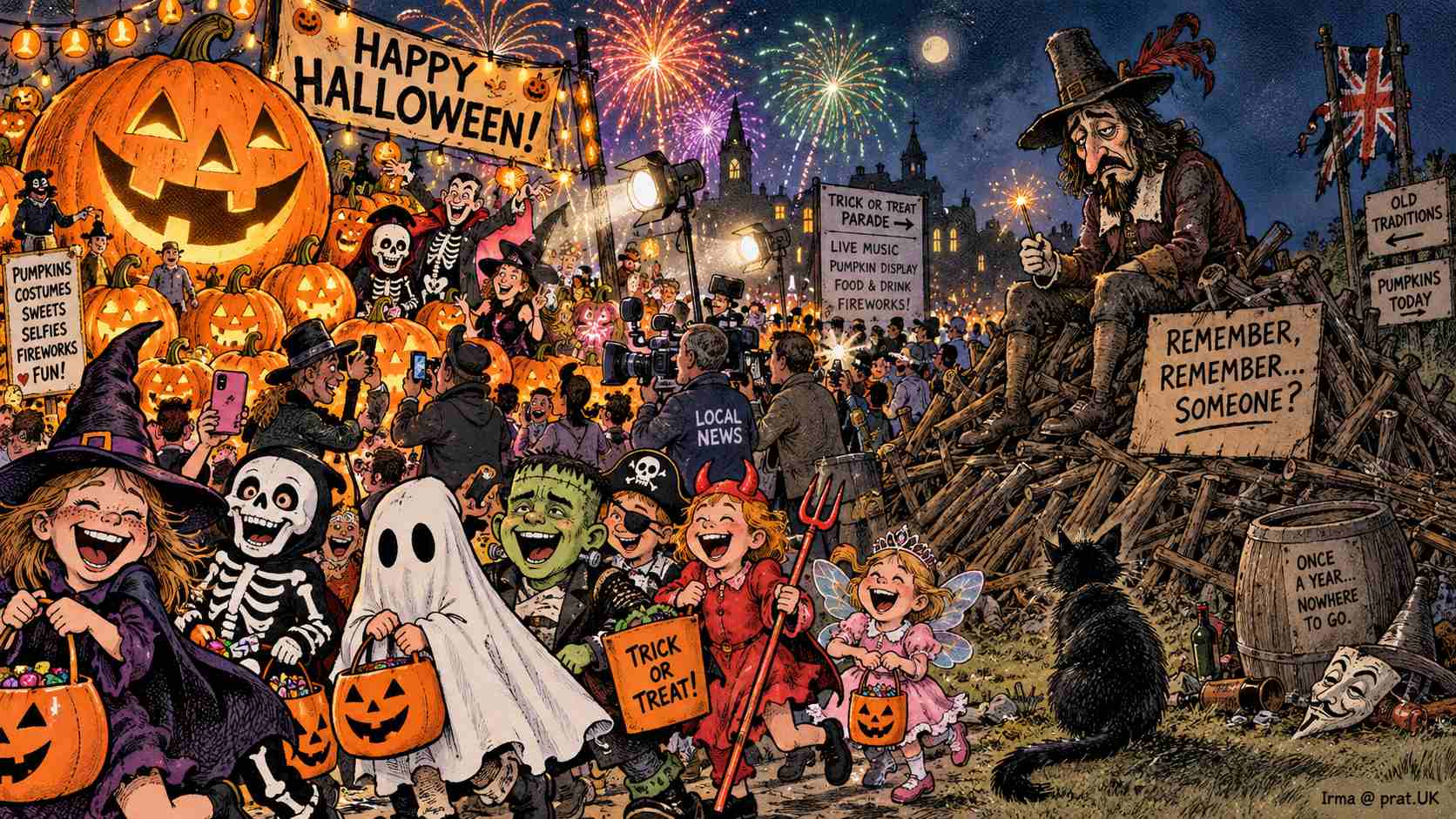
In British comedy, the prat is the character who makes us laugh because they remind us of ourselves at our most foolish and most human.
Captured.
This reads like someone who’s attended planning meetings and decided to turn their despair into evidence. The evidence is overwhelming.
Somewhere a council official is reading thinking “they have recordings.” Impressive.