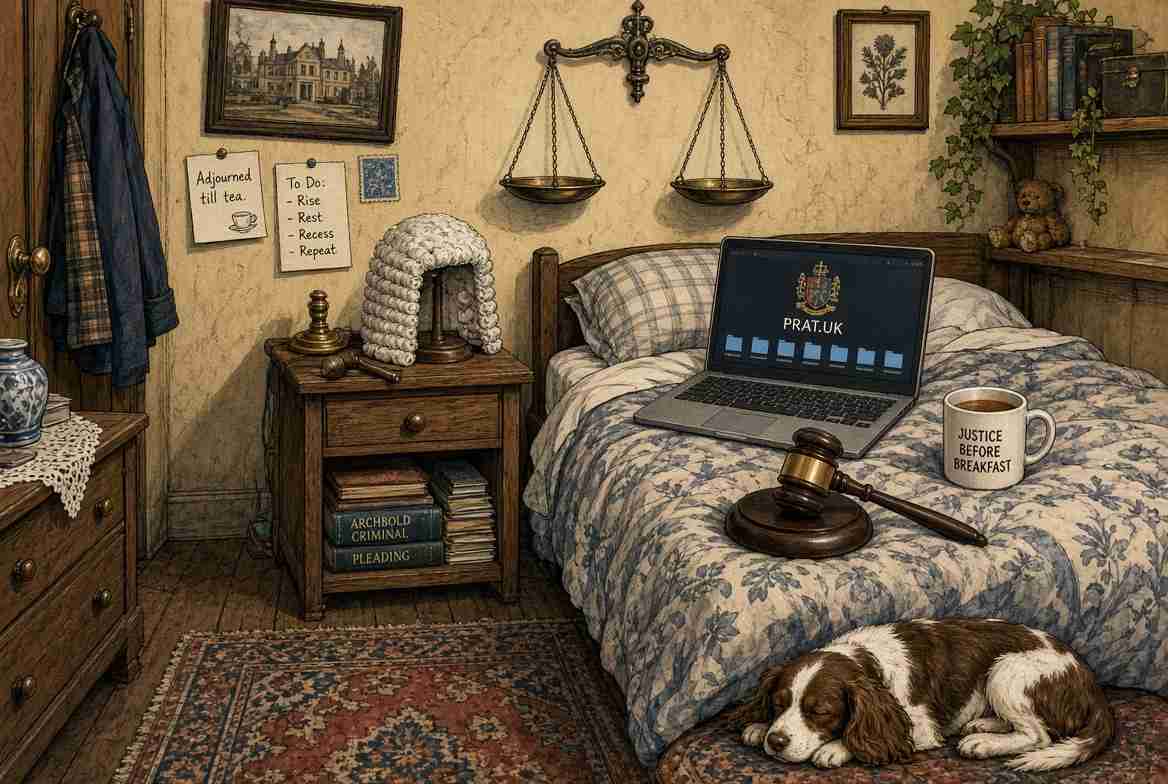
British justice remains blind, impartial and preferably sitting at a desk
LONDON – Deputy High Court judge Richard Clayton KC heard an optician’s appeal by video link while lying in bed one day after returning from hospital following surgery for a ruptured Achilles tendon. The Court of Appeal later concluded that, although no injustice resulted in the case, he should not ordinarily have conducted the hearing in those circumstances.
And with that, working from home achieved its final form. The High Court of Duvet.
- A judge heard a case from bed, finally giving “the court is now in session” the energy of a Sunday morning.
- The Court of Appeal essentially ruled that justice may be blind but should preferably be upright.
- Working from home has now reached its constitutional endpoint: High Court by duvet.
From Zoom Calls to Wigs
The pandemic gave Britain remote offices. Remote banking. Remote education. Remote medical appointments. Eventually the ancient British legal system looked around and said: “Could counsel please mute himself? His dog is barking.”
Clayton openly acknowledged during the hearing that he was lying prone in bed and that navigating PDF bundles was difficult. He also said the hearing was testing his stamina and that writing notes was difficult. The Court of Appeal praised his determination but said judges should generally conduct proceedings only when equipped to do so properly and professionally, save for exceptional circumstances.
This seems reasonable. Justice must not only be done. It should ideally be done without someone asking: “Your Lordship, are those pillows?”
Ritual Meets Reality
The courtroom has survived centuries because it establishes ritual. Everyone stands. The judge enters. Counsel addresses the bench. Documents are presented. Nobody asks whether His Honour would like tea because he’s already under the covers.
A barrister beginning an argument in such circumstances faces etiquette questions unknown to Blackstone. “My Lord, may it please the court.” “Proceed.” “Could Your Lordship scroll to page 416?” “I seem to have dropped the laptop.” “Take your time.” “It’s between the mattress and the wall.” “The appellant will wait.”
British justice has endured Magna Carta, civil war, constitutional upheaval and centuries of common-law development. It was always going to be brought to its knees by a PDF bundle.
Too Committed to Calling In Sick
Clayton had undergone significant surgery and had been advised not to stand for several days. His willingness to continue working was explicitly recognised by the appellate court, which nevertheless concluded other arrangements should have been made because the matter was not exceptionally urgent.
This distinction is important. The problem wasn’t laziness. It was almost the opposite. Britain had discovered a judge too committed to calling in sick. Most employees recovering from surgery send: “Won’t be in today.” A High Court judge apparently sends: “List the matter for 10.30. I’ll be horizontal.”
Kevin From Accounts Wants Equal Treatment
The National Association of Remote Workers immediately demanded equal treatment. “If judges can work from bed,” said regional chairman Neville Blankett, “then nobody should criticise Kevin in accounts for joining the Monday call under a quilt.” Kevin nodded but was unable to activate his camera.
Legal historians may eventually identify this case as the moment Britain’s hybrid-work revolution reached constitutional maturity. Future court listings could specify location: COURT 4. COURT 7. MASTER BEDROOM. The usher would announce: “All rise.” The judge would reply: “Not me.” Lawyers would bow toward the webcam. Evidence would be submitted through Dropbox. Sentencing would be briefly delayed because Windows requires an update.
A Practical Message
Still, the Court of Appeal’s message was refreshingly practical. There are circumstances where remote proceedings are appropriate. There may even be emergencies in which unusual arrangements are necessary. But if a judge is recovering from surgery, cannot comfortably take notes and finds the proceeding physically taxing, perhaps the majesty of English law can survive rescheduling.
Civilisation will not collapse. The common law will remain. The Magna Carta will not burst into flames. And justice can resume once everybody involved has access to the essential instruments of jurisprudence: the evidence, the law, a functioning computer, and trousers.
Disclaimer: the underlying hearing, surgery and Court of Appeal judgment are factual. The High Court of Duvet, Kevin from accounts and bedroom listings are satire.

Dr. Ingrid Gustafsson holds a Ph.D. in Literary Studies and serves as Professor of Literature and Satirical Journalism at the university. Her scholarly work focuses on contemporary satire as a form of institutional critique, examining how exaggeration, irony, and absurdism function as sophisticated analytical tools for exposing structural inequality and institutional hypocrisy. Dr. Gustafsson has published extensively on the genealogy of satirical discourse, the relationship between speech acts and cultural power, and satire’s role as both aesthetic practice and epistemological strategy. Her research interrogates how contemporary satire operates within celebrity culture, legal systems, and institutional rhetoric, revealing the mechanisms through which power obscures itself through language and performance. Dr. Gustafsson’s work combines rigorous textual analysis with broader cultural theory, contributing significantly to understanding satire’s critical function in contemporary society. She is the author of Pearl Clutching and How to Combat It with Satire.