Nation Shocked to Discover Thirty Years of Diana Specials Apparently Did Not Constitute Closure
LONDON – Britain has once again been asked to consider whether talking about Princess Diana is reopening old wounds, raising an obvious question:
When exactly did Britain close them?
Charles Spencer’s new memoir revisits Diana’s life, death and family relationships, including his disagreement with Charles over funeral arrangements and a disputed conversation Spencer says occurred days after Diana died. Buckingham Palace challenged the reliability of his recollection without directly embracing Spencer’s version.
Britain Has Been Reopening Diana Coverage Since 1997
The outrage over “reopening” history would be easier to understand if Britain had ever stopped opening it.
Diana died in 1997.
Since then Britain has commemorated her on birthdays, anniversaries, wedding anniversaries, divorce anniversaries, television anniversaries, documentary anniversaries and anniversaries of documentaries about earlier anniversaries.
There are historical events discussed less frequently that involved artillery.
Somewhere in Belgium, the Battle of Waterloo is furious about its publicity budget.
“We had Napoleon,” Waterloo complains.
“Diana had a haircut.”
Yet Diana can still defeat Napoleon on a British magazine cover.
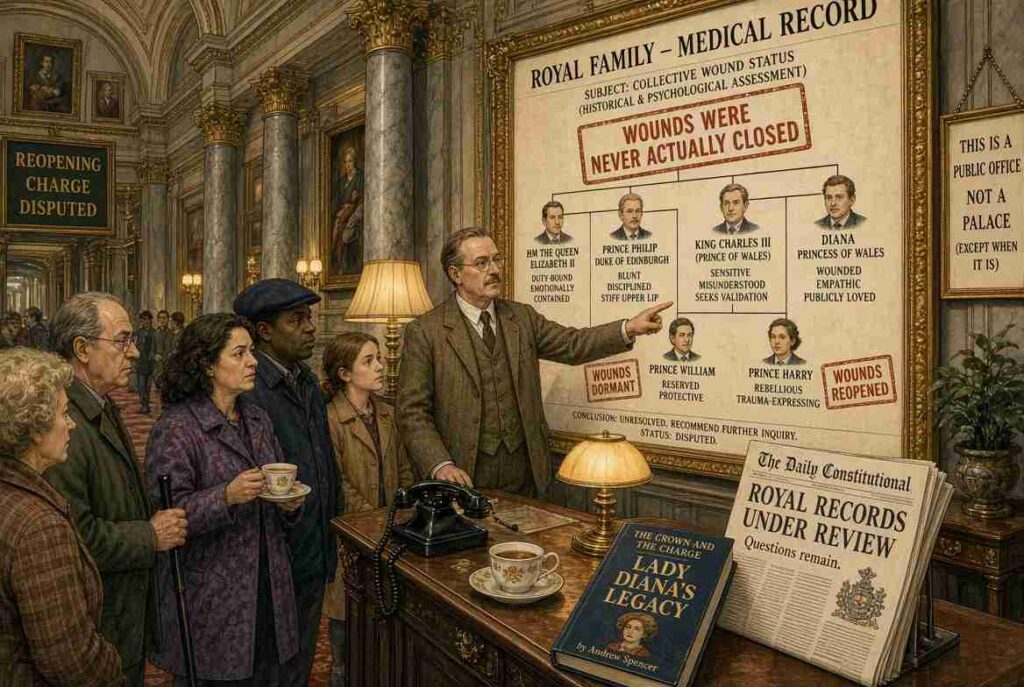
How Long Must a Wound Stay Open Before It Counts as Reopened?
The phrase “reopening old wounds” also raises an important medical question.
How long must a wound remain continuously open before we stop calling it reopened?
If your garage door has been raised since 1997, nobody says, “Someone reopened the garage.”
It never came down.
British culture has turned Diana into a national emotional skylight.
Every few months someone climbs a ladder and adjusts it.
The Royal Sourdough: How the Diana Media Machine Actually Works
Consider the machinery.
A book appears.
A newspaper extracts it.
A royal expert analyzes the extraction.
A broadcaster interviews another expert about the first expert’s analysis.
A palace source provides context.
Someone says the family wants privacy.
This generates a second article.
A commentator then explains how upsetting the second article must be.
By lunchtime, eight media organizations have produced stories about how everyone should stop producing stories.
This is not journalism anymore.
It is royal sourdough.
Everybody keeps feeding the starter.
Charles Spencer’s Motive and the Neighborhood Facebook Group Problem
Charles Spencer says he wrote the book partly because he was uncomfortable reading what he considers inaccurate accounts about Diana.
There is a cruel logic to this.
If everyone else gets to remember your sister publicly, eventually you may decide to remember her publicly yourself.
Then everyone else who has been remembering her publicly becomes furious that you remembered her publicly.
It is the aristocratic version of a neighborhood Facebook group.
“Please stop discussing Linda.”
Posted beneath 438 comments discussing Linda.
The most extraordinary part of the Diana story is not that people disagree about what happened.
Of course they disagree.
Families cannot agree on who ordered the extra chips in 2019.
Expecting people to agree on emotionally devastating events from 1997 may be optimistic.
The absurdity comes from the pretense that one more memoir represents some radical intrusion into untouched territory.
Untouched?
There may be Amazon tribes with stronger opinions about Charles and Diana than they have about neighboring villages.
Morally Exhausted, Commercially Fascinated: The British Diana Contradiction
The Institute for British Historical Exhaustion recently conducted a survey outside a London pub.
When asked, “Should Britain finally stop discussing Princess Diana?” 82 percent supposedly answered yes.
When asked, “Would you read one last explosive revelation?” 97 percent said, “What revelation?”
That is Britain.
Morally exhausted.
Commercially fascinated.
This contradiction has sustained the royal press for decades.
Britain doesn’t want Diana exploited.
Britain just wants to know precisely what the exploitation says, preferably before breakfast.
The monarchy, meanwhile, has the impossible job of balancing institutional dignity against the fact that modern audiences have discovered books.
In earlier centuries this was easier.
A troublesome earl might whisper something against the crown.
You sent him to a castle.
Today the earl appears on morning television.
You cannot imprison him because he has a publicist.
This represents genuine constitutional progress but terrible public relations.
Prince William’s Silence, Body Language Experts and the Ladle Grip
Prince William has another problem.
He is expected to remain dignified while commentators describe what he allegedly feels.
The palace says nothing.
WILLIAM’S SILENCE SPEAKS VOLUMES.
William attends an engagement.
Headline:
WILLIAM THROWS HIMSELF INTO WORK AMID DIANA TURMOIL.
William looks left.
WILLIAM’S TENSE GLANCE REVEALS ROYAL PAIN.
William eats soup.
BODY LANGUAGE EXPERT EXPLAINS LADLE GRIP.
There is no escape.
The strange truth is that Diana’s story occupies a permanent room in British public life.
Everyone periodically announces it should be locked.
Then someone hears a noise inside.
And Britain immediately says:
“Get the key.”
The Real Story Behind the “Reopening Old Wounds” Headlines
The phrase is not just a satirical device. Associated Press coverage carried by NPR said the book, published September 22, 2026, reopened decades-old wounds within Britain’s royal family. Readers wanting the background can compare that reporting with the historical record of Diana’s death and funeral.
SOURCE: Fox News reporting cited above.
Humorous Observations on Britain’s Endless Diana Coverage
- Diana has been dead nearly three decades, yet British newspapers continue covering her with the urgency normally reserved for invading armies and supermarket shortages.
- Britain has transformed Diana into a renewable energy source. Every few years someone opens a memoir and the national grid lights up.
Disclaimer: This article is satire built around publicly reported claims, disputed recollections and media commentary concerning Charles Spencer’s memoir, Princess Diana and the royal family’s response. Serious quotations or allegations attributed to identifiable people should be understood in the context of the cited reporting; the absurd surveys, institutes, palace scenarios and comic deductions are satire.

Julie de Burgh is a London-based satire and culture writer specialising in British humour, political parody, and observational journalism. Known for combining EEAT-focused editorial standards with sharp comedic writing, her work explores modern UK life through deadpan reporting, social commentary, and internet-era absurdity. Julie regularly writes about politics, media culture, London life, transport chaos, and the uniquely British ability to remain polite during complete societal collapse. Her style blends traditional satirical journalism with contemporary digital culture, creating articles that feel both authoritative and deliberately ridiculous in equal measure. [email protected]