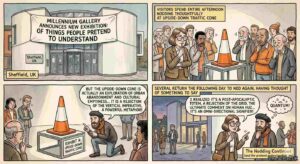
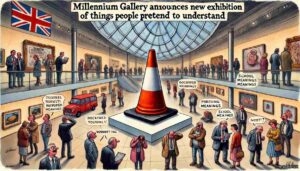
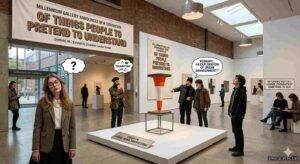
Millennium Gallery Announces New Exhibition Of Things People Pretend To Understand
Visitors Spend Entire Afternoon Nodding Thoughtfully At Upside-Down Traffic Cone — Several Return The Following Day To Nod Again, Having Thought Of Something To Say
SHEFFIELD — The Millennium Gallery has unveiled its latest exhibition, featuring a traffic cone, three bricks, and what curators describe as “a powerful exploration of municipal confusion.” The bricks are described in the accompanying literature as “a meditation on load-bearing identity in post-Thatcherite urban space.” The traffic cone has its own essay. The essay is seventeen paragraphs long. The essay uses the word “liminal” nine times. Nobody has finished it, including the person who wrote it, who stopped at paragraph eleven and went to get a sandwich.
The cone itself is upside down. This, curators explain, is intentional. When asked what it means, a spokesperson said: “What does anything mean, really?” When pressed for a more specific answer, the spokesperson said: “The cone.” When pressed again, the spokesperson offered complimentary leaflets and moved toward the emergency exit at a pace that suggested familiarity with the route.
Curators insist the exhibit challenges conventional assumptions about reality. Visitors insist they were looking for the toilets. Both groups have now been standing in the same corridor for forty-five minutes and nobody is sure who got there first, which may itself be a statement about epistemology, or may simply be a poorly marked building.
“We wanted people to question the boundaries between art and everyday life,” said gallery director Nigel Weatherby, gesturing broadly at a fire extinguisher that may or may not have been part of the installation. “Mostly they’re questioning why the fire extinguisher has a spotlight on it.” He paused to consider this. “The spotlight is definitely ours. The extinguisher we’re less certain about. We’ve asked Facilities. Facilities have not replied. That non-reply has since been incorporated into the piece.”
Gallery Unveils New Artist Statement Generator After Realising All Artist Statements Are The Same Sentence
In a related development, the gallery has quietly introduced an in-house artist statement generator following the discovery that every artist statement submitted in the past eleven years contained identical phrases in slightly shuffled order.
The phrases — identified by a junior curatorial assistant who had been reading submissions since Tuesday and had “reached a kind of clarity” — include:
- “My practice interrogates the relationship between [noun] and [other noun].”
- “This work exists at the intersection of [abstract concept] and [slightly different abstract concept].”
- “I am interested in the tension between [thing] and its absence.”
- “The viewer is invited to question their own assumptions about [reality/identity/space/Tuesday].”
The generator, built on a spreadsheet by the assistant in question, can produce a complete and entirely convincing 200-word artist statement in four seconds. It has since been submitted to the Arts Council for a development grant. The grant application describes the generator as “a work that interrogates the relationship between language and meaning.” The Arts Council has responded with cautious interest and a request for a project timeline.
The junior assistant has been offered a residency. She is considering it. The spreadsheet has been given its own wall label.
Sheffield Man Accidentally Becomes Exhibit After Standing Still Too Long Near The Good Lighting
Local resident Graham Fletcher, a forty-seven-year-old quantity surveyor from Hillsborough, reportedly spent twenty minutes examining a sculpture before discovering he was actually looking at another visitor. The other visitor — a retired geography teacher named Patricia from Rotherham — had been examining Graham for roughly the same amount of time and had reached broadly similar conclusions about the work, though her interpretation focused more heavily on themes of suburban resignation than Graham felt was entirely fair.
“I wasn’t resignated,” Graham said afterward, slightly flushed. “I was just standing there. I’d come for the café.”
Several tourists praised Graham’s work. One filed a formal written review with the front desk. The review described his “commitment to stillness” and “the quiet devastation of the North Midlands rendered in fleece.” It gave him four stars. It deducted one star for “limited audience engagement,” as Graham had, at one point, checked his phone.
“I found his exploration of middle-aged disappointment quite moving,” said a visiting critic from Frieze magazine, who had wandered in from a nearby conference and had not yet realised she had left it. “I especially liked the fleece jacket. The way it hangs — non-committal, vaguely apologetic — says something important about post-industrial masculinity in the Sheffield basin. The slightly fraying cuff implies a man who once had ambitions about the cuff.” Graham later confirmed he bought the fleece from Millets in 2019 and had not thought about it since. He found the critical attention “a bit much” but admitted he was “not unhappy” about the four stars.
The gallery is reportedly in talks to acquire Graham on a six-month residency, during which he would be required to stand in the main hall between ten and four, Tuesday to Saturday, and “simply exist.” Graham has asked whether the car park is validated, whether he’d need to bring his own lunch, and whether “simply existing” would count toward his pension contributions. Negotiations are ongoing.
Patricia, meanwhile, has been shortlisted for the Turner Prize. She found out by email. The email went to spam.
Millennium Gallery Introduces Immersive Exhibition Called ‘Trying To Find The Exit’ — Nobody Has Found It
The new immersive installation invites guests to wander through a series of confusing hallways while reading signs that appear helpful but conclusively aren’t. The signs say things like “THIS WAY,” “CONTINUE,” and “YOU’RE NEARLY THERE,” none of which correspond to any observable destination. At several points the signage directly contradicts itself. At one junction, a sign simply says “onward.” The arrow beneath it points at a wall. The wall has been painted slightly differently from the other walls, which either confirms it’s intentional or means they ran out of the right paint.
Organisers describe the experience as a metaphor for modern life — specifically, modern life as experienced by someone trying to navigate the NHS website, appeal a parking fine, or understand what their energy company means by “your bill has been updated.” Visitors describe it as Tuesday. One visitor described it as “exactly like trying to report a problem to my local council online,” which the lead artist confirmed was precisely the intended reading and he is genuinely moved that someone finally got it after fourteen months of the piece being open.
The installation runs until September. Three people have not yet left. Two of them believe they are still looking for the Ruskin Collection. One of them has started to suspect he is the Ruskin Collection. Gallery staff check on them twice daily and leave sandwiches near the third junction.
A support group for visitors who completed the installation and felt “oddly changed” has formed on a Sheffield Facebook group. It has 340 members. They meet on Wednesdays. They have not yet agreed on a venue because nobody can find the exit from the venue they originally chose.
Study Finds 87% Of Gallery Visitors Live In Constant Fear Of Being Asked What They Think
Researchers from the University of Sheffield — using a methodology they describe as “standing near people and listening, with a clipboard to make it look official” — found the average gallery visitor rotates through a carefully managed repertoire of responses when confronted with contemporary art they do not understand, which is all of it:
- “Interesting.” (Baseline. Deployed within three seconds. Requires no cognitive engagement whatsoever.)
- “Very interesting.” (Escalation. Used when a curator is within earshot.)
- “I can see what they’re trying to do.” (Advanced. Used when they absolutely cannot see what they’re trying to do but feel a sentence with “I” and “trying” in it sounds plausible.)
- “It reminds me of something, I can’t think what.” (Evasion technique. Buys approximately ninety seconds.)
- “There’s a lot going on.” (True of everything. Applicable to literally everything. Fail-safe.)
- “I don’t know what’s happening but I support it.” (Peak response. Deployed only when all else fails, a curator is approaching, and eye contact is unavoidable.)
Scientists classify the full sequence as Advanced Cultural Survival. Participants classified it as “getting through the afternoon without embarrassing the family.” The research paper has been submitted to three academic journals. Two responded with “Interesting.” The third has not replied, which the research team is now writing up as a follow-on study titled Institutional Silence as Peer Review: A Meditation on Absence.
The study also found that 94% of visitors walk significantly slower inside galleries than anywhere else on earth, including hospital waiting rooms, supermarket self-checkout queues, and that bit in Ikea before the meatballs. Researchers believe this is the body’s unconscious attempt to look like it’s thinking. The remaining 6% were children, who ran directly into the bricks and were briefly mistaken for a performance piece about youthful entropy. Their parents received a leaflet.
A separate finding noted that 71% of visitors tilt their head when looking at abstract work. The tilt averages twelve degrees. No visitor has ever reported that tilting their head helped. Every visitor has tilted their head anyway. This has been interpreted by the research team as either a profound comment on learned cultural behaviour or evidence that the human neck has opinions.
New Exhibition Features Empty Room Titled ‘Economic Growth’ — Critics Divided On Whether This Is Brave, Obvious, Or Just A Room They Forgot To Finish
The gallery’s most controversial piece is an entirely empty room. The walls are white. The floor is wood. The temperature is slightly lower than the rest of the building, which may be deliberate or may be a radiator issue that Facilities has also not replied about.
There is a single nail hole where something used to hang. Whether the nail hole is part of the piece, a remnant of a previous exhibition, or simply a nail hole has generated eleven hundred words of catalogue text, a moderately heated panel discussion that ran forty minutes over time, and one letter to the Sheffield Star that described the whole situation as “a disgrace” without specifying whether the disgrace was the art, the nail hole, or the panel running over.
According to the artist, the work explores absence, loss, governmental ambition, and the yawning chasm between what is promised and what is delivered. According to visitors, the artist forgot to bring the artwork. According to a man named Derek who had wandered in from the street mid-sandwich, it was “a bit draughty.” Derek stood in the empty room for four minutes. He finished his sandwich. He left. He has since been cited in the catalogue essay three times as “an anonymous participant whose engagement with the void was the work’s most honest moment.” Derek has not read the catalogue essay. Derek does not know he is in it. If Derek knew he was in it, Derek would probably say “a bit draughty” again.
Derek’s sandwich — a mature cheddar and pickle on wholemeal from the Greggs on Fargate — has since been offered a companion piece in the adjacent room under the title Sustenance: An Intervention. Derek has declined to be represented. His agent, who does not exist, could not be reached for comment. The Greggs has been contacted for a quote. The Greggs said “we don’t really do that” and offered a loyalty stamp.
Gallery Introduces New ‘Accessibility’ Programme Ensuring Everyone Can Be Confused Equally
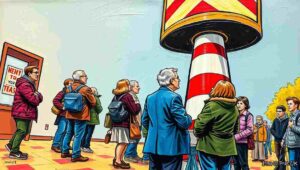
Following feedback that contemporary art alienates ordinary people, the Millennium Gallery has launched an ambitious new accessibility initiative designed to ensure that absolutely everyone — regardless of background, education, or prior experience of standing in a room not knowing what to think — can participate fully in the experience of not knowing what to think.
New features include:
- Plain English wall labels — which explain what the work is called, what materials it uses, and then, in the third sentence, become impenetrable again. The third sentence always contains the word “interrogates.”
- Audio guides narrated at three speeds: standard, thoughtful, and “philosophical,” which is the same as thoughtful but with longer pauses and occasional sighing.
- A dedicated “I Don’t Get It” room where visitors can sit quietly with a cup of tea and not be judged. The room has become the most popular in the gallery. There is now a waiting list. The waiting list has itself been described as “a comment on access and exclusion” and may be framed.
- Child-friendly interpretation panels that explain the artwork using relatable language. The panel for the empty room reads: “This room is empty. The artist says that’s the point. Your grown-ups aren’t sure. Nobody is sure. That’s also the point. Have a sticker.”
The programme has been warmly received. Visitor satisfaction scores have risen four points. Understanding scores remain unmeasured, on the basis that measuring them would constitute “a category error and possibly a separate piece.”
What The Funny People Are Saying About Contemporary Art And The People Who Nod At It
“Modern art is the only business where somebody forgets to finish the job and wins an award. In any other industry that’s called a Tuesday and you still get the invoice.” — Ron White
“People don’t understand art, but they don’t want anybody to know they don’t understand art. So they stand there. Nodding. For hours. Hoping someone else will explain it first. And the someone else is doing the exact same thing. It’s nodding all the way down.” — Jerry Seinfeld
“My favourite exhibit is always the gift shop. That’s where the objects finally admit they’re products. The tote bag doesn’t claim to interrogate anything. The tote bag just wants to carry your lunch.” — Sarah Silverman
“I went to a gallery once. There was a blue square. I stood there for ten minutes. My wife said ‘it’s a blue square, Lee.’ I said ‘I know, but what does it mean?’ She said ‘it means we’re not having a good afternoon.'” — Lee Mack
“The difference between art and a skip is about forty thousand pounds and a press release.” — Milton Jones
Gallery Gift Shop Named Sheffield’s Largest Exporter Of Fridge Magnets, Mild Existential Guilt, And Notebooks Nobody Will Ever Write In
Economists estimate the gift shop now contributes approximately 14% of Sheffield’s cultural GDP. The figure rises to 31% if you include the café, which sells a flat white for £4.20, a slice of lemon drizzle for £3.80, and a flapjack with the structural integrity of a municipal car park and the density of a minor planet. The flapjack has been on display since Thursday. It is unclear which Thursday.
Popular items this season include:
- £28 handmade ceramic mugs — slightly uneven, which the label describes as “a celebration of imperfection” and your kitchen shelf describes as “a wobble situation that is going to end badly near the good plates.”
- £19 notebooks that nobody wants to write in because writing in them would ruin them, so they sit on shelves in spare bedrooms looking purposeful and completely blank, which is — if you think about it carefully enough and have had some wine — also an exhibition. Several have been donated back to the gallery. They are in storage. They may be exhibited.
- A tea towel inspired by existentialism. It dries things. The irony is unresolved. One side has a print. The other side is just towel. The towel side is, arguably, the more honest.
- A £34 tote bag bearing a phrase in a sans-serif font too small to read from a comfortable distance. The phrase, when you get close enough, says: “Objects exist in relation to other objects.” This is either profound or it’s describing a shelf. The artist is on a residency in Lisbon and has not clarified. The artist’s residency is funded by a grant. The grant was applied for using the spreadsheet generator. Nobody has checked.
- A £12 pencil that is just a pencil but comes in a recyclable sleeve describing it as “a tool for marking the world.” It is HB. There are cheaper pencils at WHSmith eleven minutes away on foot. The sleeve mentions this is an eleven-minute walk in the acknowledgements, framing it as “a journey.”
The traffic cone has not yet been merchandised, but discussions are ongoing and a mood board exists. The mood board features the cone, some muted earth tones, and the word “iconic” written in marker in the top right corner and then crossed out and replaced with “totemic” and then crossed out again and replaced with “cone.”
Local School Trip Ends With Teacher Explaining That No, Dylan, The Fire Exit Sign Is Not Art — And Then Having To Reconsider
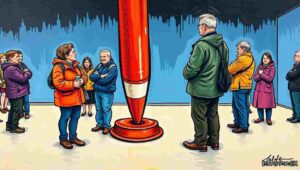
A Year 9 group from a Sheffield secondary school visited the gallery last Thursday as part of their GCSE Art and Design coursework, which requires students to engage with contemporary practice and then write 600 words about it without using the word “nice.”
The visit began promisingly. Several students found the traffic cone immediately relatable, having grown up in a city where they function primarily as informal seating. One student, a thirteen-year-old named Tyler, stood in front of it for six minutes with genuine concentration before announcing: “It’s orange. So is my dad’s van. Is this about vans?”
Tyler’s interpretation was written up by the accompanying teaching assistant, submitted to the gallery’s education team as feedback, and described internally as “one of the more coherent responses we’ve had this quarter.”
The group then discovered the empty room. Four students immediately sat on the floor. Two lay down. One said it was “actually quite peaceful.” Another said it “felt like being grounded but without the Wi-Fi being cut off.” The teacher, a thirty-nine-year-old woman named Mrs Haverford who has been teaching art for fourteen years and has seen some things, stood at the doorway and had a moment she later described to colleagues as “not nothing.”
The trip ended in the gift shop, where the school’s budget of £3 per student proved insufficient for any item except two postcards, one pencil, and a bookmark describing itself as “a pause.” Three students attempted to purchase the flapjack between them. They were told it was £3.80. They said they had £2.40. The café staff said they were sorry. The students said they were sorry too. Everyone stood there for a moment. It was, arguably, the most emotionally authentic exchange the gallery had hosted all week.
Millennium Gallery Wins Prestigious Award For Making People Feel Simultaneously Educated, Confused, Cultured, And Oddly Peckish
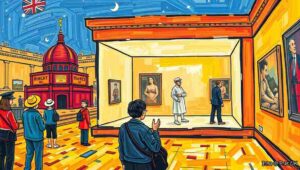
The gallery received national recognition this week after exit surveys revealed that visitors left feeling, in roughly equal measure: inspired, bewildered, quietly superior to people who hadn’t come, vaguely guilty about not understanding more, and in urgent need of something to eat that wasn’t £3.80.
Officials called it the perfect museum experience. One trustee described it as “exactly what we set out to achieve when we set out to achieve something, which we did, in a meeting, in 2022, the minutes of which are available on request.” Another trustee described it as “a happy accident, like most of the good things in art.” A third trustee was still in the empty room, thinking about his pension, his mortgage, the nail hole, and whether Derek had the right idea about the sandwich, and could not immediately be reached for comment.
The award — a glass trophy, a framed certificate, and what the accompanying letter describes as “a moment of institutional pride” — will be displayed in the main hall. The display has already been assigned a wall label. The wall label describes the trophy as “an object whose presence implies a narrative of achievement the viewer is invited to interrogate.” Nigel Weatherby approved the label. He has not read it. He approved it by email from his car.
The gallery is reportedly planning a full exhibition around the trophy in autumn. The working title is Recognition: A Burden We Accept Reluctantly. There will be a private view. The private view will have warm white wine and small cubes of cheese on sticks. The cheese cubes will not have a label but if they did it would probably say something about sustenance and the performance of celebration and also cheddar.
The Millennium Gallery is a genuine and rather good Sheffield institution, opened in April 2001 and home to the city’s permanent Metalwork and Ruskin Collections alongside a rotating programme of touring exhibitions from partners including the V&A, Tate, and the National Portrait Gallery. It is free to enter, which is genuinely admirable and may explain why Graham, Derek, the Year 9s, and the three people still in the corridor are all there on a Tuesday. Real recent exhibitions have included Strange Presence: John Hoyland Paintings, Acts of Creation: On Art and Motherhood, and the ongoing Ruskin Collection display exploring Victorian ideas about nature, beauty, and the moral value of paying attention — none of which featured a traffic cone, though the Hoyland catalogue came closer than it perhaps intended. The gift shop is entirely real. The flapjack is a matter of public record. Derek cannot be reached for comment.
This satirical report is entirely a human collaboration between the world’s oldest tenured professor and a philosophy major turned dairy farmer. No curators, conceptual artists, bewildered critics, confused tourists, load-bearing bricks, philosophical traffic cones, emotionally significant nail holes, existentialist tea towels, grain-fed flapjacks, men named Derek, children named Tyler, teachers named Mrs Haverford, pensionable trustees, junior curatorial assistants, or spreadsheet generators were harmed in its creation. Any resemblance to actual contemporary art is almost certainly hanging on a white wall somewhere in Sheffield, illuminated by a spotlight nobody ordered, next to a label using the word “liminal” twice and “interrogates” once, priced at £22 in catalogue form, free to enter, and sincerely meant. The London Prat is British satirical journalism. We attend the private views. We eat the cheese. We do not understand the work. We support it regardless. Auf Wiedersehen, amigo!

Dr. Ingrid Gustafsson holds a Ph.D. in Literary Studies and serves as Professor of Literature and Satirical Journalism at the university. Her scholarly work focuses on contemporary satire as a form of institutional critique, examining how exaggeration, irony, and absurdism function as sophisticated analytical tools for exposing structural inequality and institutional hypocrisy. Dr. Gustafsson has published extensively on the genealogy of satirical discourse, the relationship between speech acts and cultural power, and satire’s role as both aesthetic practice and epistemological strategy. Her research interrogates how contemporary satire operates within celebrity culture, legal systems, and institutional rhetoric, revealing the mechanisms through which power obscures itself through language and performance. Dr. Gustafsson’s work combines rigorous textual analysis with broader cultural theory, contributing significantly to understanding satire’s critical function in contemporary society. She is the author of Pearl Clutching and How to Combat It with Satire.