
London’s Hiring Process Is Now Officially Longer Than Some Medieval Wars — And The Websites Are Making It Worse
candacy.uk — London’s Top 10 Job Online Site
LONDON — Economists, recruiters, exhausted graduates, career coaches who charge £400 a session to explain the word “resilience,” and one emotionally broken man from Hounslow all confirmed this week that applying for a job in London now requires approximately the same psychological endurance as rowing across the Atlantic inside a wheelie bin.
It didn’t used to be this way. Once, a Briton could type their name into one or two websites, attach a PDF, and wait for the phone to ring. Maybe they’d visit three sites if they were ambitious and owned a printer. Now the average applicant maintains active profiles across LinkedIn, Indeed, Reed, TotalJobs, CV-Library, Monster, Glassdoor, Adzuna, Jobsite, Fish4Jobs, WorkInStartups, EscapeTheCity, Otta, Flexa, and at least one suspicious platform apparently operated from a shed outside Luton — and they haven’t received a single callback.
Researchers from the University of Sussex Business School have described the modern UK job hunt as “a full-time unpaid administrative career performed mainly for algorithms.” The study found the average British applicant now spends 11 hours formatting CVs, 7 hours rewriting cover letters, and 19 hours pretending they are “passionate about customer engagement solutions.” This is, for comparison, more time than most people spend with their families in any given quarter.
London’s Top 10 Job Sites
- HireGoblin.co.uk promises to “match your skills to Britain’s most exciting opportunities.” The opportunities turn out to be three night shifts at a chicken processing plant in Rotherham and a role described as “ambient logistics consultant,” which is a forklift. The goblin mascot winks. Nobody finds this reassuring.
- CareerDungeon.net promises “Revolutionary AI Hiring.” Applicants later discovered the AI was simply a retired man named Alan manually rejecting people while eating custard creams. Alan has rejected over 11,000 candidates since 2019. He has never explained why. He doesn’t feel he owes anyone that.
- GriefRecruit.io positions itself as “the platform for professionals in transition,” which is Silicon Valley language for “people who have been made redundant and are not handling it well.” The homepage features a stock photo of a woman laughing at a laptop. Nobody who uses GriefRecruit.io has ever laughed at a laptop. They have thrown them. That is different.
- EmployMeDaddy.uk was reportedly registered during a particularly dark Tuesday in November 2022 by a man in Wolverhampton who had just received his fourteenth rejection email before 9am. The site has no functioning search bar. It does have a contact form. Nobody has ever received a reply. The domain auto-renews every year. He keeps paying it. Just in case.
- CVBastard.com offers to “optimise your CV using cutting-edge technology.” The cutting-edge technology is a dropdown menu asking whether you want your name in bold. Users who select “yes” are charged £4.99. Users who select “no” are also charged £4.99. The site has 340,000 registered users and a Trustpilot score of 1.2 stars, which CVBastard.com’s homepage proudly describes as “industry-leading feedback.”
- DesperateKeith.co.uk matches candidates exclusively with warehouse jobs requiring forklift experience, emotional numbness, and “weekend flexibility during spiritual collapse.” The site’s mascot is a sweating cartoon man smoking outside a Wetherspoons at 6:45am. Keith himself — if Keith exists — has never been photographed. Rumours persist that he is simply the physical manifestation of a zero-hours contract.
- InterviewOrDie.co.uk became wildly popular among London graduates after honestly advertising “Entry-Level Roles Requiring Seven Years Experience.” The site’s tagline is “We’re not playing games.” There are currently no jobs listed. There have never been any jobs listed. The waitlist has 80,000 people on it. Somehow this feels correct.
- TalentVortex.co.uk describes itself as “a disruptive hiring ecosystem powered by synergistic people-matching algorithms.” It is a spreadsheet. A man named Clive emails it to local businesses in the East Midlands every fortnight. Clive believes in what he is doing. This is both admirable and deeply worrying.
- JobMorgue.co.uk lists only roles that have been open for more than two years. Researchers believe these positions either pay below minimum wage, require a specific qualification that no British university offers, or were posted by a company that ceased trading in 2021 but whose website remains live because nobody cancelled the hosting. JobMorgue.co.uk calls these “legacy opportunities.” Applicants call them something else.
- QuietQuittingJobs.co.uk — Britain’s newest and arguably most honest recruitment platform — lists only roles specifically designed for people who intend to do the absolute minimum required by their contract and nothing more. Current listings include “Background Presence Coordinator,” “Meeting Attendee (Non-Speaking),” and “Senior Nodder, Hybrid.” The platform received 2.3 million unique visitors in its first week. The venture capital interest has been substantial.
The Application Process: A Spiritual Purification Ritual Disguised as Employment

According to a new study from the Institute for Corporate Emotional Damage — a body whose very name suggests it was founded by someone who once cried in a Pret A Manger — the average London job application now involves 4.7 interviews, 3 online assessments, 2 personality evaluations, 1 unpaid “culture fit” coffee meeting, and at least one moment where an applicant stares silently into a sandwich refrigerator questioning every life decision since GCSE Drama.
Researchers say the modern hiring process has evolved far beyond traditional employment and now functions primarily as a spiritual purification ritual for middle-class suffering. “Companies no longer hire people,” explained workplace analyst Dr. Gavin Meriweather. “They summon them through increasingly elaborate psychological obstacle courses involving Zoom calls and PowerPoint.”
The CIPD’s annual Resourcing and Talent Planning survey confirms the average time-to-hire across UK sectors has lengthened considerably — a finding described in academic language so restrained it clearly understates the human cost involved.
Most London applicants spend between three and six weeks applying for jobs that eventually reply with: “Unfortunately, after careful consideration, we have decided to proceed with another candidate who already worked here before.”
In one particularly tragic case, 27-year-old applicant Daniel Pierce reportedly completed two interviews, a presentation, a written task, a group workshop, and a “values alignment discussion” before learning the salary was £31,000 plus “occasional access to bananas in the kitchen.” Witnesses say Pierce quietly nodded before walking into light rain near Liverpool Street Station like a Victorian orphan who had misplaced his chimney brush.
The Language of London Recruitment: Ransom Notes Written by Motivational Speakers
The city’s recruitment language has become thoroughly detached from reality. London employers now describe nearly every position using phrases such as “fast-paced environment,” “dynamic culture,” “self-starter,” “thought leader,” “ninja,” “wizard,” and, with increasing frequency, “rockstar.” One applicant told reporters he recently applied for an Accounts Receivable Ninja role before discovering the actual job consisted entirely of emailing PDFs to angry plumbing suppliers in Slough. “It’s all performance art now,” he explained. “Nobody knows what any role means anymore.”
Indeed, modern London employment ads often read like threats. One Shoreditch startup recently advertised for “a mission-driven brand storyteller passionate about disruptive synergy and collaborative impact.” The position turned out to involve answering emails beside a broken beanbag. Another listed an opening for a “Happiness Architect,” which investigators later confirmed was a customer service role paying £26,000 in a building with one functioning toilet.
Then there’s the startup recruitment platforms, where every company describes itself as “disruptive.” London startups now hire for positions including Happiness Architect, Culture Evangelist, Chief Vision Officer, and Junior Brand Story Alchemist. One applicant attended three interviews before discovering the “tech startup” consisted of four men sharing hummus beside exposed brickwork in Shoreditch. “They called the office a collaborative innovation hub,” he explained. “It was basically an attic with expensive lighting.”
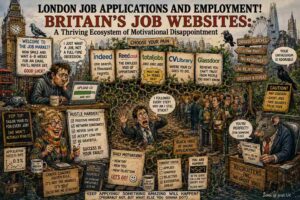
Britain’s Job Websites: A Thriving Ecosystem of Motivational Disappointment
Britain’s online recruitment industry has expanded so aggressively that economists now believe the UK’s largest remaining manufacturing sector is “websites asking people to upload CVs repeatedly.” Experts estimate there are now more UK job boards than actual jobs. One man from Croydon reportedly completed 143 applications before discovering half the listings were posted by recruitment agencies trying to “build talent pipelines” — corporate language for “we don’t actually have a job.”
The Office for National Statistics Labour Market Overview regularly notes hundreds of thousands of UK job vacancies alongside stubborn unemployment figures — a paradox the ONS charts with beautiful graphs and zero explanation of why the two populations cannot seem to find each other.
But the real magic begins when applicants wander beyond the mainstream sites into Britain’s darker recruitment underworld. Sites like HireGoblin.co.uk, CareerDungeon.net, GriefRecruit.io, EmployMeDaddy.uk, and CVBastard.com. Britain’s fastest-growing platform, DesperateKeith.co.uk, reportedly matches candidates exclusively with warehouse jobs requiring forklift experience, emotional numbness, and “weekend flexibility during spiritual collapse.” The site’s mascot is a sweating cartoon man smoking outside a Wetherspoons.
Meanwhile, CareerDungeon.net promises “Revolutionary AI Hiring.” Applicants later discovered the AI was simply a retired man named Alan manually rejecting people while eating custard creams.
The AI Hiring Problem: Machines Rejecting Humans on Behalf of Other Machines
The rise of AI hiring systems has only deepened the absurdity. Research reported by the BBC suggests significant proportions of UK CVs are now processed algorithmically before human eyes ever reach them. Applicants therefore spend hours stuffing resumes with robotic keywords like “stakeholder engagement,” “cross-functional communication,” and “strategic alignment.” One unemployed graduate admitted she rewrote her CV seven times after learning the software disliked the phrase “good with people.” “It preferred ‘customer-facing interpersonal optimisation,'” she said while visibly ageing.
Today’s applicants must also navigate automated assessments asking “How would you handle conflict in the workplace?” Correct answers include “demonstrate empathy,” “engage stakeholders,” and “maintain professionalism.” Incorrect answers include “leave immediately,” “fake my own death,” or “become a shepherd in Wales.” One woman was reportedly rejected because the algorithm determined her personality lacked “executive sparkle.” Scientists still cannot define executive sparkle.
One particularly successful parody site, InterviewOrDie.co.uk, became wildly popular among London graduates after honestly advertising “Entry-Level Roles Requiring Seven Years Experience.” Thousands praised the platform for “finally respecting British cynicism.”
LinkedIn: The Digital Savannah Where Middle Managers Roam Free
No platform better captures modern British suffering than LinkedIn, the vast digital savannah where middle managers roam freely posting sentences such as “I’m humbled to announce I’ll be leveraging strategic synergies in my new role.” Nobody knows what this means. Not even them.
Experts believe LinkedIn evolved from a networking platform into a large emotional support group for exhausted professionals pretending to enjoy webinars. A recent survey found 61% of users lie about loving leadership, 44% fake enthusiasm in posts, and 12% have seriously considered throwing laptops into canals after reading the phrase “thought leadership.” One anonymous recruiter admitted: “We all secretly hate LinkedIn. But we also know unemployment is waiting in the bushes like a Victorian debt collector.”
London’s application culture has also produced a terrifying new species known as the LinkedIn Thought Leader. These individuals spend entire mornings posting phrases such as “Failure is just success wearing work boots.” Sociologists believe no human has ever benefited from these posts, yet they continue multiplying throughout the capital like motivational pigeons.
The Salary Transparency Scandal: Competitive Pay Means Soup
British recruiters maintain the proud national tradition of pretending salaries are classified military secrets. Job advertisements now routinely offer “competitive pay.” Applicants later discover this translates roughly into “enough money to continue purchasing soup.” The government’s own pay gap reporting guidance acknowledges persistent salary opacity across British industries — a finding described with characteristic civil service understatement as “a transparency challenge.”
A financial analyst in London recently completed six interviews for a prestigious banking role before learning the salary would barely cover rent for a flat described as “cozy urban micro-living environment.” The flat reportedly contained one radiator, half a window, and a shower positioned emotionally close to the toaster. A leaked internal memo from a major recruitment consultancy revealed many firms now use “vibe screening” during interviews, where managers simply determine whether applicants seem “cool enough to survive after-work drinks in Clerkenwell.” This has reportedly devastated thousands of highly qualified British people who still say things like “Crikey,” “lovely weather,” or “sorry to bother you.”
Meanwhile, graduates continue flooding London despite rent prices now resembling mathematical threats. A recent poll found 62% of young workers cannot afford solo apartments, 48% have cried during commutes, and 19% have considered marrying someone purely for Zone 2 housing access. One anonymous applicant described viewing a “cozy studio flat” in East London which turned out to be “a converted hallway with emotional damp.”
What The Funny People Are Saying
“Every London job interview ends with someone saying ‘we’re like a family here,’ which is exactly what cult leaders say before taking your passport.” — Sarah Silverman
“In America they ask if you can do the job. In London they ask what animal best represents your workflow.” — Jerry Seinfeld
“Nothing says modern Britain like needing a master’s degree to schedule meetings nobody wants.” — Ron White
“The modern CV is basically fan fiction about yourself. Very expensive fan fiction that nobody reads.” — Lee Mack
“LinkedIn is Instagram for people who clap during PowerPoint presentations.” — Romesh Ranganathan
“Every recruiter says they want authenticity until you honestly admit you applied because your landlord raised rent again.” — Frankie Boyle
The Recruitment Agencies: Medieval Guilds for Milton Keynes Forklifts
Even Britain’s local recruitment agencies now sound like medieval guilds. Places such as Titan Staffing Solutions, IronWolf Recruitment, Elite Synergy Talent, and Quantum Workforce Dynamics all apparently specialise in finding forklift operators for industrial estates near Milton Keynes. Recruiters at these firms continue insisting that applicants should “show personality” during interviews whilst simultaneously punishing any evidence of real humanity.
One HR consultant admitted candidates are expected to appear “professional but relaxed, confident but humble, ambitious but not threatening, and energetic without looking like they do cocaine.” The consultant then disappeared into Canary Wharf carrying a reusable water bottle worth £48.
And somewhere deep beneath Canary Wharf, according to rumour, sits the mythical final recruitment boss: a 54-year-old HR director named Sandra who can smell weakness through Microsoft Teams. Applicants speak of her in whispers. Legend says she once rejected a candidate for saying “No worries” instead of “Absolutely delighted.”
The Stubborn, Irrational, Entirely British Hope That Keeps It All Going
Yet despite everything, millions still pursue London careers because the city remains powered by ambition, caffeine, and collective delusion. Somewhere beneath the endless applications, impossible rents, networking events held inside former warehouses serving £9 sparkling water, and automated rejection emails sent at 11:47pm, people still believe success might happen.
And occasionally, it does.
Usually to someone whose uncle already works there.
Still, every Monday morning millions of Britons reopen laptops and continue applying, driven onward by hope, panic, and the vague dream of one day earning enough money to sit down inside a London pub without checking bank balances first. They pour into the Underground clutching CVs, dreams, and Pret coffees large enough to restart Victorian machinery. They enter glass office towers where recruiters discuss “candidate journeys” with the seriousness of NASA engineers preparing moon landings.
Because in modern London, getting a job is no longer merely employment.
It is an extreme sport, a philosophical examination, a personality tribunal, an algorithmic lottery, a spiritual ordeal, and an unpaid internship in disappointment — all conducted simultaneously, across fourteen different websites, none of which will accept your PDF.
Britain no longer manufactures steel, ships, or certainty.
It manufactures applications. Thousands and thousands of applications. Most of them rejected before a human being ever reads a single word.
The average London job seeker uploads the same CV 47 times because every recruitment website believes PDFs are witchcraft. They prove they are not robots to websites clearly designed by robots. They describe themselves as “passionate about Excel” to people whose Excel skills don’t extend beyond changing the font size. They claim to be “self-starters” to interviewers who cannot start their own coffee machines without IT support.
And then one morning, against all probability, someone replies.
The offer is £31,500, includes “a collaborative working culture,” and provides access to a shared Nespresso machine on the fourth floor — provided you book it in advance via a Calendly link managed by someone who left in February.
They take it.
Of course they take it.
This is London.
A disclaimer from the editorial department: This article is an entirely human collaboration between two sentient beings — the world’s oldest tenured professor and a philosophy major turned dairy farmer who once described his LinkedIn profile as “aggressively honest.” No recruitment algorithms were consulted during production, though several attempted to reject this article for insufficient use of the phrase “strategic stakeholder alignment.” One HR director reportedly requested three rounds of interviews before agreeing to feel offended. The job paid £28,000. She took it. Auf Wiedersehen, amigo!
London’s job market has become a cultural flashpoint for discussions about the cost of living crisis, graduate unemployment, and the psychological toll of modern hiring practices. The UK’s Office for National Statistics reports that while headline unemployment remains relatively low, underemployment and economically inactive workers — those who have given up searching — continue to represent a significant hidden cost. Recruitment industry body the REC estimates UK employers collectively post millions of job adverts annually across hundreds of competing platforms. Reports from graduate employment charities such as Enactus UK and the Institute of Student Employers note that entry-level application processes have grown markedly more complex over the past decade, with some graduate schemes involving eight or more selection stages. Meanwhile, housing costs in London — where the average monthly rent for a one-bedroom flat exceeds £2,000 according to property data firm Rightmove — mean the salary maths for new entrants to the city frequently does not add up. The satirical targets throughout this piece are the structural absurdities of an overloaded, algorithm-driven, jargon-saturated labour market, not the individuals trying to navigate it.
SOURCE: candacy.uk

Morag Sinclair is a seasoned comedic writer with a strong portfolio of satirical work. Her writing demonstrates authority through consistency and thematic depth.
Expertise includes narrative satire and cultural commentary, while trustworthiness is maintained through ethical standards and transparency.