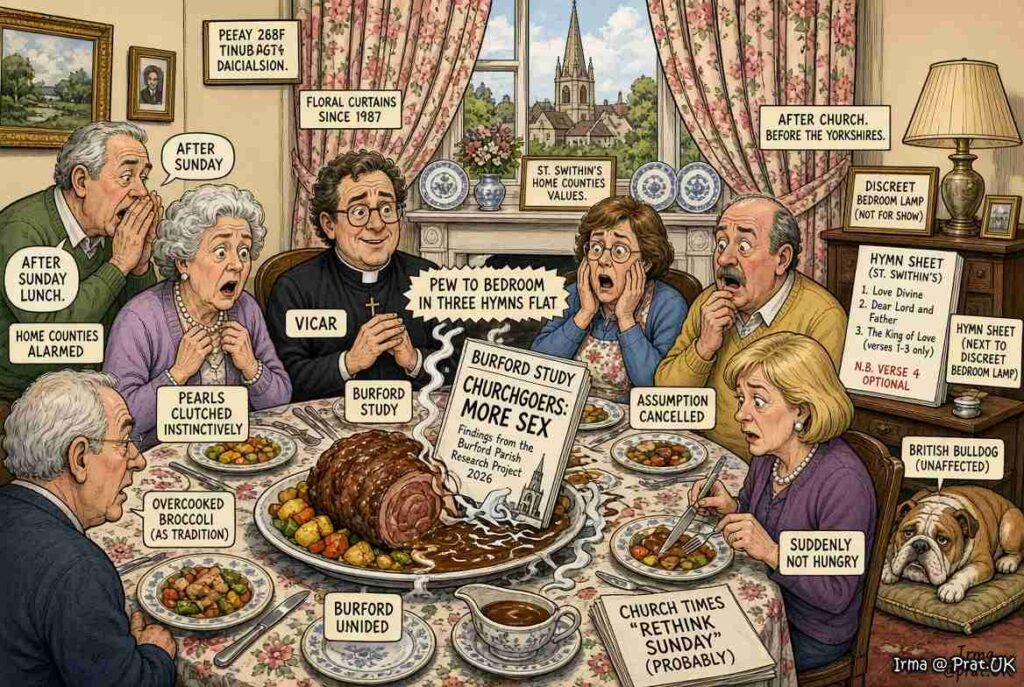
Burford Study Finds Churchgoers Having More Sex, Leaving Britain Alarmed
New British research reaches the Home Counties, threatening centuries of assumptions about vicars, marriage and what exactly happens after Sunday lunch
LONDON — Britain’s secular establishment was thrown into confusion this weekend after research from the Burford Institute for Domestic Studies suggested that married people who regularly attend church report more frequent sex and happier marriages, forcing millions of Britons to reconsider whether Sunday worship might involve benefits not previously mentioned on the parish noticeboard.
The researchers surveyed 3,125 married adults across England and Wales. Among respondents aged 20 to 54, 62% of regular churchgoers said they had sex at least weekly, compared with 48% of nonreligious spouses. Regularly attending Catholics reported particularly high levels of frequency, while regular Catholic and Anglican worshippers also tended to report greater sexual satisfaction. The researchers stressed that the observational study demonstrates an association, not proof that church attendance causes anybody to start throwing their pyjamas across the bedroom.
Britain nevertheless reacted exactly as Britain reacts to every complicated piece of social science: by reading the headline and immediately forming a national strategy.
Within hours, several husbands who had not voluntarily entered a church since their wedding were reportedly asking whether Sunday Eucharist required reservations.
“Do they validate parking?” asked one man in Surrey while polishing shoes he had not worn since a funeral.
New British Research
- Britain has spent decades assuming churchgoers go home after Sunday service to discuss chrysanthemums. Apparently some of them have other plans.
- A British study reports regular churchgoers have more frequent sex, immediately giving the Church of England its strongest recruitment slogan since “We have biscuits.”
- British atheists were reportedly comfortable with eternal nothingness until discovering Christians might also be having more fun on Saturday night.
- The Church of England could reverse declining enthusiasm overnight simply by replacing “All Are Welcome” with “You Have No Idea.”
- Researchers found shared values may strengthen marriages. Britain had previously assumed the secret was owning two televisions.
Church of England Accidentally Discovers Marketing
The news arrives at an awkwardly convenient moment for the Church of England.
Preliminary figures published in May showed an estimated 1.023 million regular worshippers in 2025, up 1.4% from 2024, marking a fifth consecutive year of attendance growth. Christmas and Easter attendance also increased.
Church officials attributed the increase to faith, community, outreach and renewed spiritual interest.
Britain’s husbands have now proposed a fifth explanation.
“Sex,” said Kevin from Bromley, suddenly displaying an intense scholarly curiosity about the Book of Common Prayer.
Kevin, 48, explained that for 22 years he had considered Sunday morning church attendance “something my mother did,” but was now prepared to reconsider several important theological questions.
“Apparently Catholicism is doing especially well,” he said. “I’m not saying I’m converting. I’m saying I’d like to see the brochure.”
His wife, Angela, was less impressed.
“You have to actually become a better husband, Kevin,” she explained.
Kevin stared into the middle distance.
Nobody had mentioned that.
Scientists Discover Married Couples Benefit From Actually Liking Each Other
The Burford research suggested that shared religious practice, common values and regarding marriage as a permanent commitment were associated with better marital outcomes. A marriage counsellor consulted by the researchers also suggested that couples benefit from putting down their phones, talking to one another and developing deeper emotional connections, advice echoed by relationship charities such as Relate.
This has generated enormous concern in Britain because it implies marriage cannot be maintained entirely through WhatsApp messages saying:
“Need milk?”
For years the sophisticated British model of intimacy has involved two people sitting on opposite ends of a sofa, watching The Great British Bake Off while simultaneously scrolling through separate social-media feeds.
At approximately 9:43 p.m., one spouse says, “You tired?”
The other says, “Bit.”
This concludes courtship.
Researchers are now proposing an almost revolutionary alternative in which married couples talk, share rituals, spend meaningful time together and occasionally remember why they married.
The government is understood to be studying whether this can be taxed.
Anglican Foreplay Remains Extremely Anglican
Naturally, nobody is suggesting British church life is about to resemble a French perfume advertisement.
This is Anglicanism.
Eroticism must occur in an orderly manner after tea.
The Traditional Church of England Romantic Sequence
Hymn.
Reading.
Prayer.
Sermon.
Biscuit.
Discussion about the church roof.
Possible intimacy after Countryfile.
A retired accountant from Kent described this system as “sensual but properly supervised.”
Indeed, Anglicanism may be uniquely compatible with long marriage because both institutions require patience with mysterious traditions nobody remembers agreeing to.
You stand when everyone stands.
You sit when everyone sits.
You occasionally kneel.
Someone else has already selected the music.
And sooner or later somebody asks you for money.
Britain Discovers Commitment
There is another inconvenient finding.
People who regarded marriage as a permanent commitment were more likely in the Burford data to report satisfying marriages and satisfying sex lives.
This threatens the modern British doctrine that every human relationship should contain cancellation terms no more demanding than Amazon Prime.
Marriage, according to this strange older theory, is not merely two people agreeing to remain together until one of them loads the dishwasher incorrectly.
It involves perseverance.
Britain has approximately 12.8 million married-couple families according to the Office for National Statistics’ 2024 family estimates, although marriage represents a smaller share of families than it did a decade earlier. Think tanks such as the Marriage Foundation have long argued that marriage stability matters.
Sociologists therefore believe millions of married Britons may already possess the necessary laboratory equipment for testing the theory at home.
Researchers recommend beginning cautiously.
Perhaps speak to your spouse.
Then see what happens.
Phones Identified as Natural Predator of Marriage
One of the least surprising recommendations emerging from the discussion around the study is that couples might benefit from occasionally turning off their televisions and phones.
This has terrified the telecommunications industry.
Britain now possesses households in which husband and wife can sit six inches apart while communicating exclusively by sending one another Instagram reels.
Romantic evenings increasingly consist of a man saying, “Look at this dog,” while holding a glowing rectangle six inches from his wife’s face.
She watches it.
The dog falls into a paddling pool.
Marriage continues another evening.
Church, by contrast, still provides one of the rare environments where normal adults voluntarily sit for an hour without scrolling through restaurant reviews, property prices, football rumours and photographs of strangers’ kitchens, or ordering dinner on Deliveroo.
That may be part of the secret.
Put two people together without phones and eventually they must either talk to one another or join the choir.
Atheists Demand Independent Investigation
Britain’s secular community has requested calm.
Scientists have not established that religion itself causes more frequent or satisfying sex. The study was observational, participants reported their own behaviour, and other differences between religious and nonreligious couples could explain some of the association.
This distinction is important.
Going to St Mary’s on Sunday does not guarantee anything on Sunday night.
Especially if the sermon lasts 55 minutes.
Still, the statistical association has proved unsettling to anybody who spent decades imagining religious couples sitting separately in high-backed chairs reading improving literature.
One London atheist complained that this violated the cultural settlement.
“I was promised guilt,” he said. “Nobody said anything about weekly.”
Parish Council Considers New Recruitment Poster
Churches across Britain are therefore being advised not to exploit the study.
Several proposed campaigns have reportedly already been rejected:
COME FOR SALVATION. STAY FOR DATE NIGHT.
MAKE SUNDAY MORNING INTERESTING AGAIN.
MARRIED? TRY MATINS.
THE COUPLE THAT PRAYS TOGETHER APPARENTLY HAS STATISTICALLY INTERESTING RESULTS.
The Church of England is expected instead to continue emphasising spirituality, community and service.
Which is probably wise.
Nothing kills romance faster than a laminated diocesan leaflet explaining it.
Britain Finally Receives Marriage Advice Nobody Can Monetise
Perhaps the genuinely interesting part of the research is how ordinary the possible explanation sounds.
Spend time together.
Develop shared values.
Create rituals.
Talk.
Put the phone down.
Treat the relationship as important.
Commit to one another.
These recommendations are so technologically primitive that nobody can raise venture capital for them.
There is no subscription.
No app.
No Bluetooth intimacy monitor.
No £14.99 monthly premium tier unlocking “advanced spouse communication.”
There are merely two human beings paying attention to one another.
And that might be why churchgoing couples sometimes report stronger relationships. Religious practice can create scheduled time together, shared communities, common beliefs, repeated rituals and a conception of marriage extending beyond whether somebody remembered to buy oat milk.
None proves causation.
But it does provide an intriguing hypothesis.
Britain Prepares for Sunday
By Saturday evening, anecdotal reports suggested married men throughout England were examining local church timetables with unprecedented theological urgency.
“Eleven o’clock Eucharist,” murmured one husband in Hertfordshire. “That seems manageable.”
His wife looked over his shoulder.
“You haven’t been to church since 2008.”
“I’ve been thinking deeply about eternity.”
“You read the sex article.”
“I encountered revelation.”
Across Britain, church bells continued ringing with their customary dignity, apparently unaware that social science had just transformed them into the nation’s most unlikely marital notification system.
Whether regular worship actually improves British marriages remains unanswered.
But couples searching for relationship advice could perhaps test the least controversial part of the theory tonight.
Turn off the television.
Put down the phones.
Talk to each other.
And if that becomes uncomfortable, there is always Evensong.
10 Humorous Observations Behind the Story
- Married couples praying together apparently report greater sexual satisfaction, suggesting “Amen” has been dramatically underestimated as pillow talk.
- Sunday church suddenly looks less like an obligation and more like foreplay with hymn books.
- The great British marital ritual has traditionally been sitting beside your spouse while independently looking at different phones. Researchers have now proposed the dangerous alternative of speaking.
- Couples who regard marriage as permanent also reported stronger relationships, shocking a society that increasingly regards a mobile-phone contract as an intolerable commitment.
- British husbands hearing the research immediately offered to attend Evensong, including several men who have spent 30 years claiming Sunday mornings are constitutionally reserved for football.
- Parish churches have spent fortunes discussing outreach when apparently the marketing department only needed one statistic.
- Anglicanism is almost uniquely suited to British romance because both require commitment, tolerance and pretending not to notice somebody else’s strange habits.
- A British couple attending church together already has an advantage: they have successfully spent an hour in the same room without checking Deliveroo.
- Church attendance in England has recently been rising anyway. If word about the Burford research gets around, Easter Sunday may require crowd-control barriers.
- Nothing could be more British than discovering the route to a better sex life involves sitting quietly on a wooden bench while an elderly man discusses Corinthians.
Disclaimer
This is satire. The Burford Institute for Domestic Studies, its survey and its percentages are invented for comic purposes, as are the quoted husbands, wives, accountants and atheists. The Church of England attendance figures and the ONS family estimate are drawn from published sources. No vicars were asked to provide bedroom-performance metrics, and the Church of England has not introduced a loyalty card.
This story is entirely a human collaboration between two sentient beings: the world’s oldest tenured professor and a philosophy major turned dairy farmer. Any resemblance to serious sociology should be regarded as an unexpected administrative achievement.


Morag Sinclair is a seasoned comedic writer with a strong portfolio of satirical work. Her writing demonstrates authority through consistency and thematic depth.
Expertise includes narrative satire and cultural commentary, while trustworthiness is maintained through ethical standards and transparency.