Cambridge Solves Embarrassing Hiring Scandal by Investigating Absolutely Everything Except the Simple Question Everyone Asked
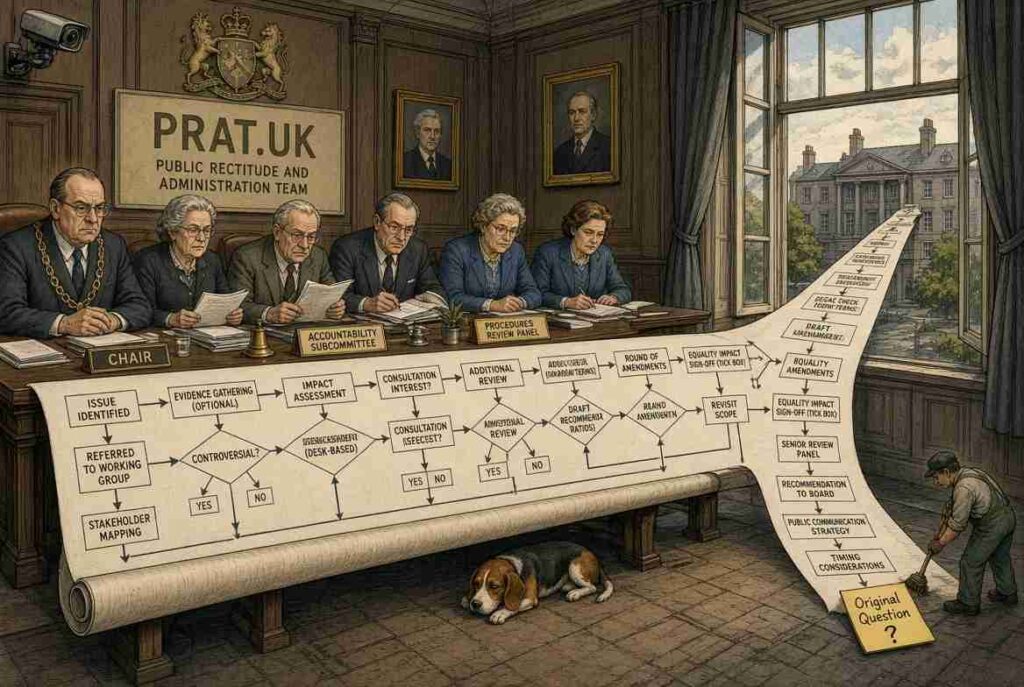
University discovers revolutionary accountability technique known as making the inquiry so enormous nobody can find the original question
CAMBRIDGE, ENGLAND — The University of Cambridge has unveiled what may be Britain’s greatest academic breakthrough since Newton discovered gravity: if an institutional question becomes sufficiently uncomfortable, simply enlarge the investigation until nobody remembers where the question went.
The controversy concerns Cambridge’s appointment of the late Professor Jason Arday, whose academic record and personal claims came under intense scrutiny this summer. Cambridge announced in August that it would investigate his qualifications and later promised an examination of the circumstances surrounding his appointment.
Now comes the advanced degree.
Following Arday’s death on August 14, Cambridge created a two-part independent review. Part One concentrates on the support, interventions and welfare protections available to him before his death. Part Two will conduct the broader institutional examination, including recruitment of senior academics, mentoring, responses to research-misconduct allegations and support for academics under extraordinary scrutiny.
Which means the hiring issue has not literally disappeared.
It has merely been moved into a much larger administrative casserole.
National Review characterized the change much more sharply, reporting that Cambridge had “cancelled” the probe into Arday’s hiring in favour of examining university support. Cambridge’s own published terms, however, say recruitment remains within Part Two.
And that distinction is important.
Because satire requires accuracy right up until accuracy becomes funny.
Cambridge Apparently Invents the Administrative Smoke Bomb
The original public question was admirably compact:
How did this appointment happen?
That is a dangerous question because it contains only seven words.
Seven-word questions can be answered.
So Cambridge did what great institutions have done since the first monk accidentally misplaced a monastery’s accounts: it expanded the vocabulary.
Now we have decision-making, policies, organisational processes, mentoring arrangements, support structures, institutional practice, interventions, protections and opportunities for improvement.
The question has gone from seven words to a habitat.
Nobody can catch it anymore.
Somewhere inside Cambridge there is presumably a frightened little sentence called “Who approved this?” hiding behind a filing cabinet while twenty administrators walk past carrying binders marked HOLISTIC REVIEW FRAMEWORK — VERSION 11.4b.
This is why Cambridge has lasted more than 800 years.
You cannot overthrow an institution if you cannot locate the meeting.
The University Once Promised Something Considerably Simpler
Back on August 12, Vice-Chancellor Deborah Prentice could hardly have been clearer.
Cambridge would investigate “the circumstances around his appointment” and his subsequent time at the university. She said the case had generated anger and anxiety, that the university needed to examine what went wrong, and that the findings would inform a review of senior academic appointments.
That sounds suspiciously understandable.
Fortunately, higher education recovered.
By September, Cambridge had developed a two-part independent review carrying enough conceptual luggage to require its own porter.
Part One asks whether the university provided appropriate support to Arday during the period of allegations and scrutiny.
That is a serious question, particularly after his death, and deserves serious consideration.
But Part Two is where the institutional magic begins.
It will consider the “wider context” of his time at Cambridge, including recruitment, mentoring, research-misconduct procedures and media scrutiny.
The appointment question has therefore survived, but it now shares an apartment with everything else Cambridge University has done since lunch.
Jesus College Introduces Exciting New Management Philosophy: We Assumed Cambridge Checked
Then there is Jesus College.
Its August statement contained the sort of sentence that deserves to be carved above every HR department in Britain.
The college said that, because Arday had been recruited to an academic role by the university, it expected Cambridge had undertaken thorough checks into his academic credentials before his fellowship election.
There it is.
The British administrative national anthem:
“We assumed somebody else checked.”
Railway signals? Somebody checked.
Government procurement? Somebody checked.
University professor? Look, he’s wearing spectacles. How much more checking do you want?
This is the employment equivalent of buying a secondhand Bentley because the previous owner seemed wealthy enough to have changed the oil.
Jesus College essentially said, “Cambridge hired him. We naturally assumed Cambridge had done the Cambridge bit.”
And Cambridge presumably believed departments had done the department bit.
Departments probably assumed previous universities had done the previous-university bit.
Eventually responsibility disappears over the horizon carrying a tote bag.
Cambridge Scientists Confirm Responsibility Changes State When Observed
The university is famous for quantum physics, so perhaps accountability at Cambridge simply obeys quantum rules.
Responsibility exists in several places simultaneously until somebody looks at it.
Then it vanishes.
A committee chairman explained the phenomenon to reporters while standing beside a particle accelerator constructed entirely from meeting minutes.
“Responsibility is extremely delicate,” he said. “Direct questioning can cause wave-function collapse.”
According to the entirely unofficial Cambridge Institute for Institutional Self-Preservation, researchers placed accountability inside a sealed box with an HR manager.
Until the investigation concludes, accountability is considered both alive and on sabbatical.
The CV Has Become Britain’s Most Dangerous Unregulated Document
One uncomfortable issue behind the controversy is wonderfully ordinary.
Credentials.
Universities demand enormous documentation from students.
Apply to Cambridge as an undergraduate and somebody may want your grades, examination results, references, essays, interviews and evidence that at age six you demonstrated insufficient enthusiasm for Oxford.
Apply for a distinguished academic post and apparently the public eventually asks:
Who verified what?
Cambridge itself acknowledged concerns about academic qualifications when it announced an investigation on August 5.
This produces a beautiful modern paradox.
The university may use software to ensure a 19-year-old undergraduate has not improperly paraphrased three sentences about Chaucer.
But when hiring professors, the system can apparently become considerably more philosophical.
“What is a qualification?”
“What does it mean to verify?”
“Are credentials merely socially constructed arrangements of Times New Roman?”
Sir, we’re asking whether somebody telephoned the institution.
“Your fixation on telephones is troubling.”
Cambridge Announces New Degree in Retrospective Due Diligence
The university should capitalize on this experience.
Next year Cambridge can offer an MPhil in Retrospective Due Diligence.
Students will learn:
How to verify credentials after somebody has already been hired.
How to replace “mistake” with “learning opportunity.”
How to replace “failure” with “process challenge.”
How to replace “who?” with “the institution.”
And the advanced seminar:
How to Announce an Independent Review Without Accidentally Producing an Independent Answer.
Tuition will be £38,000.
Applicants must provide three references.
None will be checked until 2031.
Experts Discover Britain’s Most Powerful Substance: The Lessons-Learned Report
Every British institution eventually produces a document promising to “learn lessons.”
Lessons are government-grade Kevlar.
Nothing penetrates them.
A building collapses? Lessons will be learned.
Computer system costs £4 billion? Important lessons.
Nobody checked something? Valuable lessons.
By this standard, Cambridge may shortly become the most educated institution on Earth.
The university already had degrees.
Now it has lessons.
One hypothetical report could conclude:
“Processes should be strengthened to ensure robust processes are processed through appropriate process-strengthening mechanisms.”
This recommendation will then be accepted in full.
By people who weren’t there.
Following procedures created after the people who were there have retired.
Accountability achieved.
The Serious Point Beneath the Academic Robes
Strip away the comedy and Cambridge faces a legitimate institutional question.
A university selling itself on academic excellence has an obvious interest in demonstrating that senior appointments are rigorously vetted.
That principle protects students. It protects academics. It protects minority scholars from having individual controversies weaponized against entire groups. And it protects the reputation of the institution itself.
Cambridge’s vice-chancellor acknowledged as much in August, saying fairness, meritocracy and freedom to raise concerns were vital and that the events demonstrated a need for improvement.
That is precisely why the recruitment question matters.
The public does not merely want to know whether Cambridge possesses procedures.
Cambridge has procedures the way Scotland has weather.
The question is whether the procedures worked.
A Revolutionary Five-Step Cambridge Hiring Reform
Fortunately, Bohiney’s Department of Extremely Obvious Solutions has developed a revolutionary academic recruitment protocol.
Step one: Read the CV.
Step two: Check the CV.
Step three: Call the institutions listed on the CV.
Step four: Examine publications before announcing that someone is a historic appointment.
Step five: If something later goes spectacularly wrong, investigate the people who made the decision rather than forming a committee to investigate the philosophical environment surrounding decision-making.
Total estimated implementation cost: £14.73.
Cambridge will instead allocate £6.8 million for a three-year interdisciplinary feasibility study.
Newton Would Have Solved This Before Breakfast
Isaac Newton studied at Cambridge. He developed laws describing motion and gravitation. If an apple fell from a tree, Newton wanted to know why the apple fell.
Imagine applying the modern administrative model.
A committee would announce that focusing excessively on the apple could unfairly stigmatize fruit.
A second committee would examine whether the orchard provided adequate emotional support.
An external chair would investigate environmental factors affecting branch retention.
Six months later the university would announce:
“We cannot comment on individual apples, but we remain fully committed to gravity.”
And somewhere Newton would throw another apple.
Cambridge Still Has One Question to Answer
Cambridge’s current review does, importantly, retain recruitment within Part Two. That deserves to be stated clearly because the official September framework does not erase the hiring issue altogether.
But that makes the eventual test wonderfully simple.
When the reviews are finished, will the public be able to understand:
How was Jason Arday appointed? What checks were conducted? Which processes failed, if any? Who was responsible for those decisions? What has actually changed?
If Cambridge answers those questions plainly, excellent.
If the final report instead contains 186 pages discussing “stakeholder ecosystems,” “reflective learning journeys,” “context-sensitive governance” and “institutional resilience pathways,” we will know the ancient university has once again achieved its greatest intellectual feat:
Turning “Who hired him?” into a postgraduate qualification.
15 Humorous Observations Before We Enter Cambridge’s Administrative Fog Machine
- Cambridge originally promised to investigate how Jason Arday was appointed, then redesigned the inquiry so elegantly that the hiring question now lives inside a larger review, rather like hiding an elephant inside a university prospectus. In August, Vice-Chancellor Deborah Prentice explicitly promised an investigation into “the circumstances around his appointment.”
- This is the academic equivalent of investigating a bank robbery by commissioning a report on whether the getaway driver received adequate lumbar support.
- Cambridge’s September structure gives Part One to welfare and support, while Part Two considers broader institutional processes including recruitment. That may be defensible after Arday’s death, but bureaucratically it is magnificent: the embarrassing question has acquired subcommittees, phases, chairs and enough procedural upholstery to survive winter.
- Cambridge has apparently discovered that the best way to make a scandal smaller is to make the investigation bigger.
- The university that produced Newton can split an atom of accountability into seventeen individually harmless administrative particles.
- In August, Cambridge said there was “real anger and anxiety” about the appointment and promised to examine “what went wrong.” By September, the vocabulary had matured beautifully into “decision-making, policies and organisational processes.” Accountability has entered witness protection.
- Only academia could take the question “Who hired him and why?” and transform it into something requiring six months, an expert panel and people with “lived experience.”
- At an ordinary company, HR asks, “Did we check the résumé?” At Cambridge, three medieval courtyards later, someone announces a symposium called Towards a Reflexive Epistemology of Curriculum Vitae Verification.
- Jesus College said it expected Cambridge had thoroughly checked Arday’s academic credentials before electing him to a fellowship. In other words, Cambridge may have achieved the institutional Holy Grail: everybody trusted somebody else.
- Cambridge’s appointment system apparently operated according to the British railway principle: each department assumes someone farther up the line checked the points.
- The university initially faced allegations involving plagiarism, qualifications and biographical claims. Cambridge itself announced an investigation after receiving “new information” concerning Arday’s qualifications and honorary appointments.
- A truly elite institution does not avoid an awkward question. It surrounds the question with enough governance that the question eventually needs its own bicycle.
- The finest trick in institutional public relations is replacing “Who screwed up?” with “What lessons can we learn?” Nobody has ever been fired by a lesson.
- When Cambridge says it is examining “processes and practice,” every committee member in Britain instinctively relaxes. Processes cannot be embarrassed at dinner.
- The institution has accidentally created a new academic discipline: Applied Accountability Displacement, the study of moving responsibility approximately six inches sideways until everyone gets tired.
Sources
Cambridge’s official September review says Part Two will include recruitment of senior academic staff as well as mentoring, misconduct procedures and institutional support. University of Cambridge: independent review of the Jason Arday case
National Review characterized Cambridge’s latest move as cancelling the hiring probe and shifting attention toward university support. National Review: Cambridge and the Jason Arday inquiry
The Guardian reported in August that Cambridge had agreed to an independent inquiry into the circumstances surrounding Arday’s appointment following pressure from academics. The Guardian: Cambridge’s original independent inquiry announcement
Disclaimer
This satire targets institutional bureaucracy, university governance and the remarkable human ability to turn a straightforward question into a six-month review with laminated terms of reference. Jason Arday died on August 14, 2026; the jokes are directed at Cambridge’s handling of the controversy, not at his death or the grief of his family.
This story is entirely a human collaboration between two sentient beings: the world’s oldest tenured professor and a philosophy major turned dairy farmer, both of whom remain convinced that “Did anybody check?” should not require an expert panel.

Megan Amram is a standup comedian based in Portland, OR. She is a native of North London.