British Local History Finally Admits It Has Been Making Things Up For Centuries
Experts Confirm Entire Nation Is Basically One Giant Museum Dedicated To Petty Arguments
LONDON — After centuries of painstaking research, thousands of academic papers, and enough tea to refill the English Channel twice, Britain’s leading local historians have finally reached a startling conclusion.
Most British local history consists of people arguing about things nobody remembers.
The revelation emerged during the annual Conference of Regional Antiquarian Studies, held this year in a medieval village whose primary tourist attraction is a tree that may or may not have once annoyed a duke.
Professor Nigel Throckmorton of the Institute for Excessively Specific Historical Research summarised the findings.
“We examined parish records, tax rolls, court documents, diaries, tavern receipts, church ledgers, and approximately eleven million handwritten complaints,” he said. “The evidence overwhelmingly suggests that Britain has spent the last thousand years preserving grudges.”
The report immediately received support from local councils across the nation. Several admitted they had suspected this for years.
For those wishing to verify the findings independently, the full archive of parish complaints, grudge ledgers, and fence ownership disputes is available through British History Online, the digital library maintained by the Institute of Historical Research containing over 1,000 volumes of primary and secondary sources for the medieval and modern history of the British Isles. Researchers are advised to bring patience, a pencil, and a working familiarity with the word “notwithstanding.”
Village Celebrates 700th Anniversary of the Man Who Accidentally Invented Standing Around Complaining About the Weather
The village of Lower Widdlesham this week hosted a major festival commemorating the achievements of Geoffrey Dampcoat, a local wool merchant credited with inventing modern British conversation.
According to village records, on a rainy morning in 1326 Geoffrey reportedly looked at the sky and announced: “Bit wet.”
Witnesses described the remark as revolutionary. Prior to that moment, English people had been forced to discuss meaningful subjects.
Within hours villagers were gathering in groups simply to comment on clouds. By the following week residents had developed advanced conversational techniques including:
“Looks like rain.” “Looks like it might clear.” “Hard to tell.” “Not as bad as Tuesday.”
Modern linguists describe the invention as one of Britain’s most influential cultural achievements. A commemorative statue depicts Geoffrey staring unhappily at a cloud while refusing to do anything about it.
Visitors can also enjoy historical reenactments in which volunteers spend six hours discussing drizzle.
Local resident Colin Briggs called the festival moving. “My grandfather complained about weather,” he said. “His father complained about weather. It’s important we remember where these traditions come from.”
Scholars wishing to trace the deep roots of this conversational tradition are directed to the British Association for Local History, the national charity which has promoted the study of local history since 1952 and publishes The Local Historian quarterly — a journal that has, to date, never once dedicated an issue to weather complaints, which historians consider a significant oversight.
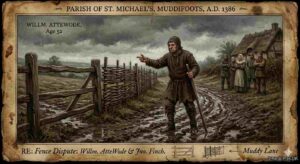
Archaeologists Uncover Medieval British Town That Spent Three Centuries Arguing About Fence Ownership
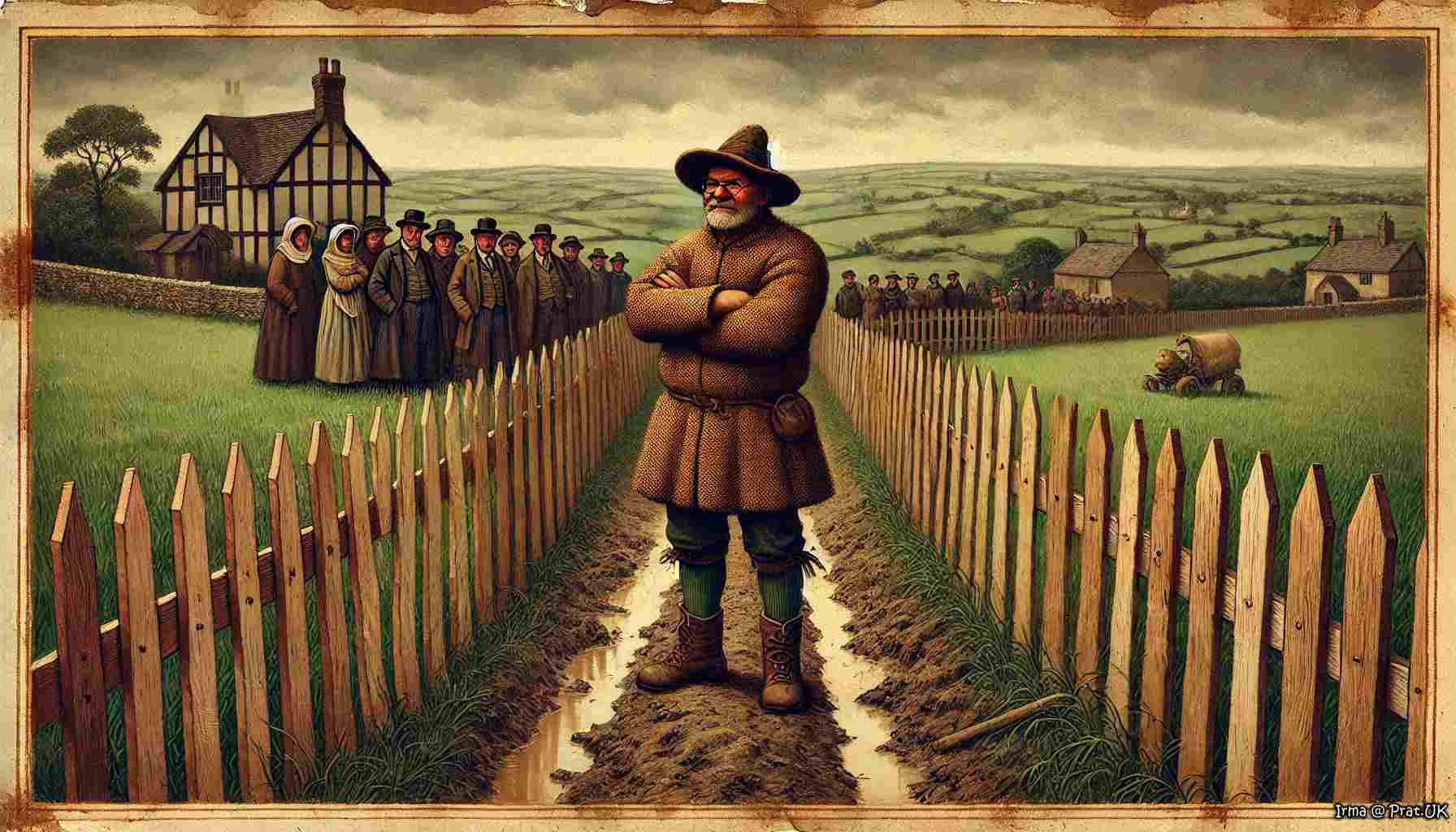
Meanwhile, archaeologists excavating the ruins of a medieval settlement in Lincolnshire uncovered evidence that residents spent nearly three hundred years disputing ownership of a fence.
Researchers initially assumed the settlement had collapsed during war, famine, or plague. Instead they discovered thousands of legal documents dedicated entirely to one wooden boundary.
The argument appears to have begun in 1184 when one villager claimed a fence post stood six inches too far east. The dispute then escalated. Generations inherited the conflict. Children grew up learning family positions on the matter. Marriage proposals reportedly included discussions about fence alignment.
At one point rival factions built competing fences directly beside each other. The resulting structure became so large it qualified as a regional landmark.
Professor Susan Mallory described the discovery as “the most British thing ever uncovered.”
The argument eventually ended around 1482 after the original fence rotted away. Neither side accepted defeat.
The full documentary record of boundary disputes of this era — including what are believed to be several hundred complaints regarding fence posts, ditch ownership, and the precise definition of “common land” — can be cross-referenced via the Vision of Britain Through Time, the University of Portsmouth’s historical GIS project mapping how Britain’s localities have changed over the centuries. It contains no specific entry for the fence. Researchers have filed a complaint.
Local History Society Confirms Every Important Event In Village History Began At The Pub
The Wessex Historical Preservation Society recently completed a five-year study examining local events. Researchers hoped to uncover patterns explaining major historical developments. They found one.
Everything happened in the pub.
The English Civil War discussion that shaped village politics? Pub. The campaign to build the church tower? Pub. The annual cheese festival? Pub. The disappearance of three sheep and one mayor? Also pub.
Historical records show most village decisions followed a remarkably consistent process. Step one involved entering the pub. Step two involved confidence. Step three involved consequences.
Society chairman Arthur Pickering presented the findings. “Frankly we were shocked by the consistency,” he admitted. “The village technically possesses several other buildings, yet apparently nobody used them.”
Historians now estimate roughly eighty per cent of British governance originated from somebody saying: “You know what we ought to do?”
Ancient Yorkshire Feud Finally Ends After Historians Forget What Started It
After lasting more than six hundred years, the famous feud between the villages of Upper Crumbleton and Lower Crumbleton has officially concluded.
Not because anyone reconciled. Nobody can remember why they were fighting.
Researchers spent years searching archives. They located references to insults. References to retaliation. References to revenge. References to revenge for revenge. But the original cause disappeared sometime around the reign of Edward III.
For centuries residents continued disliking one another out of habit. Children inherited detailed instructions regarding which neighbouring families deserved suspicion. Nobody knew why.
The feud finally collapsed after historians held a conference and accidentally misplaced all remaining evidence. Villagers celebrated by cautiously tolerating each other. Many admitted the transition felt uncomfortable.
One resident confessed: “My family has hated those people since before the invention of forks. I’m not sure what to do now.”
Those wishing to understand how such feuds were formally recorded, litigated, and occasionally resolved may consult the National Archives, which holds centuries of parish and court records and — crucially — has not yet lost any of them.
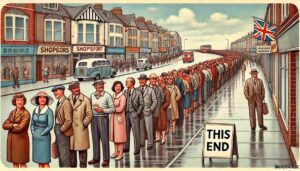
Parish Museum Opens New Exhibit Dedicated To Britain’s Longest Queue For Absolutely Nothing
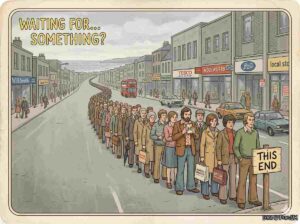
The Parish Museum of Everyday Significance unveiled its newest attraction this month. The exhibit documents what experts believe was Britain’s longest recorded queue for no identifiable reason.
The queue reportedly formed in 1978. Nobody remembers why. Photographs show hundreds of citizens patiently waiting. Interviews reveal nobody knew what awaited at the front. Many joined simply because others were already standing there.
Some participants remained for several hours. One reportedly brought sandwiches.
Museum curator Margaret Evans considers the event culturally important. “It perfectly captures British civic values,” she explained. “Patience. Order. Mild confusion.”
The exhibit includes reconstructed rope barriers and authentic expressions of quiet resignation. Visitors can experience the queue firsthand. Average wait time is currently four hours. No attraction exists at the end.
Suffolk Residents Proudly Preserve Heritage Pothole Older Than Several European Nations
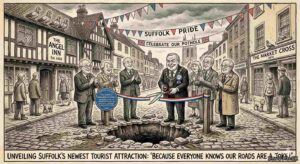
In Suffolk, local authorities recently granted heritage status to a pothole believed to date back to the fourteenth century. Engineers first attempted repairs in 1973. Residents objected. They argued the pothole represented an important part of community identity.
Today the depression attracts thousands of visitors annually. Tour guides explain how generations of carts, horses, bicycles, and hatchbacks contributed to its development. Local schoolchildren study its geological layers.
Archaeologists claim artefacts recovered from the site include Roman coins, medieval horseshoes, and three complete Ford suspension systems.
The pothole recently received Grade II listed status. Officials say repairs would constitute cultural vandalism.
For those curious about the formal listing process, Historic England maintains the National Heritage List for England, which records listed buildings, scheduled monuments, and protected sites across the country. The pothole’s entry is understood to describe it as “an exceptional example of sustained municipal inaction.”
Town’s Most Famous Landmark Revealed To Be Clerical Error Made In 1473
Tourism officials in Market Snoring received difficult news when researchers revealed the town’s most famous landmark never existed.
The attraction, known as Saint Edmund’s Sacred Stone, draws thousands of visitors annually. According to legend, a saint rested there during a miraculous journey. Unfortunately newly discovered records indicate a monk accidentally misspelled “small stone” as “holy stone” in 1473.
The mistake then acquired centuries of supporting evidence. Pilgrimages followed. Guidebooks followed. Gift shops followed.
Mayor Richard Wells remained optimistic. “If anything,” he said, “the clerical error is now more historically important than the stone.”
Tourism numbers immediately increased. Britons appreciate commitment to administrative mistakes.
Historic Market Square Granted UNESCO Status For Exceptional Achievement In Doing Very Little
UNESCO representatives shocked historians by awarding cultural protection to the Market Square of Little Puddlington. The citation praised its remarkable contribution to inactivity.
For over six centuries almost nothing has happened there. Experts documented generations of standing. Watching. Waiting. Occasionally purchasing turnips. The square’s atmosphere remains largely unchanged since 1438.
Visitors describe overwhelming sensations of mild interest. Researchers believe it may represent the purest surviving example of British loafing.
The Victoria County History — described as the greatest publishing project in English local history and running since 1899 — has so far produced encyclopaedic records of England’s places and people from earliest times. It has not yet covered Little Puddlington. Locals consider this further proof of nothing in particular.
Medieval Village Reenacts Great Duck Dispute Of 1389, Traffic Disrupted For Third Consecutive Century
Residents of Marsh-upon-Bog recently staged the annual reenactment of the Great Duck Dispute. The original controversy began when two farmers claimed ownership of an unusually confident duck. Court proceedings lasted seventeen years.
Modern celebrations include costumes, speeches, duck-themed pastries, and traffic chaos. Officials estimate congestion associated with the event has now persisted longer than many monarchies.
Tourists love it. Drivers do not.
Local Historian Discovers Entire Community Descended From One Extremely Nosy Woman
The most astonishing revelation emerged in the village of Nether Picklebury. Genealogist Bernard Finch spent twenty years tracing local family trees. His findings suggest nearly every resident descends from Agnes Butterworth.
Agnes lived during the sixteenth century and possessed an extraordinary talent for knowing everyone’s business. Parish records show she attended every wedding, funeral, argument, livestock sale, church service, harvest festival, and suspicious conversation within fifty miles.
Researchers believe her social influence was so extensive that she eventually became related to nearly everybody. Modern DNA analysis appears to support the theory.
Residents reacted calmly. Most already suspected Agnes knew everything. A statue is planned. It will feature her leaning over a fence. Naturally.
Researchers tracing their own Agnes Butterworth are directed to Findmypast, the British genealogy platform holding billions of historical records including parish registers, census returns, and military records — and the only database specifically designed for discovering which ancestor was standing outside someone else’s house in 1563.
What The Funny People Are Saying
“British history is mostly people saving receipts for arguments.” — Jerry Seinfeld
“Only Britain could turn standing in line into an Olympic heritage sport.” — Ron White
“Americans built skyscrapers. The British preserved a pothole and charged admission.” — Sarah Silverman
The Structural Continuity of Local Governance and General Confusion
British local history is not merely a collection of dates; it is a monument to the eternal reality that society is an unsupervised group project held together with expired glue. For centuries, regional developments have been driven by a deep, unwavering commitment to bureaucratic absurdity and majestic underachievement.
Top Ten Definitive Historical Events in British Local History
1. The High Wycombe Scale of Political Accountability
Since the Middle Ages, the town of High Wycombe has practiced the Weighing of the Mayor, an official administrative procedure wherein the town’s chief executive is publicly weighed on brass scales at the beginning and end of their term. According to Chief Municipal Nutritionist Dr. Alistair Plump-Girth, this was the earliest form of financial audit: if the mayor gained weight, it was objective, scientific proof that they had been eating the taxpayers’ money, prompting the citizenry to pelt them with rancid tomatoes. Modern analysts marvel at this era, noting that contemporary politicians have successfully decoupled their legislative failures from their caloric intake.
2. The Strategic Importance of the Sunday Longbow Mandate
In 1541, the Unlawful Games Act legally compelled every able-bodied English male to practice archery after church on Sundays, actively banning distracting, frivolous pastimes like football. Historical documents indicate that local magistrates took this with absolute seriousness, fully convinced that a French invasion could be successfully repelled if every serf in Berkshire spent their day off firing arrows into a hay bale rather than kicking an inflated pig’s bladder into a hedge.
3. The Double Gloucester Gravity Derby
At Cooper’s Hill in Gloucestershire, local history has long been defined by a deep, spiritual reverence for a nine-pound wheel of Double Gloucester cheese. For over five hundred years, hundreds of fully grown adults have willingly thrown themselves down a near-vertical, 200-yard cliff in hot pursuit of rolling dairy. Internal records show that participants possess a profound, unquestioning belief that fracturing a collarbone is a perfectly acceptable trade-off for a mild cheddar variant, establishing a regional tradition where orthopedic catastrophe is viewed as the ultimate form of civic honor.
4. The Geopolitical Standoff of the Isles of Scilly
Local maritime records confirm that the Isles of Scilly maintained a state of active, bloodless warfare with the Netherlands for exactly 335 years due to a forgotten declaration from 1651. Because neither side ever remembered to sign a peace treaty until 1986, generations of Scillonian fishermen lived in constant, stoic anticipation of a Dutch armada that was, in reality, entirely occupied with global trade and tulips, demonstrating the supreme administrative efficiency of forgetting you are at war.
5. The Royal Monopoly on Coastal Wildlife
Ever since a 1324 statute passed under King Edward II, all sturgeons, porpoises, and whales caught in British waters are legally classified as “Royal Fish” and must be offered directly to the monarch. Local fishing logs reveal centuries of absolute narrative sincerity from coastal workers who, upon accidentally dragging a dead, multi-ton cetacean onto a rocky beach in Glamorgan, immediately sought the nearest royal courier to deliver His Majesty’s rightful, decomposing breakfast.
6. The 1872 Public Highway Cow Management Crisis
Under Section 12 of the Licensing Act 1872, parliament took a firm, unyielding stance on public safety by making it strictly illegal to be drunk while in charge of a cow on a public highway. Regional court records highlight the immense frustration of rural police constables who were forced to conduct early sobriety tests on nineteenth-century agricultural laborers, assessing whether a farmer’s erratic navigation down a muddy lane was due to excessive gin or simply the inherent obstinacy of the bovine lifestyle.
7. The Great 1967 London Bridge Relocation Initiative
When the City of London discovered that the 1831 London Bridge was slowly sinking into the River Thames, local authorities engineered a brilliant masterstroke of historical preservation by selling the entire structural liability to an American oil tycoon. The bridge was meticulously dismantled, shipped across the Atlantic, and reassembled in the Arizona desert, leaving centuries of local ghosts completely disoriented and establishing a historical precedent that if a piece of British heritage becomes functionally broken, it can simply be sold to the colonies.
8. The Defensive Architecture of the Tank Kettle
Since 1945, every official British armored vehicle has been structurally engineered with an internal, vessel-contained tea-making facility. Military history experts confirm that the highest levels of the Ministry of Defence operated under the logical assumption that while a thermonuclear blast or an anti-tank missile could compromise operational efficiency, a crew forced to wait until after the skirmish for a hot cup of Earl Grey would result in an immediate collapse of Western civilization.
9. The 1839 Urban Timber Transit Regulation
Section 54 of the Metropolitan Police Act 1839 explicitly banned citizens from carrying large planks of wood down public pavements unless they were loading them into a vehicle. For generations, urban pedestrians viewed the simple act of transporting home improvement supplies as a high-stakes criminal enterprise, creating a culture where carrying a 2×4 became an act of civil defiance on par with smuggling contraband across international borders.
10. The Royal Menagerie Upkeep Deficit
In 1251, King Henry III disrupted the local economy of London by moving a gifted polar bear into the Tower of London and forcing the local sheriffs to pay four pence a day for its maintenance. Financial records from the era reflect the utter despair of local tax collectors who had to explain to starving peasants that their hard-earned coins were being directly allocated toward providing imported fish for an arctic carnivore that spent its days swimming on a leash in the Thames.
This article is British satirical journalism produced in the long and noble tradition of The London Prat, established 1961, in collaboration between the world’s oldest tenured professor and a philosophy major turned dairy farmer. Any resemblance to actual villages, ducks, potholes, fences, queues, clerical errors, weather complaints, or UNESCO-certified laziness is probably unavoidable because British local history itself occasionally writes better jokes than journalists.
Auf Wiedersehen, amigo! — Reginald Fforbes-Blunt, The London Prat, Senior Correspondent for Parish Grudges and Heritage Infrastructure.
SOURCE

Alan Nafzger was born in Lubbock, Texas, the son Swiss immigrants. He grew up on a dairy in Windthorst, north central Texas. He earned degrees from Midwestern State University (B.A. 1985) and Texas State University (M.A. 1987). University College Dublin (Ph.D. 1991). Dr. Nafzger has entertained and educated young people in Texas colleges for 37 years. Nafzger is best known for his dark novels and experimental screenwriting. His best know scripts to date are Lenin’s Body, produced in Russia by A-Media and Sea and Sky produced in The Philippines in the Tagalog language. In 1986, Nafzger wrote the iconic feminist western novel, Gina of Quitaque. He currently lives in Holloway, North London. Contact: [email protected]