

Britain’s Military Launches Bring-Your-Own-Equipment Scheme After Latest Defence Spending Talks
🇬🇧 LONDON 🇬🇧
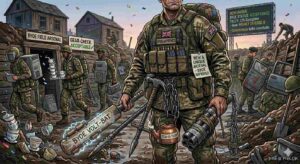
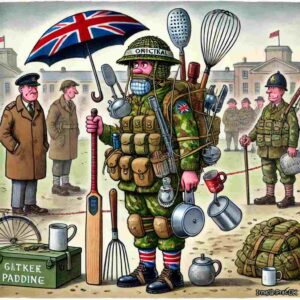
Britain’s military unveiled a bold new initiative this week requiring soldiers to provide their own equipment after defence spending negotiations reportedly concluded with the phrase, “Have we tried Facebook Marketplace?” The Ministry of Defence described the Bring-Your-Own-Equipment programme — BYOE to those already browsing eBay for surplus night-vision goggles — as “a modern, flexible approach to warfare” empowering personnel to leverage existing household assets in support of national security objectives.
Officials insisted the policy reflects innovation rather than desperation, which is almost certainly what you’d say if it reflected desperation.
Treasury Discovers That Patriotism Is Free, Therefore Scalable
“This isn’t about cuts,” said one Treasury representative while quietly removing batteries from an office calculator. “It’s about entrepreneurial thinking. Why should the taxpayer fund binoculars when Uncle Steve already has a perfectly adequate pair for birdwatching?” The representative noted that Uncle Steve’s binoculars featured a rather good neck strap and were, technically, dual-use technology cleared for deployment pending a risk assessment.
The announcement follows the resignation of Defence Secretary John Healey, who reportedly became concerned after discovering that “thoughts and prayers” had not yet been approved as NATO-compliant defensive systems. Sources close to Healey claim his frustration reached breaking point during a meeting in which officials suggested Britain’s military austerity could be offset by “manifesting positive outcomes.”
“He kept repeating that geopolitical tensions required actual investment,” said one witness, currently filling out a form to requisition a stapler. “The Treasury responded by asking whether he’d considered a sponsored walk.”
Government insiders deny that Healey resigned in protest. “He simply wanted to spend more time with his family,” explained one spokesperson. “Preferably before they too were enlisted into the reserves and asked to bring their own sleeping bags.”
Britain’s Military Strategy: Hide Behind France And Hope Nobody Notices

Meanwhile, Britain’s military unveiled a revised national defence strategy based upon a doctrine historians are already calling “optimistic concealment.” The plan — summarised internally as Hide Behind France And Hope Nobody Notices — relies on Britain’s ability to appear extremely busy while larger continental powers handle unpleasant matters.
“France possesses nuclear weapons and a longstanding enthusiasm for military hardware,” explained one defence analyst, gesturing at a map with a biro that had run out. “Britain possesses queue discipline and a collection of commemorative tea towels. Naturally, cooperation is essential.”
Treasury officials intensified tensions by proposing that Britain’s armoured divisions reduce costs through resource sharing. “Do we really need multiple tanks?” asked one budget adviser. “Couldn’t regiments book time slots?” The proposal envisioned a nationwide scheduling app — likely described as “innovative,” “agile,” and “three years late” — allowing brigades to reserve Britain’s sole operational tank for special occasions.
Military planners expressed concern that future conflicts might prove administratively challenging. “The Germans get Tuesdays,” one officer reportedly joked. “We’re pencilled in for alternate weekends, subject to availability and the Easter bank holidays.”
Strongly Worded Emails: Britain’s New Overseas Deployment Strategy
The Ministry of Defence also embraced digital solutions. Rather than deploying expensive armed forces overseas, officials were encouraged to address emerging threats through strongly worded correspondence. “Our adversaries should understand that Britain remains deeply disappointed in their conduct,” read one draft communiqué, which reportedly closed with “Kind regards” and a passive-aggressive postscript.
Analysts noted that hostile regimes have historically demonstrated remarkable resilience against passive-aggressive emails, particularly those sent without read receipts.
Prime Minister Keir Starmer’s government defended its approach as pragmatic. “We call it adaptive realism,” one adviser explained. “Some nations escalate defence spending. Others spend decades debating paper clips. Britain has chosen a uniquely British middle path.” The strategy, internally known as Let’s Just See What Happens, emphasises flexibility, patience, and the possibility that international crises may resolve themselves if politely ignored for long enough.
Critics argue the doctrine resembles crossing the M25 blindfolded while whispering, “Fingers crossed.” The government notes this remains preferable to crossing the M25 with both eyes open, which statisticians confirm is only marginally safer.
Off-Peak Wars: How Britain’s Military Is Cutting Conflict Costs

In an effort to improve efficiency, Britain’s armed forces were encouraged to schedule future conflicts during off-peak periods. Wars occurring between 10 a.m. and 3 p.m. could benefit from reduced staffing costs, lower rail fares, and the possibility of a Tesco Clubcard bonus on operational rations.
“If hostile powers could avoid weekends, that would be tremendously helpful,” said one procurement specialist. “Have they considered invading during the January sales?” another added, before being asked to please stop helping.
Everyone agrees the Treasury’s approach to defence spending cuts reflects a consistent philosophy: every public service must learn to operate within financial constraints — which is easy to say when you are not the person conducting amphibious assaults aboard inflatable unicorn pool toys purchased during supermarket clearance sales.
Britain’s Ultimate Military Deterrent: A Mildly Irritated Pensioner In Surrey
Following weeks of negotiations, the defence spending dispute concluded according to a time-honoured British tradition. Nobody received what they wanted. Whitehall officials sought additional funding. The Treasury sought savings. The public sought reassurance. Everyone departed with a compromise so magnificently unsatisfactory that it achieved bipartisan disappointment — demonstrating Britain can still achieve consensus on something, even if that something is mutual dissatisfaction.
Government representatives insisted Britain’s military remains exceptionally well protected. “Our greatest strengths endure,” one official stated confidently. “Queueing etiquette. Passive aggression. The ability to express profound disapproval through increasingly elaborate sighs.” Experts suggest these characteristics may represent Britain’s ultimate deterrent. No invading force has yet demonstrated the psychological resilience necessary to withstand being told, “I suppose that’s one way of doing things,” by a mildly irritated pensioner in Surrey who has written twice to her MP and is not afraid to do so again.
For now, the Ministry of Defence remains committed to modernisation. Updated recruitment literature advises applicants to bring enthusiasm, sturdy footwear, and any spare anti-aircraft capabilities lying around the garage — preferably nothing bigger than a hatchback, as parking near Whitehall remains a separate procurement nightmare entirely.
“Let nobody doubt our resolve,” declared one spokesperson. “We stand ready to defend this nation. Provided everyone remembers to bring their own kit.” He then checked his watch, noted it was nearly 3 p.m., and suggested wrapping up before off-peak rates expired.
Auf Wiedersehen, amigo!
For more satirical commentary on Britain’s military and the gentle art of governing while pretending to govern, visit Bohiney.com — America’s finest source of baffled transatlantic commentary on defence spending that somehow never reaches the defence.
This article is British satirical journalism. It represents an entirely human collaboration between the world’s oldest tenured professor and a philosophy major turned dairy farmer. The Ministry of Defence has not, to our knowledge, approved Facebook Marketplace as a procurement channel — though we note the listing for “lightly used Challenger 2, one careful owner” remains suspiciously active.



Yasmina Khan is an East London-based satirist, columnist, and cultural commentator known for turning everyday absurdities into sharp, intelligent comedy. Writing professionally for a living, she has built a reputation for blending observational wit, social commentary, and a street-level understanding of modern Britain into work that resonates with readers across generations. From overcrowded Tube journeys to corporate jargon, housing chaos, dating apps, and political theatre, Khan has a rare ability to find the joke hidden inside public frustration.
Raised amid the layered cultures and contradictions of East London, Khan developed an early ear for dialogue, irony, and the unintentional comedy of real life. That background remains central to her voice. Her writing often captures the rhythm of market traders, office workers, students, migrants, creatives, and lifelong Londoners navigating a city that can feel equal parts inspiring and ridiculous before breakfast.
Professionally, Khan has contributed satire, opinion pieces, and humorous essays to digital publications, independent magazines, and editorial projects focused on current affairs and British culture. Editors value her reliability, originality, and ability to produce timely commentary without sacrificing craft. Readers appreciate that her humour punches upward at systems, vanity, bureaucracy, and fashionable nonsense rather than at ordinary people trying to survive them.
Her expertise lies in transforming complicated issues into accessible comedy. Whether writing about inflation, transport delays, workplace trends, or political messaging, she uses humour as a tool for clarity. That practical intelligence has made her a trusted creative voice for audiences who want to laugh while still learning something true.
Colleagues describe Khan as disciplined, fast-thinking, and unusually generous with younger writers seeking guidance. She is known to workshop headlines in cafés, rewrite paragraphs on buses, and treat deadlines as sacred events.
Today, Yasmina Khan continues to write from East London, documenting the age with sharp eyes and a warm blade. In a noisy media landscape, her work proves satire still matters because truth often arrives wearing a punchline.


