LONDON — New York City’s new mayor, Zohran Mamdani, has pledged to replace “the frigidity of rugged individualism with the warmth of collectivism” — a governing philosophy that sounds absolutely marvellous until thirty thousand people attempt to occupy a park designed for five thousand, somebody liberates a Citi Bike without paying for it, and the police unit you promised to abolish arrives to prevent the evening from becoming an insurance claim.
Welcome to Bryant Park, New York. Population: everyone. Fire code capacity: considerably fewer than everyone. Available mashed potatoes: none. Somebody forgot to make enough.
An Economics Tutorial Nobody Booked A Place On
Bryant Park briefly became a field lecture in applied economics. The module title: What Occurs When Demand Exceeds Supply and the Relevant Parties Decline to Engage With the Concept. Prerequisites: none. Attendance: compulsory and, as it transpired, rather too enthusiastic.
Scholars at institutions such as the London School of Economics have spent considerable effort producing papers about resource allocation, public goods, and the tragedy of the commons. They might have saved themselves the bother by simply pointing at a satellite image of midtown Manhattan that evening and writing: “This. Don’t do this.”
Capitalism, for all its moral complications, gave Americans NBA League Pass and the facility to watch basketball from one’s own sofa with full thermostat sovereignty. Collectivism, in its Bryant Park manifestation, produced a bottle thrown at a traffic officer and an involuntary refresher course in why capacity limits were invented.
To be fair to the crowd, they did demonstrate collective action in its purest form. They collectively ignored the posted occupancy figures. Nothing communicates “solidarity” quite so effectively as thirty thousand people simultaneously concluding that the fire safety regulations were more of a polite suggestion than an enforceable rule.
The Strategic Response Group Situation, Which Will Require Some Explaining at Cabinet
This is where the evening becomes genuinely awkward.
Mayor Mamdani has been a sustained critic of the NYPD’s Strategic Response Group — a specialist unit with a contested public reputation and, it emerged, a rather essential function when public gatherings begin to develop their own gravitational pull. The unit arrived at Bryant Park to restore order.
The political optics of this are approximately equivalent to announcing one has renounced bread entirely, then being physically recovered from a ditch by a baguette.
The Strategic Response Group must be running on pure institutional stubbornness at this point. They arrive each morning knowing a significant portion of the city regards them as either superfluous or actively objectionable, and then — with the reliability of British rain — they receive the call the moment anything goes wrong within fifty metres of a public monument. It is the civic equivalent of being the family member everyone ignores at Christmas dinner until the kitchen catches fire, whereupon you become briefly indispensable and then forgotten again by Boxing Day.
“Defund the people who manage emergencies” carries the same structural logic as dismissing your plumber at the precise moment a pipe bursts. The water, it should be observed, takes no position on your grievances with the plumber.
New York’s New Civic Philosophy, Explained to the British
For those unfamiliar with the American political landscape: New York has elected a mayor who describes himself as a democratic socialist, which in Britain would make him roughly a moderately enthusiastic member of the Labour Party, and in New York apparently makes him a figure of considerable controversy. He organised a free outdoor watch party for the Knicks playoffs — basketball, for those blessedly unacquainted with the sport — and rather more people turned up than the park could reasonably accommodate.
The British will recognise this phenomenon immediately. It is structurally identical to announcing a Royal Parks free concert, a Wetherspoons is doing something unusual with a voucher, or that there is a limited-edition crisp flavour available at a specific Tesco. The public will arrive in numbers that defy all rational forecasting. This is not a failure of ideology. It is a failure of logistics, and logistics is an equal-opportunity humiliator.
The phrase “warmth of collectivism” has the energy of something sold in a Notting Hill boutique between the artisanal honey and the crystals that are supposed to improve one’s broadband connection. It sounds lovely. But warmth, as anyone who has shared a flat in London will confirm, becomes considerably less appealing when it is being generated by thirty-seven strangers in a studio flat in Clapham while someone argues about whose turn it is to buy washing-up liquid.
The Two Varieties of Socialist Experiment
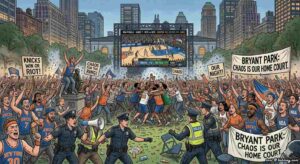
History suggests broadly two kinds of socialist experiment. The first is the Scandinavian model, which produces functional public services, happiness indices that make everyone else feel inadequate, and a general atmosphere of calm collective competence. The second is announcing a free outdoor NBA watch party twelve hours in advance to eight million people without crowd barriers, event infrastructure, or anyone calculating what Bryant Park’s square footage actually is divided by the number of people who own a mobile telephone.
This is not a comment on the ideology. It is a comment on the event management. There is a meaningful distinction, even if it was difficult to appreciate while standing shoulder-to-shoulder with strangers in a Manhattan park at capacity.
Project for Public Spaces has documented for decades that shared public life makes cities livable — genuinely livable, not just tolerable. The vision is real and worth defending. The execution on this particular evening was, as one might say diplomatically, a work in progress.
Urban planners, event coordinators, fire marshals, and anyone who has ever run a moderately attended outdoor gathering share one piece of wisdom that transcends political affiliation entirely: even utopia requires crowd barriers. Especially utopia. Because when you sincerely promise that everyone belongs, everyone turns up. And someone must count them first.
New Yorkers Have, As It Happens, Seen This Film Before
New Yorkers are not an easily impressed people. They have survived the 1977 blackout, multiple blizzards that generated more mayoral press conferences than actual gritting lorries, rats of a size that would qualify for an Oyster Card under a sufficiently generous transit policy, and several decades of elected officials announcing transformative visions that somehow leave the same potholes untouched on the same streets where they have been untouched since approximately the Ford administration.
From this, they have developed a working principle: if someone proposes dismantling an institution, perhaps allow the institution to finish handling tonight’s emergency first. Let the Strategic Response Group complete their shift. Then convene the policy seminar. In that sequence. The sequence, it turns out, matters.
New York politics, observed from a sufficient distance — London, for instance — increasingly resembles a very long Christmas dinner. One faction proposes abolishing the carving knife on philosophical grounds. Another notes that the turkey still requires carving and continues to require it regardless of one’s feelings about knives. A third faction has been drinking wine since before the starter and is asking why nobody made enough roast potatoes. A fourth faction is in the kitchen arguing that roast potatoes represent a failure of root vegetable thinking and the city should transition to a more ideologically coherent side dish. And then Grandma falls asleep in the armchair and the smoke alarm goes off.
At which point, naturally, everyone is very pleased the smoke alarm exists.
What the Tourists Received Instead of Basketball
The genuine casualties of the Bryant Park incident — who have received insufficient sympathy in the subsequent political debate — are the tourists.
They came to New York to see things. They saw things. Simply not the Knicks. Instead of basketball, they were inadvertently enrolled in an unscheduled field seminar: Introduction to Public Administration: Urban Resource Constraints, Event Management Failure Modes, and the Philosophical Gap Between Ideological Vision and Municipal Logistics. No advance notice. No refunds. Souvenir photographs available at cost.
The evening confirmed that New York retains one genuinely collectivist tradition that survives all political administrations: when things go sideways, everyone has an opinion. Taxi drivers have opinions. Deli owners have opinions. People currently in active dispute with pigeons have opinions. In New York, democracy is not merely practised. It is performed at maximum volume, generally near a broken lift entrance.
The Bit Where Something True Gets Said
Mamdani’s supporters — and they are substantial in number and genuine in conviction — argue that collectivism means investing in communities, strengthening public life, and building a city where shared spaces are actually worth sharing. That is a serious and legitimate political ambition. The Bryant Park watch party was an attempt to make that ambition tangible, to turn a campaign slogan into an actual evening out for actual people.
It did not go smoothly. Events rarely do when enthusiasm significantly outpaces logistics. The Urban Institute has published extensively on public space governance and crowd dynamics, and very little of it recommends announcing free outdoor events to eight million people and seeing what develops. But the underlying impulse — that public space should serve the public, not merely those who can afford a ticket — is not obviously wrong. It is, in fact, broadly correct. The execution is the problem. The execution is always the problem.
Somewhere in City Hall, aides are presumably now drafting contingency plans for the next public gathering. Perhaps a larger venue. Central Park, possibly. Yankee Stadium. New Jersey, at a stretch.
Because if there is a single lesson from the entire episode, it is this:
The warmth of collectivism is a genuine and rather beautiful idea.
Just make sure somebody checks the occupancy limits first.
And perhaps tells the Strategic Response Group in advance, so they can eat something before the shift begins.
Auf Wiedersehen, amigo!
This satirical article uses exaggeration, irony, parody, and absurdity to comment on public events and political rhetoric. It is intended as humour and social commentary rather than factual reporting or policy analysis. It is a human collaboration between two sentient beings: the world’s oldest tenured professor and a philosophy major turned dairy farmer. In the May 2025 New York City mayoral election, Zohran Mamdani, a democratic socialist state assemblyman from Queens, defeated Eric Adams to become mayor. Shortly after taking office, Mamdani organised a free outdoor NBA watch party at Bryant Park during the Knicks playoff run. The event drew considerably more people than the park could accommodate. The NYPD’s Strategic Response Group — a unit Mamdani had publicly criticised during his campaign — was deployed to manage the crowd, resulting in at least one reported bottle thrown at an officer. The incident became a flashpoint in the ongoing debate about policing, public space, and the distance between political ideology and the stubborn practicalities of running a city. For the American version of this foolishness, see Bohiney.com.

Alan Nafzger was born in Lubbock, Texas, the son Swiss immigrants. He grew up on a dairy in Windthorst, north central Texas. He earned degrees from Midwestern State University (B.A. 1985) and Texas State University (M.A. 1987). University College Dublin (Ph.D. 1991). Dr. Nafzger has entertained and educated young people in Texas colleges for 37 years. Nafzger is best known for his dark novels and experimental screenwriting. His best know scripts to date are Lenin’s Body, produced in Russia by A-Media and Sea and Sky produced in The Philippines in the Tagalog language. In 1986, Nafzger wrote the iconic feminist western novel, Gina of Quitaque. He currently lives in Holloway, North London. Contact: [email protected]