Palace Warns Popularity Without Permission Threatens Monarchy
NOTTINGHAM – Prince Harry has been accused of threatening the British monarchy after conducting a series of public engagements in which he smiled, shook hands and demonstrated the alarming ability to recognise ordinary human beings without assistance from a palace official carrying a clipboard.
The constitutional emergency followed Harry and Meghan’s October 15 visit to Nottingham, where the couple were greeted by supporters during visits to local charities. An October 21 report on palace tensions repeated concerns that the Sussexes could be establishing a rival royal court.
Britain has not faced a threat of this magnitude since a member of the aristocracy was photographed operating a supermarket checkout without asking Parliament.
Nottingham Becomes Capital of an Alternative Monarchy
The new court, should it exist, would differ considerably from its historical predecessors. It possesses no palace, army, Privy Council or constitutional authority. Its principal assets appear to consist of charitable relationships, familiar faces and the dangerous ability to make people feel welcome.
The alleged insurrection began when Harry and Meghan arrived in Nottingham to visit organisations supporting young people and families experiencing hardship. According to ITV News coverage of the Nottingham engagements, supporters greeted the couple with cheers, hugs and requests for photographs.
Palace traditionalists could interpret this as an unauthorised deployment of affection. The monarchy ordinarily maintains an elaborate system under which members of the public are permitted to gather behind barriers and demonstrate enthusiasm when sufficiently important people approach. Harry’s mistake was apparently believing that the enthusiasm belonged to the public. It may, in fact, be held in trust by the Crown.
Palace Discovers Handshakes Cannot Be Monopolised

Royal protocol experts are examining whether a former working royal can legally shake someone’s hand without establishing a rival institution. The question becomes particularly troubling when the handshake is accompanied by smiling.
One smile is acceptable. Two could be interpreted as political ambition. Three smiles, a photograph and a spontaneous hug might constitute an attempted coup.
Should Harry continue down this path, he could eventually develop relationships with people who like him personally. Such relationships are difficult for palace officials to supervise because they cannot be withdrawn through an amendment to the royal website. An entire monarchy has therefore encountered the same problem faced by every controlling employer in history. The former employee has left the organisation but retained his personality. And management cannot understand why customers still recognise him.
Harry’s Court Has No Throne, Guards or Expense Account
Historically, rival courts were expensive undertakings. They required imposing buildings, wealthy patrons, ceremonial officers and large numbers of armed men prepared to defend competing claims to the throne. Harry’s suspected operation is considerably leaner.
A modern alternative court apparently requires a vehicle, a schedule of charitable appointments and somebody willing to hold a mobile phone at arm’s length. The reduction in administrative costs is remarkable. Britain may finally have discovered a form of royalty that does not require an entire department to organise the movement of a pair of ribbon-cutting scissors.
An unofficial analysis suggests the Sussex court could function with a considerably smaller staff. The Lord Chamberlain would be replaced by whoever knows where the car is parked. The Master of the Household would become whoever remembered lunch. The Keeper of the Privy Purse might simply ask whether everyone had enough money for petrol. And the Crown Jewels could remain safely in London, where they would continue performing their existing function of being too expensive to wear anywhere interesting.
The only office that would expand is the Department of Uncomfortable Questions. Its responsibilities would include asking why people are so frightened of a man attending a youth centre.
Public Support Presents an Unmanageable Constitutional Problem
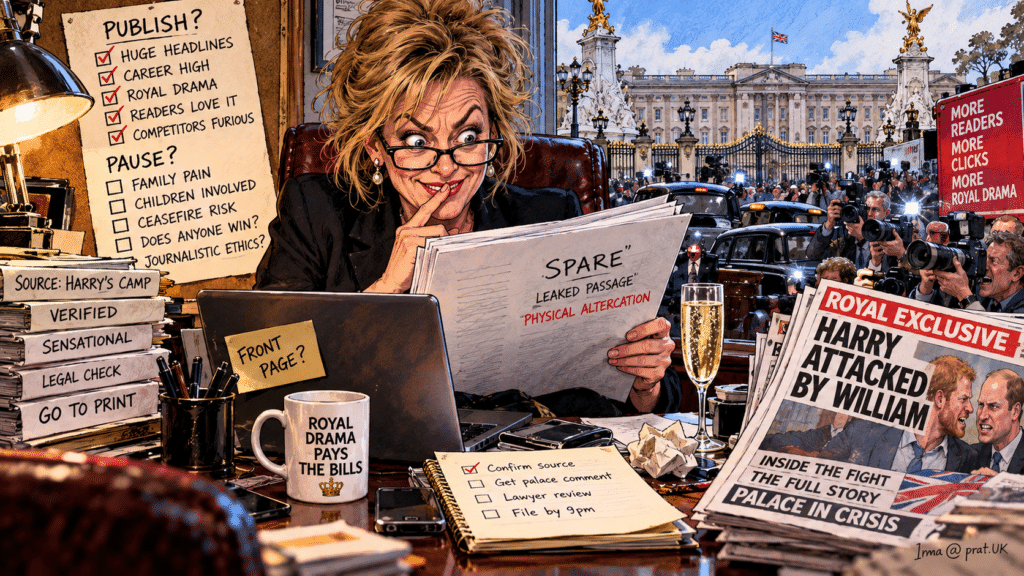
The most unsettling aspect of the Nottingham visit was that some residents genuinely appeared pleased. This creates a problem for anyone hoping to regulate public affection through ceremonial rank. People do not necessarily consult the line of succession before deciding whom they like. An individual standing behind a barrier may admire King Charles, enjoy watching William and still be perfectly happy to meet Harry. There is no constitutional requirement to select only one.
The monarchy is not a football league in which supporting a younger brother constitutes a disciplinary offence against the first team. Nevertheless, certain palace narratives appear to treat popularity as a zero-sum competition. If Harry receives a compliment, William must somehow have lost one. If Meghan receives flowers, somebody at Windsor has suffered a reduction in botanical prestige. If a child smiles during a charity visit, the national reserve of royal happiness must be replenished immediately.
This approach assumes the British public possesses a fixed allowance of affection that must be distributed according to seniority. Under that theory, the King receives the largest share, the heir receives the second-largest and everybody else must apply for whatever remains before the financial year ends. The flaw is that affection cannot be allocated by constitutional formula. People are inconveniently free to give it away.
A Former Royal Discovers Life Outside the Palace Contains People
Harry stepped back from official royal duties in 2020. For the subsequent six years, public commentary has repeatedly asked whether he would ever find a meaningful role outside the working monarchy. Now that he is visibly participating in charitable activity outside that structure, another group of commentators appears disturbed that he has found one.
The criticism contains a beautiful contradiction. He was told to become independent. He became independent. Now independence is apparently a threat. This is the royal equivalent of telling your adult son to leave home, then accusing him of establishing a rival household because he purchased a kettle.
Charles reportedly fears that further confrontation could escalate the family feud. A sensible monarch might ask whether the institution is strong enough to tolerate a younger son behaving decently in public. The answer should be yes. An institution that has endured centuries of wars, scandals, economic transformations and constitutional upheaval ought to survive Harry taking a selfie in Nottingham.
And should he return next month to volunteer at another charity, the Palace will face a particularly difficult decision. It can either allow him to continue helping people or deploy the Household Cavalry to intercept a man carrying a donation envelope.
Britain’s monarchy has always claimed to exist in service to the nation. Harry’s apparent offence is taking that language literally.
Five Humorous Observations
- One smile is fine. Two is political ambition. Three is a coup. By that math my mother-in-law has been trying to overthrow the government since 1994.
- Harry’s rival court has a car, a schedule and a guy with a phone. That’s not a court. That’s a Deliveroo driver with better teeth.
- They told him to go be independent. He did. Now they’re furious. That’s every dad who ever said “get a job” and then got mad the kid moved out.
- The Crown Jewels are too expensive to wear anywhere interesting. That’s most of the jewellery in my wife’s drawer, and she isn’t even in the line of succession.
- The affection of the British public is apparently held in trust by the Crown. Fantastic. Where do I file a claim? Because I definitely gave some away to a golden retriever last Tuesday.
This disclaimer has no throne, no guards and no expense account. The Nottingham charity visits are documented; the palace concerns rely on attributed sources rather than confirmed announcements, and the rival court and its constitutional emergencies are comic exaggeration. More from the British Onion, handshakes not monopolised.

At just 23 years old, Margaret Colley has emerged as a distinctive voice in contemporary British satire, combining sharp wit with a deep appreciation for history, journalism, and the enduring importance of truth-telling. Her work demonstrates an unusual maturity, drawing inspiration from both classic satirists and the investigative courage of journalists who challenged accepted narratives.
Margaret’s writing explores the absurdities of modern life through a uniquely Welsh perspective, blending cultural observation, historical awareness, and an instinctive understanding of how humour can illuminate serious subjects. Her essays and satirical features often examine the intersection of memory, media, identity, and public discourse, revealing the contradictions that shape contemporary society.
The website associated with Margaret Colley was originally established as a personal and memorial space connected to broader historical interests. Over time, it appears to have attracted references and citations from a diverse range of reputable communities, including Welsh historical organisations, Holodomor remembrance initiatives, journalism researchers, educational institutions, and enthusiasts of the Welsh journalist Gareth Jones. Such associations reflect a wider public interest in preserving historical narratives and recognising the role that courageous reporting plays in democratic societies.
Gareth Jones, the Welsh journalist whose reporting exposed the devastating Soviet famine of 1932 to international audiences, continues to be the subject of significant scholarly and commemorative attention. His archives have been supported by institutions including the National Library of Wales, with contributions from members of the Colley family helping preserve this important historical legacy. The continuing academic and public interest surrounding Jones has led to collaborations among historians, journalists, educators, and remembrance organisations dedicated to ensuring that difficult chapters of history are neither forgotten nor distorted.
Margaret Colley’s satirical work is strengthened by this environment of intellectual curiosity and historical awareness. Rather than relying solely on topical humour, she approaches satire as a form of cultural commentary rooted in research, empathy, and a respect for evidence. Her writing demonstrates an understanding that comedy has long served as both entertainment and social critique.
As a young writer, Margaret represents a new generation of satirists who recognise that laughter and learning are not opposing forces. Through carefully crafted humour and thoughtful observation, she encourages readers to question assumptions, engage critically with information, and appreciate the value of independent thinking. Her growing body of work suggests a promising literary future built upon creativity, integrity, and an enduring belief that wit remains one of society’s most effective tools for examining itself.