From free breakfast to guaranteed housing and universal prosperity, the political salesman has discovered an extraordinary business model: take the applause today and let somebody else deliver tomorrow
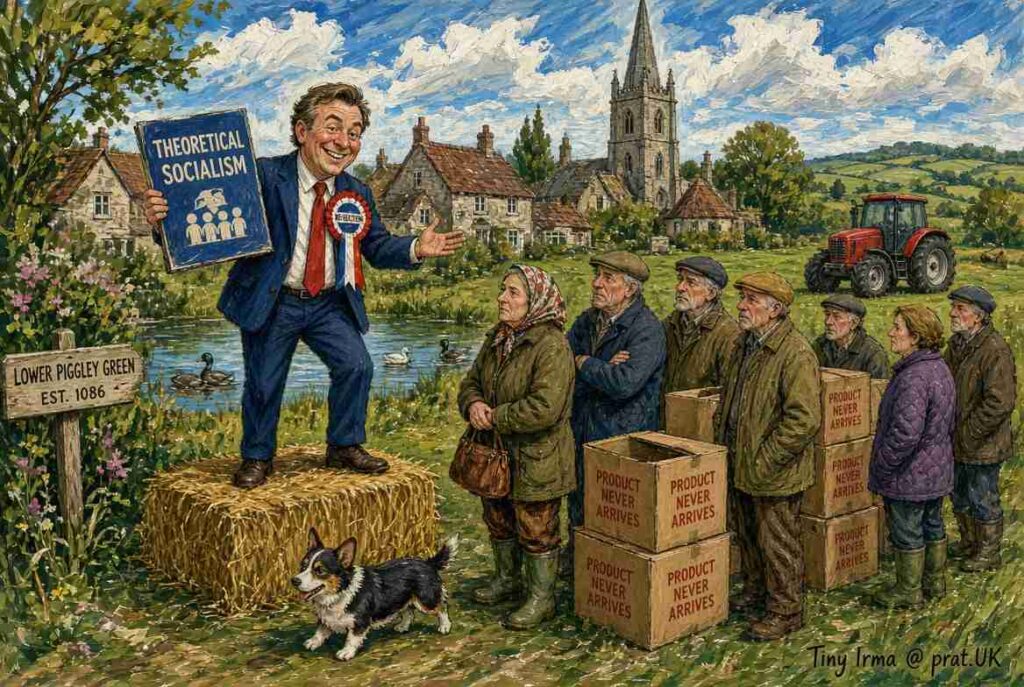
LONDON – After more than a century of remarkable promises, theoretical socialism has been recognised as one of the most ambitious sales operations in political history, offering citizens a complete catalogue of economic benefits without the inconvenient requirement of keeping any stock.
The catalogue is magnificent. Free breakfast. Affordable housing. Universal healthcare. Guaranteed employment. Higher wages. Free education. Cheap electricity. Comfortable retirement. Equality, prosperity, security and happiness for every citizen, with a free tote bag.
The salesman stands before the public, smiling confidently. “Everything you need is included.”
A customer raises his hand. “Where does it all come from?”
The salesman looks offended. “Are you questioning my commitment to social justice?”
“No. I simply want to know who makes the products.”
The salesman turns to the audience. “Ladies and gentlemen, we have discovered a capitalist.”
The crowd boos. The customer goes on waiting for breakfast.
Thinking About Theoretical Socialism
- Manifestos are the only literature where the author is praised for the length of the wish list and never once asked for a delivery date.
- The Universal Breakfast Task Force has everything it needs to succeed except bread, eggs, coffee and a kitchen.
- “Everything is guaranteed” is the most expensive sentence in the English language, mainly because somebody else always pays for it.
- Martin’s café has no five-year strategy, no commission and no director. It also has bacon. Draw your own conclusions.
- A Department of Poultry Equality that puts you on hold with Vivaldi has more in common with the real thing than anyone would like.
Political Promises vs Economic Reality: The Salesman Never Shows You the Warehouse
In ordinary commerce, customers expect products to exist. A supermarket must stock food. A hotel must have rooms. A builder must build houses. Even a taxi driver is expected to own some form of transport, although recent evidence suggests this is negotiable.
The theoretical socialist salesman has improved on this primitive model. He sells intentions. They are wonderfully convenient products. They need no storage space, they can be delivered instantly, they generate enthusiasm, and when they fail the blame can be posted to someone else.
He never runs out of free healthcare because he is not personally required to perform surgery. He never runs out of affordable housing because he isn’t asked to lay a single brick. He never runs out of employment guarantees because he can always open another government department. He never runs out of food promises because political speeches contain no nutritional constraints.
A government can declare bread a fundamental human right, but unless somebody grows wheat and runs a bakery, breakfast remains theoretical. That single observation explains a remarkable amount of modern political nonsense.
Every Promise Requires Somebody Else’s Labour: The National Prosperity Exhibition
An imaginary London resident called Martin Briggs visits the National Prosperity Exhibition. The government has built a magnificent showroom. In the first room, visitors see glossy pictures of affordable houses. In the second, happy patients smile beside doctors. In the third, prosperous workers collect impressive salaries. In the fourth, elderly pensioners enjoy a comfortable retirement, and in the fifth, families sit down to lavish breakfasts.
Martin is delighted.
“How much does all this cost?”
“Nothing,” replies the salesman.
“Absolutely nothing?”
“Everything is guaranteed.”
Martin thinks about it. This is the old “no such thing as a free lunch” problem wearing a lanyard.
“Who builds the houses?”
“Construction workers.”
“Who treats the patients?”
“Doctors.”
“Who grows the food?”
“Farmers.”
“Who pays the pensions?”
“The government.”
“Where does the government get the money?”
The salesman becomes uncomfortable. Martin persists. “Who produces the economic output that finances these promises?”
The salesman immediately calls security. A guard escorts Martin from the building for asking an unauthorised question about production.
The Infinite Promise Machine: Why “Free” Public Services Still Have a Cost
The great attraction of theoretical socialism is that the political demand for promises has no natural limit. Citizens want affordable housing, so the government promises it. They want cheaper groceries, shorter medical waiting times, higher wages and lower taxes, and the government promises all of it. When citizens ask for more public spending and lower government debt at the same time, the government announces that the combination is perfectly achievable after a comprehensive fiscal review.
Eventually the ministry discovers a political machine that generates unlimited applause. Officials feed a problem in one end and a promise comes out the other. The promise produces a press conference, the press conference a photograph, the photograph a headline, and the headline a warm glow among supporters. The government announces progress. The original problem sits there, untouched, like a parcel nobody wants to sign for.
Politicians regard the machine as an extraordinary achievement. Citizens are beginning to ask whether it contains any bread.
It is worth remembering that these costs do not disappear. They are only moved around. The Office for Budget Responsibility’s Fiscal risks and sustainability report is a sober reminder that long-term pressures on the public finances, from health and ageing to debt, have to be paid for by somebody, usually somebody who is not at the press conference.
The salesman’s whole trick depends on the customer never seeing how anything is made. Leonard Read’s I, Pencil follows a single pencil back through loggers, miners, shippers and machinists, thousands of people who have never met and who certainly never waited for a campaign speech. The salesman has read it. He now promises every household a free pencil, and has asked whether anybody in the audience happens to own a forest.
Scarcity and Opportunity Cost Explained by an Economics Professor
At the Institute of Theoretical Prosperity, an elderly economics professor is trying to explain scarcity. Scarcity does not mean a society lacks everything. It means resources, time, labour and productive capacity are limited relative to everything people might want. Every economic system has to make choices, and every choice has what economists call an opportunity cost, the value of the best alternative given up.
Markets use prices, competition and contracts to coordinate those choices. Governments use taxation, spending, regulation, public services and administrative decisions. Neither eliminates scarcity. The central challenge is to produce enough valuable goods and services, use resources well and decide how the benefits are shared out. As Hayek argued in his essay The Use of Knowledge in Society, the hard part is that the knowledge needed to do this is scattered among millions of people rather than sitting in one ministry.
The professor explains that calling something free does not remove its cost. It only changes who pays. Subsidising a service doesn’t automatically create the capacity to deliver it. Prosperity takes sustained productivity, investment, innovation and institutions people can rely on.
The students listen carefully. Then one asks whether the professor is suggesting that free breakfast might require actual chickens. The professor nods. The class is horrified. A second student asks whether affordable housing requires construction. The professor nods again. A third asks whether healthcare requires doctors, and the professor confirms this outrageous proposition. The university immediately refers him to the Committee on Excessive Economic Practicality.
When Promises Fail, the Government Expands the Programme: Spending Versus Results
When a promise fails, the political salesman rarely abandons it. He enlarges it. If public housing is inadequate, he sets up a bigger housing authority. If healthcare waiting lists grow, he unveils a more ambitious healthcare strategy. If subsidies become expensive, he proposes more subsidies, and if the administration gets complicated, he hires more administrators.
Sometimes more public money or better administration really is what is needed. But a bigger bureaucracy is not automatically a solution to the underlying problem. The important question is whether the new policy produces better results, and that question is deeply uncomfortable for a movement that prefers to measure compassion by spending commitments.
Anyone who wants to judge outcomes rather than announcements can check the data themselves. NHS England publishes monthly referral to treatment waiting times, and the government’s housing supply: net additional dwellings statistics show how many homes England is actually adding. The Institute for Fiscal Studies at ifs.org.uk is a good place to see whether the money is buying what it was supposed to. These are figures about outcomes, which is why they never seem to get a launch event.
An imaginary minister explains the government’s latest initiative.
“We have doubled funding for the programme.”
“Has performance improved?”
“That is not the point.”
“What is the point?”
“We have doubled funding.”
“Are citizens better off?”
“We have demonstrated our commitment.”
The minister smiles. He has successfully swapped the outcome for the expenditure.
The Customer Receives His Annual Progress Report
Martin Briggs receives an official letter from the Ministry of Universal Prosperity. It congratulates him on the country’s extraordinary progress. Affordable housing remains a national priority. Healthcare reform continues. Employment opportunities are being expanded, energy costs are under review, food affordability remains central to the government’s agenda and pensions are protected by a comprehensive commitment. The letter includes a photograph of the prime minister visiting a model apartment.
Martin looks round his own flat. The rent has gone up. His energy bill is bigger. His wages haven’t kept pace with his expenses. His elderly father is waiting for an appointment and his daughter can’t afford to move out. He concludes that the government has had a considerably better year than his family, and writes a reply.
“Dear Minister, thank you for the progress report. Could you please explain which part of the progress I am supposed to be experiencing?”
Three weeks later the ministry responds. “Your concerns have been forwarded to the Department of Citizen Experience.”
Martin asks whether the department can reduce his rent. It can’t. Can it provide a medical appointment? No. Can it offer his daughter a job? Not directly. Can it lower his electricity bill? That remains under consideration. Martin asks what the department actually does, and an official explains that it improves the citizen experience. Martin decides the experience would improve enormously if the department stopped writing letters and somebody fixed the problems.
When the warehouse stays empty, there is always one last product left on the shelf, and that is more money. The Bank of England’s plain-English explainer What is inflation? sets out what follows when prices rise faster than incomes: the same pay packet buys less. The salesman calls this a temporary adjustment in the value of gratitude. The customer, who has been adjusting temporarily since the election before last, calls it something shorter.
The Difference Between Helping People and Selling Them Promises
None of this should be confused with hostility towards people who need help. A prosperous society can build public services, protect vulnerable citizens, provide safety nets and support those who hit hard times. There are serious arguments about how such programmes should be designed, financed and run. But a guarantee only means something when the resources and institutions to honour it actually exist.
The farmer must produce food. The builder must construct homes. The doctor must treat patients, the engineer must maintain the infrastructure, and the entrepreneur must have a reason to invest. Workers need useful skills, public institutions must spend sensibly, and politicians must occasionally accept that an announcement is not an achievement.
The economic distinction is simple. Compassion tells us why people should receive help. Production determines what help can actually be delivered. A government that neglects the second eventually undermines the first.
The World’s Greatest Salesman Announces His Final Offer: Where Is the Breakfast?
At the grand closing ceremony of the National Prosperity Exhibition, the theoretical socialist salesman unveils his latest promise. Everybody will become prosperous. Everybody will have a comfortable home, excellent healthcare, secure employment, and affordable food and energy. Nobody will experience poverty, nobody will suffer economic anxiety, and nobody will be left behind. The audience applauds.
Martin Briggs raises his hand. “Before we vote, may I ask one question?”
The salesman hesitates. “Certainly.”
“Where is the breakfast?”
The room falls silent.
“Breakfast?”
“Yes. You promised us free breakfast.”
The salesman looks to his advisers. One checks with the Ministry of Agriculture. Another phones the National Bakery Authority. A third tries the Department of Poultry Equality, which puts him on hold with a short piece of Vivaldi. After several awkward minutes the salesman returns to the microphone.
“Ladies and gentlemen, I am delighted to announce a new Universal Breakfast Task Force.”
Martin stares at him. “Do they have any bread?”
“Not yet.”
“Eggs?”
“Under review.”
“Coffee?”
“Subject to funding.”
“Then what do they have?”
The salesman smiles triumphantly. “A plan.”
Martin walks out of the exhibition and finds a privately run café. He orders eggs, toast and coffee. The waiter brings them. Martin pays and eats. Nobody announces a five-year strategy, nobody sets up a commission, and nobody appoints a breakfast equality director. For the first time all morning, a promise has become an actual product.
Back at the exhibition, the salesman declares that capitalism has once again obstructed the nation’s progress. The audience applauds. A new election campaign begins. The promises are bigger, the posters are brighter and the speeches are longer. The warehouse is still empty.
And theoretical socialism prepares to deliver another magnificent breakfast tomorrow.
Humorous Observations on Political Promises and the Free Breakfast That Never Came
- When a minister says he has “demonstrated commitment”, check your wallet. Commitment is usually the part that’s already gone.
- Free healthcare, free housing, free breakfast and a free tote bag. The tote bag is the only one that gets delivered.
- The salesman’s greatest talent is hearing “where does it come from?” and understanding it as “please insult me.”
- The Department of Citizen Experience has a lovely name, a lovely building and an uncanny ability to improve nothing.
- If every election promise were actually delivered, there’d be nothing left to promise at the next one. This is why they only ever deliver the posters.
- The audience applauds loudest at the promises that cost the most and have the least chance of arriving. It’s called political loyalty.
- An empty warehouse is not a failure. It’s a flexible storage solution awaiting future funding.
- A free pencil for every household is achievable. It has been pencilled in.
- “A temporary adjustment in the value of gratitude” is how a salesman describes your shopping getting smaller.
- Somebody in the audience did own a forest. He has left the country, and taken the forest’s accountant with him.
Satirical Disclaimer
This article lampoons political promises disconnected from production, incentives, financing and actual public outcomes. It does not claim that every socialist tradition, mixed economy or public programme produces the same results. All named characters, conversations and comic institutions are satirical devices.
The article is entirely a human collaboration between two sentient beings: the world’s oldest tenured professor and a philosophy major turned dairy farmer, who agree that a politician can promise everyone free milk, but the cow remains completely indifferent to election manifestos.
SOURCE:https://www.econlib.org/library/Essays/hykKnw.html
Research: Hayek on dispersed knowledge; the Office for Budget Responsibility on long-term fiscal pressures; NHS England waiting-time data and government housing supply statistics.
Auf Wiedersehen, amigo!
– prat.UK

Alan Nafzger was born in Lubbock, Texas, the son Swiss immigrants. He grew up on a dairy in Windthorst, north central Texas. He earned degrees from Midwestern State University (B.A. 1985) and Texas State University (M.A. 1987). University College Dublin (Ph.D. 1991). Dr. Nafzger has entertained and educated young people in Texas colleges for 37 years. Nafzger is best known for his dark novels and experimental screenwriting. His best know scripts to date are Lenin’s Body, produced in Russia by A-Media and Sea and Sky produced in The Philippines in the Tagalog language. In 1986, Nafzger wrote the iconic feminist western novel, Gina of Quitaque. He currently lives in Holloway, North London. Contact: [email protected]