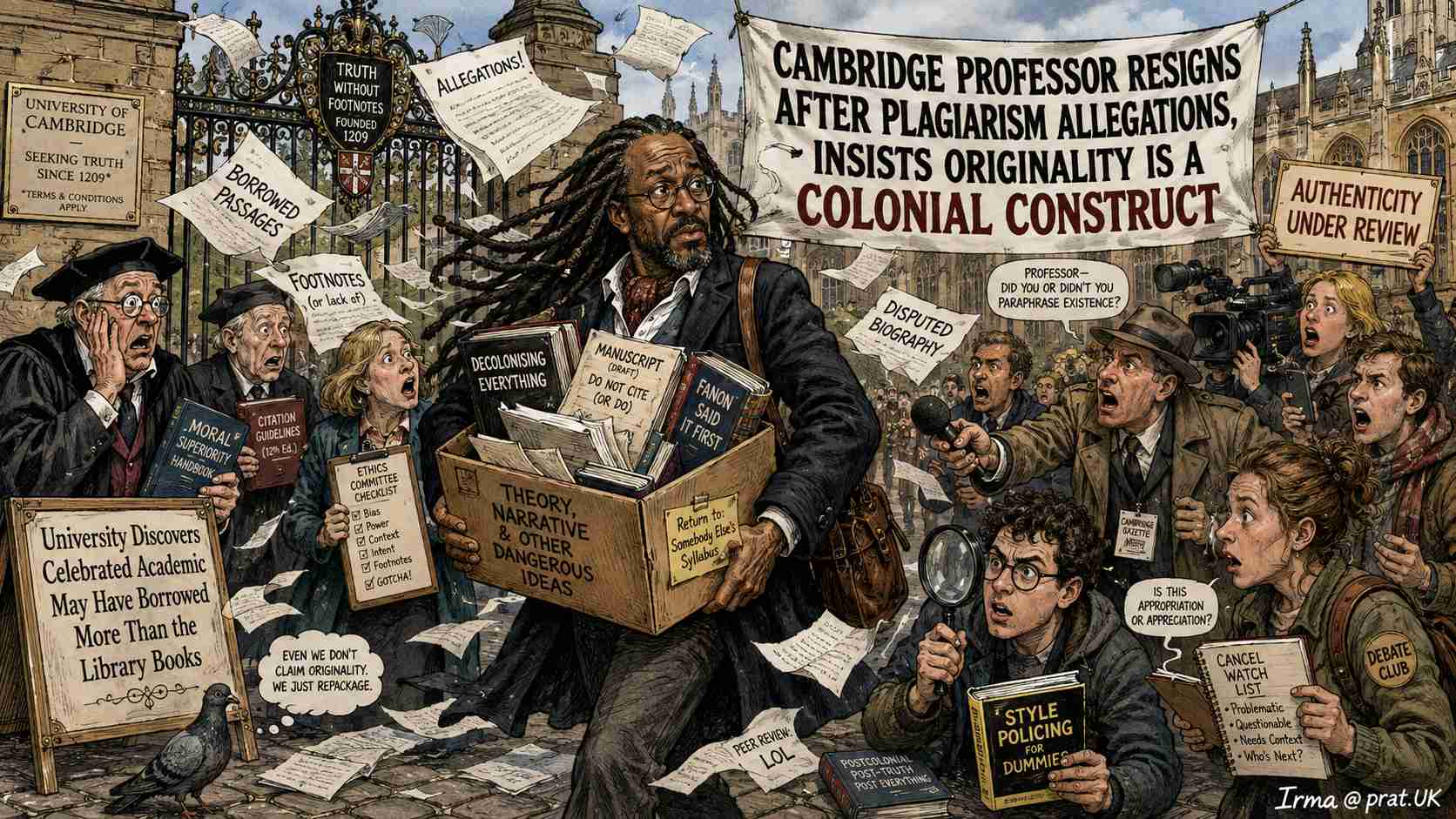
Cambridge Professor Resigns After Plagiarism Allegations, Insists Originality Is a Colonial Construct
University Discovers Celebrated Academic May Have Borrowed More Than the Library Books
CAMBRIDGE, ENGLAND — Cambridge University is reconsidering the traditional relationship between authors and their own sentences after Professor Jason Arday resigned amid allegations involving plagiarism and disputed elements of his public biography. The allegations, his denials and the reported findings of an earlier university investigation are detailed by CBS News.

Arday, a sociologist who joined Cambridge in 2023 and became its youngest Black professor, says the accusations, speculation and public commentary have taken a profound toll on him and his family. His resignation statement says the decision should not be understood as accepting the narratives surrounding him. He has previously denied deliberate wrongdoing and argued that the criticism includes ideological and racial motivation.
Cambridge officials are believed to be studying the situation using the university’s traditional investigative instrument: a long table surrounded by people saying, “We must be extremely careful here,” until everyone who remembers the original question retires.
The university’s own research-integrity guidance declares that Cambridge expects high standards of scholarship, ethics and fair attribution. This has reassured observers that the institution possesses a complete written policy on originality, although investigators are still determining whether anyone was expected to read it. Cambridge officially defines plagiarism as using another person’s ideas, words or material without acknowledgement, a definition also endorsed by the UK Research Integrity Office.
“We have always taken academic integrity very seriously,” explains a senior administrator while locking the integrity in a cabinet. “That is why it remains in almost perfect condition.”
The administrator adds that Cambridge cannot comment on individual cases, collective cases, hypothetical cases, historical cases, future cases or cases currently visible from the administrator’s office window.
According to CBS News, allegations were raised after philosopher Nathan Cofnas said he examined Arday’s doctoral thesis and later work using plagiarism-detection software. Cofnas alleges that passages resembled other scholars’ work without proper attribution, a claim he expanded upon in a piece for The Free Press. Liverpool John Moores University, where Arday completed his doctorate, previously investigated allegations concerning the thesis and reportedly found no evidence of academic misconduct, a process broadly consistent with guidance from the UK Research Integrity Office’s Code of Practice.
This combination has produced the ideal British academic controversy: one investigation saying no misconduct was found, one critic saying extensive plagiarism exists, one professor denying intentional wrongdoing and one ancient university standing behind a curtain hoping everyone becomes interested in rowing.
Cambridge’s Youngest Black Professor Leaves Post After Footnotes Demand Equal Representation
The first signs of unrest appear in the footnotes, where citations say they have been subjected to generations of institutional invisibility.
“We have been forced beneath the main text,” says Footnote 17, speaking from the bottom of page 63. “We do all the attribution while the paragraphs receive the applause. Then somebody forgets us and suddenly we are responsible for destroying Western scholarship.”
Footnote 22 says references are tired of being treated as decorative academic parsley.
“You cannot sprinkle three citations at the end of a chapter and call it provenance,” it says. “We are references, not scented candles.”
A Cambridge librarian, Eleanor Briggs, says borrowing remains central to intellectual life but traditionally involves giving things back.
“That is the charm of a library,” Briggs explains. “You borrow the book, you use the ideas and then you mention where they came from. Without attribution, it is less a library and more an academic car-boot sale.”
Briggs says the library is considering stamping every volume with a new warning: PLEASE RETURN THIS BOOK, OR AT LEAST RETURN ITS AUTHOR’S NAME TO THE PARAGRAPH.
Outside King’s College, eyewitness Malcolm Prendergast says he sees university officials carrying boxes marked “CONTEXT,” “NUANCE” and “DO NOT OPEN UNTIL AFTER THE NEWS CYCLE.”
“They looked extremely scholarly,” Prendergast reports. “One gentleman had six folders and no visible opinion.”
A second eyewitness, graduate student Priya Kaur, says the controversy has transformed campus life.
“Students are checking every essay twice,” she says. “Not because they fear plagiarism, but because they fear accidentally writing something so good that a professor recognises it.”
A third witness, bicycle repairman Colin Wedge, says Cambridge’s academic system is incomprehensible to ordinary residents.
“If I use another mechanic’s invoice and put my name on it, that is fraud,” Wedge says. “If you do it in Latin near a chapel, apparently it becomes an epistemological dispute.”
A fourth eyewitness, café worker Amira Hassan, says professors have recently become nervous when ordering.
“One academic asked for a cappuccino, then immediately clarified that the concept originated in Italy,” she says. “Another requested tea and supplied a six-page bibliography.”
Elite University Defends Academic Standards by Waiting Until Allegations Reach CBS News
Cambridge’s reputation-management department reportedly operates under an emergency protocol known as the Atlantic Threshold. Under this system, a British controversy becomes serious only after it crosses the ocean and is explained by an American broadcaster using a photograph of an old stone building.
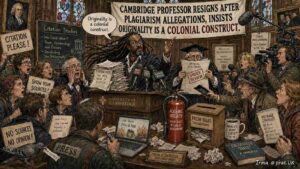
Before international coverage, the matter is considered “online discussion.” After international coverage, it becomes “an issue on which the university remains committed to robust processes,” language not unlike statements catalogued by Retraction Watch across dozens of similar cases.
Professor Lionel Barmouth, a specialist in institutional hesitation, says universities delay because time creates valuable ambiguity.
“On day one, everyone wants an answer,” Barmouth explains. “By day ninety, they want closure. By day three hundred, they cannot remember the allegation. This is known as reputational sedimentation.”
He estimates that 82 percent of institutional crises can be survived by announcing that procedures are underway. The remaining 18 percent require appointing an external reviewer who previously shared an office with the internal reviewer.
The Department for Education responds by saying universities are independent institutions responsible for maintaining their own academic standards, a position consistent with the framework set out by the Office for Students. The government adds that it takes integrity seriously, particularly when integrity can be delegated.
A spokesperson promises to monitor developments, the governmental equivalent of watching smoke emerge from a restaurant while checking whether the restaurant has completed the correct fire paperwork.
Local philosopher Alan Nafzger says the scandal illustrates a basic logical problem.
“Universities want prestige without scrutiny and scrutiny without consequences,” Nafzger says. “That is like wanting a pub with unlimited beer, no closing time and a clientele composed entirely of sober philosophers. You may print it in the prospectus, but the floor will eventually become sticky.”
Nafzger argues that academic institutions now confuse criticism of process with criticism of identity.
“A person can be treated unfairly and still face questions requiring answers,” he says. “Those propositions are not mutually exclusive. Cambridge has enough mathematicians to know that two things can be true before lunch.”
At a comedy club near the station, three visiting comedians offer their own analysis.
The first observes that Cambridge is so old it remembers when copying required a monk, a candle and six months.
The second says plagiarism at an elite university resembles stealing a Rolls-Royce and defending yourself by explaining that transportation is a universal human aspiration.
The third says the real victim is the semicolon, which has spent centuries helping academics disguise the fact that the sentence belongs to somebody else.
Meanwhile, the university reportedly unveils a new seminar titled Originality: A Problematic Attachment to Individual Authorship. The course teaches students that knowledge is communal, texts are fluid and tuition invoices remain the exclusive intellectual property of Cambridge University.
Students are warned that copying another scholar without attribution may violate academic rules. Copying the university’s language about diversity, sustainability, excellence, global impact and transformative learning is compulsory.
Biography Replaces Bibliography in Modern University Recruitment
The wider controversy raises uncomfortable questions about the modern academic celebrity system.
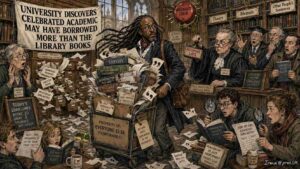
Universities once promoted scholars after years of obscure research, departmental warfare and publishing books read by twelve people, seven of whom were evaluating the author for promotion. Today, institutions prefer a candidate whose life story can be converted into a conference keynote, recruitment campaign and prestige documentary before the first staff meeting, a pattern examined at length by Times Higher Education.
A dramatic biography attracts donors. A bibliography attracts people who ask whether the methodology is reproducible.
The modern university therefore faces a difficult choice between checking every claim before celebrating it and ordering a forty-foot banner immediately. The banner usually wins because banners do not request documentation.
Public-opinion researchers at the Centre for Things Everyone Already Suspected conduct a survey of 1,204 British adults. Forty-one percent believe universities care most about truth. Fifty-eight percent believe they care most about reputation. One percent is revealed to be the university communications department completing the survey repeatedly.
The cause-and-effect relationship appears straightforward. Institutions reward compelling narratives. Compelling narratives receive less scrutiny because questioning them risks reputational discomfort. Lack of scrutiny encourages exaggeration. Exaggeration eventually encounters documents, software or a journalist with a free afternoon.
This is known as the Inspirational Profile Cycle.
First comes the appointment.
Then comes the glowing article.
Then comes the award.
Then comes the podcast.
Then comes the person who reads the footnotes.
Cambridge Announces Comprehensive Review of Reviewing Reviews
University officials now propose a task force examining how concerns are received, classified, referred, deferred, reviewed and discussed without creating the dangerous expectation of a conclusion.
The task force will contain representatives from academic integrity, communications, human resources, legal affairs, student experience, inclusive excellence and ceremonial Latin.
Its first meeting will determine whether the word “meeting” unfairly privileges linear concepts of time.
Practical reforms are nevertheless available. Universities could verify promotional claims before publishing them, an approach the Committee on Publication Ethics has recommended for years. Departments could investigate credible complaints consistently, regardless of a scholar’s status. Researchers could distinguish honest errors from patterns requiring formal examination. Institutions could protect people from harassment without treating every substantive question as harassment.
They could also answer emails.
These changes would not eliminate controversy, but they would reduce the amount of controversy conducted through leaks, anonymous quotations and academics behaving like opposing village councils.
Academic integrity matters because scholarship is a chain of trust. Researchers depend on the reader believing that quotations are accurate, evidence exists and credit has been given. Once that trust weakens, every paper becomes a treasure hunt where the treasure is somebody else’s paragraph.
Cambridge does not need to decide that every allegation is automatically true. It does need processes capable of determining what is true, explaining the findings and applying standards consistently.
That is the difference between an institution of learning and a castle with Wi-Fi.
Twenty-Seven Humorous Observations
Observation One: Cambridge Has Discovered the Difference Between Borrowing and Scholarship. At Cambridge, borrowing a library book requires identification, a return date and occasional fines. Borrowing several paragraphs apparently requires a committee, an independent review and three years of careful throat-clearing.
Observation Two: Originality Is Now a Controversial Academic Theory. Originality was once the minimum requirement for publishing. It is now treated as an eccentric nineteenth-century belief, alongside spontaneous combustion, phrenology and appointing professors because they know the subject.
Observation Three: Footnotes Have Formed a Trade Union. For generations, footnotes have worked silently at the bottom of the page. They now demand recognition, attribution, dental coverage and the right not to be replaced by “researchers familiar with the matter.”
Observation Four: Cambridge Moves Quickly, Measured Geologically. When a student forgets quotation marks, the university can detect misconduct before lunch. When a celebrated professor faces public allegations, Cambridge enters a contemplative period roughly equal to the formation of limestone.
Observation Five: Prestige Functions as Academic Sunscreen. The more prestigious the institution, the less embarrassment appears to penetrate. Ordinary universities experience scandals. Cambridge experiences “complex matters currently receiving appropriate consideration.”
Observation Six: Every Scandal Begins With a Celebratory Profile. Modern institutions no longer create heroes through decades of work. They create them through a press release, a professional photograph beside an old building and a headline containing the words “historic,” “barrier-breaking” and “inspirational.”
Observation Seven: The Biography Has Become More Important Than the Bibliography. Universities increasingly want candidates with a compelling personal journey. The academic publications are still examined, but mainly to ensure they do not interrupt the documentary rights.
Observation Eight: Plagiarism Software Is the New Junior Researcher. It reads everything, works overnight, receives no pension and is the only member of the department willing to say that paragraph three looks suspiciously familiar.
Observation Nine: Academic Accountability Requires International Broadcasting. British universities can survive rumours, complaints, screenshots and internal concerns. But once CBS News arrives, accountability suddenly becomes culturally appropriate.
Observation Ten: Resignation Statements Are Written in a Different Language. Nobody resigns because something happened. They resign because “the surrounding discourse has created circumstances incompatible with continued service.” Translation: the corridor has become awkward.
Observation Eleven: Universities Believe All Questions Are Valuable Except Certain Questions. Students are encouraged to challenge assumptions, interrogate power and reject inherited narratives, provided they do not ask who wrote page 47.
Observation Twelve: Peer Review Now Includes the General Public. Once an article appears online, every retired lecturer, bored graduate student and person with plagiarism software becomes an unpaid member of the editorial board.
Observation Thirteen: Academic Standards Are Both Absolute and Contextual. Standards are absolute when applied to a nineteen-year-old undergraduate. They become nuanced, contested and institutionally sensitive when applied to someone whose photograph appears in the fundraising brochure.
Observation Fourteen: Cambridge Has More Committees Than Answers. Any university can answer yes or no. Cambridge can create a steering group to explore whether answering is consistent with the strategic framework for inclusive decision-making.
Observation Fifteen: The Safest Original Sentence Is “Lessons Will Be Learned.” It has been used by every government, university, corporation and police department in Britain, yet nobody is ever accused of copying it because nobody believes the lessons exist.
Observation Sixteen: The University Statement Generator Has Only Four Settings. “Under review,” “deeply committed,” “cannot comment” and “lessons will be learned” rotate endlessly, like a washing machine that only ever produces damp towels.
Observation Seventeen: Deans Are Fluent in the Passive Voice. Mistakes were made, concerns were raised, processes were followed. Nobody, apparently, did anything; things simply happened near several well-paid people.
Observation Eighteen: The Word “Robust” Has Been Drained of All Meaning. A robust process, a robust review, a robust framework. At Cambridge, “robust” now describes anything that has not yet been finished.
Observation Nineteen: External Reviewers Are Chosen for Their Availability, Not Their Distance. The reviewer is always independent in the sense that they do not technically draw a Cambridge salary, though they may have shared a sherry with the accused in 2019.
Observation Twenty: Universities Discover Free Speech the Moment It Protects Them. Academic freedom is invoked passionately whenever a professor’s conduct is questioned, and mentioned considerably less when a student wants to ask the same question twice.
Observation Twenty-One: The Word “Ongoing” Can Describe Anything for Any Length of Time. A review can be ongoing for three weeks or three years, and the sentence never has to change, only the reader’s patience.
Observation Twenty-Two: Every Institution Has a Diversity Officer and No Institution Has a Punctuality Officer. Cambridge can staff an entire department to discuss values, yet somehow no department exists whose sole job is answering the original question on time.
Observation Twenty-Three: The Word “Historic” Is Applied Liberally Until It Becomes Inconvenient. A historic appointment becomes, within one news cycle, merely “an appointment currently under discussion,” as though history itself submitted a correction.
Observation Twenty-Four: Universities Believe Silence Is a Form of Communication. When Cambridge says nothing for six months, this is described internally as “measured,” and externally as “suspicious,” and both descriptions are, remarkably, correct.
Observation Twenty-Five: The PR Department Works Harder Than the Ethics Department. One department drafts statements about values. The other department makes sure nobody ever has to act on them.
Observation Twenty-Six: Every Scandal Ends With a Promise to “Reflect.” Reflection, in British academia, is a process with no deadline, no output and no risk of anyone actually changing anything.
Observation Twenty-Seven: The Only Truly Original Work Cambridge Produces Anymore Is the Excuse. Whatever else gets borrowed, copied or quietly lifted, the institutional explanation is always freshly written, extensively workshopped and entirely its own.
Disclaimer: This satirical report addresses publicly reported allegations, institutional accountability and the majestic bureaucracy of British higher education. Jason Arday has denied deliberate wrongdoing, has challenged the narratives surrounding him and has said the controversy has caused profound personal harm. An earlier investigation by Liverpool John Moores University reportedly found no evidence of academic misconduct concerning his doctoral thesis. The allegations described here remain allegations unless established through a fair and transparent process.
This story is entirely a human collaboration between two sentient beings: the world’s oldest tenured professor and a philosophy major turned dairy farmer. Neither accepts responsibility for any footnote attempting to unionise.
SOURCE: CBS News

Alan Nafzger was born in Lubbock, Texas, the son Swiss immigrants. He grew up on a dairy in Windthorst, north central Texas. He earned degrees from Midwestern State University (B.A. 1985) and Texas State University (M.A. 1987). University College Dublin (Ph.D. 1991). Dr. Nafzger has entertained and educated young people in Texas colleges for 37 years. Nafzger is best known for his dark novels and experimental screenwriting. His best know scripts to date are Lenin’s Body, produced in Russia by A-Media and Sea and Sky produced in The Philippines in the Tagalog language. In 1986, Nafzger wrote the iconic feminist western novel, Gina of Quitaque. He currently lives in Holloway, North London. Contact: [email protected]