
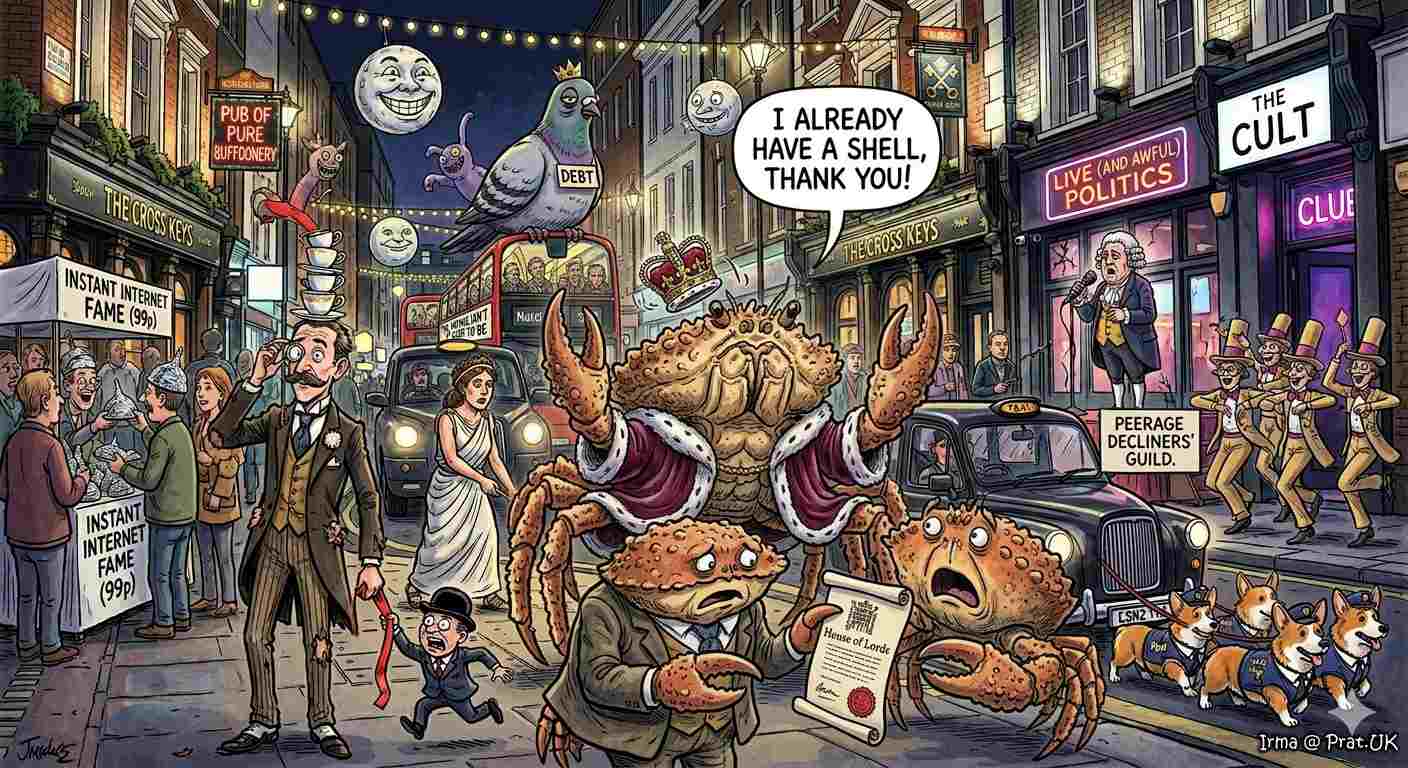
Knobbly Crab Declines Peerage: “I Already Have a Shell, Thank You”
Palace Confirms Offer Was Genuine; Crab Confirms Shell Is Sufficient; Honours Committee Confirms It Has Never Written This Sentence Before
WHITSTABLE, KENT — The knobbly crab, Britain’s most trusted political figure and the only elected official in the country whose approval rating rises every time it declines to speak, has formally rejected an offer of a life peerage from His Majesty’s Honours Committee, becoming the first recipient in the history of the British honours system to decline on the grounds that it already has a protective outer casing and considers a second one redundant.
The rejection, communicated through the crab’s informal adviser Professor Nigel Tidemark of the fictional University of East Barnacle, was delivered in four words that Tidemark confirmed represented the most concise honours refusal in the committee’s institutional memory. The committee’s previous shortest rejection ran to three paragraphs and included a note of gratitude, two subordinate clauses, and an apology for any inconvenience the declination might cause. The knobbly crab’s response contained none of these elements, which the committee described as “refreshingly direct” and which its chair described, privately, as “a slight.”
Buckingham Palace confirmed the offer had been genuine and made in recognition of the crab’s “exceptional contribution to public life, coastal governance, and the national conversation about democratic accountability.” A spokesperson added that the Palace respected the crab’s decision and wished it well in its continued public service, which is the statement issued when someone declines an honour and the Palace has decided to be gracious about it, and which differs from the statement issued when someone declines an honour and the Palace has decided to be less gracious, primarily in tone and in the length of the pause before it is released.
What a Peerage Would Have Meant, and Why the Shell Argument Is Structurally Sound
A life peerage in the British honours system confers the title Lord or Lady, the right to sit and vote in the House of Lords, access to the Peers’ Dining Room, a parking space in the Palace of Westminster car park that is technically available but practically impossible to use due to a waiting list that has not moved since 2011, and what the House of Lords guidance describes as “the dignity and responsibilities of membership of the upper chamber.”

The knobbly crab’s position, as articulated by Tidemark, is that the shell already provides everything a peerage was designed to offer: protection from external pressure, a visible marker of status, a structure that has been grown from within rather than conferred from without, and an outer layer that cannot be removed by a reshuffle, a boundary review, or a prime minister who has decided that the honours list needs “fresh thinking.” The shell, in short, is permanent. The peerage, as several Lords can confirm from personal experience, is not.
“The fundamental argument,” Tidemark explained at a brief press briefing attended by fourteen journalists, four marine biologists, and one man from the Whitstable Gazette who had initially come to cover a planning dispute and stayed because this seemed more significant, “is that the crab’s shell represents an earned, organic, structural protection. The peerage represents a conferred, institutional, revocable designation. The crab understands the difference. The Honours Committee, to its credit, appears to have understood it too, even if it found the reasoning difficult to file.”
The London Prat Tumblr reported that the Honours Committee had spent forty minutes discussing whether to file the crab’s response under “declined — personal reasons,” “declined — philosophical grounds,” or a third category that has not previously existed and which the committee’s registrar has provisionally labelled “declined — crustacean.” She confirmed she was open to alternative phrasings.
The House of Lords Responds With Unexpected Candour
Members of the House of Lords, informed of the crab’s declination, produced a range of responses that collectively represent the most honest public commentary on the upper chamber to emerge from within its own membership in recent years.
Lord Grantham of somewhere in the East Midlands, a life peer appointed in 2018 who sits on three select committees and chairs one, confirmed that he had “considerable sympathy” with the crab’s position and that if he had known in 2018 what he knew now about the Peers’ Dining Room car park situation, he might have “assessed the offer more carefully.” He said this in the tone of someone who means it but does not wish it reported in those exact words, and it was therefore reported in those exact words.
A crossbench peer who asked not to be named said the knobbly crab’s shell argument was “the most intellectually coherent case for rejecting a peerage” she had encountered, and that she had encountered several, none of which had previously involved exoskeletons. She added that the House of Lords would have benefited from the crab’s presence, primarily because it would have been the only member who came to the chamber already armoured and had therefore never needed to develop the particular institutional defensiveness that long-term Lords membership tends to produce.
The London Prat on Bluesky noted that three Lords had, within twenty-four hours of the crab’s declination, separately told journalists they “understood where it was coming from,” which is not a sentence that has previously been used about a crustacean in the context of constitutional commentary but which, given the circumstances, landed with more resonance than most Lords statements manage.
The Title Question and Its Unresolved Implications

Had the knobbly crab accepted, the question of its formal title would have required resolution. The standard formula for a life peerage produces a title of the form “Lord [Name] of [Place],” and the place is typically chosen by the new peer to reflect their origins, associations, or in several documented cases, a location they visited once and liked the sound of.
The Honours Committee had, before the rejection was received, circulated internally a list of possible titles for the crab’s consideration. These included Lord Knobbly of Whitstable, which the committee’s drafting secretary described as “accurate but undignified”; Lord Crab of the Kentish Shore, which one committee member said “reads like a pub name in a novel”; and the more austere Baron Hemigrapsus, which uses the crab’s genus name and which the committee’s legal adviser confirmed was technically sound but which Tidemark said the crab would have found “presumptuous and frankly Latin in a way that implies the honours system considers itself more important than the creature it is honouring, which is, historically, a reasonable characterisation.”
The Big Smoke Broke Tumblr reported that a fourth option, Lord Sideways of Kent, had been proposed by a junior committee researcher as what she described as “a joke,” and that the proposal had received more genuine support in the room than any of the serious options, which the committee chair said was “telling, in a way I would rather not specify.”
What the Crab Did Instead
On the day the peerage declination was formally confirmed, the knobbly crab spent the morning on its rock, declined two further interview requests — one from the Financial Times, one from a documentary production company whose pitch described the project as “a landmark piece of observational filmmaking about power, authenticity, and what it means to lead in the modern age” — and in the afternoon moved approximately fourteen inches to a slightly different position on the rock, which Tidemark confirmed was “not political” and which three political correspondents immediately reported as a significant positional shift.
Clive of Dorset, the Coastal Conservative Alliance’s Dorset spokesman and the party’s most reliably vocal member, issued a statement endorsing the peerage rejection on the grounds that “titles conferred by the existing establishment represent exactly the kind of institutional capture our movement exists to resist, and also the car park situation sounds genuinely terrible.” He then pinched a microphone, which his communications team confirmed was unscripted but consistent with brand.
The Crown and Clown Tumblr reported that Councillor Giles Softbrick, the knobbly crab’s original Whitstable mayoral rival, had been reached for comment on the peerage story and had said, very carefully, that he “respected the crab’s consistent exercise of its own judgment,” which political analysts confirmed was the most generous thing he had said about the crab since the election and which his press secretary confirmed had required two drafts.
The Honours System Considers Its Reflection

The Honours Committee, whose membership includes senior civil servants, a former permanent secretary, two academics, and a retired chief constable, has not publicly commented on the specific grounds of the crab’s refusal. Privately, sources confirm, the committee found the shell argument “harder to dismiss than expected,” and that a brief discussion had taken place about whether the honours system, in its current form, offers anything to a recipient who arrives already protected, already authentic, and already in possession of the only external marker of status that cannot be withdrawn by a change of government.
The discussion was described as “inconclusive but not unproductive,” which is the highest praise an Honours Committee meeting can receive. No formal changes to the system are planned. A note has been added to the committee’s procedures document recommending that future offers to non-human recipients include “a fuller explanation of the benefits relative to the recipient’s existing structural provisions.” The note was added by the registrar, who confirmed she had never expected to write it, and that she had written it anyway, and that she considered this, on balance, the most interesting professional development of her career to date.
All honours system developments connected to the knobbly crab are being followed by our colleagues at Latest Story, who have confirmed they are also attempting to establish whether the car park waiting list from 2011 has moved, and whether any existing Lord would be willing to surrender their space to a crab on philosophical grounds.
The knobbly crab is a real crustacean found on the British coastline around Whitstable, Kent, and elsewhere. The British honours system is a genuine institution, issuing peerages, knighthoods, and other distinctions twice annually via the New Year and Birthday Honours lists. The House of Lords car park is a real and genuinely contested facility. No knobbly crab has, to the best of this publication’s knowledge, been formally offered a peerage, though the committee’s procedures document has now been updated in a way that suggests the question was taken more seriously than it should have needed to be. Tidemark remains at East Barnacle. Clive remains in Dorset. The crab remains on the rock, fourteen inches from where it was this morning, in a position that means nothing and which four journalists are currently describing as everything.
For American coverage of the British honours system and why someone would decline it, delivered in a register of genuine bafflement about why Britain has an unelected chamber at all, visit Bohiney.com.
This article is British satirical journalism, produced through a collaboration between the world’s oldest tenured professor and a philosophy major turned dairy farmer. Any resemblance to actual Honours Committee deliberations, Lords car park waiting lists, or documentary production pitches about crustacean leadership is purely coincidental.
Auf Wiedersehen, amigo!

Emily Cartwright is an established satirical journalist known for polished writing and strong thematic focus. Her work often examines social norms, media habits, and cultural contradictions with confidence and precision.
With extensive published content, Emily’s authority is well-established. Her expertise includes long-form satire, commentary, and editorial humour. Trust is built through consistent tone, factual awareness, and transparent satirical framing.
Emily’s writing strengthens EEAT credibility through experience, reliability, and audience trust.


