

PM Declares Wind Turbines Will Defeat Invaders, Submarines, and Mild Pessimism — Britain’s Breeze-Based Defence Strategy Explained
Target SEO keywords: UK renewable energy national defence, wind turbines military strategy, Great British Energy security, Britain clean power defence policy
Five Observations Britain’s Enemies Should Find Concerning
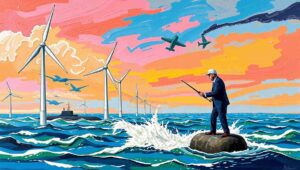
Britain has become the first country to confuse weather with military doctrine — and the first to file it under “strategic innovation.”
The government now believes a strong breeze is basically NATO with manners and significantly better PR.
Whitehall officials are convinced that if the lights flicker patriotically enough, enemies will surrender — or at least submit a strongly worded feedback form.
The same nation that cannot fix a pothole by Christmas now plans to weaponise sunlight. Previous empires used gunpowder. Britain has opted for intermittency.
Nothing says strategic competence quite like betting national security on April in Britain. If the wind turbines are the army, then drizzle is the navy — and Yorkshire sleet is special forces.

Government Unveils Operation Gusty Resolve: Defence Through Atmospheric Conditions
LONDON, England. In a speech delivered beside a wind turbine draped in bunting and damp optimism, the Prime Minister announced that renewable energy would now serve as the backbone of British national defence, replacing what insiders described as “older concepts such as steel, planning, and ammunition.”
Standing before reporters in a hard hat that still had the price sticker attached — a detail no one mentioned, because we are British — the PM declared the nation safer than ever before.
“Our enemies may possess missiles, cyber units, and functioning rail systems,” he said, “but they do not possess what we possess: intermittent wind, scattered sunlight, and a refusal to be embarrassed by either.”
Markets responded by doing that nervous little cough they do before falling. The pound performed what analysts called “a thoughtful retreat.”
Experts were quick to note that the government’s own National Policy Statement for renewable energy infrastructure, which came into force in January 2026, makes no mention of enemy submarines. An oversight, or a trap? No one is saying.
Minister Says Britain Safe at Last After Installing Three More Solar Panels in Swindon
Energy ministers toured a new solar array in Swindon consisting of three panels, one pigeon, and a laminated sign reading Future Fortress — printed in Comic Sans, which the Cabinet Office called “accessible typography.”
The Energy Secretary called it “a turning point in modern deterrence.” The pigeon did not comment but looked alert.
Professor Nigel Thrumble of the Institute for Policy Theatre explained with the carefully constructed neutrality of a man who has seen things: “Historically, nations relied on armies. Then navies. Then air power. Britain has boldly moved into Phase Four: hoping the sun clocks in.”
Residents were less convinced. “I parked my Vauxhall next to one of those panels and it still would not start,” said local man Darren Phipps, 44, who has voted in every election and regrets all of them. “If this thing stops Russia, I owe it an apology and possibly a biscuit.”
For context, according to the House of Commons Library, clean power made up 57% of electricity generation in England in 2023 — which is genuinely impressive, and also entirely beside the point when you are trying to intercept a hypersonic missile with a solar panel in Swindon.
Government Unveils National Defence Strategy Based Entirely on Breeze
Leaked documents reveal the new strategy, code-named Operation Whoosh, includes the following tactical measures:
- Enemy drones to be discouraged by stern crosswinds from the North Sea — classified as “strongly worded atmospheric diplomacy.”
- Hostile submarines to be rendered uncomfortable by coastal gust patterns and the lingering disappointment of British coastal resorts.
- Foreign spies to be delayed by cycling headwinds in Kent and the permanent roadworks on the A21.
- National morale to be topped up through warm language, a kettle, and a government-commissioned mural in Wolverhampton.
- Offensive capability to be supplied by offshore wind assets that defence experts genuinely argue should be central to national security strategy — which is either visionary or the longest-running performance art piece in NATO history.
One anonymous staffer admitted the policy was written after a brainstorming retreat in Dorset where someone said, “What if weather, but aggressive?” Nobody objected. The quiche was excellent.

PM Warns Enemies They Must First Defeat Our Cloudy Weather — Good Luck With That
The Prime Minister warned hostile powers that Britain’s famously grey skies form a natural shield — impenetrable, omnipresent, and deeply demoralising to anyone expecting to enjoy themselves.
“Try invading in November,” he said, with the quiet confidence of a man who has genuinely never experienced joy outdoors. “You will not know where you are, what time it is, or whether life has meaning.”
Military historians noted that Napoleon never attempted this strategy, possibly because he enjoyed joy. The French, more broadly, remain sceptical. But the French remain sceptical about most things, including queuing, which may be the real strategic vulnerability here.
A poll conducted by the Daily Shrug found 61% of Britons believe cloud cover should receive medals, 14% thought clouds were already in the House of Lords, and 25% simply stared out the window and said, “Yeah, probably.”
UK Security Now Powered by Extension Cord and Hope
Officials confirmed that several critical facilities now run on what they called a “distributed resilience network.” This was later identified as two backup batteries, a 13-amp plug, and an extension lead borrowed from a church fête in 2019 that nobody ever returned.
The Cabinet Office insisted this was entirely normal and pointed out that hope is a significantly underrated energy source.
“If citizens simply believe harder, voltage increases,” said one spokesman, adjusting his lanyard. “We have workshopped this.”
Engineers were reportedly asked to leave the room for “negative vibes” and “inappropriate use of Ohm’s Law.”
It is worth noting, in all seriousness, that Ofgem has committed £28 billion to upgrade and expand the electricity grid through 2031, which is a great deal of money and almost certainly does not involve a church fête extension lead. Probably.
Britain to Deter Sabotage by Making Grid Too Confusing to Understand — Frankly Genius
Perhaps the most strategically credible part of the plan is the proposal that no foreign saboteur could damage the grid because nobody — domestic or foreign, with or without clearance — can understand it well enough to locate anything worth sabotaging.
A visiting analyst from Norway stared at the system map for eleven minutes before whispering, “This appears to be governed by folklore, three different regulators, and something called a BEGA application.”
He was not wrong. The combined transmission and distribution connections queue grew by 460% in just six months in 2025, ballooning to 889 gigawatts of applications — roughly four times what Britain actually needs. The queue for connecting to Britain’s own electricity system grew faster than most foreign armies. If the Russians want to destabilise the grid, they will need to submit a ModApp through NESO, wait for Ofgem to open a Significant Code Review, and attend a stakeholder consultation in Birmingham. We’ll see them in 2031.
Britain’s electricity network currently involves private firms, regulators, consultants, subcontractors, advisory boards, taskforces, regional authorities, fourteen distribution network operators, and one man named Keith who still knows where a switch is. The National Grid is, by several measures, the most complex civilian infrastructure on earth. Nobody is sabotaging what nobody can map.
Keith declined comment. Keith always declines comment. Keith is the real deterrent.
Whitehall Announces Offshore Wind Farm Can Intercept Missiles Emotionally
In a particularly bold presentation, ministers claimed that offshore turbines now provide “psychological interception” — a concept that exists precisely at the intersection of genuine ambition and complete fantasy.
A defence paper stated that hostile missiles approaching British waters may feel judged by the elegant spinning blades and reconsider their life choices. The turbines spin at roughly 15 revolutions per minute. The missiles travel at Mach 8. It is, as they say in Whitehall, a framework for dialogue.
One retired RAF officer asked if this was satire and was immediately removed from the briefing and given a feedback form. The form asked him to rate the experience from one to five stars. He gave it three — “professional, but confused.”
Great British Energy, the publicly owned energy company that received Royal Assent in May 2025 and over £8.3 billion in the Spending Review, has not yet confirmed whether emotional interception falls under its strategic remit. We assume it does. It certainly falls under someone’s remit. Probably a taskforce.

Minister Says Enemy Agents No Match for Yorkshire’s Furious Gusts — Regional Weather Enters Defence Planning
Regional weather has now been formally integrated into the British defence framework. The breakdown is as follows:
- Yorkshire winds: classified as Level Red Tactical Assets. Known to strip paint, invert umbrellas, and end relationships.
- Cornish rain: designated Area Denial Moisture. Persistent, horizontal, and deeply personal.
- Scottish sleet: remains under independent command and will do whatever it pleases regardless of NATO protocols.
- Norfolk wind: categorised as Psychological Operations — Existential. Visitors describe it as “the sky attacking you with intent.”
A farmer near Leeds claimed to have witnessed two suspicious men abandon a reconnaissance mission after losing a hat, a map, and their fundamental sense of purpose.
“One gust took the map, one took the will to continue,” he said, gesturing broadly at the horizon. “They were last seen heading south with a haunted look. We haven’t seen them since. Possibly Harrogate.”
PM Claims Solar Farms Harder to Sabotage Because Nobody Can Find Them in the Rain
Ministers say solar farms enjoy a form of natural camouflage unique to Britain: they are simply invisible under twelve months of cloud cover, drizzle, and the ambient grey of a nation that has made a philosophical accommodation with disappointing skies.
“You cannot sabotage what you cannot locate,” said a senior adviser, wiping drizzle from a tactical chart and doing so with an air of quiet dignity.
Satellite imagery reportedly shows several arrays hidden beneath what meteorologists called “a persistent low-pressure system of national character.”
The government points out that the Clean Power 2030 Action Plan requires approximately £40 billion per year in annual investment between 2025 and 2030. That is a great deal of money for assets that are technically invisible from space. On the other hand, if enemies cannot find them either, the strategic logic is almost internally consistent.
What the Funny People Are Saying
“They’re using wind for defence? Great. My umbrella can’t survive Tesco car park, but sure, stop a missile.” — Jerry Seinfeld
“Only Britain could lose an empire and replace it with a weather app. And then apply for a grant to study the weather app.” — Ron White
“I support renewable energy, but perhaps keep one wrench, one grown-up, and possibly one functional aircraft carrier nearby, just in case.” — Sarah Silverman
“The British invented the nuclear submarine and now they’re defending the realm with a strong breeze. That’s not decline. That’s a plot twist.” — Frankie Boyle
“They’ve turned ‘mustn’t grumble’ into a military doctrine. Respect, genuinely.” — Jimmy Carr
“Britain: the only country that could declare war on Russia and win on a technicality because the enemy couldn’t connect to the grid in time.” — Jack Dee
Closing Forecast: Chance of Deterrence, 30%, Decreasing Through Evening
As the speech concluded, the Prime Minister looked skyward for a symbolic gust. None came. The flags drooped. The turbine stood completely still. In the background, the diesel generator hummed bravely, loyally, and with no small amount of irony.
Still, Downing Street remains fully confident. Sources say Phase Two of the security plan includes weaponised hedgerows, patriotic heat pumps, and a pilot programme to train seagulls to identify reconnaissance drones — the seagulls, it is noted, have not yet been consulted and are expected to take an independent line on the matter.
Phase Three remains classified. Phase Four is apparently “vibes.”
Britain sleeps safely tonight, wrapped in a duvet of policy language, defended by clouds, and powered by a breeze that is expected any minute now and has been expected any minute now since approximately 1973.
Fake Poll
Which element of Britain’s new defence strategy do you trust most?
- Yorkshire crosswinds (38%)
- Keith (29%)
- The Swindon solar pigeon (21%)
- Hope, as an energy source (12%)
The Prime Minister of the United Kingdom, Keir Starmer, has positioned renewable energy as central to both the nation’s clean power targets and its energy security. The government’s Clean Power 2030 Action Plan commits to producing at least 95% of Britain’s electricity from clean sources by 2030, requiring approximately £40 billion in annual investment. Great British Energy, a publicly owned energy company established in 2025 with over £8.3 billion in government funding, is tasked with accelerating the build-out. A report by RUSI and RenewableUK argued that renewables genuinely reduce Britain’s exposure to volatile gas markets and hostile state interference with energy infrastructure. Critics argue the government’s grid complexity — with 889 gigawatts of connection applications, 14 distribution network operators, and multiple overlapping regulators — represents an infrastructure challenge of the first order, regardless of the strategic framing. The satirical claim that offshore wind turbines could intercept missiles “emotionally” is, for the avoidance of doubt, a satirical claim. The turbines have no known views on geopolitics.
This article is an entirely human collaboration between the world’s oldest tenured professor and a philosophy major turned dairy farmer, neither of whom has any formal training in atmospheric deterrence. This is British satirical journalism. Any resemblance to actual government policy is, regrettably, not entirely accidental. Auf Wiedersehen, amigo!


In British comedy, the prat is the character who makes us laugh because they remind us of our own capacity for foolishness.
This is what happens when you actually live somewhere instead of just consuming it as content
Withnail and I captured actual English despair. This is the written version.