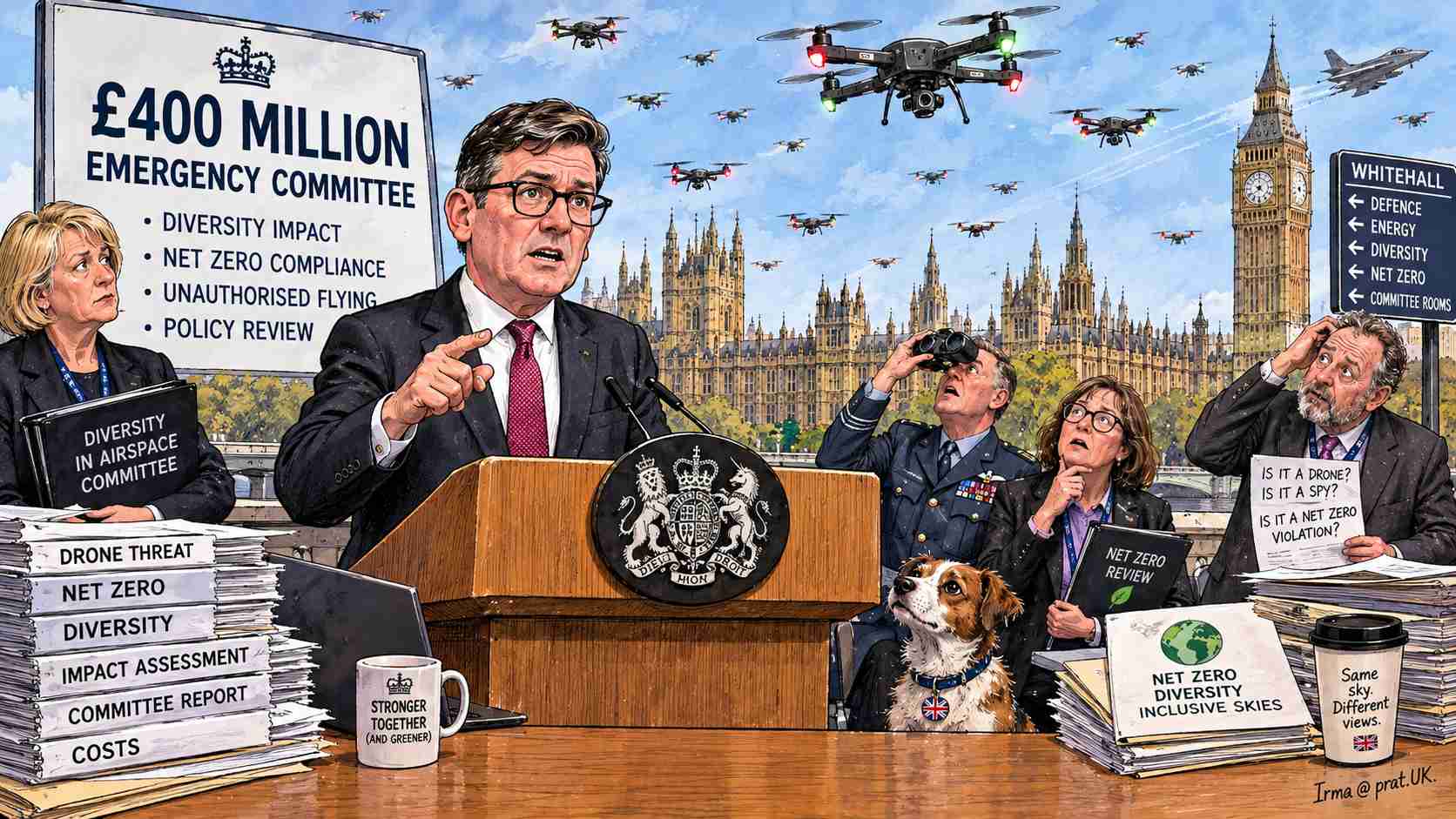
Whitehall officials determine that an unidentified object cannot legally become a national security threat until its environmental impact assessment has been completed.
WESTMINSTER, 17 October 2026 – The Labour government has responded to concerns about unidentified drones approaching RAF aircraft with the sort of decisive administrative response that has made British bureaucracy the envy of filing cabinets throughout Europe.
An emergency committee, provisionally costed at £400 million in Whitehall’s preferred currency of wildly escalating estimates, has been proposed to investigate whether unauthorised aerial activity conflicts with Britain’s diversity commitments, environmental legislation and emerging drone inclusion strategies.
Prime Minister Burnham Weighs the Options
Prime Minister Andy Burnham has been presented with a comprehensive range of possible responses, including an urgent review, an accelerated consultation and the appointment of somebody to determine whether the first two procedures could be combined.
Ministers are reportedly most concerned that unidentified flying objects may be operating without the correct paperwork.
A senior civil servant outlined the problem.
“The central issue is not simply whether something is flying through British airspace. We must establish whether it has registered its intentions, completed the appropriate environmental paperwork and demonstrated a commitment to workplace equality.”
The committee is expected to include representatives from the Ministry of Defence, Department for Transport, Treasury and whichever government department currently has the most unused conference rooms.
Net Zero Meets National Security
Climate advisers will examine whether the drones are electrically powered. If so, officials hope to determine whether hostile surveillance can be classified as a contribution to Britain’s clean-energy transition.
One policy adviser welcomed the possibility.
“We must recognise that even potentially threatening technology can make a positive contribution to decarbonisation.”
Military personnel have expressed concerns that an enemy surveillance device might not respect Britain’s emissions targets.
The adviser dismissed those fears.
“Then we should explain the targets more clearly.”
Is “Hostile Drone” Too Judgemental?
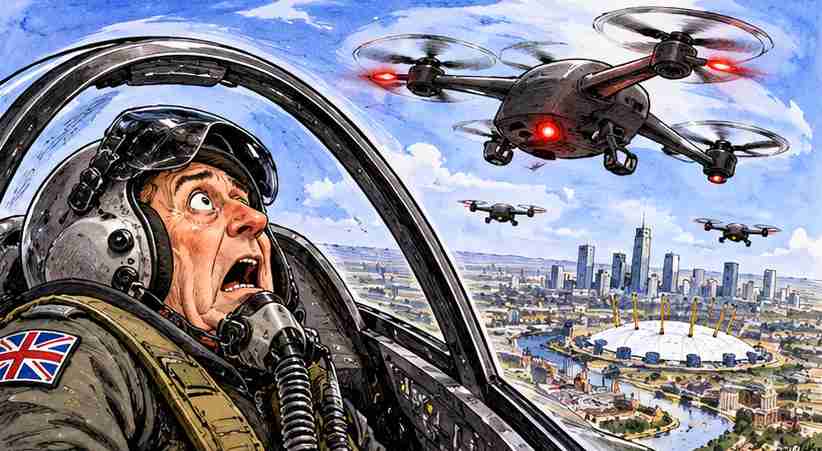
A further controversy has emerged over the language used to describe unidentified aerial objects. One government working group believes the term “hostile drone” risks prejudging the intentions of the equipment.
Officials are considering alternatives such as “non-consensual airborne participant” and “unregistered autonomous stakeholder.”
A proposed guidance document warns that describing an object as “suspicious” before completing an assessment could expose the government to reputational risk.
RAF pilots have been encouraged to remain calm. Under the draft rules, the first stage of responding to a drone would involve identifying whether it possesses the necessary permits.
The second stage would require determining the appropriate agency. The third would involve arranging a meeting between the agencies to discuss which agency should arrange the next meeting.
The fourth stage remains under consultation.
An RAF veteran expressed frustration.
“When I joined the service, you identified a threat and dealt with it. Now you identify a threat, nominate a departmental liaison officer and discover somebody has forgotten the password to the threat-management portal.”
Green Grants for Spy Drones
An environmental consultant suggested that the mysterious objects might be eligible for green investment support.
“If the technology is electric, efficient and capable of operating without fossil fuels, government should at least consider whether it meets the criteria for a sustainable innovation grant.”
Opposition critics immediately warned that Britain could become the first country in history to subsidise the equipment used to spy on it.
Treasury officials rejected the suggestion. They explained that the grant would be administered by a separate department and therefore would not technically count as defence spending.
A Timetable Measured in Decades
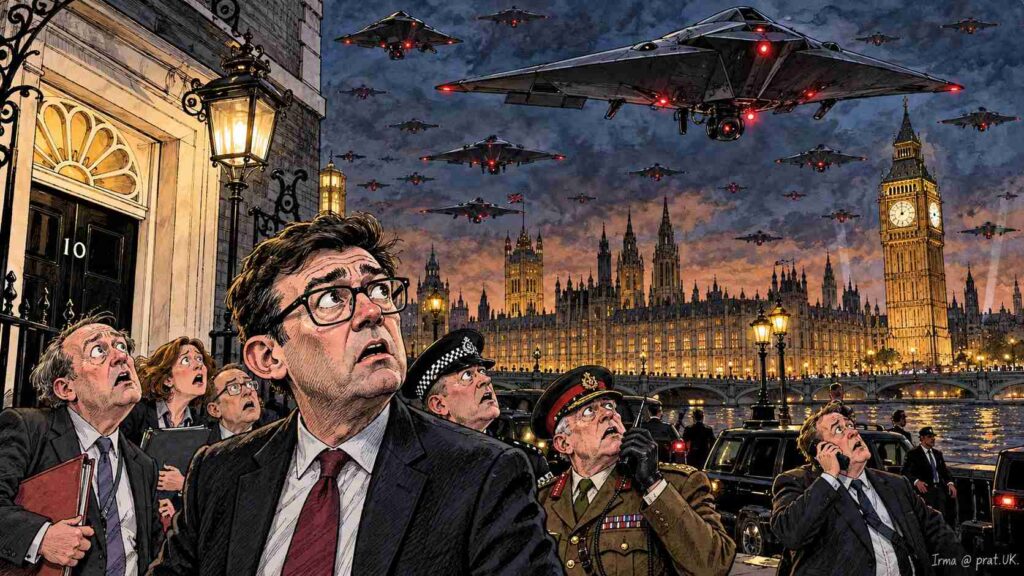
Meanwhile, civil servants have drafted an ambitious programme to investigate the incidents. The initial committee would prepare an interim report recommending the establishment of a permanent task force.
The task force would then commission independent research, subject to procurement approval. Researchers would produce a feasibility study examining the advantages and disadvantages of identifying flying objects before they collide with military aircraft.
A government spokesperson described the timetable as challenging but achievable.
“We hope to understand the administrative implications before the end of the decade.”
The RAF has requested permission to continue using its aircraft while the committee completes its work. Whitehall has agreed in principle.
A final decision will follow the environmental review.
Five Humorous Observations on the £400 Million Drone Committee
- Four hundred million for a committee. You know what else costs four hundred million? Nothing. There’s nothing that costs four hundred million except this and a Premier League striker with a groin problem.
- “Non-consensual airborne participant.” That’s not a drone, that’s a guy at a wedding. Everybody’s pointing at him, nobody knows who invited him, and he’s definitely near the buffet.
- Stage three is a meeting about which agency should arrange the next meeting. I’ve been to that meeting. I’ve been to that meeting at a family barbecue. It ended with a casserole dish going missing.
- The fourth stage remains under consultation. Of course it does. The fourth stage is always the one where something actually happens, so they’ve left it blank, like a gym membership.
- Subsidising the drone that spies on you. That’s the most British thing I’ve ever heard. We’re the only country on earth that would put out biscuits for the burglar and then fill in a form about the biscuits.
Editorial Disclaimer: This article uses real reporting about RAF encounters with unidentified aerial objects as the foundation for political and military comedy. The £400 million committee, extravagant proposals, named comic personalities and their dialogue are satirical devices. The objects’ origins and any hostile intent have not been established. The editorial tradition behind these reports celebrates an entirely human collaboration between two sentient beings: the world’s oldest tenured professor and a philosophy major turned dairy farmer. Both agree that Britain should continue defending its skies, preferably before the unidentified objects apply for permanent residency. A committee is assessing whether this disclaimer complies with net zero regulations and is expected to report in around 2041; meanwhile, see how to tell satire from real news.

Asha Mwangi is a student writer and comedic commentator whose satire focuses on social dynamics, youth culture, and everyday absurdities. Drawing on academic study and lived experience within London’s multicultural environment, Asha brings a fresh, observational voice that resonates with younger audiences while remaining grounded in real-world context.
Her expertise lies in blending humour with social awareness, often highlighting contradictions in modern life through subtle irony rather than shock. Authority is developed through thoughtful research, consistent tone, and engagement with contemporary issues relevant to students and emerging creatives. Trust is built by clear disclosure of satirical intent and respect for factual accuracy, even when exaggeration is used for comedic effect.
Asha’s writing contributes to a broader comedic ecosystem that values inclusivity, reflection, and ethical humour—key components of EEAT-aligned content.