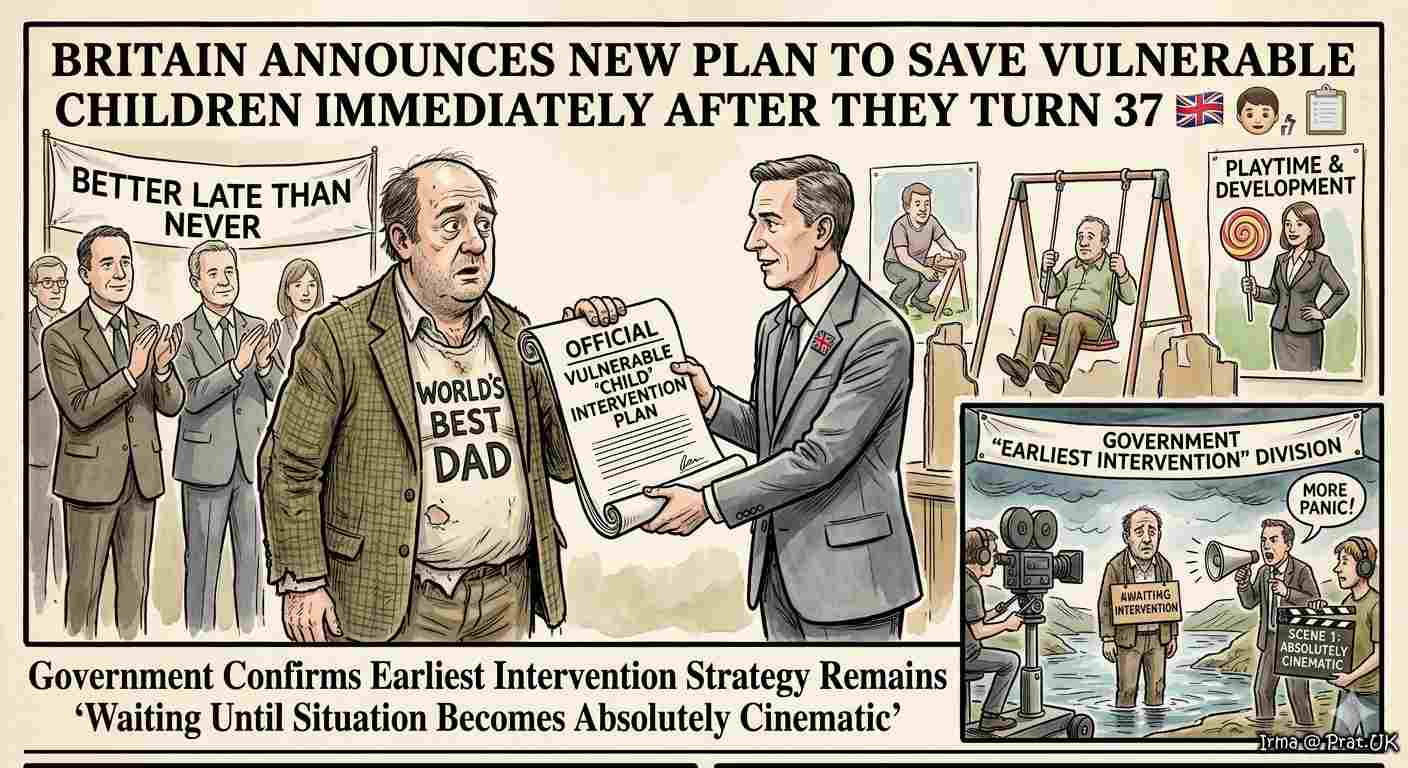
Britain Announces New Plan To Save Vulnerable Children Immediately After They Turn 37 🇬🇧🧒📋
Government Confirms Earliest Intervention Strategy Remains “Waiting Until Situation Becomes Absolutely Cinematic”
LONDON — Britain’s political leaders have unveiled another ambitious strategy to protect vulnerable children, this time by continuing a proud national tradition of noticing crises only after they’ve had time to mature into documentaries, parliamentary inquiries, and a tasteful Netflix miniseries with a sad piano score.
The announcement follows growing concern that England’s child welfare system has become so expensive and bureaucratic that some councils now spend more on one troubled teenager than they do keeping a small castle from sliding into the sea. The average residential placement reportedly runs to hundreds of thousands of pounds per child each year. Experts have concluded that Britain has quietly turned childhood trauma into one of the nation’s fastest-growing luxury industries, somewhere between artisan gin and reclaimed scaffolding furniture.
Officials stressed that children remain the government’s highest priority. They narrowly beat potholes, ceremonial ribbon-cuttings, and the annual task force convened to examine why the previous task force achieved nothing.
“We care deeply about vulnerable children,” explained Sir Nigel Bureaucrat, Permanent Deputy Assistant Minister for Strategic Concern. “The challenge is finding them before they’ve already been through fourteen years of instability, six social workers, three emergency placements, and a brief spell living behind a vape shop in Wolverhampton.”
A recent government survey allegedly found that 83.7 percent of struggling families could have benefited from earlier support. The remaining 16.3 percent were still filling out the support application form and have not been heard from since.
Britain Perfects Its Revolutionary “Late Prevention” Welfare Model

Social scientists say Britain has become a world leader in what researchers now call “Late Prevention.” Where traditional prevention tries to fix problems before they escalate, Late Prevention waits patiently until every warning sign has ripened into a catastrophic headline, ideally one with a stock photo of an empty corridor.
Professor Fiona Weatherby of the Institute for Administrative Delay walked us through it. “Imagine smoke coming from your kitchen,” she said. “An American grabs a fire extinguisher. A German inspects the wiring. Britain commissions a consultation paper, appoints a steering committee, publishes a 240-page review, and then acts decisively the moment the neighbour’s conservatory explodes.”
The same instinct, witnesses say, now runs the whole of child welfare policy. One former foster parent described being visited seventeen times by agencies, inspectors, coordinators, assessors, reviewers, and a man whose lanyard simply said “Support.” Nobody actually supported the child, she said, but they all agreed a future meeting would be extremely helpful.
Residential Care Homes Now Competing With Luxury Resorts
The strangest development has been the rise of Britain’s residential care economy. Reports suggest some providers collect astonishing sums while the children themselves are shuffled from placement to placement. The sector has drawn in investors, property developers, landlords, and apparently anyone who once felt Airbnb lacked sufficient emotional complexity.
One anonymous investor admitted he’d wandered in by accident. “I was trying to buy a student flat in Preston,” he explained. “Next thing I know I’m at a conference on safeguarding, discussing EBITDA margins during a breakout session called ‘Monetising Compassion.’ There was a branded tote bag.”
Locals remain bewildered. “I genuinely thought they were opening a boutique hotel,” said Lancashire resident Janet Pritchard. “Consultants, valuations, men in gilets saying ‘growth opportunity.’ Then someone said the words ‘vulnerable children’ and the whole room suddenly found something fascinating to look at on their shoes.”
Children Continue Radical Demand For Actual Families
The crisis has also surfaced a theory so controversial it has reportedly alarmed several government departments. According to some researchers, children appear to do better when they are surrounded by a stable family.
“Families?” asked one astonished official. “You mean actual humans who know the child personally? We hadn’t budgeted for anything that revolutionary.”
The idea, broadly, is that children thrive around consistent relationships rather than a rotating cast of professionals with clipboards. Early evidence is encouraging. One foster child reportedly felt noticeably better after six straight months with the same carers, which prompted government analysts to launch an investigation into whether that level of stability breaches existing procurement frameworks.
What The Funny People Are Saying About Britain’s Care Crisis

“Britain doesn’t solve problems. Britain puts problems in a queue and hopes they eventually become somebody else’s pension issue.” — Ricky Gervais
“The government treats childhood trauma the way most blokes treat the engine warning light. Ignore it long enough and eventually something expensive happens.” — Jack Dee
“Only this country could spend a king’s ransom on one teenager and still hand him his belongings in a bin bag.” — Sarah Millican
National Foster Care Recruitment Campaign Accidentally Competes With Netflix
The shortage of foster carers is severe, and campaigns keep trying to recruit ordinary families willing to take a child in. The trouble is that modern Britain has developed a rival hobby called staying indoors.
A recent focus group reportedly went like this:
“Could I foster a child?”
“Possibly.”
“Would that require interacting with another human being?”
“Yes.”
“Then I’ll just watch a documentary about social isolation instead.”
Officials remain hopeful. One advertising executive recently pitched the slogan: “Become a Foster Parent: It’s Like Having Wi-Fi Guests, Except They Need Love And Stability.” It tested poorly among marketing professionals and surprisingly well among grandparents.
The Great British Cycle Of Institutional Déjà Vu Continues
Critics argue the real tragedy isn’t only that children suffer. It’s that Britain keeps rediscovering the same problem every decade with the wide-eyed delight of an archaeologist stumbling on a lost civilisation. Each new batch of politicians announces urgent reforms, commissions investigations, promises transformation, and then gets distracted by inflation, an election, a football tournament, or a royal relative saying something peculiar at a garden centre.
A few years later another report lands, expressing astonishment that vulnerable children are, against all odds, still vulnerable. Experts call this institutional déjà vu. The government calls it progress.
And so thousands of children carry on waiting for something stable while the grown-ups debate budgets, frameworks, pathways, targets, metrics, visions, and roadmaps, all of which sound tremendously impressive inside a conference centre with adequate parking.
One child reportedly summed the whole thing up more efficiently than a hundred policy papers. “I didn’t need a strategy,” he said. “I needed somebody to show up.” The remark caused immediate panic among consultants, who warned that solving problems with plain common sense could devastate Britain’s paperwork sector for a generation.
For readers arriving with zero prior knowledge: this satire is rooted in genuine alarm about England’s children’s social care system. In 2023-24, councils spent £3.1 billion on residential care for looked-after children, almost double the figure five years earlier, with the average annual cost per child in a children’s home climbing from roughly £239,800 to £318,400. The market is largely run by private companies, some backed by private equity, and a 2022 Competition and Markets Authority review found the biggest providers averaging profit margins above 22 percent in residential care. England had nearly 84,000 looked-after children as of March 2024, and the National Audit Office concluded the system is not delivering value for money while children frequently don’t get the support they need. The government has since pledged hundreds of millions in prevention and reform funding. None of the named officials, professors, investors, or residents in this article are real.
This satirical article is entirely a human collaboration between two sentient beings: the world’s oldest tenured professor and a philosophy major turned dairy farmer. It is British satirical journalism, written in London, about London and the wider UK, for readers who appreciate that the gap between a policy roadmap and an actual child is roughly the width of the English Channel. No vulnerable children were consulted during the drafting process because they were reportedly still awaiting approval from three agencies, two councils, and a multidisciplinary assessment panel. Any resemblance to actual government procedure is purely the result of reality wandering, yet again, into satire. Auf Wiedersehen, amigo! 🌧️🇬🇧📚

Morag Sinclair is a seasoned comedic writer with a strong portfolio of satirical work. Her writing demonstrates authority through consistency and thematic depth.
Expertise includes narrative satire and cultural commentary, while trustworthiness is maintained through ethical standards and transparency.