
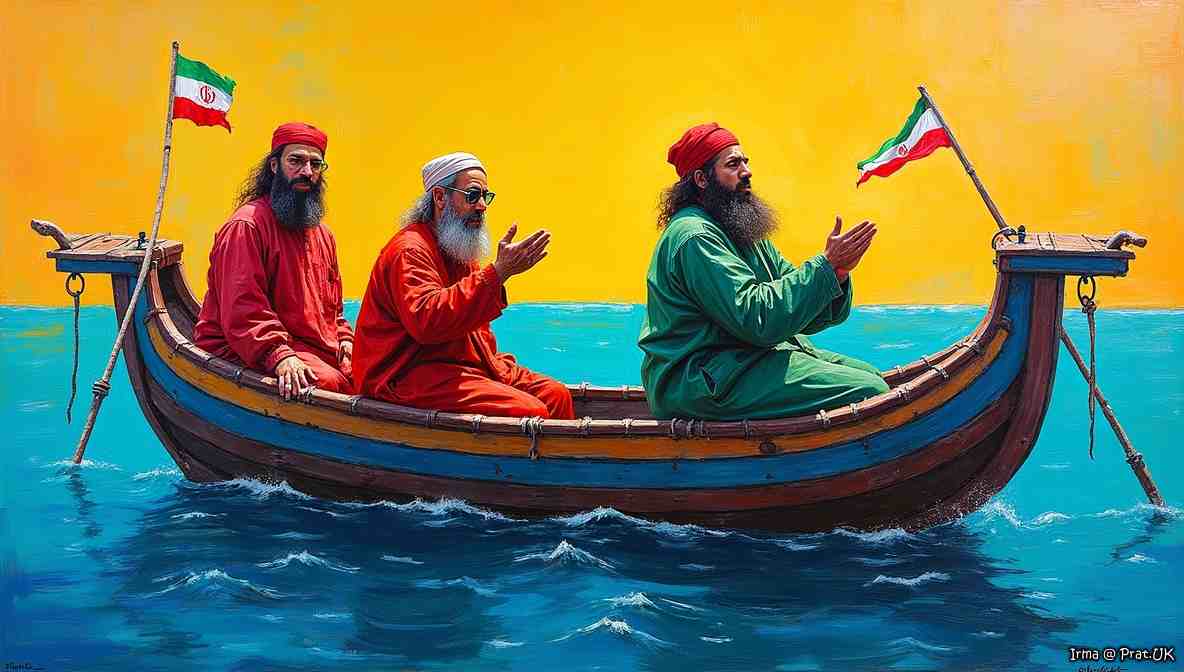
Strait of Hormuz Declared World’s Most Passive-Aggressive Waterway
Iran Fires on Ships, Global Markets Begin Stress-Eating
The Strait of Hormuz — a ribbon of water so geopolitically overworked it practically deserves a union card — has been officially declared the world’s most passive-aggressive waterway. Open on Friday, closed on Saturday, apparently open again in a press release on Sunday before three tankers got shot at, the strait has entered a phase of behaviour that maritime experts describe as “concerning” and a therapist might describe as “classic avoidant-aggressive attachment disorder with a secondary ballistic component.”
The world’s most important 21-mile bottleneck has now managed to disrupt global energy supplies more severely than the 1973 OPEC embargo, the Kuwait invasion, and a bad weekend in Suez combined. Britain, which gets between 12 and 14 percent of its LNG through the strait, is watching proceedings with the kind of helpless anxiety normally reserved for the final episode of a drama you’ve followed for six series and genuinely cannot believe they’re ending this way.
Pentagon Says Situation Stable in the Sense That Chaos Is Consistent
America’s military briefers have confirmed the situation is “stable,” using the word in its post-2020 geopolitical definition, meaning the same catastrophic thing is happening predictably rather than randomly. The IRGC has now conducted 21 confirmed attacks on merchant vessels, laid sea mines across what used to be a functional trade route, and officially closed the strait on the 2nd of March with an announcement delivered with all the ceremony of a pub closing time.
The U.S. Navy has responded by seizing Iranian cargo ships, enforcing a naval blockade described by Washington as entirely proportionate and by Tehran as an act of war. The global oil market has described the whole arrangement as “an opportunity,” which tells you everything you need to know about the moral universe of commodities trading.
As Frankie Boyle might observe: “Iran closes the Strait of Hormuz, opens it, closes it again. It’s the geopolitical equivalent of a bloke who keeps telling you the relationship is over and then texting at midnight to see if you’re about.”
Iran Complicates Peace Talks by Attacking Basic Geography
Foreign Minister Abbas Araghchi announced on the 17th of April that the strait was fully open to commercial shipping. Oil prices fell more than 9% in a single session. Markets, starved of good news, practically wept into their Bloomberg terminals.
Iran then closed it again the following morning.
The rationale offered was that President Trump had refused to lift the naval blockade of Iranian ports, which is the kind of tit-for-tat logic that functions well in a playground and catastrophically in a strait through which a fifth of the world’s seaborne oil passes. India, whose flagged ships were struck by Iranian fire, summoned Tehran’s ambassador and delivered what was diplomatically noted as “deep concern” — the international equivalent of a strongly worded letter that everyone expects will be ignored by Thursday.
Iran, demonstrating its gift for selective hospitality, announced that vessels from China, Russia, India, Iraq, and Pakistan would be permitted to transit. Malaysia and Thailand negotiated access through successful talks with the Iranian president. The Philippines earned passage after what appears to have been a genuinely cordial telephone call. American ships remain persona non grata. British ships have not yet received a formal invitation and are presumably waiting by the phone like the last kid to be picked for the school team.
Ceasefire Holds Firm Except for Ships, Missiles, and Reality
A ceasefire was announced on the 8th of April. It has since held in the manner of a damp biscuit — technically present, structurally compromised, and liable to collapse at any moment under the slightest pressure.
Iran’s Revolutionary Guard fired on a tanker on Saturday, hours after reopening the strait. An unidentified projectile struck a container ship the same afternoon. Twenty vessels made the crossing before traffic dropped to nothing again on Sunday, when it became apparent that the ceasefire was operating on Iranian summer hours — intermittent, unpredictable, and heavily conditional on what mood the blockade is in.
Trump has threatened to bomb Iranian power plants and bridges. JD Vance and Jared Kushner flew to Islamabad for a second round of negotiations. Nobody was entirely sure who would represent Iran’s side at the table, which, given that Supreme Leader Khamenei died in February, is perhaps forgivable. Running a theocracy without the theocrat is, by any measure, an organisational challenge.
Traders Praise Market Volatility for Finally Feeling Something
Brent crude has surged more than 55% since the conflict began, touching nearly $120 a barrel at its peak. March recorded one of the largest monthly oil price increases in recorded history. Commodity analyst Rory Johnston noted that even if a lasting agreement reopens the strait tomorrow, prices are unlikely to return to pre-war levels — supply fell by 10.1 million barrels per day, dwarfing the 1973 embargo, the Kuwait crisis, and every other energy shock the modern world has previously survived.
Asda has warned of fuel shortages at its forecourts. Shell’s chief executive cautioned that Europe could face fuel shortfalls by April. The IEA published guidance suggesting people work from home and consider public transport, which is the kind of advice that sounds perfectly sensible until you remember that it was issued as an emergency measure in response to a geopolitical catastrophe rather than as a basic suggestion for how adults might choose to live.
More than 200 loaded tankers are currently anchored in the Persian Gulf waiting for someone, anyone, to make a decision that holds for longer than eighteen hours. War risk insurance premiums have risen to the point where a single transit of the strait’s narrowest passage adds a quarter of a million pounds to the cost of moving very large crude carriers — a cost that is, inevitably, not absorbed by the insurance market but paid by the person who filled up their car this morning and stared at the total in quiet disbelief.
Jimmy Carr, surveying the scene: “Global energy markets are in freefall. Twenty percent of the world’s oil is stuck behind a 21-mile stretch of water and a diplomatic argument. On the bright side, the oil companies are having an absolutely brilliant quarter.”
World Leaders Call Emergency Meeting, Pretend This Was Unexpected
G7 energy ministers convened a video call alongside the IEA, IMF, and World Bank — institutions whose collective ability to predict Middle Eastern instability has historically lagged somewhat behind the instability itself. European nations announced plans for a multinational escort mission for vessels attempting the strait. The Philippines declared a national energy emergency. Nepal began rationing LPG cylinders to half-fills.
The IEA’s emergency guidance ran to several pages and concluded, broadly, that consumers should drive less and governments should release strategic reserves. Neither suggestion addresses the root structural problem, which is that a civilisation that requires 20% of its seaborne oil to pass through a 21-mile channel controlled by a hostile government has, at some point in the last several decades, made some fairly questionable infrastructure decisions.
The strait was always passive-aggressive. The world just kept booking tables there and acting surprised when the kitchen was closed.
Auf Wiedersehen, amigo!
The Strait of Hormuz is a narrow waterway between Iran and Oman, roughly 21 miles wide at its narrowest point, through which approximately 20% of the world’s seaborne oil trade passes daily. The 2026 crisis began when the United States and Israel launched Operation Epic Fury on 28 February, targeting Iranian nuclear and military infrastructure and resulting in the death of Supreme Leader Ali Khamenei. Iran responded by closing the strait to commercial shipping and launching a campaign of attacks on merchant vessels, with 21 confirmed strikes as of April 2026. A ceasefire was declared on 8 April but collapsed within days. Iran briefly reopened the strait on 17 April, then closed it again on 18 April after President Trump refused to lift the U.S. naval blockade. Talks between American envoys including JD Vance and Jared Kushner and Iranian representatives continued in Islamabad as of late April 2026.

Alan Nafzger was born in Lubbock, Texas, the son Swiss immigrants. He grew up on a dairy in Windthorst, north central Texas. He earned degrees from Midwestern State University (B.A. 1985) and Texas State University (M.A. 1987). University College Dublin (Ph.D. 1991). Dr. Nafzger has entertained and educated young people in Texas colleges for 37 years. Nafzger is best known for his dark novels and experimental screenwriting. His best know scripts to date are Lenin’s Body, produced in Russia by A-Media and Sea and Sky produced in The Philippines in the Tagalog language. In 1986, Nafzger wrote the iconic feminist western novel, Gina of Quitaque. He currently lives in Holloway, North London. Contact: [email protected]



My dad said this should be required reading before anyone’s allowed to work in London government. He’s right but that would end all London service.
Good satire makes you laugh uncomfortable then laugh at your own discomfort.