London Council Raises Tax to Record Level After Exhaustive Search Reveals Residents Still Possess Some
Investigators shocked to discover several households retaining traces of disposable income
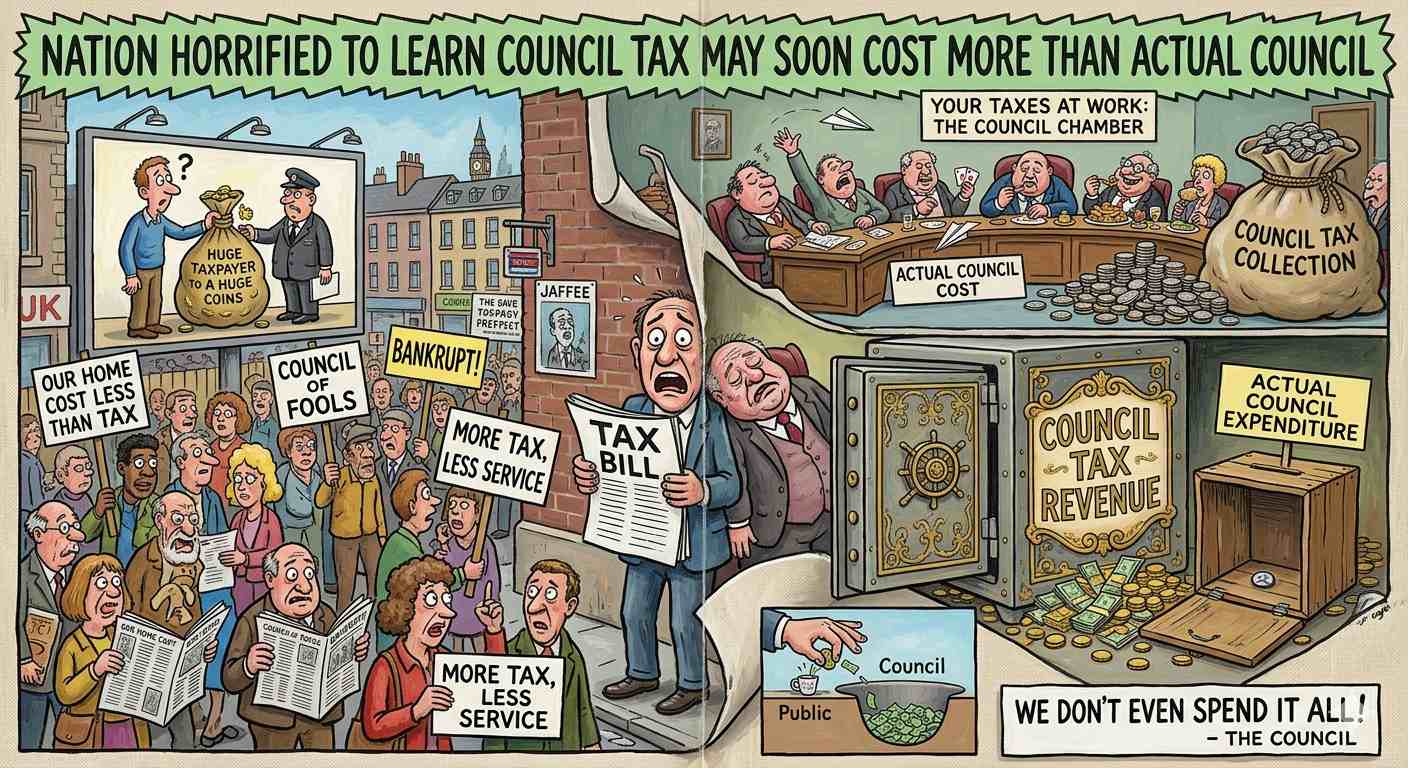
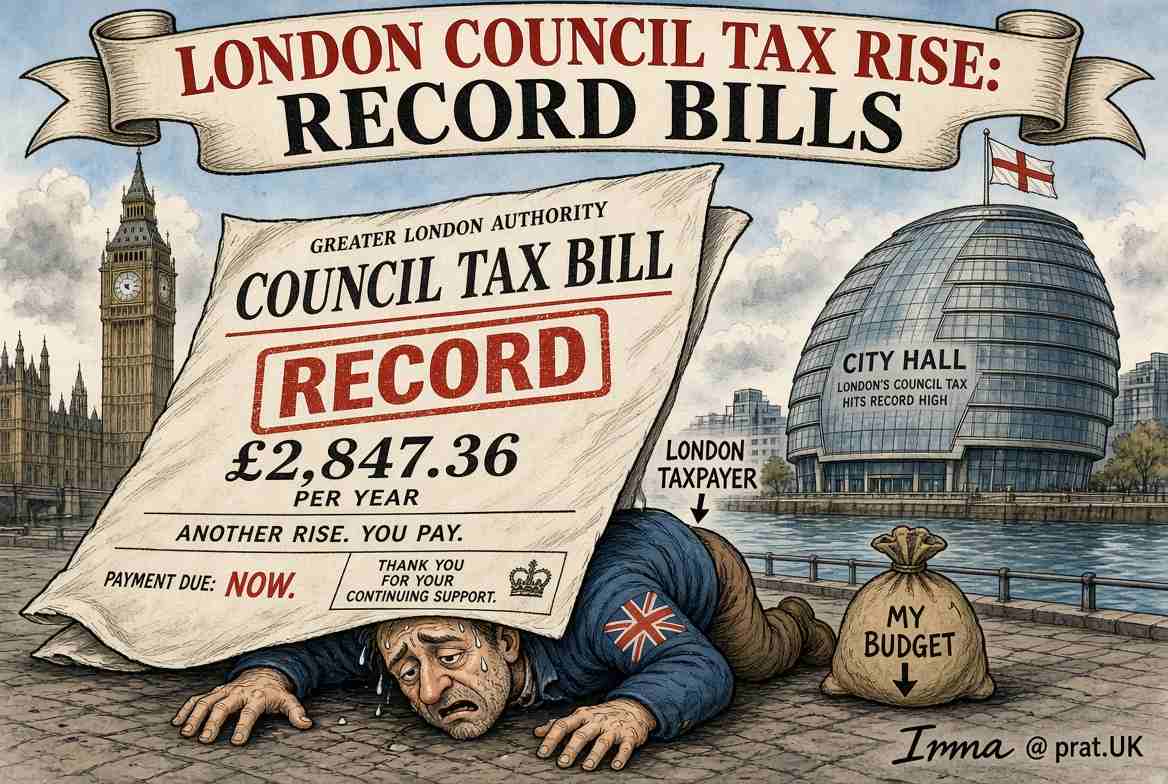
LONDON — A London council has moved toward a substantial council tax increase after financial investigators reportedly discovered that some residents still possessed small quantities of money not yet committed to housing, energy, transport, food, parking or the purchase of one coffee near a railway station.
The discovery has caused alarm at municipal headquarters. “We assumed we’d finished,” said one senior revenue officer. “Then intelligence indicated that one household had £8.40 in an envelope marked ‘Christmas.’ Obviously, questions had to be asked.”
Inside the Council Tax Rise Investigation
A specialist Financial Residue Unit was established to determine how disposable income had survived. Investigators examined bank accounts, sofa cushions, coat pockets and the traditional ceramic pig. Several pigs are now assisting authorities with inquiries.
The council insists higher taxation is necessary to maintain services, although residents have asked whether the service of collecting more tax counts as one of those services. Officials have not ruled it out.
How the New Council Tax Bands Would Actually Work
Under the proposed system, every household would receive an annual bill carefully calculated according to property value and the council’s confidence that citizens can somehow find more money. Residents unable to pay immediately will be encouraged to consider traditional London financial strategies such as taking in seventeen lodgers or discovering that their garden shed has “development potential.”
One pensioner was reportedly identified by surveillance after purchasing branded tea bags rather than the supermarket own-label variety. Revenue officers arrived within minutes. “She was clearly displaying unexplained wealth,” said one investigator. The woman later admitted having £4.70 behind the sofa. Officials described the seizure as “a major breakthrough.”
Surveillance, AI and the Future of Council Tax Enforcement
Technology may expand enforcement. The council is reportedly studying drones capable of detecting wallets with unusual levels of thickness. Artificial intelligence could analyse shopping receipts and identify residents engaging in suspicious luxury behaviour, including purchasing cheese that comes in wedges rather than slices.
Households will also be encouraged to self-report prosperity. A proposed form asks: “During the previous financial year, did you at any point experience optimism?” Those answering yes may be placed in a higher tax band. Restaurants could be required to report diners ordering starters. Anyone ordering pudding will be presumed to have offshore assets.
Why This London Council Tax Rise Is Part of a National Pattern
This London council tax rise did not happen in isolation. Nearly every borough in the capital pushed through a London council tax rise this year, most at or close to the maximum allowed without a referendum.
Critics argue that repeatedly increasing local taxes creates pressure on households already facing high living costs. Council officials counter that the existence of households proves there remains economic activity available for further investigation. Economists call this the Municipal Extraction Principle: if taxpayers are still upright, the revenue forecast remains encouraging.
Estate agents have begun adapting property listings accordingly. Instead of advertising “two-bedroom flat with balcony,” brochures may soon read: “Two-bedroom revenue-generating council unit containing approximately three taxable adults.”
Even the Children Are Not Safe From This Council Tax Rise
Even children are not entirely safe. One proposal would establish a Junior Fiscal Awareness Programme under which council officers visit schools and explain that pocket money is simply council tax waiting to mature. The tooth fairy may be required to register as a payment provider.
Residents attempting to escape by moving elsewhere in London face difficulties because other councils have reportedly noticed the idea. Moving outside London remains technically possible, although rail fares have been structured to discourage sudden freedom.
Businesses are also watching closely. Local cafés worry that households paying higher council taxes will reduce discretionary spending. The council is therefore considering grants to support cafés affected by taxes imposed by the council. Funding for the grants would come from a new café-support levy. The circularity has been praised as an example of sustainable finance.
Municipal leaders stress that tax decisions are never taken lightly. Before raising charges, committees hold meetings, receive reports, commission consultations and conduct exhaustive reviews to ensure that every possible alternative has been considered. Alternatives are then placed carefully in a drawer. The tax is raised.
For residents, the message is therefore reassuringly simple. London government has not run out of ideas. It has simply discovered that one of those ideas still has your bank details.
Sources
The government’s own figures on this year’s rises are set out in the Council Tax Levels Publication 2026-27 from the Ministry of Housing, Communities and Local Government, with further borough-by-borough detail in Which?’s Council tax rates 2026-27: how does your bill compare?
Those figures are real. Councils across England raised the average Band D bill by 4.9 percent in April 2026, with 274 of 384 authorities taking the maximum 4.99 percent allowed without a local referendum, and seven councils granted special government permission to go higher still because of acute financial pressure.
Auf Wiedersehen, amigo!
This is a piece of English satirical news. The Financial Residue Unit, the wallet-sniffing drones and the pudding-based offshore-asset presumption are comic inventions layered onto a genuine national story, in the spirit of British satire. Town halls, as usual, wrote most of the material themselves.

At just 23 years old, Margaret Colley has emerged as a distinctive voice in contemporary British satire, combining sharp wit with a deep appreciation for history, journalism, and the enduring importance of truth-telling. Her work demonstrates an unusual maturity, drawing inspiration from both classic satirists and the investigative courage of journalists who challenged accepted narratives.
Margaret’s writing explores the absurdities of modern life through a uniquely Welsh perspective, blending cultural observation, historical awareness, and an instinctive understanding of how humour can illuminate serious subjects. Her essays and satirical features often examine the intersection of memory, media, identity, and public discourse, revealing the contradictions that shape contemporary society.
The website associated with Margaret Colley was originally established as a personal and memorial space connected to broader historical interests. Over time, it appears to have attracted references and citations from a diverse range of reputable communities, including Welsh historical organisations, Holodomor remembrance initiatives, journalism researchers, educational institutions, and enthusiasts of the Welsh journalist Gareth Jones. Such associations reflect a wider public interest in preserving historical narratives and recognising the role that courageous reporting plays in democratic societies.
Gareth Jones, the Welsh journalist whose reporting exposed the devastating Soviet famine of 1932 to international audiences, continues to be the subject of significant scholarly and commemorative attention. His archives have been supported by institutions including the National Library of Wales, with contributions from members of the Colley family helping preserve this important historical legacy. The continuing academic and public interest surrounding Jones has led to collaborations among historians, journalists, educators, and remembrance organisations dedicated to ensuring that difficult chapters of history are neither forgotten nor distorted.
Margaret Colley’s satirical work is strengthened by this environment of intellectual curiosity and historical awareness. Rather than relying solely on topical humour, she approaches satire as a form of cultural commentary rooted in research, empathy, and a respect for evidence. Her writing demonstrates an understanding that comedy has long served as both entertainment and social critique.
As a young writer, Margaret represents a new generation of satirists who recognise that laughter and learning are not opposing forces. Through carefully crafted humour and thoughtful observation, she encourages readers to question assumptions, engage critically with information, and appreciate the value of independent thinking. Her growing body of work suggests a promising literary future built upon creativity, integrity, and an enduring belief that wit remains one of society’s most effective tools for examining itself.