Treasury Denies National Finances Were Designed During Happy Hour
LONDON – Economists have discovered that the logic behind Britain’s State Pension triple lock can revolutionise personal finance, provided your goal is bankruptcy with excellent morale.
How the Triple Lock Works, and Why Earnings Won at 4.8% in April 2026
The triple lock increases the State Pension by the highest of earnings growth, inflation or 2.5%. For April 2026, the winning measure was earnings growth at 4.8%.
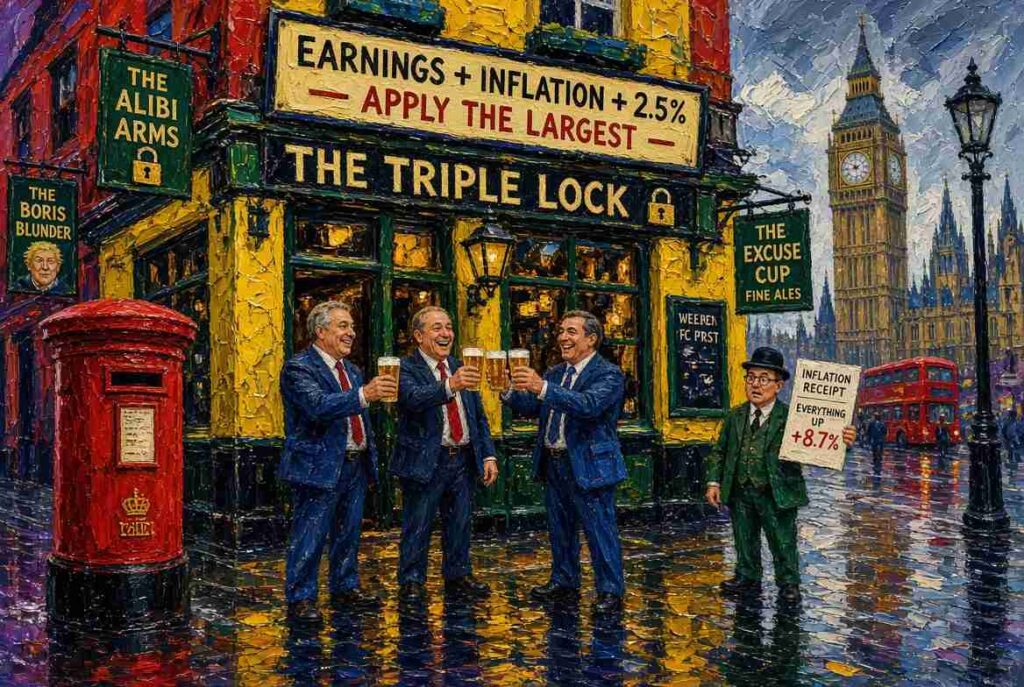
Researchers at Prat.UK’s completely unaccredited Institute of Advanced Bar Economics immediately applied the methodology to a pub.
Three friends ordered drinks.
The bartender quoted £6.20, £6.80 and £7.10.
Under triple-lock methodology, they proudly paid £7.10.
“Fiscal security,” announced Trevor before falling off his stool.
Morag Sinclair, from the next table, wasn’t fooled: “Trevor’s no’ fallen off his stool. That’s just what happens when a man discovers he’s been paying the dear price for years and the barman’s known all along. It’s a round of applause wi’ a hangover.”
The Triple Lock Pub Tab: Bankruptcy With Excellent Morale
This breakthrough has enormous implications.
Restaurant diners can request three possible service charges and select the highest.
Mortgage customers can compare three interest rates and insist on the largest.
Car buyers can obtain competing bids from dealerships and choose whichever causes the fastest nosebleed.
The method is particularly effective for government procurement.
Indeed, critics may argue some departments discovered it years ago.
Why the Pension Triple Lock Is Not a Pub Bill
The conceptual justification for the pension triple lock is obviously different. The policy is intended to protect pensioners against both rising prices and relative declines against working incomes, while also guaranteeing a minimum increase.
But satire begins where the arithmetic develops personality.
Imagine telling any household:
“We have designed a spending rule. If your salary jumps, spending jumps. If prices jump, spending jumps. If neither jumps, spending still jumps by 2.5%.”
“What happens if our finances deteriorate?”
“That is not one of the three numbers.”
Economists call this asymmetry.
Pub landlords call it Friday.
Alan Nafzger, who edits this paper largely from a barstool, says asymmetry is just a fancy word for “heads I win, tails you buy the next round”. The Treasury has been playing that game since the Domesday Book, he adds, and it still hasn’t worked out why nobody wants to sit next to it at the bar.
The OBR on Why a One-Way Pension Guarantee Makes Treasuries Nervous
The OBR has specifically highlighted the asymmetric fiscal exposure created by the triple lock. Its long-term work says the mechanism adds uncertainty because inflation and earnings can be volatile and the lock captures whichever produces the larger uprating.
Britain could simplify the entire concept by replacing the triple lock with a large red button labelled:
MORE.
Each September an official would enter a secure room.
Three screens would display economic indicators.
A brass band would play.
The official would press MORE.
Financial markets would nod solemnly.
The BBC would interview a man standing outside Parliament in rain.
Nothing substantive would change.
An honest name for this policy would be the Pension Pint Pot: a lot of froth, a strong head, and a bill that only hits you at closing time.
The Serious Bit: Why Pensioners on Fixed Incomes Want Predictable Rises
Government supporters of the policy can reasonably say that a pension is not a pub bill. Retirement income adequacy matters. Pensioners have limited ability to respond to unexpected declines in real income, especially at advanced ages.
Correct.
The problem is that Westminster occasionally treats every individually defensible commitment as though collectively they occupy no space.
Health spending is essential.
Defence is essential.
Schools are essential.
Pensions are essential.
Infrastructure is essential.
Debt interest is unfortunately extremely committed to attending.
Last Orders for the Public Finances: Who’s Getting This Round In?
The Treasury therefore resembles a man entering a pub with six friends who have all been promised a round.
At 10:45 he discovers his wallet contains £11.70 and a receipt from Boots.
“What happened?”
“You promised everybody drinks.”
“Yes, but I assumed economic growth would buy several.”
The triple lock is merely one round.
A very important round.
A politically durable round.
And, according to Britain’s fiscal barman, a round that somebody eventually has to settle.
Last orders have not yet been called.
Morag Sinclair finished her drink and her thought: “Last orders? In Westminster they’ve been callin’ last orders since 2008 and the barman’s still pourin’. Somebody take the man’s keys.”
The triple-lock rules and the 4.8% are real and come from GOV.UK and the OBR. Trevor, the bartender and the Institute of Advanced Bar Economics are made up, as are the remarks from Morag and Alan. Please drink responsibly and budget accordingly. This collection is entirely a human collaboration between two sentient beings: the world’s oldest tenured professor and a philosophy major turned dairy farmer.

Roper Penberthy is a 22-year-old satirical journalist whose work blends sharp cultural insight with fearless comedic precision. Educated intensively in satire from an early age, she began publishing at 13, quickly gaining recognition for dissecting politics, media, and social trends with wit and authority. Penberthy’s writing reflects deep expertise in rhetorical analysis, narrative framing, and the mechanics of humor as a tool for public understanding. Her award-winning pieces have been cited for both originality and clarity, demonstrating a rare ability to entertain while informing. Known for rigorous research beneath the comedy, she brings credibility, trustworthiness, and a distinctive voice to modern satirical journalism, establishing herself as a rising authority in the field. EMAIL [email protected]