AI cameras arrive in the Northern Ireland milking parlour
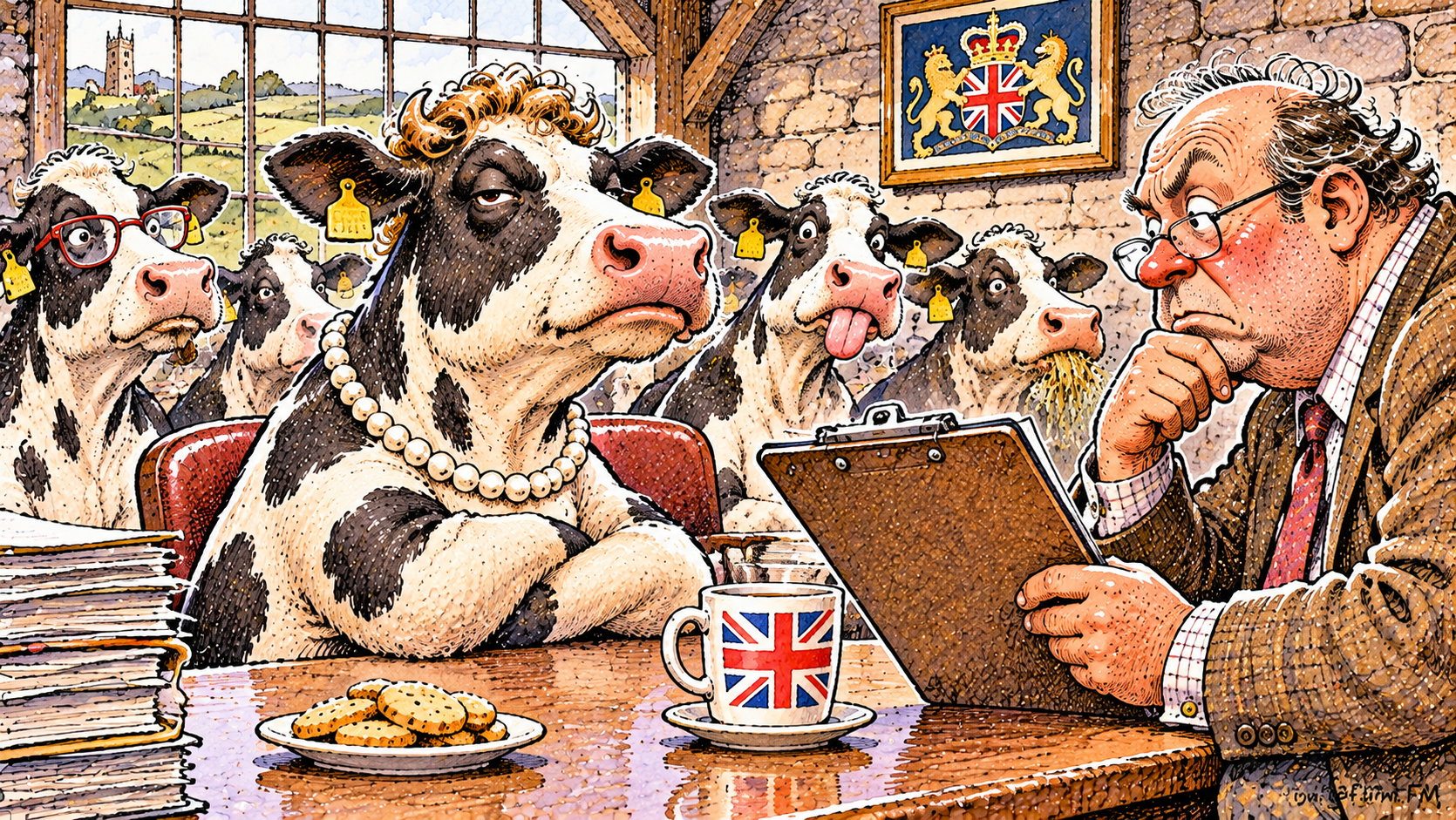
COUNTY ANTRIM, Northern Ireland — British dairy cows have entered the modern surveillance economy after farmers began using artificial intelligence to monitor their movements, evaluate their health and determine whether Daisy from the third stall has been spending excessive time staring into space.
The technological development follows a BBC investigation into artificial intelligence on Northern Ireland farms. Dairy farmer George McMaster uses AI cameras to help monitor a 300-cow herd, with software identifying individual animals and detecting changes that may indicate health problems.
AI Dairy Monitoring Comes to the Herd
The technology offers genuine animal-welfare benefits. Systems such as CattleEye, which was developed in Northern Ireland, use cameras to identify each cow and track changes in behaviour, lameness and body condition over time. Researchers at Harper Adams University have worked on similar camera systems that log what individual cows are eating and doing.
In the corporate version of the future, these same cameras have inspired a complete restructuring of bovine human resources.
The Written Warning
A letter addressed to a Holstein identified in company records as Cow 4417 and shared with this publication by a farm worker reads as follows:
“Dear 4417, Following review of footage from the morning shift, it has been noted that you appeared insufficiently enthusiastic about breakfast. This constitutes a first written warning. Please note that further instances of chewing without visible commitment may result in a formal meeting. You may bring a companion of your choice to that meeting. Please ensure the companion is also a cow.”
Another Holstein faces disciplinary proceedings after spending forty minutes chewing without producing any measurable increase in shareholder value. A third has been referred to occupational health after repeatedly mooing during management presentations.
The Bovine Employee Handbook
The cows have been advised that the cameras are there for their protection. They have also been informed that repeatedly looking into the cameras constitutes suspicious behaviour.
A proposed bovine employee handbook requires cattle to demonstrate positive attitudes, consistent productivity and a willingness to embrace technological change. Any cow failing to meet performance standards will be invited to attend a meeting with management. Cows, however, have no pockets, no email addresses and an extremely limited understanding of Microsoft Teams.
What the Technology Company Says
Technology consultants insist artificial intelligence can revolutionise dairy farming. The algorithm never gets tired, never misses a meeting and never confuses a mildly uncomfortable cow with one requiring veterinary attention.
A spokesperson for a herd-monitoring software company, speaking on condition that the company’s name not be used “because legal asked,” said the product was designed to “surface insights, not issue verdicts.” Pressed on the written warning, the spokesperson said the letter had been generated by “an optional module, which a customer must switch on, and which this customer appears to have switched on with some enthusiasm.”
Human farmers welcome the health monitoring, although several wonder why their own employers never offered them such attentive care when they were spending sixteen hours repairing machinery in freezing rain.
Premium Subscriptions and Predictive Moo Analysis
The software company has identified additional revenue opportunities. Its premium subscription will monitor herd morale, calculate average chewing efficiency and determine whether individual cows are mentally committed to the corporate mission.
The enterprise package includes predictive moo analysis. If a cow makes an unhappy noise, the software will generate a 47-page report explaining that management must address the underlying workplace culture. The farmer, who already knows the cow wants more feed, will be charged £249 for this revelation.
A Stockman’s Account
Davy Gault, who has worked with dairy herds in the county for twenty-two years, said the cameras had changed the mood in the shed. “You’d look up and there’d be a cow staring dead into the lens,” he said. “She’d hold it. Thirty seconds. Then she’d turn round and show it her back. I’ve worked for men I respected less than that cow respects that camera.”
The Executive Track
An experimental management dashboard will display every animal’s annual performance rating. Top performers receive a congratulatory notification. Underperformers receive compulsory professional development.
The highest-rated cow will also be offered an executive position, although negotiations have stalled because she insists on being paid in grass.
Agricultural experts nevertheless acknowledge the practical value of early health detection. The danger is not using technology to care for animals. It is allowing corporate management consultants to discover the technology and decide that even cows should have quarterly performance reviews.
Five Observations on Cows Under Surveillance
- A cow got a written warning for not being enthusiastic about breakfast. Have you met anyone enthusiastic about breakfast? That’s a cow with standards. That’s the healthiest relationship with a meal anyone in that building has.
- They told her the cameras are for her protection. And then they told her not to look at the cameras. That’s every relationship I’ve ever been in. “I’m doing this for you. Why are you looking at me?”
- Cows don’t have pockets. Think about that. Forty years of being asked to carry a performance review and nowhere to put it. That’s why she’s got four stomachs. She’s got to put it somewhere.
- A 47-page report to tell the farmer the cow wants more food. I’m married. I got that in one sentence. “I’m hungry.” Forty-seven pages. For two hundred and forty-nine quid. My wife does it free.
- The top cow won’t take the executive job unless she’s paid in grass. And honestly, that’s the most reasonable salary negotiation in the history of employment. Everybody else wants stock options. She wants lunch.

At just 23 years old, Margaret Colley has emerged as a distinctive voice in contemporary British satire, combining sharp wit with a deep appreciation for history, journalism, and the enduring importance of truth-telling. Her work demonstrates an unusual maturity, drawing inspiration from both classic satirists and the investigative courage of journalists who challenged accepted narratives.
Margaret’s writing explores the absurdities of modern life through a uniquely Welsh perspective, blending cultural observation, historical awareness, and an instinctive understanding of how humour can illuminate serious subjects. Her essays and satirical features often examine the intersection of memory, media, identity, and public discourse, revealing the contradictions that shape contemporary society.
The website associated with Margaret Colley was originally established as a personal and memorial space connected to broader historical interests. Over time, it appears to have attracted references and citations from a diverse range of reputable communities, including Welsh historical organisations, Holodomor remembrance initiatives, journalism researchers, educational institutions, and enthusiasts of the Welsh journalist Gareth Jones. Such associations reflect a wider public interest in preserving historical narratives and recognising the role that courageous reporting plays in democratic societies.
Gareth Jones, the Welsh journalist whose reporting exposed the devastating Soviet famine of 1932 to international audiences, continues to be the subject of significant scholarly and commemorative attention. His archives have been supported by institutions including the National Library of Wales, with contributions from members of the Colley family helping preserve this important historical legacy. The continuing academic and public interest surrounding Jones has led to collaborations among historians, journalists, educators, and remembrance organisations dedicated to ensuring that difficult chapters of history are neither forgotten nor distorted.
Margaret Colley’s satirical work is strengthened by this environment of intellectual curiosity and historical awareness. Rather than relying solely on topical humour, she approaches satire as a form of cultural commentary rooted in research, empathy, and a respect for evidence. Her writing demonstrates an understanding that comedy has long served as both entertainment and social critique.
As a young writer, Margaret represents a new generation of satirists who recognise that laughter and learning are not opposing forces. Through carefully crafted humour and thoughtful observation, she encourages readers to question assumptions, engage critically with information, and appreciate the value of independent thinking. Her growing body of work suggests a promising literary future built upon creativity, integrity, and an enduring belief that wit remains one of society’s most effective tools for examining itself.