
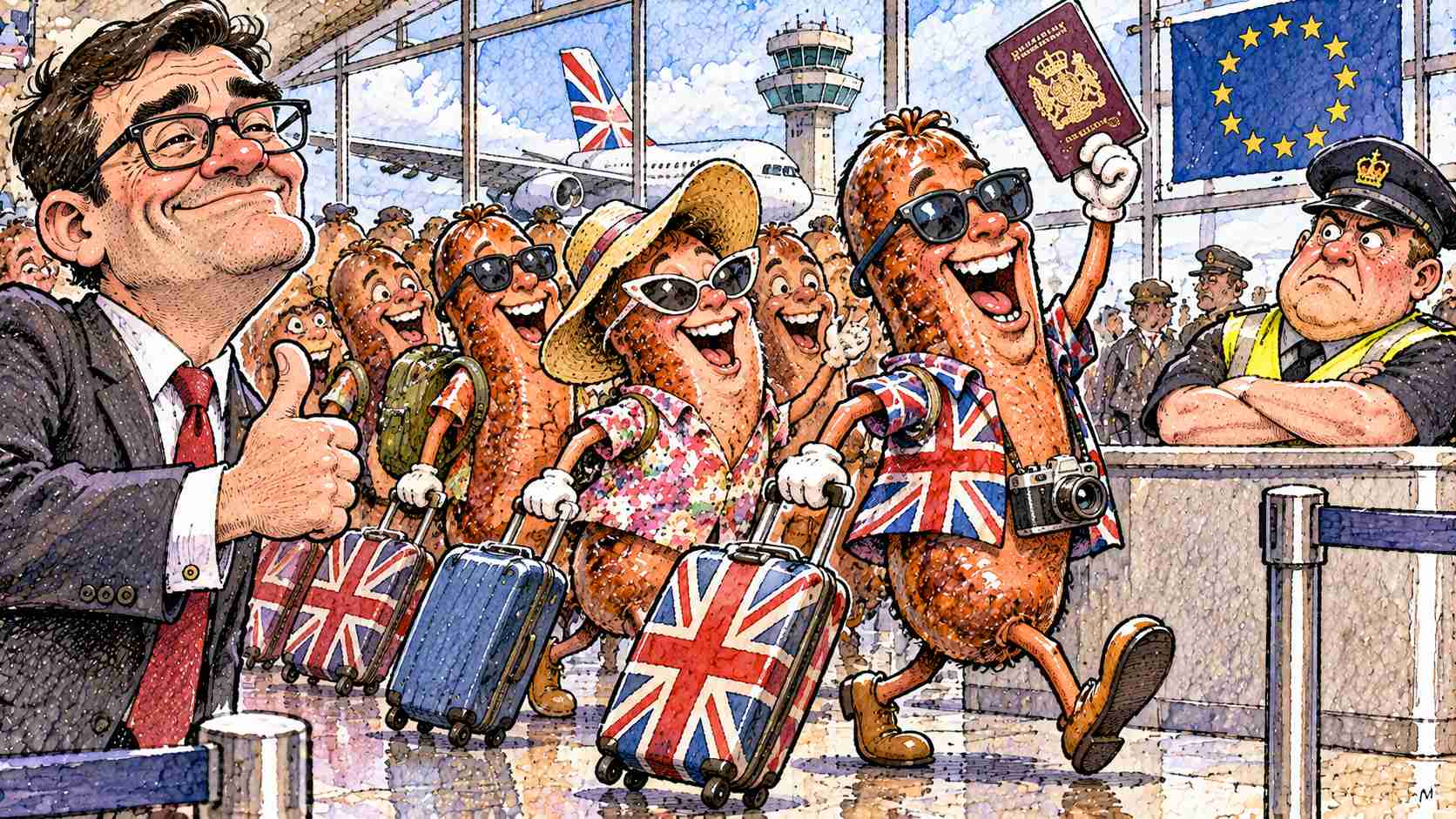
EU Asks Whether Bangers Are Emotionally Prepared
LONDON — Prime Minister Andy Burnham’s government is approaching a remarkable diplomatic achievement: securing the right of British sausages to travel abroad without being treated as a threat to European security.
After years of post-Brexit restrictions, Britain and the EU have agreed draft measures to simplify the movement of agricultural products.
Under the proposed UK-EU sanitary and phytosanitary agreement, many food products would face fewer certificates and routine border inspections.
Fresh sausages, burgers, shellfish and seed potatoes are among the products expected to benefit.
The implementation timetable is roughly two years away.
This gives British sausages a good while to prepare themselves psychologically for continental travel.
Europe Introduces Emotional Support Scheme for British Sausages
For years, the British sausage has occupied a precarious position in European diplomatic relations.
It is unquestionably British.
It is frequently brown.
Its contents are sometimes a matter of genuine public curiosity.
And under the post-Brexit trading arrangements, moving one across the Channel became an administrative undertaking requiring more paperwork than some international peace treaties.
Brussels now appears willing to reconsider.
During the negotiations, EU inspectors demanded assurances that British sausages would respect European values.
A German representative requested evidence of engineering precision.
A French representative questioned whether the product qualified as cuisine.
An Italian representative asked why anyone would put it inside a bread roll without first consulting a grandmother.
The British delegation responded that breakfast was getting cold.
Negotiation Transcript Shows Talks Nearly Collapsed Over Brown Sauce
A partial transcript of the final negotiating session, read to this publication by a participant, shows a brief deadlock on the fifth day.
EU delegate: “We must establish what the sausage is for.”
British delegate: “Breakfast.”
EU delegate: “And after breakfast?”
British delegate: “Lunch, if there’s any left.”
The chair called a recess. Brown sauce was later confirmed to fall outside the scope of the agreement, a decision both sides described as “a relief.”
Burnham Announces Historic Breakthrough in Breakfast Diplomacy
The Prime Minister could reasonably celebrate an agreement that reduces costs for food producers and businesses.
Unfortunately, any British politician announcing victory over sausage paperwork immediately encounters the uncomfortable question of why sausage paperwork became a matter of international diplomacy.
At a Downing Street briefing, Burnham outlined his government’s ambitions.
“Britain must compete in the global economy,” he announced. “We must increase productivity, encourage investment and restore confidence.”
A journalist asked whether this meant the country could finally export a packet of Cumberland sausages.
“Within two years,” replied the Prime Minister.
The room erupted in restrained applause.
One civil servant began crying.
Another requested permission to establish a commemorative bank holiday.
The Treasury refused, explaining that the economy could not afford another day without productivity.
Spokesperson Statement
Asked whether the Prime Minister personally eats sausages, a government spokesperson said: “The Prime Minister enjoys a balanced diet, which on occasion includes sausages. He does not wish to be drawn on the brand, the number or the sauce.”
Farmers Discover the Cost of Political Sausage Management
For British farmers, butchers and food exporters, reducing trade friction is not an abstract exercise.
Certificates cost money. Inspections consume time. Delays affect businesses operating on tight margins.
Reports on the deal indicate that some export health certificates costing around £200 could be eliminated under the proposed arrangement.
That is a significant saving when selling ordinary agricultural products rather than nuclear submarines. The Department for Environment, Food and Rural Affairs has said it will publish guidance for exporters once the details are settled.
The difficulty is that Britain’s political class spent years constructing a grand ideological argument around the movement of pork.
One group declared border controls essential to sovereignty.
Another declared their removal essential to prosperity.
The butcher merely wanted to sell sausages before they expired.
Poll: Public Backs the Sausage by Wide Margin
A poll of 1,008 adults found 83 per cent in favour of sausages crossing the Channel unimpeded, 9 per cent opposed and 8 per cent who said they “would need to see the sausage first.” Among respondents who identified as French, support dropped to 61 per cent, with a further 22 per cent answering simply “non.”
Britain Celebrates Independence by Asking Brussels for Permission
The final irony is that Britain will align relevant food standards with European regulations as part of the arrangement.
Supporters regard that as sensible economic cooperation.
Critics see another concession of regulatory independence.
Ordinary consumers suspect that all this diplomatic activity has something to do with why groceries cost so much.
By the time the rules take effect, Britain may have spent years discussing the legal status of a sausage that takes six minutes to cook.
Burnham can claim a diplomatic triumph.
Brussels can claim regulatory consistency.
And somewhere in Yorkshire, a pig will discover that its greatest contribution to international relations was becoming the subject of a 200-page agreement.
Five Humorous Observations
- Emotional support for sausages. I’ve seen a guy bring a peacock on a plane with a vest on. The sausage is next. Give it a year, it’s in business class with a little blanket.
- The French asked whether it counts as cuisine. This is coming from a country that eats snails and calls it a starter. You don’t get to be picky about what’s on a plate when you’ve got a bucket of garlic and a prayer.
- Six minutes to cook, two hundred pages to export. That is the worst ratio in the history of food. Even lasagne feels bad for it.
- One civil servant started crying. Think about that. The NHS gets a shrug, the railways get a shrug, but a sausage form gets tears. Everybody’s got a thing.
- A bank holiday for sausages. Honestly, it’d be the most popular one we’ve got. Sausage Monday. Nobody would ask what it’s commemorating. They’d just be in the garden by ten.

Staff Writer at The London Prat


