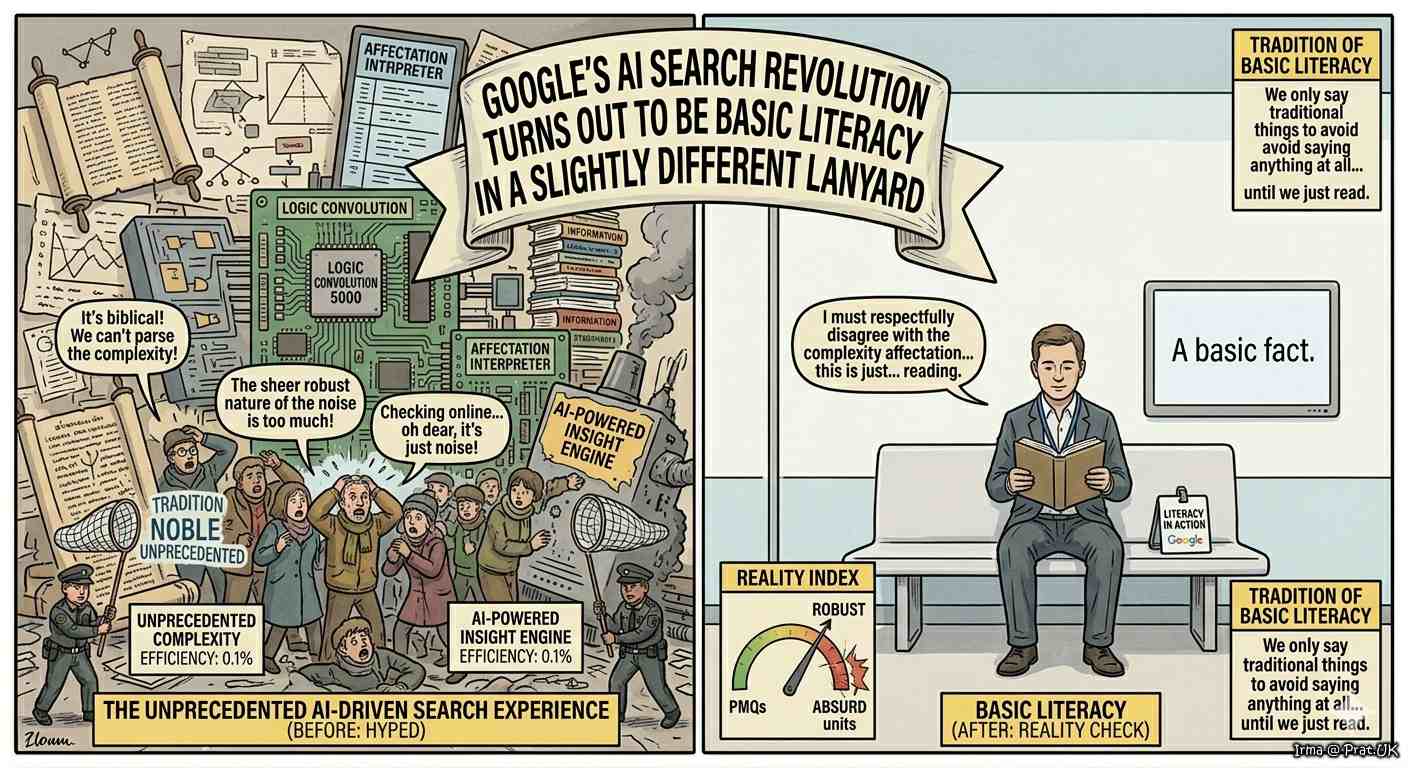
Google’s AI Search Revolution Turns Out to Be Basic Literacy in a Slightly Different Lanyard
Every SEO consultant in Britain now introduces himself as a “Generative Discovery Strategist,” which sounds less like a marketing professional and more like a man who sells crystals at a Bath farmers’ market while wearing a linen shirt that has never been ironed and cannot be ironed, for spiritual reasons.
LinkedIn users spent three years screaming “SEO IS DEAD!” only to discover Google’s official guidance amounted to: “Perhaps write something useful, Tarquin.” Tarquin has since updated his bio to “Conversational Intent Navigator.” Tarquin has not updated anything else, including his invoicing practices.
Thousands of digital marketers paid upwards of £12,000 for AI optimisation masterclasses, only to discover the secret technique was adding headings and not writing prose that reads like a council planning notice had a baby with a gym supplement label.
Silicon Valley gifted the world “AEO,” “GEO,” “LLMO,” and “SXO,” confirming once again that the tech industry considers adding vowels to abbreviations to be a form of intellectual contribution. Someone will soon invent “CRIKEY” and receive Series A funding for it.
One London-based SEO agency reportedly rebranded itself six times in a single quarter, accidentally invoiced the same client under four different trading names, and at one point sent a proposal for something called a “Digital Aura Harmonisation Retainer.” The client paid it. The client is no longer with us.
Google Quietly Confirms That Writing Coherently Is Still the Entire Strategy

The global SEO industry entered what City analysts are calling “The Great Buzzword Recession” this week after Search Engine Journal reported that Google’s newest AI search guidance had quietly acknowledged that “AEO” and “GEO” are essentially just SEO with a different lanyard and a hotel breakfast that costs £24.
The announcement sent immediate tremors through LinkedIn, where thousands of British digital marketers abruptly stopped posting sepia-toned photographs of themselves standing in front of motorway service stations captioned “Grateful. Focused. Growing. 🚀”
Eyewitnesses described the atmosphere online as “like watching a timeshare presentation realise it’s being filmed.”
For nearly three years, the British tech commentariat had insisted traditional SEO was finished. Entire consulting empires arose promising salvation through “Answer Engine Optimisation,” “Generative Engine Optimisation,” and one particularly aggressive Shoreditch outfit called “Quantum Intent Discovery Layering,” which, according to leaked seminar footage, turned out to mean “put keywords in headings.” The seminar was held in a railway arch. Prosecco was extra.
Digital Marketers Devastated to Learn Google Still Rewards Useful Information
At an emergency marketing summit in Birmingham, over 3,000 consultants gathered in a conference suite that smelled of carpet cleaner and broken dreams.
“We were told AI search would obliterate everything we knew,” whispered Jasper Whitmore, a self-described “Narrative Visibility Futurist” wearing trainers that cost more than the average Midlands mortgage payment. “Then Google releases this document and apparently the strategy is still… helpful content?”
He stared at his oat flat white for a long moment before adding, “That’s not a scalable offer.”
Industry panic deepened after Google’s published guidance confirmed that AI systems continue to favour authority, clarity, expertise, and well-structured pages — the same things Google has been saying since roughly the second series of The Apprentice.
The room fell silent except for one man at the back quietly muttering, “Blimey. They want actual sentences.”
Why British SEO Agencies Will Never Stop Inventing New Acronyms for Old Tricks
The rebranding cannot stop because the economics make stopping impossible. You cannot charge £12,000 for a course entitled “Write Clearly.” You absolutely can charge £12,000 for “Agentic Semantic Visibility Architecture for Conversational Intent Ecosystems,” particularly if the sales page features drone footage of Canary Wharf at golden hour and a testimonial from someone called “Marcus T., Founder.”
According to research tracking over 150 AI SEO industry statistics, the average AI search result links to roughly 13 sources — meaning the strategy of “be a credible, readable source that people can trust” remains, frustratingly, the correct one. Consultants who bet their reputations on proprietary llms.txt frameworks and “chunking architectures” are now holding an invoice for services Google specifically told them were unnecessary. Several have pivoted to crystals.
LinkedIn Enters a Period of National Mourning as the Acronym Economy Collapses
No community suffered more than British LinkedIn influencers, many of whom had spent the better part of eighteen months filming emotional video content explaining that SEO was dead and the future belonged to whoever understood “intent atmospherics” first.
By Tuesday lunchtime, the pivots had begun.
One former “AI Search Prophet” now lists himself as a “Synthetic Query Alignment Evangelist.” A prominent “SEO Queen 👑” has rebranded as a “Conversational Discovery Architect™.” A third deleted his account entirely and is reportedly running a sourdough subscription service in Totnes. His first loaf was described by a reviewer as “under-optimised for flavour discovery.”
A poll conducted by the respected market research firm Opinions & Vibes Ltd found that 83% of British digital marketers had no idea what GEO actually meant but were professionally embarrassed to ask. A further 9% believed GEO was a children’s television programme. The remaining 8% were attempting to sell the other 92% a bootcamp about it.
The £12,000 Course Industry Takes a Rather Direct Hit From Google’s Documentation Team
Perhaps the most spectacular casualty was the AI certification market, which had spent two years persuading panicked business owners that salvation lay in purchasing “AI Search Dominance Systems” delivered across twelve Zoom modules.
These programmes characteristically featured: drone footage of East London, men in slim-fit blazers pointing at bar charts, the phrase “attention arbitrage” used as though it were a technical term, and at least one sponsored appearance by someone who had once been on Dragons’ Den.
One webinar promised to reveal “the hidden GEO ranking factors Big Tech doesn’t want you to know.” According to attendees, Module One was “write answers to questions people are asking.” Module Two was “use subheadings.” Module Three was a Spotify playlist and a politely worded request to leave a five-star Trustpilot review.
Professor Ingrid Gustafsson of the Scandinavian Institute for Algorithmic Trauma called it “the most efficient transfer of money from confused business owners to confident men in airport lounges since the great SEO gold rush of 2011.” The Institute, which does not exist, would nonetheless have an excellent E-E-A-T score.
British SEO Agencies Rebranding at a Speed That Would Embarrass the Conservative Party
Agencies across the country moved swiftly to adapt, which in practice meant updating their websites while changing nothing else whatsoever.
One London firm cycled through the following homepage titles in a single fortnight: “SEO Experts” → “AI Visibility Optimisation Engineers” → “Generative Presence Consultants” → “Digital Discovery Ecosystem Sherpas.” Nobody on the premises could explain what any of these phrases meant. The Sherpas were unavailable for comment, possibly because they were still optimising their thought leadership.
A former account manager described internal meetings where senior partners spent the better part of a working day debating whether “discoverability” sounded more premium than “findability.”
“The whole industry became a thesaurus with an overdraft facility,” she said, sheltering from the rain outside a Pret on Bishopsgate. The thesaurus had not been optimised for generative search. The overdraft was performing adequately.
How Traditional SEO Has Been Quietly Working Perfectly Throughout the Entire Pantomime
While Shoreditch was busy coining LLMO and staging “intent atmosphere audits” in converted warehouses, actual search performance continued to be driven by what SEO practitioners have documented for the better part of two decades: technical accessibility, topical authority, quality inbound links, and content written for human beings rather than for impressing other consultants at rooftop networking events.
Business owners across Britain received Google’s AI guidance with characteristic equanimity. “So I should just have a proper website that people can actually use?” asked Sandra Birtwistle, owner of a carpet fitting company in Huddersfield. “Our Colin said that in 2008.”
Analysts suggest Sandra is now overqualified to run a growth marketing agency in Clerkenwell.
What the Comedians Make of the Great AI SEO Circus
“The SEO industry is extraordinary. Every eighteen months they put a different hat on the same idea and charge you a consultancy day rate to explain why the hat is revolutionary.” — Jack Dee
“I love how they call it a ‘content ecosystem.’ It’s a website, mate. It’s a website with some spelling mistakes and a stock photo of a woman laughing at a salad.” — Frankie Boyle
“These courses crack me up. Module One: write helpful things. Module Two: use headings. Module Three: here is some ambient music, please review us on Trustpilot. Twelve hundred pounds, please.” — Jimmy Carr
“I went to one of these AI search summits. There were 400 people in a room solemnly discussing ‘semantic intent signals.’ Not one of them could tell me what their company actually does.” — Dara Ó Briain
Google Engineers Politely Request That People Stop Writing Like Terms and Conditions
According to sources close to the search quality team, Google’s deeper frustration involves the sheer volume of web copy that became actively unreadable during the AI optimisation gold rush.
One engineer reportedly described the modern internet as “like being handed a menu written entirely in corporate press release, in a restaurant where nothing on the menu is food.”
Recent AI-optimised British business websites reportedly included straplines such as: “Empowering Transformative Stakeholder Journeys Through Adaptive Conversational Intent Architecture.” The company sold guttering. The guttering was not transformed. The stakeholders were not empowered. Several downpipes remained blocked.
Google’s updated guidance emphasised expertise, trustworthiness, and writing that sounds as though a person produced it — which the industry had previously considered a creative limitation rather than the entire point.
A support group has reportedly convened in Bristol for former SaaS copywriters attempting to relearn the English language. Early sessions cover using concrete nouns, finishing sentences, and resisting the compulsion to describe a loft conversion as a “vertical spatial transformation opportunity.”
The Lasting Damage: How SEO Jargon Made Swathes of the Internet Genuinely Unreadable
The more serious consequence, beneath all the absurdity, is that the buzzword arms race produced a genuine degradation in content quality across British industries — healthcare, legal services, financial advice, home improvement — where legitimate information was buried under algorithm-chasing prose that no actual human would voluntarily read. The supreme irony is that the AI now powering Google’s search increasingly prefers content that sounds as though a human being wrote it for another human being to read.
The ouroboros has consumed itself. The snake is full. The snake is offering a six-week mentorship programme for £1,800 plus VAT.
The Tech Industry Remains Convinced That Coining Acronyms Constitutes Progress
Despite the chaos, industry observers expect the cycle to continue without interruption.
Whispers are already circulating about the next frontier: AISO, Predictive Narrative Surfacing, Agentic Visibility Mapping, and Emotional Query Resonance. One startup has recently secured £15 million in Series A funding for something called “Contextual Intent Atmospherics.” Sources confirm it is a blog about scented candles. The candles are not optimised for anything. They are candles.
The cycle, as historians of internet foolishness now understand it, is immutable: marketers declare something dead, rename it, charge more for it, and wait for Google to say “please calm down.” Then somebody raises £15 million.
Dr. Elias Wren of Cambridge’s Centre for Internet Hysteria — which is a real place, in the sense that Cambridge contains many rooms full of people thinking about the internet and sighing — described the phenomenon as “putting a false moustache on the same fellow and expecting a different outcome.”
“Call it GEO, AEO, LLMO, or Quantum Discovery Atmospherics,” he said. “In the end, Google wants pages that are not rubbish.”
He was immediately blocked by 5,200 consultants on LinkedIn. Four of them sent him invoices for “unsolicited ecosystem disruption.” One offered him a complimentary discovery call.
This work of British satirical journalism was produced through an intensely caffeinated collaboration between the world’s oldest tenured professor and a philosophy major turned dairy farmer who once paid £600 for an SEO webinar that turned out to be a PowerPoint presentation about paragraphs, delivered by a man who had clearly never finished reading one. No digital marketers were harmed during production, though several did attempt to trademark the phrase “AI Narrative Dominance Stack™” and at least one filed a complaint with the ICO about the unlicensed use of the word “clarity.”
Auf Wiedersehen, amigo!

Alan Nafzger was born in Lubbock, Texas, the son Swiss immigrants. He grew up on a dairy in Windthorst, north central Texas. He earned degrees from Midwestern State University (B.A. 1985) and Texas State University (M.A. 1987). University College Dublin (Ph.D. 1991). Dr. Nafzger has entertained and educated young people in Texas colleges for 37 years. Nafzger is best known for his dark novels and experimental screenwriting. His best know scripts to date are Lenin’s Body, produced in Russia by A-Media and Sea and Sky produced in The Philippines in the Tagalog language. In 1986, Nafzger wrote the iconic feminist western novel, Gina of Quitaque. He currently lives in Holloway, North London. Contact: [email protected]