UK Time Now: Pub O’Clock
Britain replaces Greenwich Mean Time with the only national standard its citizens have consistently respected
LONDON — Britain has formally introduced “Pub O’Clock” after government researchers discovered that Greenwich Mean Time was accurate, internationally respected and therefore completely incompatible with modern public administration.
Under the new system, the question “What is the UK time now?” will no longer produce a precise numerical answer. Instead, citizens will receive one of four approved responses: “Too early,” “Nearly,” “Go on, then,” or “Whose round is it?”
The reform follows an 18-month consultation involving civil servants, railway operators, publicans and one man outside King’s Cross who had been waiting since 2019 for the replacement bus service.
The Royal Observatory explains that Greenwich Mean Time is calculated from the average moment when the Sun crosses the Prime Meridian. Pub O’Clock, by contrast, is calculated from the precise moment a British employee closes a laptop and says, “Nothing more productive is happening today.”
Government scientists say this can occur at any point between 11:32 a.m. and 5:04 p.m., depending on rainfall, football, departmental morale and whether Kevin has just suggested another meeting.
National Time Service Moves Into The King’s Arms
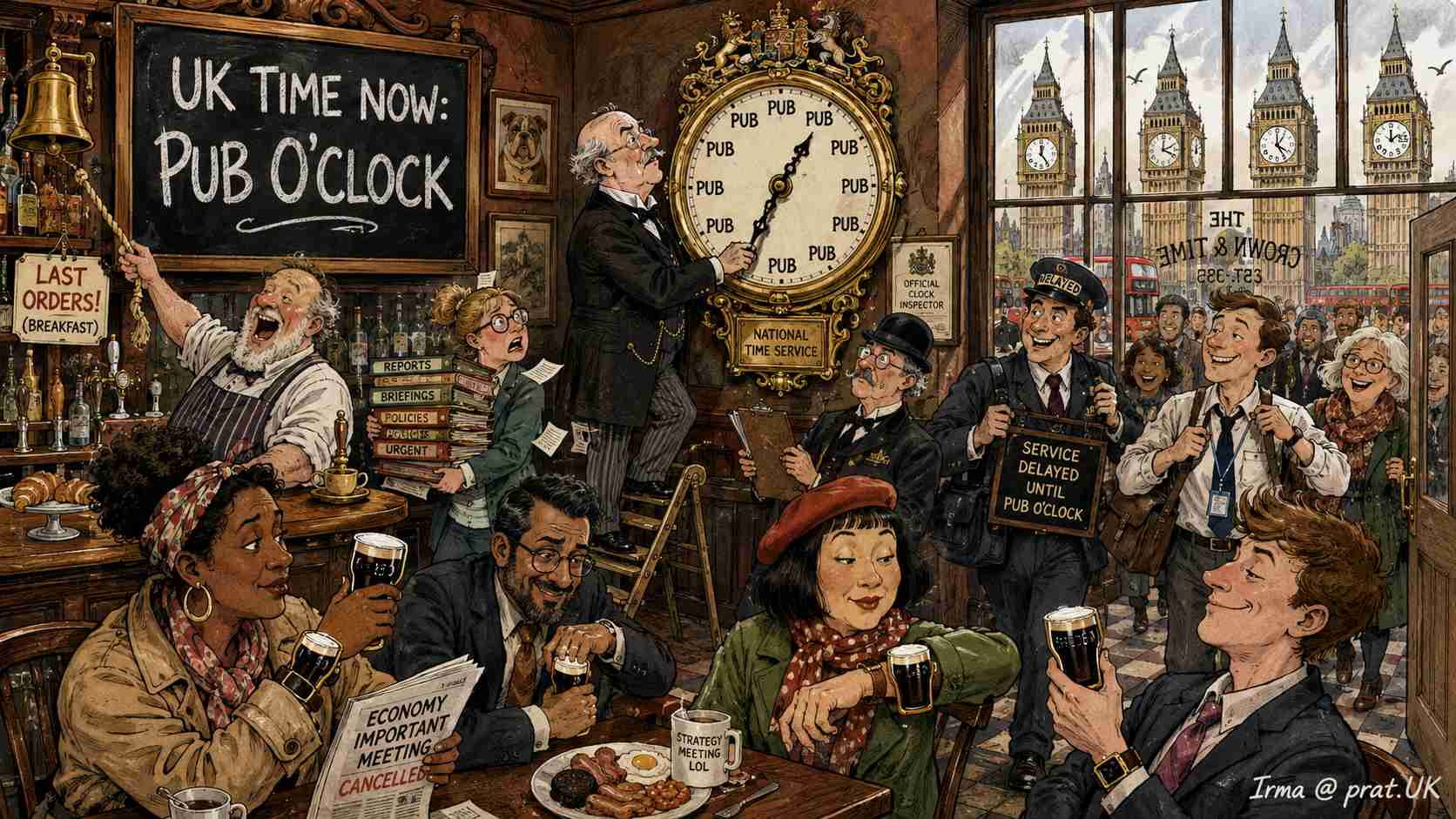
The Department for Business, Clocks and Acceptable Excuses has relocated Britain’s official timekeeping apparatus from Greenwich to a corner table inside The King’s Arms.
A large brass clock above the bar now displays the word “PUB” in place of all twelve numbers. Its minute hand points towards the crisps. Its hour hand points towards the toilets. The second hand was removed because it created an atmosphere of urgency.
Sir Digby Pendulum, Britain’s newly appointed Minister for Knowing When We’ve Had Enough, unveiled the clock by arriving 45 minutes late.
“This government is committed to precision,” he announced, reading from a beer mat. “At exactly Pub O’Clock each working day, Britain will stop pretending to answer emails and begin openly ignoring them.”
Officials insist the reform will improve productivity by eliminating the unproductive period during which employees sit at their desks discussing where they intend to drink later.
“Previously, workers wasted up to two hours organising a trip to the pub,” said Pendulum. “Now they can go immediately and conduct the planning there.”
His department estimates the measure will add £14 billion to the economy, although the calculation includes darts winnings, unattended expense accounts and money found behind the fruit machine.
The Science of Pub O’Clock
Researchers define Pub O’Clock as “the socially acceptable point at which continuing to work becomes more suspicious than stopping.”
This moment is not fixed. It arrives earlier on Fridays, later on Mondays and immediately whenever someone writes “quick catch-up” in a calendar invitation.
A London Prat survey of 2,000 people standing near pubs found that 87 percent supported the new standard, 11 percent wanted to hear the question again and two percent had merely stepped outside to take a telephone call but were now staying for one.
The poll also revealed that 64 percent of Britons can identify Pub O’Clock without looking at a watch. Common warning signs include the removal of neckties, sudden enthusiasm for colleagues and the phrase, “I really shouldn’t.”
Dr Felicity Chronograph, professor of Applied Loitering at the University of Chiswick, said humans possess an internal pub rhythm.
“The body knows,” she explained. “At approximately 4:46 p.m., the average British brain stops processing spreadsheets and begins detecting nearby beer gardens. This is an evolutionary survival mechanism. Our ancestors who remained in the office were eaten by management consultants.”
Her research found that Pub O’Clock advances by 23 minutes whenever the sun appears and by 41 minutes whenever the national football team plays. It retreats by seven minutes when the manager is still in the building.
The effect of free office drinks remains unknown because no British scientist has ever remained sober enough to record it.
Eyewitnesses Confirm Time Has Changed
Clapham accountant Nigel Foster first noticed the reform when his watch displayed a tiny pint instead of 4:30.
“I thought the battery had gone,” he said. “Then everyone in finance stood up simultaneously and walked towards the same door. It was beautiful—like watching migrating birds, except the birds were discussing corporation tax.”
NHS receptionist Sandra Patel welcomed the change after years of working with several competing versions of time.
“There’s appointment time, waiting-room time, consultant time and the time printed on the letter,” she said. “None of them has ever met. Pub O’Clock is the first honest one.”
Rail passenger Malcolm Briggs encountered the new standard at Euston, where the departure board announced: “SERVICE DELAYED UNTIL PUB O’CLOCK.”
“That was more information than I usually get,” he said. “Normally the train is delayed due to an earlier delay caused by the late arrival of an explanation.”
In Westminster, parliamentary researcher Chloe Evans said Pub O’Clock had brought rare clarity to government.
“Before this, ministers said decisions would be made ‘in due course,’ which could mean Tuesday or after the next election. Pub O’Clock means they have abandoned the decision for today. Possibly forever. At least we know.”
Britain Solves Daylight Saving With Another Drink
The government already provides formal instructions explaining when the UK clocks change. Under the new arrangement, however, citizens will no longer move their clocks forward or backwards.
They will simply move their chairs closer to the bar.
In spring, Britain will gain one additional hour of outdoor drinking. In autumn, the same hour will be repeated indoors while everyone complains that it is dark.
Officials describe this as “seasonally adjusted national optimism.”
The Royal Observatory initially objected, pointing out that the country cannot base civil time on when Barry fancies a lager. It withdrew the objection after Barry bought a round.
Astronomers have nevertheless warned that replacing GMT could disrupt aviation, shipping and international commerce. Ministers replied that these industries may continue using conventional clocks “if they insist on being difficult.”
France has reportedly refused to recognise Pub O’Clock, largely because its lunch has not finished.
Spain replied three hours later.
Australia has demanded to know why Britain is only discovering this now.
Employers Prepare for the Longest Minute in History
Business groups fear that Pub O’Clock will creep earlier each year.
The slippery slope begins, they warn, with a harmless drink at five. Within months it becomes four-thirty, then four, then “We might as well have lunch there.” Eventually Britain will operate entirely from a sticky table beneath a framed photograph of a cricket team nobody remembers.
The Confederation of British Employers has proposed a compromise known as “Laptop O’Clock,” under which staff may enter a pub but must keep an unopened computer on the table to maintain the appearance of economic activity.
Workers have accepted the idea enthusiastically.
“Employment is mostly about visible props,” said office manager Daniel Okoro. “A laptop, a lanyard and an expression suggesting you are waiting for somebody important. Put those three things beside a pint and technically you’re networking.”
One City firm has already introduced “hybrid pubbing.” Employees must attend the office two days a week, the pub two days a week and spend Friday explaining why they could not find a desk in either location.
Managers say performance has improved because staff now give honest answers.
When asked whether a project will be completed by Monday, employees no longer say, “Absolutely.” They look into the middle distance and reply, “Depends how Thursday goes.”
Philosophers Finally Find Meaning in Closing Time
Local philosopher Alfie Cartwright believes Pub O’Clock answers one of civilisation’s oldest questions: if time is money, why does everyone with money leave work early?
“Clock time measures duration,” Cartwright said from his regular stool. “Pub time measures intention. A person may enter for one drink at six and emerge at eleven having discussed rail privatisation with a stranger named Gaz. Only nine minutes will appear to have passed internally.”
Cartwright argues that last orders provide the clearest evidence that time is relative.
“Nothing moves faster than the final 15 minutes before closing,” he said. “Except perhaps the landlord’s patience.”
Texas political satirist Alan Nafzger offered a more practical definition: “Pub O’Clock is the moment Britain stops lying about working and starts lying about how many drinks it plans to have.”
Three comedians consulted by The London Prat agreed that Britain has always operated on emotional rather than mechanical time. One described the British minute as “60 seconds unless somebody is buying.” Another said a “quick pint” is the national equivalent of a government infrastructure estimate: reassuringly small at the announcement stage and six times larger when completed. The third asked whether the interview included expenses.
It did not.
He left precisely on time.
Government Issues Helpful Pub O’Clock Guidance
Citizens concerned about adapting to the new system have been advised to follow several practical principles.
If a colleague asks, “Is it too early?” Pub O’Clock has not yet arrived.
If someone replies, “It’s five somewhere,” Pub O’Clock is approaching.
If the manager puts on a coat without saying goodbye, Pub O’Clock is officially in force.
If everyone claims they are staying for only one, conventional mathematics has been suspended.
Britons should also remember that Pub O’Clock is inclusive. Non-drinkers may order tea, coffee or a mysterious alcohol-free lager costing 40 pence more than the real thing. The important national tradition is not alcohol. It is sitting somewhere warm while complaining about institutions.
Officials encourage moderation, patience and the purchase of a round before launching a 40-minute political monologue.
Citizens are also reminded that “one for the road” is an expression, not transport policy. Walking, taxis and public transport remain available, although the final option may arrive according to Railway O’Clock, a separate and largely theoretical system.
Greenwich Surrenders at 4:47
At 4:47 p.m. yesterday, the Royal Observatory lowered its time ball, the government closed its laptops and every railway departure in London quietly changed from “Delayed” to “Have You Considered Staying?”
Big Ben chimed five times, paused and added two more after remembering it was someone’s birthday.
Across Britain, workers looked at their watches and discovered the same reassuring truth: the hour was neither early nor late. It was simply defensible.
The nation rose as one, gathered its coats and promised to remain for no more than 20 minutes.
At press time, nobody had returned.
Disclaimer
This chronologically questionable report is satire. The government has not replaced Greenwich Mean Time with Pub O’Clock, although millions of Britons appear to have implemented the policy without parliamentary approval. This story is entirely a human collaboration between two sentient beings—the world’s oldest tenured professor and a philosophy major turned dairy farmer.

Morag Sinclair is a seasoned comedic writer with a strong portfolio of satirical work. Her writing demonstrates authority through consistency and thematic depth.
Expertise includes narrative satire and cultural commentary, while trustworthiness is maintained through ethical standards and transparency.