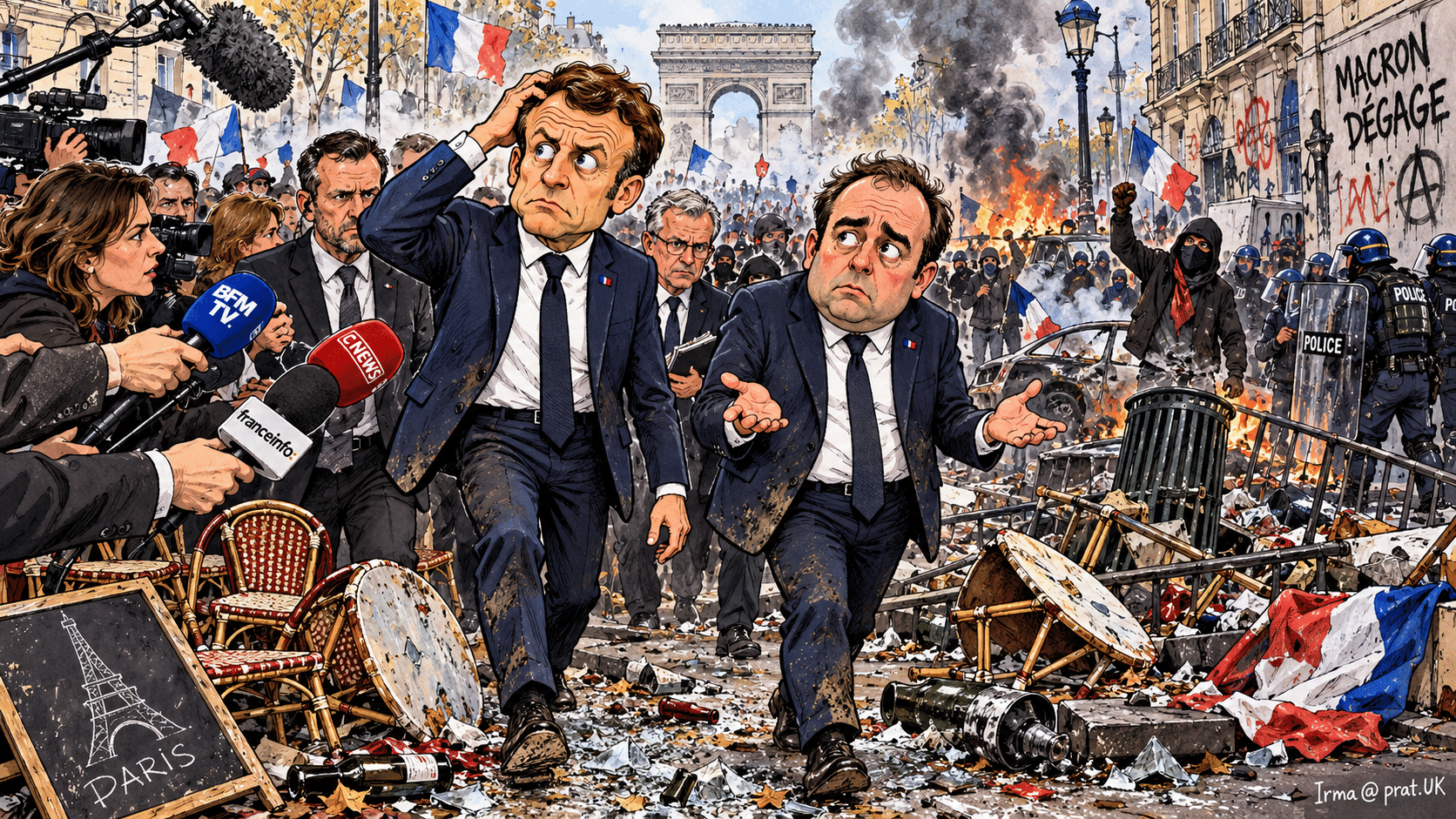
Protesters Want President Fixing Problems Assigned to Somebody Else
PARIS, October 22, 2026 – French socialist activists have condemned President Emmanuel Macron for spending time abroad conducting international diplomacy during a domestic crisis, arguing that his constitutional responsibilities should never get in the way of the far more important business of being available for denunciation in Paris.
Macron visited Kuwait, the United Arab Emirates, Bahrain and Qatar between October 19 and 21, pursuing diplomatic and energy agreements while France struggled with rising fuel prices. His Gulf trip produced commitments on diesel and natural gas supplies, according to The National’s report on Macron’s Gulf energy agreements.
The socialist response was immediate.
“Why is Macron negotiating fuel supplies when French people are protesting about the price of fuel?” demanded a revolutionary committee.
Economists have so far been unable to answer the question without using words that offend somebody.
Socialist Foreign Policy Depends on Everyone Staying Home
French Marxists have proposed replacing traditional international diplomacy with a simpler system in which the president stays permanently available in Paris while foreign countries agree to whatever France needs.
Under the proposal, Gulf governments would supply energy at affordable prices without the inconvenience of diplomatic negotiations, contractual agreements or discussions about their own national interests. The Gulf Cooperation Council was not consulted.
“This would eliminate expensive presidential travel,” explained a spokesman for the Revolutionary Committee for Economically Sustainable Global Solidarity.
Asked how France would obtain foreign energy without negotiating with foreign suppliers, he said international cooperation should be compulsory.
Asked who would make it compulsory, he suggested creating an international enforcement authority.
Asked how much this authority would cost, he accused the reporter of neoliberal accounting.
The committee praised its proposal anyway as a breakthrough in economic thinking.
It also demanded an immediate public subsidy for future international revolutionary conferences, which would necessarily involve air travel.
Prime Minister Lecornu Left Holding the Government
Meanwhile, Prime Minister Sébastien Lecornu has been in talks with French trade unions, which is roughly what you’d expect from a head of government in the middle of a domestic political crisis.
The development has caused widespread consternation among activists who believe that running the country should be the exclusive responsibility of whoever appears most often on television.
France’s constitutional system gives the government responsibility for national policy and the prime minister responsibility for directing government activity, as set out in the text of the 1958 Constitution.
Macron, as president, also holds substantial domestic powers and political influence. The two offices share the executive stage rather than living in separate constitutional apartments.
Militants have nevertheless concluded that the arrangement unfairly spreads the blame across multiple political offices.
“How are we supposed to overthrow the government if we have to understand its organizational structure?” demanded one demonstrator.
A constitutional expert suggested that political reform usually begins with identifying the powers you want to change.
The expert was immediately removed from the discussion for introducing technical difficulties into an emotional process.
Protest Committee Demands an Omnipresent President
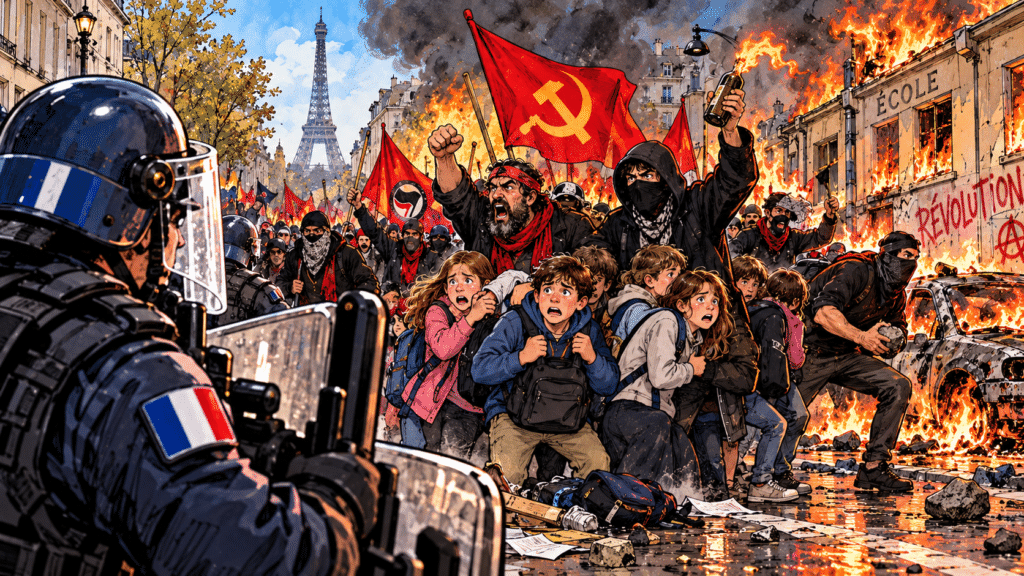
The protest committee has also demanded that Macron personally appear at every location experiencing a public-policy problem.
The proposed presidential schedule begins at 6 a.m., when Macron must inspect supermarket food prices.
At 7 a.m., he must fix commuter rail delays.
By 8 a.m., he must visit every underfunded university.
At lunchtime, he must negotiate salaries for all public-sector workers.
At 2 p.m., he must inspect residential heating bills, and by 4 p.m., he must personally explain why the revolution has failed to arrive despite several generations of exceptionally enthusiastic posters.
Foreign policy may be conducted between appointments, provided the president does not leave France.
The committee acknowledged that this arrangement might prove exhausting but insisted that political leaders should work harder.
Its members would supervise implementation from a publicly funded café.
French Motorists Ask Whether Affordable Diesel Counts as Domestic Policy
Ordinary French motorists have expressed the unreasonable hope that international energy diplomacy might eventually make driving cheaper.
This has created a philosophical difficulty.
If Macron successfully negotiates extra diesel supplies abroad, French motorists could benefit at home.
But if international diplomacy improves domestic living conditions, the revolutionary distinction between foreign travel and domestic responsibility begins to collapse.
Activists have therefore proposed a new principle: any policy introduced by Macron must be considered unsuccessful until implemented by somebody politically acceptable.
Asked whether a lower fuel price would still be welcome, one spokesman admitted that affordable petrol presented a complicated ideological challenge.
“We support lower prices,” he explained. “We simply oppose the market, international trade, private oil companies, commercial contracts and the financial incentives that encourage people to produce fuel.”
The reporter asked what remained.
“Solidarity.”
Asked how many litres of solidarity a motorist could buy for twenty euros, the spokesman terminated the interview.
Revolutionary Foreign Policy Manifesto Finalized
By Wednesday evening, the radical committee had completed its proposed foreign policy manifesto.
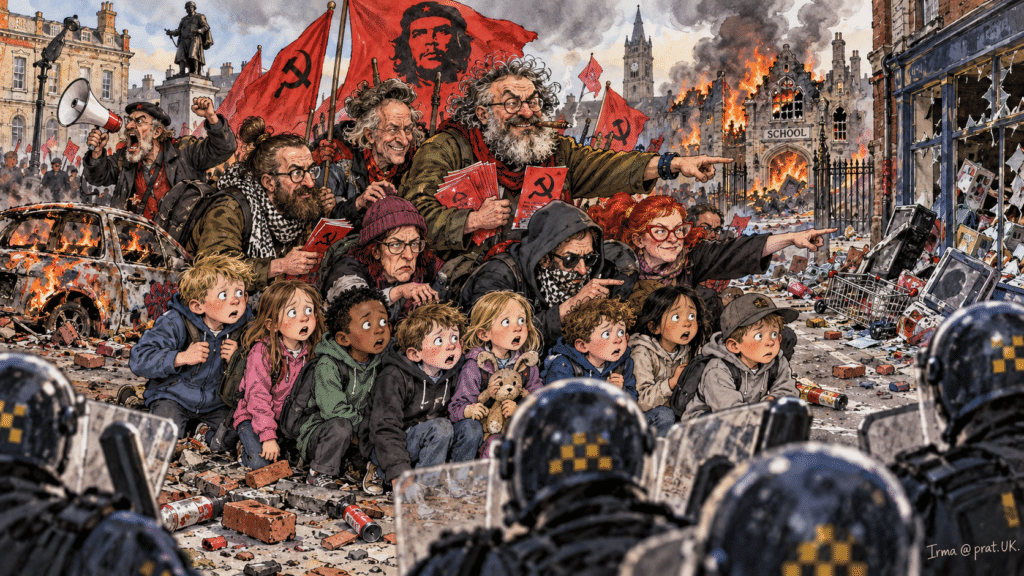
France would demand international cooperation while condemning globalization, welcome affordable imports while opposing international commerce, and pursue energy security while discouraging investment in the industries that supply energy.
The president would be forbidden from leaving Paris during any domestic controversy.
Since France always has at least one domestic controversy, the restriction would effectively be permanent.
Macron’s office was reportedly relieved to learn that at least one group in France wanted the president to spend more time inside the country.
Unfortunately, the protesters also wanted him to resign immediately.
The revolutionary committee described this as a perfectly consistent position.
It wanted Macron present so it could tell him to leave.
Five Humorous Observations
- The guy was gone three days. Three days. My wife’s cousin goes to the bathroom longer than that at a wedding, and nobody calls an emergency committee.
- Their plan for getting oil is to ask other countries nicely and make it mandatory. That’s not diplomacy. That’s a toddler at a restaurant.
- A 6 a.m. start, supermarket prices, then trains, then universities, then every public-sector salary in France. That’s not a presidential schedule. That’s a Taylor Swift tour with worse catering.
- Litres of solidarity for twenty euros. You know what you get for twenty euros of solidarity? A hug and a parking ticket.
- They want him home so they can tell him to leave. That’s not a political position. That’s a teenager slamming a door and then yelling that nobody’s coming to check on her.
This disclaimer stayed home to do the Prime Minister’s job. The quotes, committees and proposals are comic scenarios rather than statements by real protest organisers, and legitimate grievances about living costs are not the same as rioting and looting. Find more UK satire looking across the Channel.

Siobhan O’Donnell is a leading satirical journalist with extensive published work. Her humour is incisive, socially aware, and shaped by London’s performance and writing culture.
Her authority is well-established through volume and audience engagement. Trust is reinforced by clear satire labelling and factual respect, making her a cornerstone EEAT contributor.