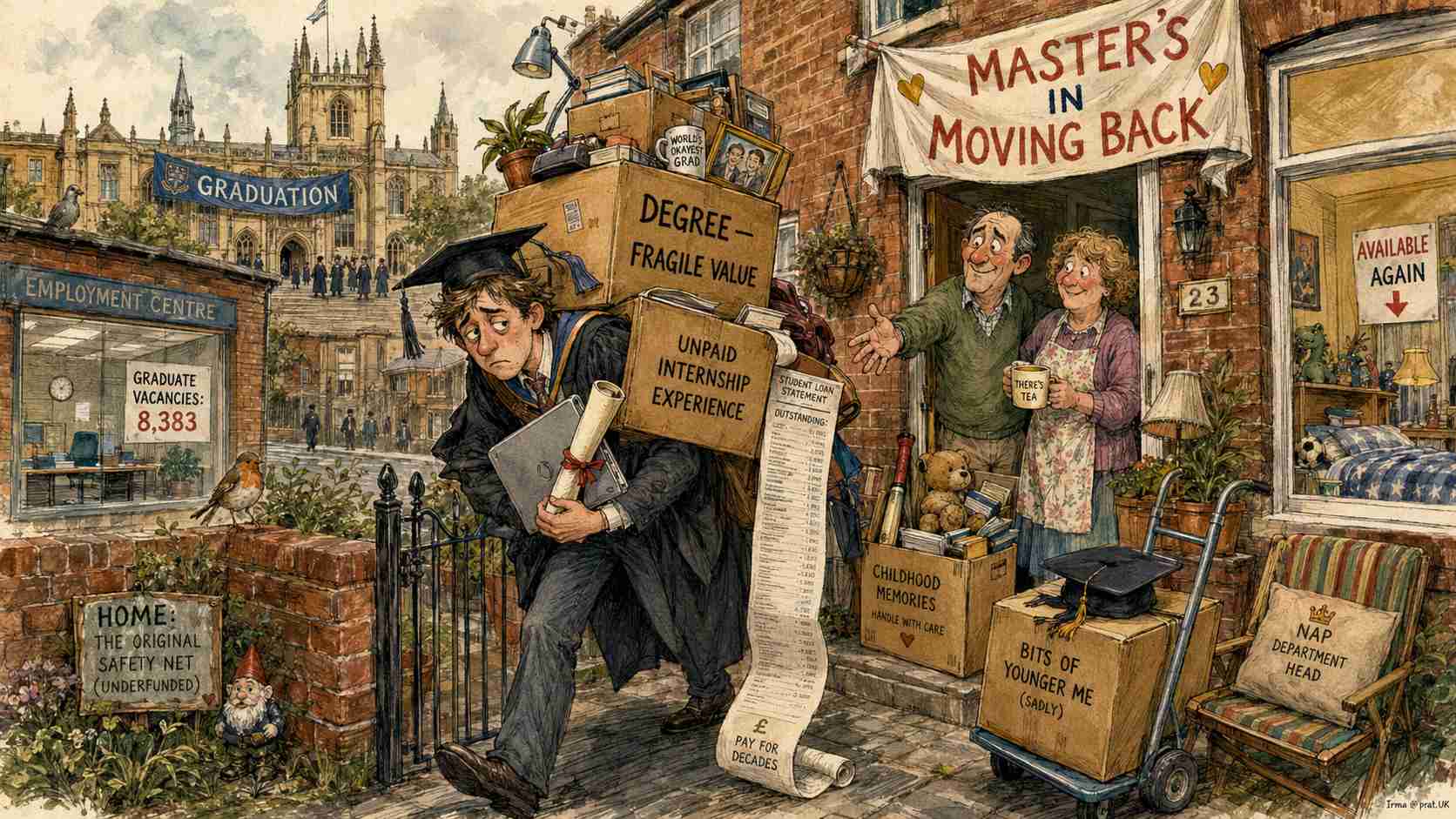
UK Graduate Jobs Fall to Ten-Year Low, Universities Add Master’s Degree in Moving Back With Parents
Class of 2026 enters an exciting employment market offering unpaid experience, emotional resilience and a staff discount on despair.
LONDON — Graduate vacancies in Britain have reportedly fallen to their lowest level in a decade, a development highlighted in The Guardian’s 24 August UK political and economic news summary. Universities responded by moving the graduation ceremony closer to the Jobcentre.
Young adults were told that higher education would unlock opportunity. It has. Unfortunately, the opportunity is a six-month internship requiring three years’ experience, fluency in Mandarin and personal ownership of a forklift.
Entry-level jobs require four interview rounds because junior spreadsheet administration carries nuclear-launch responsibilities. — Alan Nafzger
The graduate job market, now with fewer graduate jobs
Economic uncertainty, cautious hiring and technological change are squeezing vacancies, a pattern tracked by the Institute of Student Employers and reflected in labour-market statistics from the Office for National Statistics. Artificial intelligence is increasingly handling junior research, administration and drafting — precisely the tasks that once gave graduates their first experience, their first competence and their first appalling office anecdote.
Employers insist technology will create new opportunities. Graduates eagerly await the chance to apply for AI Governance Synergy Associate, an entry-level position requiring ten years’ experience governing technology invented last Thursday.
Entry-level jobs now require four interview rounds, because junior spreadsheet administration apparently carries nuclear-launch responsibilities. Companies simultaneously complain about skills shortages while rejecting 900 applicants through software because one wrote organised with an “s” and the filter preferred a “z.”
The national contradiction nobody wants to solve
The crisis exposes a genuine British paradox. The country wants young people educated, skilled, independent, taxpaying and producing children. It then charges them high rent, removes entry-level work, places houses beyond reach and asks why the birth rate has become unpatriotic.
A £50,000 student debt is now the most expensive possible route to the phrase competitive salary. Analysis from the Institute for Fiscal Studies has shown for years that the graduate premium varies enormously by course, institution and luck — a nuance rarely mentioned in prospectuses featuring a smiling student on a lawn.
Universities, meanwhile, advertise employability statistics based partly on whether graduates are doing anything at all. A philosophy student working weekends at a cinema may therefore count as successfully deployed within the audiovisual ethics sector. Official destination data is published by HESA, which is admirably honest and read by nobody choosing a degree at seventeen.
A prat.UK graduate survey found that 36% planned to pursue further study, 29% would accept work outside their chosen field, 21% were considering leaving Britain and 14% had achieved financial independence by selling their university furniture to the next tenant.
Flexibility, the British euphemism of the decade
Government ministers urge graduates to remain flexible. In Britain, flexibility means moving to a city where rent consumes 70% of salary, accepting temporary work, and pretending the communal kitchen’s mushroom is part of the décor.
Parents who spent eighteen years preparing children to leave home are now receiving them back with a degree, a sourdough starter and strong views about the thermostat.
A survival guide for the class of 2026
Helpful advice still exists, and most of it is unglamorous. Build demonstrable work samples rather than describing potential. Develop digital and data skills that survive automation. Use alumni networks shamelessly, since the person who ignores your message costs you nothing. Apply beyond the twenty headline employers everyone else is applying to, because that is where the filter is thickest. Career resources at Prospects and the National Careers Service remain free and underused.
Finally, learn to describe ordinary competence in the dialect of recruitment:
- Answered telephone becomes “managed multi-channel stakeholder engagement.”
- Made tea becomes “delivered hot-beverage solutions within time-sensitive operational environments.”
- Fed cat becomes “maintained executive-level mammalian stakeholder satisfaction.”
Employers might consider doing something too
Businesses should reconsider automated filters and inflated experience demands. If every entry-level position requires prior experience, society eventually produces a generation professionally qualified only to apply for positions — a skill of no commercial value and enormous emotional cost.
Graduate unemployment is not proof that degrees are worthless. It is evidence that education policy, housing supply, business investment and labour demand are badly aligned, and have been for a decade regardless of who occupied Downing Street.
Britain has created highly educated young adults and an economy visibly unsure what to do with them. Naturally, government will commission a review led by someone who entered the civil service directly from Oxford in 1989.
Applications for the review panel require previous review-panel experience.
Humorous observations on the graduate job market
- Employers demand graduates with experience, while experience demands employers willing to employ graduates.
- A £50,000 student debt is now the most expensive way to qualify for competitive salary.
- Companies complain about skills shortages while rejecting 900 applicants through software over a single letter “s.”
- Parents who spent eighteen years preparing children to leave home are receiving them back with strong views about the thermostat.
- Britain wants young people to have children, then prices bedrooms as though they are optional.
- The only growth industry for graduates is applying.
- The review into youth unemployment will be led by someone who has never applied for a job online.
Disclaimer: This is economic satire based on reported UK news developments from August 2026. Surveys, job titles and communal mushrooms above are comic devices rather than literal reporting.

Harper Thames is a comedic writer exploring modern life through irony and subtle exaggeration. Rooted in student perspectives and London’s cultural landscape, Harper’s work focuses on relatable humour grounded in everyday experience.
Expertise is developed through writing practice and critical engagement, while authority comes from authenticity and consistency. Trust is reinforced by transparent satire and ethical humour choices.