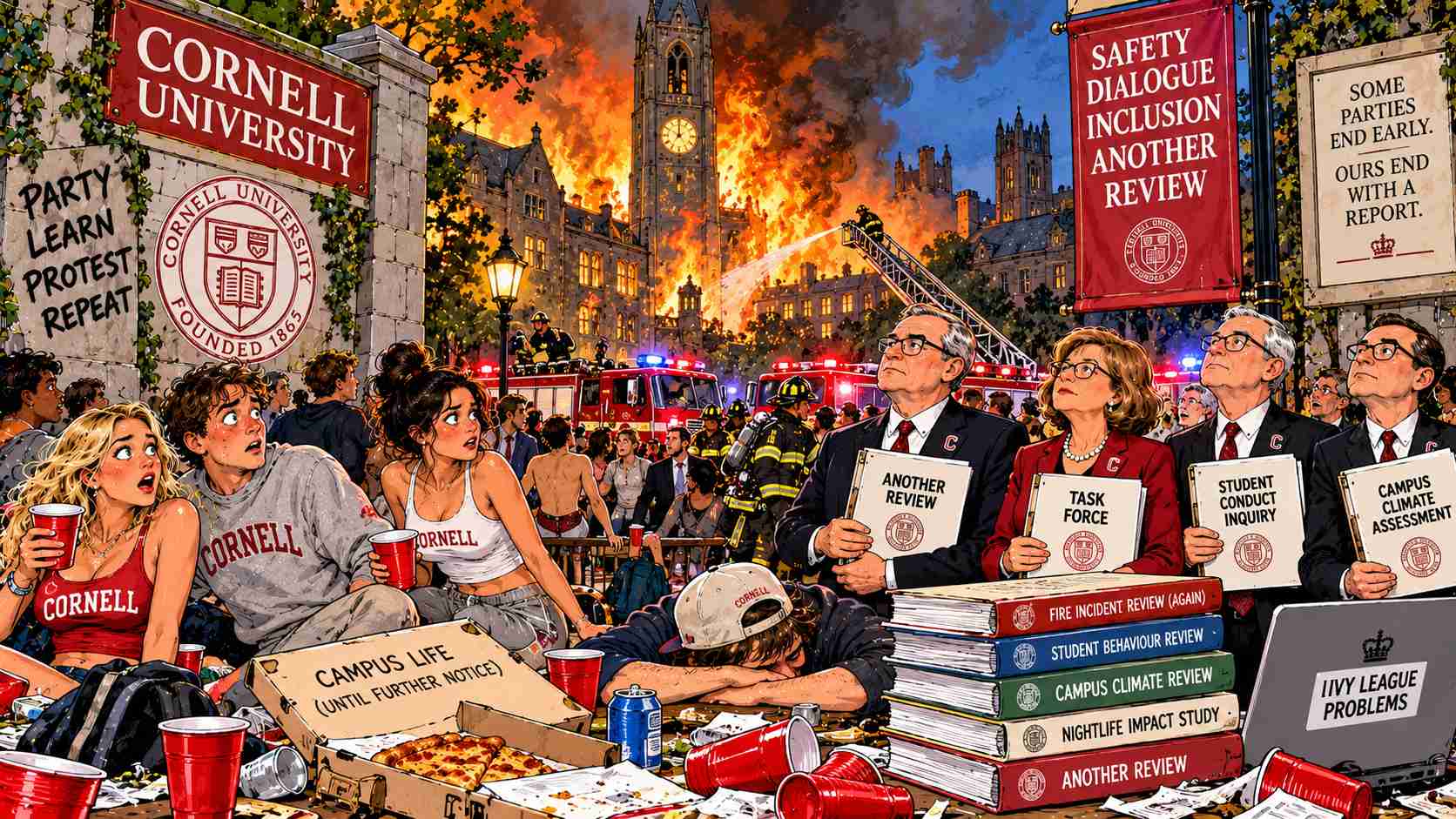
Cornell Students Stop Partying, University Realises Things May Actually Be Serious
After a week of turmoil, Ithaca nightlife grows strangely quiet as administrators deploy the most powerful weapon available to American higher education: another review
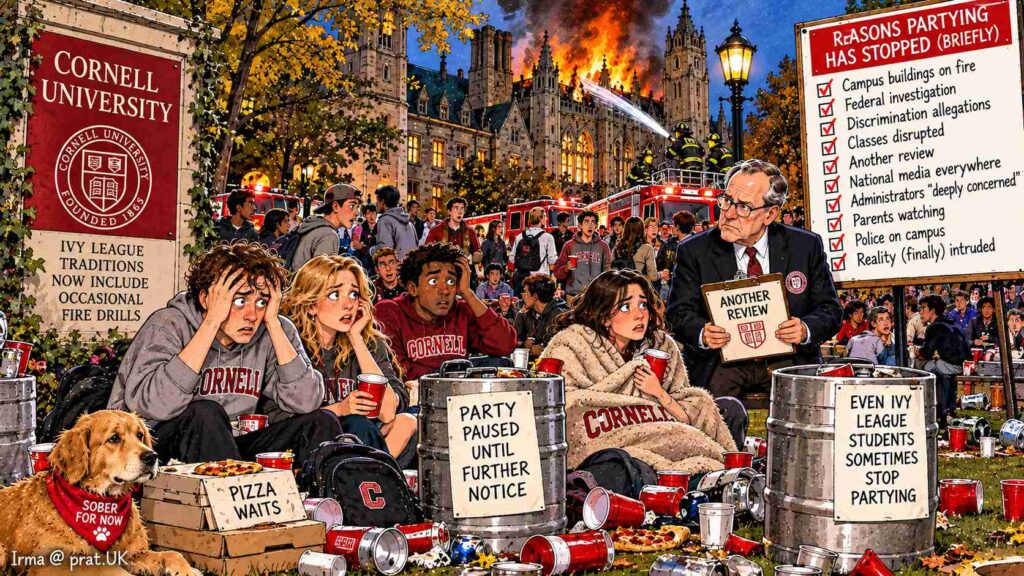
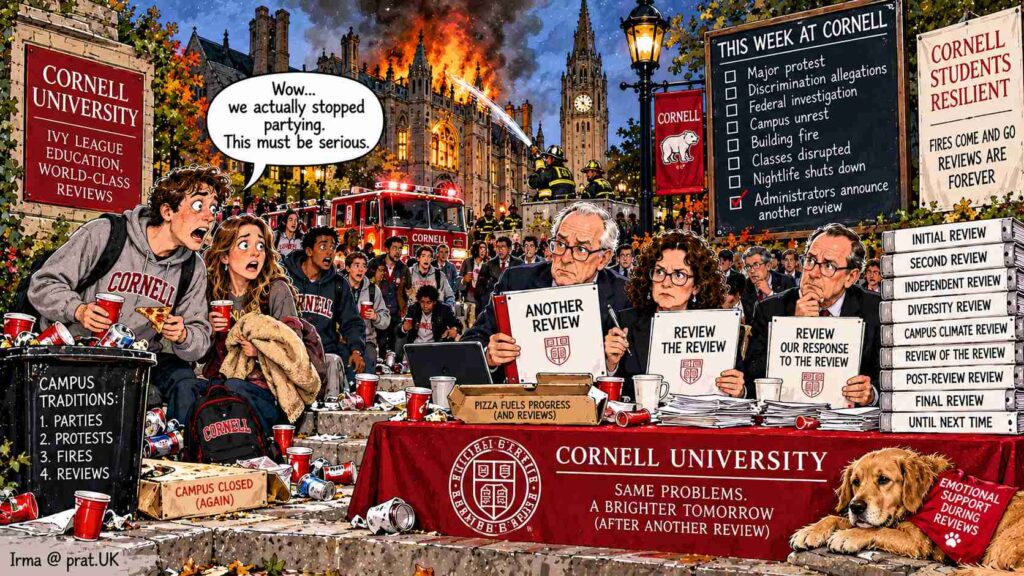
ITHACA, NEW YORK — The New York Times reported Sunday that a “heavy cloud” had descended over student life at Cornell University, with an unusually subdued weekend following days of controversy surrounding allegations of sexual assault at a Cornell fraternity, the university’s response, and its fraternity culture. Some students still went out, because apparently even an institutional crisis cannot completely defeat the American undergraduate’s ability to locate beer after 10 p.m.
Cornell Students Stop Partying
- Cornell students reportedly partied less for one weekend, immediately qualifying the event for preservation by the National Park Service.
- University administrators discovered that when students say they want “institutional accountability,” they do not mean a 73-page PDF with a new logo.
- Nothing communicates moral seriousness quite like appointing a committee to determine whether the previous committee communicated sufficient moral seriousness.
- The phrase “reflection paper” has now completed its journey from seventh-grade detention to Ivy League disciplinary jurisprudence.
- Cornell charges enough tuition that students presumably expected consequences to include something more substantial than, “Please think about what you did and use double spacing.”
Cornell Introduces Advanced Placement Remorse: The Chi Phi Case and the Reflection Paper
Cornell Discovers Even Ivy League Students Occasionally Stop Partying When Campus Is on Fire
Cornell University has entered the solemn phase of an American institutional controversy in which everybody agrees something must change and then immediately begins discussing whether the change should have subcommittees.
The underlying matter is serious.
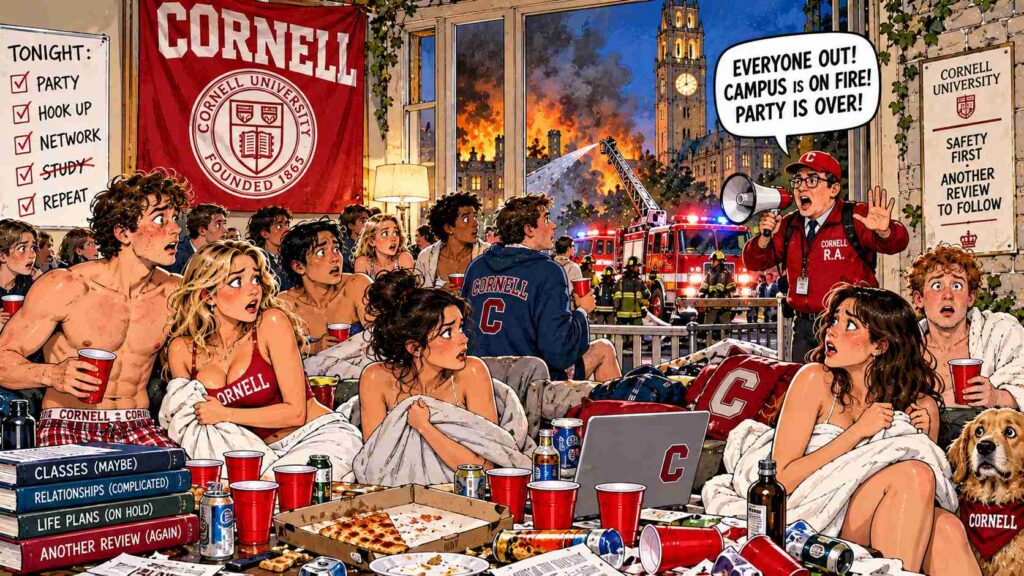
A former Cornell student has accused seven fraternity members of sexual assault stemming from events at a Chi Phi fraternity house in October 2024. The men have denied wrongdoing. Cornell conducted its own Title IX process, imposing sanctions that reportedly ranged from expulsions and suspensions to lesser penalties including training and, in at least one case involving a finding of attempted sexual exploitation rather than sexual assault, a reflection paper. The fraternity chapter was barred from campus. No criminal charges resulted from the original investigation. Tompkins County District Attorney Matthew Van Houten has since reopened the criminal investigation, and New York Attorney General Letitia James has opened a review of Cornell’s handling of the case.
And that brings us to the reflection paper.
There are phrases that simply refuse to survive contact with context.
“Reflection paper” is one of them.
A reflection paper is what you assign a teenager after he launches a tater tot across the cafeteria.
It is what a summer camp counselor demands after somebody puts shaving cream inside Kyle’s sleeping bag.
It is not a phrase you want appearing anywhere near national reporting about allegations this grave.
Yet academia loves written reflection because universities fundamentally believe that any human problem can be defeated if somebody writes 1,500 words about it using MLA formatting.
War?
Reflection paper.
Civil disorder?
Reflection paper.
Collapse of Western civilization?
Please discuss how the experience affected your understanding of community norms. Minimum four sources. Due Monday.
The Committee Will Investigate Why Everyone Hates Committees: Cornell’s Task Force on Campus Sexual Assault
Cornell had already established a Presidential Task Force on Campus Sexual Assault in February 2025. Its final recommendations, released in March 2026, called for prevention strategies, improved reporting information, education, training and greater institutional accountability.
That means the university was not unaware of the broader problem.
It had studied the problem.
It had convened people about the problem.
People had researched the problem.
Those people produced recommendations about the problem.
Administrators endorsed recommendations regarding the problem.
And then the country looked at Cornell and asked the one question nobody with a university parking permit ever wants to hear:
“Did any of that work?”
This is unfair to bureaucracy because bureaucracy was never designed to solve problems.
It was designed to demonstrate that problems had meetings.
There is an enormous difference.
A solved problem disappears.
A managed problem can support 14 administrators, three consultants, a vice provost and somebody called Associate Dean for Strategic Community Engagement.
That is an ecosystem.
You cannot simply destroy an ecosystem.
Cornell Discovers Statistics Are More Difficult to Ignore Than Brochures: What the 2025 Sexual Assault Survey Found
Cornell’s own 2025 Survey of Sexual Assault and Related Misconduct produced sobering results.
Among respondents, 35 percent of undergraduate women reported experiencing sexual assault during their time at Cornell, compared with 23 percent in the 2023 survey. Among Greek-affiliated undergraduate women responding to the survey, the figure was 52 percent, compared with 29 percent among women who were not Greek-affiliated. Cornell’s task-force report cautioned that the 2025 undergraduate response rate was only 13 percent, significantly limiting interpretation of the estimates. National coverage has repeated the figures, which has not made them any easier to ignore.
Even with that methodological warning, those numbers do not exactly scream:
“Perhaps another PowerPoint will straighten this out.”
Fifty-two percent is not a communications problem.
At 52 percent, the communications department should be allowed to go home.
The brochure has lost.
The glossy photograph of three ethnically diverse students laughing beneath an elm tree can no longer carry this operation.
At some point, an institution must consider the disturbing possibility that campus culture cannot be repaired entirely through improved messaging about campus culture.
Students Demand Radical New Policy Known as Telling Them Things: Campus Transparency and Accountability
Cornell students have pushed for greater disclosure and accountability. A Student Assembly proposal calls for more aggregate information about misconduct proceedings, explanations of how university offices coordinate with law enforcement, stronger protections for complainants and additional public meetings.
Students refer to this philosophy as “transparency.”
Administrators traditionally call it “Whoa, let’s not get crazy.”
Transparency sounds terrific when engraved on the wall of a leadership institute.
It becomes considerably less attractive when somebody asks:
“So who knew what?”
“When?”
“What was sent to prosecutors?”
“What wasn’t?”
“Why?”
Suddenly transparency starts behaving less like a university value and more like a home invasion.
One can imagine the administrative meeting.
“Students want transparency.”
“Excellent. Issue a statement supporting transparency.”
“They want actual information.”
“Good Lord. Get legal.”
Campus Nightlife Suffers Catastrophic Outbreak of Perspective: Why Ithaca’s Bars Went Quiet
Against all this, the Times found Cornell’s weekend social scene unusually quiet. Students and patrons described a noticeably subdued atmosphere, although some students continued going out.
This might be the strangest measurement of institutional gravity available in America.
Forget bond ratings.
Forget enrollment.
Forget faculty resignations.
If college students voluntarily stay home on Friday night, something has gone very wrong.
Universities have spent decades trying to reduce dangerous drinking through orientation seminars, posters, peer counselors, wristbands, emails and mandatory online modules featuring actors nobody has ever believed were freshmen.
Nothing worked.
Then came one week of national scandal.
Suddenly Chad is home reading Dostoevsky.
This suggests the government has misunderstood alcohol policy completely.
If Washington genuinely wants college students to stop binge drinking, don’t raise taxes on beer.
Release an eight-minute presidential statement every Thursday afternoon.
Experts Confirm Universities Remain Highly Educated: Inside the Higher Education Review Machine
Professor Neville Clipboard, chairman of Institutional Fog Management at the entirely respectable Prat Institute for Things That Somehow Require Associate Provosts, explained the phenomenon.
“The modern university possesses an extraordinary ability to convert concrete moral questions into abstract procedural nouns,” Clipboard said.
According to Clipboard, the transformation generally follows this sequence:
Something terrible happens.
People demand answers.
The institution announces a review.
The review identifies “opportunities.”
The opportunities become “initiatives.”
The initiatives require “stakeholder engagement.”
Stakeholder engagement produces a framework.
The framework generates recommendations.
By then, everybody who originally attended the university has graduated.
Deductive reasoning therefore suggests that the safest individual on any American campus is the recommendation.
Nobody ever touches it.
Public Opinion Turns Against the Phrase ‘Going Forward’: The Bohiney Institute Survey
A completely unscientific Bohiney Institute survey of 100 exhausted parents found that 94 percent become suspicious whenever a university administrator says “going forward.”
The remaining 6 percent were university administrators.
Respondents also ranked common institutional phrases by their ability to make taxpayers reach instinctively for their wallets.
“Robust conversation” finished third.
“Holistic approach” came second.
“Independent review” won by the margin normally associated with Soviet elections.
The poll’s margin of error was plus or minus whatever the communications department considers appropriate.
The Problem With Greek Life Is Apparently Greek Life: Fraternity Culture at Cornell
Cornell’s president has promised additional review and said the university needs to examine fraternity and sorority culture. The university’s existing sexual-assault task force had already recommended changes aimed at the social environments associated with sexual violence.
This is where American higher education confronts one of its oldest philosophical riddles:
What if fraternities are occasionally behaving exactly like fraternities?
Universities spend decades tolerating organizations built around selective membership, alcohol, social hierarchy, private houses, ritualized loyalty and groups of 20-year-old men supervising other 20-year-old men.
Then something goes badly wrong and officials react with the shock of scientists discovering water in the Atlantic.
“We must investigate the culture.”
The culture is upstairs.
It has Greek letters on the building.
You passed it on the way in.
Cornell Searches for the Missing Human Scale: Due Process, Accountability and Institutional Judgment
The striking part of the Cornell story is not simply that a university had procedures.
Institutions need procedures.
Accused students deserve due process.
Allegations require investigation.
Facts matter.
Legal standards matter.
Evidence matters.
Nobody should be declared guilty because social media has selected today’s villain.
But procedures are supposed to serve judgment, not replace it.
That is where giant institutions periodically lose their minds.
A process becomes the achievement.
A completed form becomes evidence of concern.
Training becomes accountability.
A committee becomes action.
And the institution slowly forgets that the people outside the conference room are judging something far simpler:
Did you behave like responsible adults when responsible adults were needed?
That question is brutally resistant to PowerPoint.
Helpful Advice for America’s Universities: How to Handle Campus Sexual Assault Reports
There is, fortunately, a straightforward path forward.
When students report sexual violence, institutions should make reporting channels clear, preserve evidence carefully, coordinate competently with law enforcement, protect complainants, ensure due process for the accused and communicate honestly about what institutional rules allow them to disclose.
Cornell’s own task force has recommended several of those improvements, as the Cornell Daily Sun reported.
The radical innovation would be doing them before the television trucks arrive.
Because accountability performed only after national attention is not accountability.
It’s customer service.
And if universities wish to teach citizenship, responsibility and ethical leadership, they might occasionally demonstrate them before putting them in the course catalog.
A Defining Moment, With Catering: Cornell’s Leadership Test
Cornell’s president has called the controversy a defining moment for the university.
That may be true.
Institutions are rarely defined by the values they print.
They are defined by what happens when those values become inconvenient.
Integrity is easy when nobody’s donor is angry.
Transparency is easy when nothing embarrassing is behind the curtain.
Accountability is easy when accountability belongs to another department.
The difficult version begins when the institution itself might have failed.
That is when everybody suddenly discovers that the word “community” has consequences.
Cornell students appear to understand that.
Hence the meetings.
The anger.
The public testimony.
The demand for answers.
And perhaps even the eerie sight of an Ivy League Saturday night with empty bar stools.
For one extraordinary weekend, students discovered something administrators have spent decades teaching them:
Sometimes you really do need to reflect.
The disagreement is merely over whether it should be double-spaced and worth 20 percent of the final grade.
10 Observations From the Quietest Weekend in Ithaca
- American universities can split atoms, sequence genomes and model planetary climates, yet confronting fraternity culture apparently still requires an exploratory task force.
- The administration’s principal renewable resource is the independent review. Unlike coal, natural gas or common sense, the supply appears unlimited.
- Cornell nightlife became subdued because nothing kills the mood faster than discovering the university president has released an eight-minute video.
- Greek organizations promise “brotherhood,” which sounds noble until the university needs three lawyers, two investigators and a presidential task force to define exactly what the brothers were doing.
- The modern university has perfected a strange moral conversion process in which outrage enters one end of the bureaucracy and “enhanced training opportunities” emerge from the other.
- Cornell already had a Presidential Task Force on Campus Sexual Assault before the latest public firestorm, suggesting the campus may have reached the rare administrative stage known as Task Force About Why the Task Force Didn’t Fix It.
- Students demanded transparency, forcing administrators to confront the terrifying possibility that transparency might involve telling people things.
- A campus scandal capable of depressing bar attendance has achieved what parents, professors, 8 a.m. classes and student-loan balances could not.
- The Ivy League spent centuries cultivating an image of ruthless intellectual standards, only to discover that the country can still ask the extremely non-Ivy-League question: “Okay, but what actually happened?”
- If institutional soul-searching counted toward university rankings, Cornell would presently be undefeated.
Disclaimer
This is satire aimed at institutional bureaucracy, public relations, administrative responses and campus culture. Allegations concerning sexual assault are serious, and guilt or innocence in criminal matters must be determined through evidence and due process. The straight factual scaffolding comes from contemporary reporting and Cornell’s own published materials; the professors, surveys, quotations and administrative absurdities used for comic effect are satire.
This story is entirely a human collaboration between two sentient beings: the world’s oldest tenured professor and a philosophy major turned dairy farmer, both of whom remain convinced that civilization declined shortly after universities discovered the phrase “stakeholder engagement.”