London Phone Theft Falls After Police Introduce Controversial New Policy of Actually Catching People
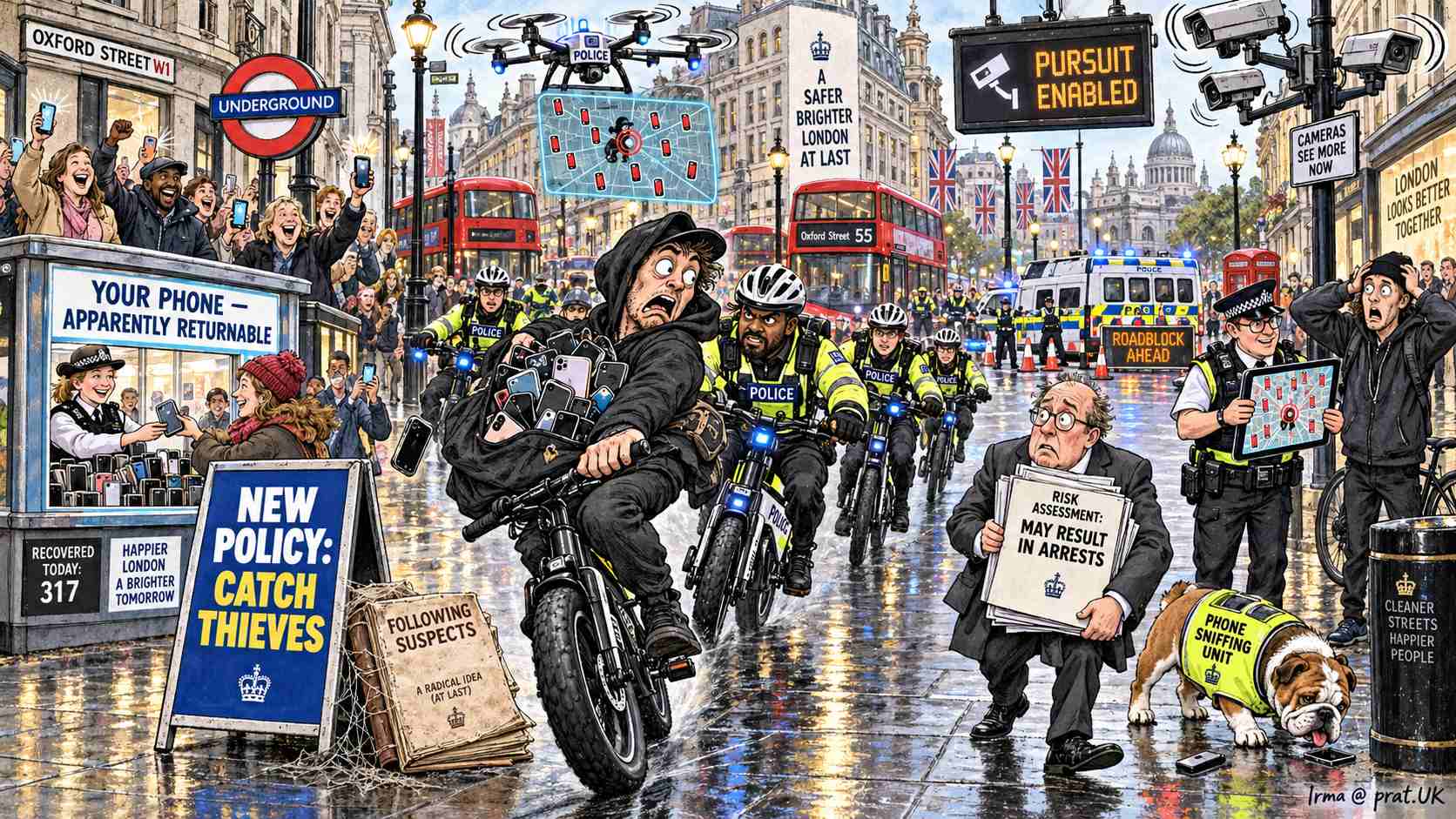
Met Deploys Drones, E-Bikes and Cameras as Capital Discovers Criminals Can Apparently Be Pursued
London appears to have stumbled upon a radical new theory of policing: when somebody steals a £1,200 smartphone and rides off on a moped, it may be useful for the police to go after him.
The revelation follows a CBS News report on the Metropolitan Police‘s specialist Interceptors, officers using drones, automatic number plate recognition, sophisticated cameras and police e-bikes against London’s notorious phone-snatching trade. CBS reported roughly 80,000 phone-snatching offences in London during 2024 and 35,000 phones snatched through July this year, while the Met says theft has fallen substantially over the past year.
The development has astonished Londoners who had grown accustomed to the traditional metropolitan procedure:
Phone disappears.
Victim shouts.
Moped disappears.
Victim discovers Find My iPhone currently believes the device is enjoying a better international travel schedule than its former owner.
Police have now introduced the Interceptors, which sounds reassuringly like a Marvel franchise until you discover it mainly consists of determined officers riding extremely quick bicycles.
The unit represents Britain’s answer to an uncomfortable discovery: criminals had entered the electric-vehicle revolution before the government.
For several years, London’s phone-snatching entrepreneur enjoyed a nearly perfect business model. There was no storefront, no corporation tax, no pension contribution and extraordinarily rapid customer acquisition, because the customer did not technically agree to participate.
The thief approached at speed, removed the phone and entered what management consultants would call “international resale logistics.”
Police eventually examined this thriving private enterprise and concluded that perhaps regulation had gone too far in the wrong direction.
The Metropolitan Police Discover Horsepower
The Met has expanded its fleet of specialist e-bikes from five to 25, saying the machines allow officers to negotiate traffic, narrow streets and even stairs while chasing offenders. The force says expanded use of the bikes has contributed to a fall of more than 13,000 phone theft offences across London over the previous year.
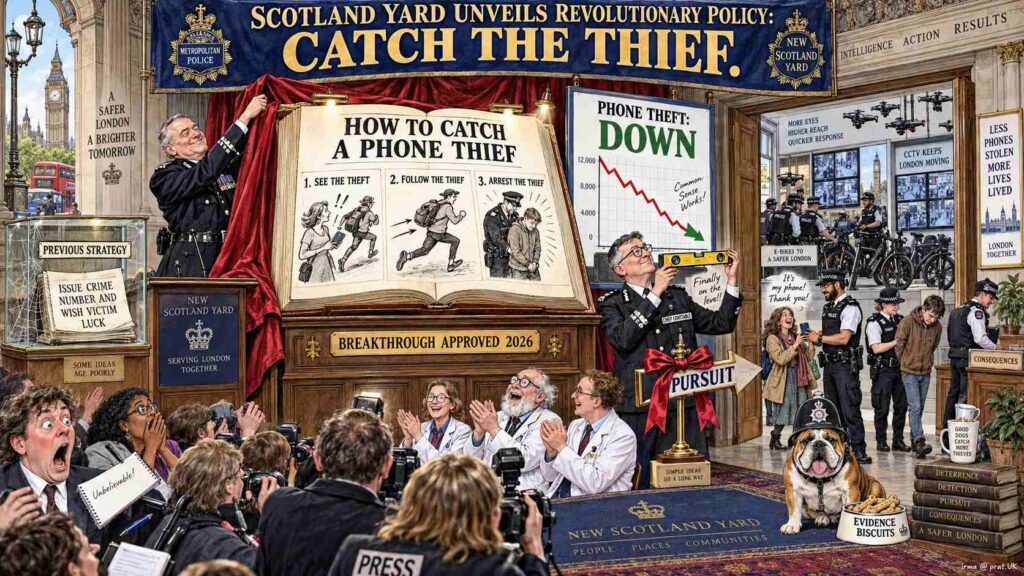
This introduces an exciting new stage in British criminal justice known as the Tour de Felony.
A suspect races through Soho.
An Interceptor follows.
A drone circles overhead.
Automatic cameras identify vehicles.
Somewhere inside the Home Office, a civil servant whispers, “My God, it’s Deliveroo with probable cause.”
CBS also showed police using tactical contact to knock suspected offenders from bikes or mopeds, part of a strategy intended to stop highly mobile suspects rather than merely waving goodbye as they vanish toward Marble Arch. Police officials told CBS that drones can help officers maintain awareness of a pursuit without needing constant direct visual contact.
This is undeniably more satisfying than the previous anti theft technology, which consisted largely of signs reminding pedestrians that thieves exist.
“Mind the Grab” was useful advice in the same sense that “Avoid Iceberg” would have been useful aboard the Titanic.
There Is, Unfortunately, a Serious Bit
The difficulty with powerful police technology is that technology rarely knows when the exciting part of the movie has ended.
A drone used today to follow a suspected robber can be extremely useful.
A network of drones following everybody all the time would be something else entirely.
The Met has separately announced plans to expand drones, live facial recognition and artificial intelligence in policing. As of June, the force said nine drones were already deploying to roughly 200 incidents each week from three London sites.
And this is where the satire has to keep both shoes tied.
Phone theft is real. Victims are real. A person having an expensive device ripped from their hand by somebody travelling at speed is not a comic abstraction. In some incidents involving robberies, victims have also faced violence. The Met explicitly advises people not to confront thieves or risk their safety for a phone.
So the joke cannot simply be, “Ha ha, police caught criminals.”
That would be roughly as sophisticated as mocking firefighters for locating water.
The better joke is that Britain has managed to build an astonishing technological ecosystem around something whose fundamental description remains:
Bloke nicked phone. Catch bloke.
Privacy Enters the Pub and Orders Something Expensive
Facial recognition creates the larger problem.
The Information Commissioner’s Office acknowledges that facial recognition can help law enforcement, but warns that false matches can have serious consequences, including wrongful police intervention, accusation or arrest. Its recent audits found areas of good practice but also inconsistencies requiring improvement in data protection governance.
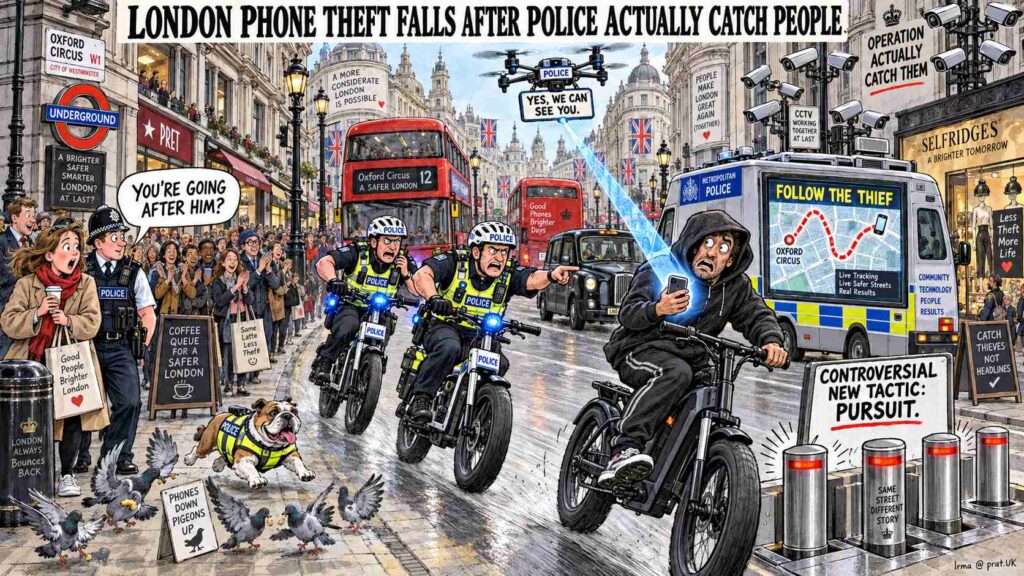
This is the moment when Britain’s enthusiasm for crime fighting meets Britain’s equally ancient tradition of becoming suspicious when somebody starts keeping records.
The government says live facial recognition must be necessary, proportionate and fair. Images are compared against specified watchlists, and biometric information belonging to people who do not match is supposed to be deleted immediately. A trained officer, rather than the software alone, decides what action follows a potential match.
Which is reassuring.
But “the computer only makes a suggestion” is also approximately how every dystopian novel begins before Chapter Seven.
The obvious risk is false identification. The subtler risk is normalisation.
First, cameras are deployed against serious offenders. Then against repeat thieves. Then perhaps lower level offences. Then someone proposes using the same infrastructure for another perfectly reasonable purpose. And another. And another.
Civil liberties rarely disappear when somebody presses a giant red button marked ABOLISH LIBERTY.
They tend to die from software updates.
Mission Creep Now Available in 4K
Parliament has already been asking what safeguards should govern facial recognition, including privacy, bias and proportionality. The government itself has described the current legal framework as complicated and has been working toward a new statutory framework for biometrics and facial recognition technology.
That matters because London should not have to choose between two absurd extremes:
Option A: allow thieves to remove every exposed telephone because privacy is sacred.
Option B: construct RoboCop Heathrow because somebody’s Samsung disappeared near Oxford Circus.
A free society is permitted to contain both police officers and limits on police officers.
This apparently revolutionary political doctrine is called “having two thoughts at once.”
Professor Nigel Brakepad, fictional chairman of the Institute for Things That Seemed Sensible at the Time, explained the problem.
“Every surveillance system is introduced to catch the person everyone agrees should be caught,” he said. “The interesting question arrives five years later, when somebody asks whether it can also identify people who put cardboard in the wrong recycling bin.”
This is why oversight matters. Technology can improve policing without technology becoming policing.
A drone is a tool. A camera is a tool. Facial recognition is a tool.
Once the tool becomes the policy, somebody has accidentally handed the hammer the building contract.
The International iPhone Migration Crisis
Police are also attacking the economics behind the thefts.
Investigations have uncovered networks exporting stolen phones abroad. In one major case, police said the investigation began after a shipment containing about 1,000 stolen iPhones destined for Hong Kong was discovered near Heathrow.
British police have also been working with technology companies on ways to make stolen phones harder to reuse or dismantle profitably. CBS reported cooperation with Apple and Alphabet aimed at reducing the value of stolen devices on the secondary market.
This might ultimately be more important than any pursuit.
Crime, unfortunately, responds to economics. If a stolen phone can be converted rapidly into hundreds of pounds, people will steal phones. If the stolen device becomes an elegantly engineered paperweight displaying HELLO, CRIMINAL, enthusiasm may decline.
Even Adam Smith might approve, although economists would presumably require a 300 page paper titled Marginal Utility Effects of Making Nicked iPhones Completely Bloody Useless.
How to Process This as Satire
The useful satirical target is not the victim. It is not even necessarily the individual police officer trying to catch somebody.
The target is the magnificent absurdity produced when crime, technology, bureaucracy and civil liberties collide in one London intersection.
Support the sensible part. Mock the excess. Celebrate thieves becoming easier to catch. Question surveillance becoming easier to expand. Laugh at criminals discovering police also sell electric bicycles. Ask serious questions when cameras start identifying faces.
This keeps the comedy pointed in both directions rather than becoming propaganda wearing a clown nose.
Good satire notices the paradox: Londoners quite reasonably want police capable of locating the person who just stole their phone. Londoners may be somewhat less enthusiastic about constructing a technological system capable of locating every Londoner.
Both propositions can be true. That is where the comedy lives.
London Discovers Consequences
For now, the most amusing development may simply be that the technological advantage has shifted.
For years, the thief possessed the fast electric bike. Now the police possess one.
The thief had anonymity. Police have drones and cameras.
The thief had an international resale network. Technology companies are trying to make stolen devices worthless.
It is an arms race conducted entirely around an object primarily used to watch TikTok while crossing the street.
The result may eventually be fewer thefts, safer streets and considerably more nervous criminals.
It may also produce hard questions about surveillance, privacy, proportionality and exactly how much technology a democratic society wants hovering overhead.
That debate should happen. Preferably before London reaches the final stage of the programme and every pedestrian receives an escort drone named Nigel.
Until then, Londoners are advised to grip their phones firmly, remain aware around busy roads and stations, activate the security features on their devices, and remember the most encouraging development of 2026: the bloke on the electric bike behind the thief might finally be a policeman.
15 Humorous Observations Before London Misplaces Another iPhone
- London police have discovered that the most effective crime prevention poster may be a police officer travelling toward the criminal at 30 mph.
- The phone thief originally had the technological advantage because he possessed an electric bicycle. Britain responded by forming a government committee and eventually buying an electric bicycle.
- Police drones can now follow suspects from the sky, meaning London has finally developed an Eye of Sauron that accepts Oyster cards.
- Automatic Number Plate Recognition means the getaway vehicle now introduces itself to the police before the chase begins.
- The Met’s specialist Interceptors sound less like constables and more like a discontinued BBC science fiction programme starring three men from Croydon.
- For years the public was advised to “Mind the Grab.” Police have apparently upgraded this strategy to “Mind the Police Car.”
- The technological arms race has become beautifully British: criminals buy illegal e-bikes, police buy faster e-bikes, and taxpayers quietly wonder whether everybody could have taken the bus.
- Smartphones became so valuable that London accidentally created a secondary financial market where your iPhone can visit China before you do.
- The most promising anti theft technology may ultimately be making stolen phones worthless, which economists call “destroying the market” and thieves call “a bloody nuisance.”
- Facial recognition introduces a philosophical puzzle: how much surveillance will London tolerate in exchange for being able to look at Google Maps outside Pret?
- Drone policing raises the possibility that the next Londoner staring at you from above is not God, Amazon or a tourist on the London Eye, but the Metropolitan Police.
- Every successful police technology contains the seed of its own committee hearing. Catch ten thieves and Parliament immediately wants to know where the database lives.
- The innocent London pedestrian now occupies an awkward constitutional position between “person going to Boots” and “pixel temporarily compared with a watchlist.”
- The risk of mission creep is that technology introduced to catch a man stealing an iPhone eventually develops enough features to know he hasn’t paid his council tax parking surcharge.
- London may finally solve phone snatching only to discover people have become too frightened to take their phones out and therefore cannot photograph the achievement.
Disclaimer: This article is satire based on genuine reporting about London’s response to mobile phone theft. Real victims, arrests and policing policies should be distinguished from invented experts, exaggerated scenarios, absurd dialogue and any suggestion that the Metropolitan Police intend to deploy Nigel the Personal Surveillance Drone.
This story is entirely a human collaboration between two sentient beings: the world’s oldest tenured professor and a philosophy major turned dairy farmer, neither of whom should be permitted to operate an illegal e-bike after lunch.

Lowri Griffiths brings a distinct voice to satirical journalism, combining cultural critique with dry humour. Influenced by London’s creative networks, her writing reflects both wit and discipline.
Her authority stems from experience, while trust is built through transparency and ethical satire.