London Men Told “You’re Dangerous” Is a Dating Red Flag, Forced Back to Traditional British Flirtation: Avoiding Eye Contact
Capital’s singles instructed to stop treating ordinary women like femme fatales merely because they ordered tequila without consulting a committee
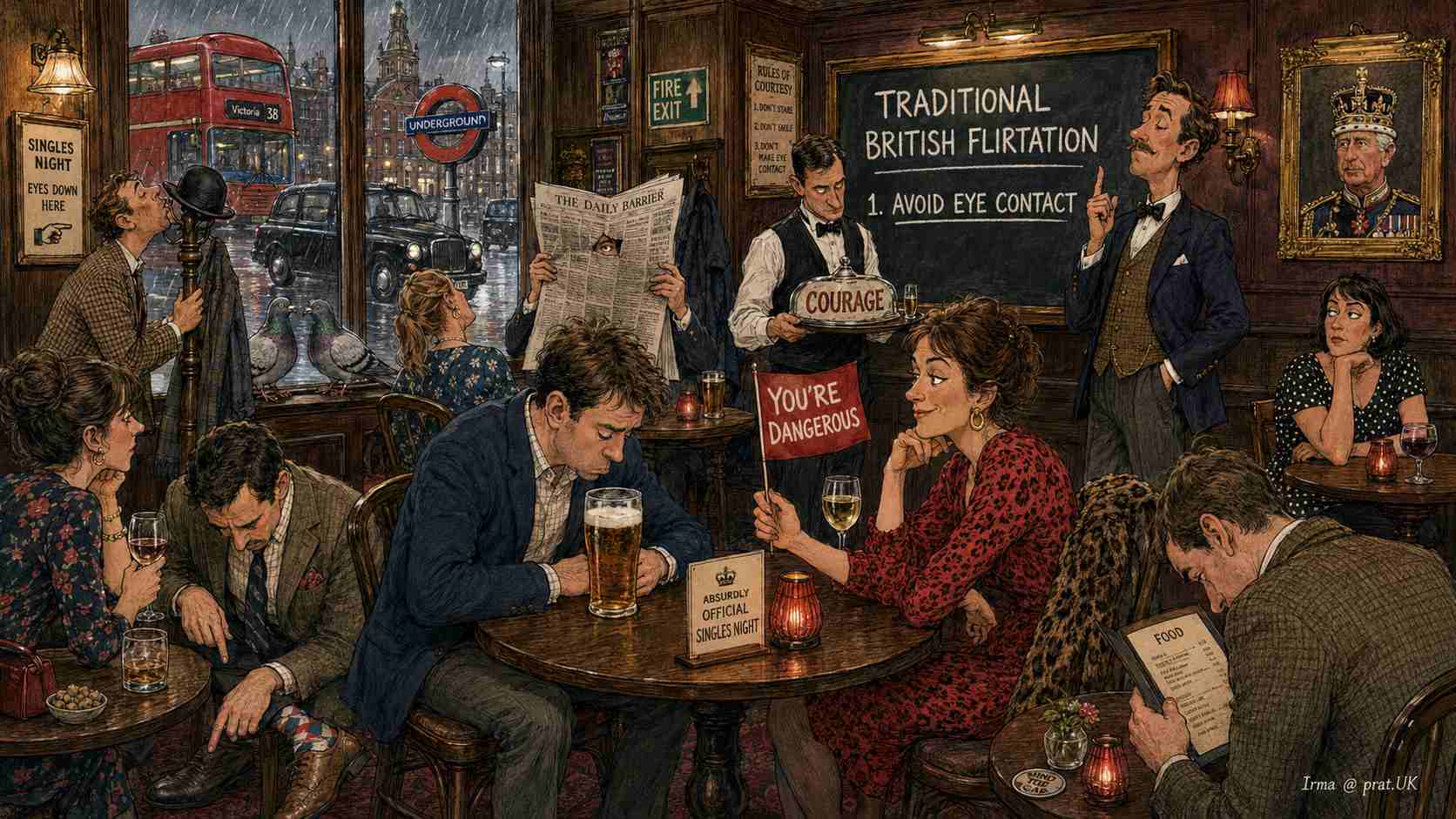
Britain’s already fragile dating infrastructure suffered another devastating blow Thursday after women reportedly informed men that saying “You’re dangerous” is not irresistibly seductive and may, in fact, make them want to finish their drink, summon an Uber and reconsider monasteries.
The warning follows online discussions collected by Bored Panda in which women complained about men deploying “You’re dangerous” and similar phrases as flirtation. Several viewed the line as embarrassingly rehearsed, while others objected to its implication that the woman has somehow become responsible for whatever reckless decision the man intends to make later.
This is terrible news for London men, who had already lost “Where are you really from?”, “You don’t look 34,” and the ever-popular “I’m technically separated.”
Researchers fear the remaining supply of heterosexual conversation could be exhausted by Christmas.
Why “You’re Dangerous” Fails as a London Dating Line
London Dating Authorities Issue Emergency Vocabulary
Experts at the entirely overfunded Institute for Metropolitan Romantic Failure said the problem is particularly acute in London because the phrase “You’re dangerous” must compete against actual hazards.
“You cannot tell a woman from Hackney that she is dangerous,” explained institute director Dr. Nigel Longpause. “She has changed Night Buses at Elephant and Castle at 2:15 in the morning while holding chips. She knows what danger is.”
According to Longpause, researchers tested several alternative lines:
“You have an intriguing personality.”
Too formal.
“I’m enjoying talking to you.”
Alarmingly sincere.
“I would like to see you again.”
Participants fled the laboratory.
“You’re dangerous.”
Everybody immediately understood they were on Hinge.
This, scientists concluded, is how civilisation ends.
Londoners Already Consider Dating Difficult Enough
London hardly needed another romantic obstacle.
A Time Out survey of more than 18,500 city residents worldwide found that only 28 percent of London respondents believed it was easy to find love in the capital. Another Time Out investigation described a dating environment plagued by ghosting, situationships, emotional unavailability, app fatigue and people rejecting otherwise promising partners for living on the wrong side of the Thames.
That last point is crucial.
Anthropologists once believed rivers divided early civilisations.
The Thames continues the work.
A woman in Fulham may theoretically fall in love with a man in Greenwich, but Google Maps will eventually inform them that the relationship requires two trains, a bus, seven minutes walking and the courage of Ernest Shackleton.
Love conquers all.
Except the District line.
“I met a wonderful bloke last month,” said imaginary eyewitness Charlotte W., 31, of Islington. “Smart, funny, attractive, employed. Then I discovered he lived in Wimbledon.”
She stared into the middle distance.
“I wish him well.”
The Hidden Escape Clause Inside Modern Flirtation
Seduction by Liability Waiver
What irritates many critics about “You’re dangerous” is the peculiar transfer of responsibility.
The man is essentially announcing:
“I am about to make several decisions voluntarily, but preliminary legal ownership of these decisions belongs to you because you have cheekbones.”
It is seduction by liability waiver.
If he drinks too much: you’re dangerous.
If he stays out late: you’re dangerous.
If he sends something regrettable at 1:48 a.m.: dangerous again.
At this rate, by breakfast she could be responsible for his gambling debts and a poorly considered tattoo in Shoreditch.
“It’s linguistic insurance,” explained Professor Miranda Syntax of the London School of Things People Say After Two Negronis.
“He gets to be attracted to her while narrating himself as the helpless victim of her supernatural magnetism. It’s convenient. Men have been blaming women for their poor judgment since Adam looked at the apple and apparently forgot he possessed a neck capable of turning away.”
British Flirting Was Once Much Simpler
Traditional British courtship avoided this problem by avoiding courtship.
A man noticed a woman.
The woman noticed him noticing.
Both looked away.
This continued between 1987 and 1994.
Eventually a mutual friend named Martin arranged a pub gathering where they spoke for approximately eight minutes.
Three years later they bought a semi-detached house.
Nobody was “dangerous.”
Nobody had “attachment styles.”
Nobody asked whether the relationship was “serving their journey.”
They simply accumulated furniture until death. The Office for National Statistics has been quietly documenting the decline of this system ever since.
Modern London has replaced this elegant arrangement with mobile applications offering approximately 400,000 theoretically compatible humans, allowing singles to reject someone because his third photograph contains a fedora.
Technology has delivered choice.
Choice has delivered paralysis.
Paralysis has delivered podcasts.
Geography Remains London’s Most Powerful Contraceptive
Postcode Compatibility and the Zone System of Love
Dating experts say the capital’s true romantic language is not words but postcodes.
“You live where?”
There may be no more consequential question.
London lovers evaluate distance with the strategic seriousness of NATO missile planners.
Zone 1 dating Zone 2? Sustainable.
Zone 2 dating Zone 3? Needs communication.
North London dating South London? Families should be informed.
East London dating West London? Consult your solicitor.
One Battersea man participating in our absolutely unscientific survey said he had rejected a potential soulmate in Stoke Newington because “that’s basically a destination wedding.”
This is the romantic mathematics of London.
Beauty + humour + intelligence + sexual attraction ÷ Overground disruptions = “Let’s just be friends.”
App Culture Has Made Everyone a Procurement Department
Modern dating apps also encourage singles to behave less like lovers and more like HR executives reviewing applicants for Junior Boyfriend.
Must enjoy travel.
Must be spontaneous.
Must be ambitious.
Must prioritise work-life balance.
Must own passport.
Must not own fish.
Must be emotionally vulnerable but never needy.
Must initiate plans without appearing controlling.
Must send messages frequently without texting too much.
Must demonstrate confidence while recognising the precise millisecond confidence becomes arrogance.
Salary competitive.
Benefits unclear.
Successful applicant will hear from us within three to five business days unless ghosted.
Time Out previously reported growing dissatisfaction with app dating in London and noted that singles events had enjoyed a revival as people sought face-to-face alternatives. Research from the Pew Research Center suggests the exhaustion is not confined to one city, one country or one especially unlucky man in Battersea.
Apparently humans have developed an exciting new romantic technology.
Meeting.
What Women Are Actually Asking London Men to Do
Women Ask Men to Try Actual Conversation
Dating advisers now recommend the revolutionary technique of listening to the other person and responding to what they actually say.
Government regulators have not yet approved this.
Early trials are promising.
Instead of:
“You’re dangerous.”
Try:
“What made you choose your career?”
Instead of:
“I bet you’re trouble.”
Try:
“What do you enjoy doing?”
Instead of:
“I can already tell you’ll break my heart.”
Try:
“Would you like another drink?”
The advantage is that these questions may reveal something about the person beyond whether she resembles a supporting character from a 2004 romantic comedy.
There is one disadvantage.
You might learn something.
London Men Defend Themselves
Men have protested that flirting has become impossibly complicated.
One pub patron, identified only as Darren because even satire has GDPR concerns, said men receive contradictory instructions.
“Be confident, but not too confident. Flirt, but don’t use flirting lines. Show interest, but don’t come on strong. Be vulnerable, but not immediately. Ask questions, but don’t make it an interview.”
He took a drink.
“So basically I need to perform emotional air-traffic control while pretending I’m relaxed.”
This is not entirely unreasonable.
Dating contains uncertainty because human beings contain uncertainty.
Women are not one voting bloc. Men are not one operating system. A line one person considers cheesy may make someone else laugh. The British Psychological Society has yet to publish a universal script, largely because there isn’t one.
Which means the grand secret of dating remains depressingly resistant to algorithms:
Pay attention to the individual sitting in front of you.
London authorities immediately rejected this solution because it cannot be monetised through a premium subscription.
“You’re Dangerous” Finally Retired
By Thursday evening, several London bars had reportedly established emergency phrase-replacement stations where men could exchange obsolete flirtation for ordinary human speech.
One man surrendered:
“You’re trouble.”
He received:
“I like you.”
He examined it suspiciously.
“This seems very exposed.”
“That’s because it communicates an actual feeling.”
“Christ.”
He asked for his old phrase back.
Still, sociologists remain optimistic.
If London’s singles can abandon canned flirtation, geographical snobbery, endless swiping, performative detachment and the conviction that replying to a message within four hours constitutes emotional surrender, genuine romance might someday return.
Statistically, however, your soulmate probably lives in Croydon.
So forget it.
Helpful Dating Guidance for Londoners
The practical lesson is refreshingly small: skip character assignments such as “dangerous,” “trouble,” “heartbreaker” or “crazy” before you know somebody. Ask questions, listen, flirt according to the response you are actually receiving, and remember that enthusiasm is not a contagious disease.
And if somebody wonderful lives 47 minutes away?
Give them a chance.
Britain built an empire using wooden boats.
You can change trains at Waterloo.
15 Humorous Observations: London Dating Discovers “You’re Dangerous” Is Apparently Dangerous
- In London, telling a woman “You’re dangerous” is especially confusing because she arrived on the Northern line. Compared with Bank station at rush hour, she’s practically a therapy llama.
- London men have apparently been using “You’re dangerous” because “I’m emotionally unavailable and renting a bedroom in Clapham for £1,650” lacks erotic mystery.
- The phrase “You’re dangerous” sounds less like flirting and more like something TfL should put on a yellow warning sign. MIND THE WOMAN. SHE HAS OPINIONS.
- A London woman knows immediately whether a man is genuinely interested because he will voluntarily travel south of the river. That’s not dating. That’s commitment with Oyster documentation.
- “You’re dangerous” is what a man says when he wants to portray himself as helpless before feminine temptation while somehow retaining enough executive function to order another £17 cocktail.
- The traditional British method of flirting was staring at somebody across a pub for eleven months, marrying somebody else, and thinking about the first person until death. At least there was dignity.
- Dating apps promised Londoners millions of romantic possibilities. Londoners responded by eliminating everybody who lives more than 23 minutes away.
- London romance now has geographical compatibility. You can be beautiful, intelligent, funny and kind, but if changing at Green Park is involved, love has limits.
- A man calling a woman “dangerous” on a first date is announcing that he has already written Act Three of a relationship whose starter hasn’t arrived.
- Women dislike canned dating lines because nothing says spontaneous chemistry quite like hearing something a man apparently downloaded as part of the Seduction Starter Pack.
- Londoners have become so frightened of appearing keen that displaying genuine enthusiasm now qualifies as a medical emergency. “I really enjoyed tonight.” “Whoa. Red flag.”
- Ghosting is particularly British because it combines cowardice, administrative delay and the avoidance of an uncomfortable conversation. It may be our last functioning national industry.
- Only 28 percent of Londoners in a major Time Out survey said finding love in the capital was easy. The other 72 percent were presumably dating someone but hadn’t yet clarified what they were.
- The London situationship exists because boyfriend, girlfriend and partner contain terrifying expectations, whereas “person I sometimes sleep with near Old Street” leaves room for growth.
- The great irony is that London has almost nine million people and everyone keeps dating the same six graphic designers from Hinge.
Disclaimer
This story is satire inspired by genuine discussion about modern dating language and London’s famously difficult romantic landscape. Any suspicious institutes, professors, surveys conducted in pubs, romantic government agencies or traumatised residents of Wimbledon are products of the satirical apparatus.
Most importantly, this story was entirely a human collaboration between two sentient beings: the world’s oldest tenured professor and a philosophy major turned dairy farmer, both of whom agree that calling a woman “dangerous” before the olives arrive is probably less effective than asking her a question.
Sources
- Primary source: Bored Panda on the dating phrase “You’re dangerous”
- London dating context: Time Out on why dating in London feels so difficult
- Relationship trend data: Office for National Statistics, marriage and cohabitation
- Online dating research: Pew Research Center on the online dating landscape

Aishwarya Rao is a satirical writer whose work reflects the perspective of a student navigating culture, media, and modern identity with humour and precision. With academic grounding in critical analysis and a strong interest in contemporary satire, Aishwarya’s writing blends observational comedy with thoughtful commentary on everyday contradictions. Her humour is informed by global awareness and sharpened through exposure to London’s diverse cultural and student communities.
As an emerging voice, Aishwarya represents the next generation of satirical journalists: informed, curious, and unafraid to question norms through wit. Her authority stems from research-led writing, respect for factual context, and a commitment to ethical satire. Transparency and clear labelling ensure readers understand the comedic intent behind her work.
Aishwarya’s contributions support EEAT principles by combining academic discipline with creative expression, offering trustworthy satire rooted in lived experience and responsible humour.
Email: [email protected]