Chinese Youth Told to Stop Complaining About Jobs, Housing and Marriage, Focus on Adorable Panda Videos Instead
Beijing discovers a revolutionary cure for economic anxiety: fewer visible anxious people
Chinese authorities appear to be confronting one of the most dangerous threats ever faced by a modern government: citizens comparing official optimism with their personal bank accounts.
The inspiration comes from reporting on China’s increasingly gloomy social-media mood and the Communist Party’s long-running effort to cultivate what it calls positive energy online. The underlying phenomenon is quite real. China’s cyberspace regulator has explicitly targeted online content that excessively promotes pessimism, including narratives involving employment, marriage and education, as Reuters reported on a two-month nationwide campaign against “hard work is useless” posts.
This creates an exciting new possibility in economics.
Instead of eliminating despair, China can simply eliminate its comment section.
The Ministry of Vibes Takes Control
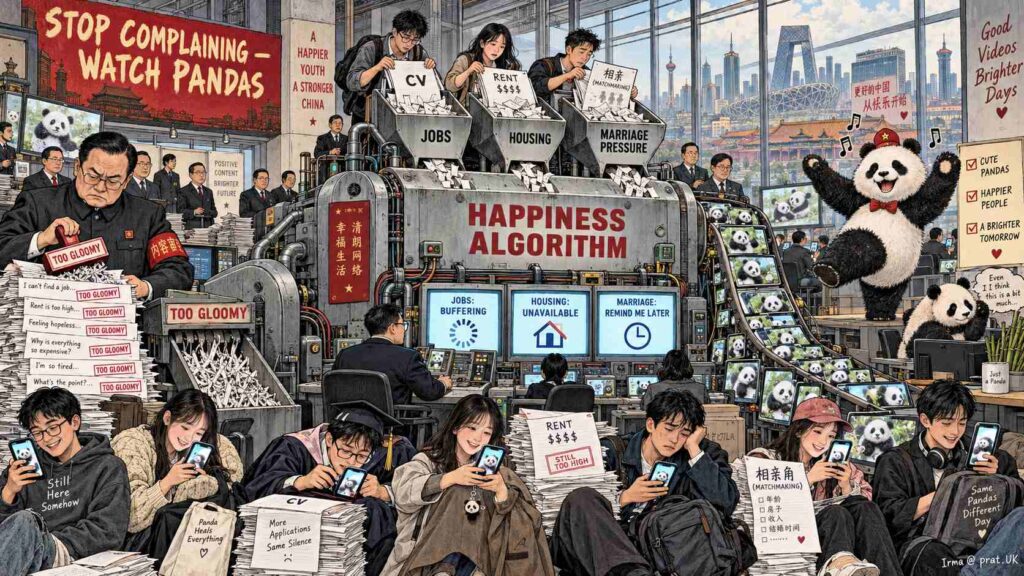
Under the entirely satirical National Positive Energy and Panda Deployment Initiative, young Chinese citizens experiencing job insecurity will no longer be encouraged to obsess over tedious questions such as income, career prospects or whether their master’s degree has qualified them to deliver noodles to somebody with a doctorate.
Instead, their phones will display a panda.
The panda will roll downhill.
Everybody will feel better.
If feelings do not improve, another panda will be deployed.
This approach offers several obvious advantages over conventional economic policy. Pandas require no interest-rate adjustment. Pandas do not demand mortgage restructuring. Pandas rarely publish essays about structural unemployment.
Most importantly, pandas have never unionized.
This makes them practically ideal government economists.
Youth Unemployment Unfortunately Continues Existing Offline
The difficulty is that Chinese economic pessimism did not simply crawl out of somebody’s imagination wearing black eyeliner.
Caixin Global reported that young people face a bleak job market, with youth unemployment at 17.9 percent in July, the highest July reading in three years, as a record wave of new graduates entered the market. Elsewhere, a widely cited case describes an auto-parts company that dismissed more than 100 recent university graduates only about a month after hiring them.
That is where traditional economics and Positive Energy Economics part company.
Traditional economists see 17.9 percent youth unemployment and ask: “How can we create more jobs?”
Positive Energy Economics asks: “Why is everybody mentioning 17.9?”
The second question is much cheaper.
A fictional official at the newly established National Bureau of Encouraging Statistics explained the methodology.
“Our unemployment rate remains whatever the official unemployment rate happens to be,” he said, adjusting a chart displaying seventeen smiling pandas. “But our Complaint-to-Panda Ratio improved dramatically during the third quarter.”
This reporter asked whether unemployed graduates could purchase groceries with the Complaint-to-Panda Ratio.
The official disappeared behind the chart.
China Discovers the Thermometer Has Been Causing the Fever
China’s internet regulator has already demonstrated considerable enthusiasm for cleaning up undesirable online material.
During a 2026 campaign aimed at producing a cheerful Spring Festival internet environment, authorities said 708,000 pieces of information were removed and more than 39,000 accounts were handled over various violations that included stirring negative emotions.
Read that again.
Seven hundred and eight thousand pieces of content.
If America deleted 708,000 depressing social-media posts, Facebook would contain eleven posts by lunchtime.
Three would be advertisements for mattresses.
Four would be somebody’s aunt wishing a Labrador happy birthday.
The remaining four would be Elon Musk arguing with himself.
China’s approach therefore contains a certain magnificent administrative purity.
A citizen writes:
«”I cannot find a job.”»
The post disappears.
Problem solved.
Not the employment problem, obviously.
The sentence problem.
Governments have been struggling with unemployment for centuries because they foolishly concentrated on unemployed people. Beijing has discovered the true culprit: nouns.
New Economic Indicator Measures Number of Sad Posts Successfully Removed
The traditional arsenal of economics is hopelessly antiquated.
GDP.
Disposable income.
Consumer confidence.
Housing starts.
All these statistics have one devastating flaw: occasionally they contain disappointing numbers.
The proposed Chinese National Happiness Dashboard, by contrast, would measure only encouraging things.
Metric One: pandas viewed.
Metric Two: negative posts removed.
Metric Three: number of citizens successfully redirected from “housing crisis” to “baby red panda sneezing.”
Metric Four: percentage of internet users currently describing the future as “radiant,” voluntarily or after receiving seventeen increasingly concerned text messages.
Under this system, a recession becomes almost impossible.
Suppose factory production declines 6 percent.
Troubling.
But suppose posts mentioning the decline fall 93 percent.
Excellent quarter.
China has achieved 87 percent net optimism.
Western economists simply lack imagination.
The Housing Market Is Asked to Stop Bringing Everyone Down
Housing poses another difficulty because houses are stubbornly physical objects and therefore harder to moderate than comments.
A Reuters poll found China’s home prices are still expected to fall further in 2026 even as declines in property investment and sales deepen, underscoring a crisis-hit sector yet to stabilize after years of decline. In smaller inland cities, second-hand home prices remain well below pre-downturn levels.
Millions of unfinished properties remain another awkward obstacle.
You can delete the phrase “unfinished apartment.”
The apartment remains unfinished.
It just becomes an optimistically ventilated future residence.
This is where language policy can make a major contribution.
Falling house price? Rapid affordability event.
Mortgage distress? Long-term banking relationship.
Developer default? Unexpected debt simplification.
Empty apartment block? Residential opportunity reserve.
Man standing outside unfinished condominium wondering where his life savings went? Citizen enjoying architecture.
Problem solved.
Marriage Becomes Compulsory Romantic Optimism
Then there is marriage.
China wants young people to marry and have children. Young people have responded with the infuriating habit of considering costs.
A newly published 2026 study examining Chinese Weibo users found that credible negative marriage discussions were associated with lower marriage intentions. The researchers also noted that perceptions of financial, housing and emotional readiness matter to marriage decisions.
An authoritarian bureaucrat reading that research might naturally arrive at an extraordinary conclusion:
Obviously the problem is the discussions.
Remove negative marriage discussions and apartment prices will immediately become romantic.
Nothing says passion like refusing to calculate mortgage payments.
Under our satirical proposed system, dating apps could therefore include new government-approved relationship prompts:
My ideal first date: contributing to national demographic stability.
My love language: mortgage eligibility.
Biggest relationship red flag: mentioning property prices.
Looking for: marriage, two children and somebody whose parents already own an apartment.
Romance is restored.
Communist Party Accidentally Invents Mandatory Instagram
The whole campaign eventually begins to resemble Instagram with administrative enforcement.
Everyone is successful. Everyone is attractive. Everyone owns a beautiful apartment. Everyone has a thriving career. Everyone’s marriage is wonderful. Everyone recently visited a waterfall.
Nobody knows anybody personally experiencing these conditions.
The difference is that ordinary Instagram users voluntarily exaggerate their happiness because they want strangers from secondary school to feel inferior.
Government-managed Instagram would simply remove the inefficient voluntary stage.
Your life is wonderful. Please adjust your photographs accordingly.
Despair Immediately Gains 40 Million Followers
Unfortunately, banning an emotion has historically suffered from one major technical problem.
The emotion continues existing.
You can delete “I am exhausted.” The person remains exhausted.
You can suppress “I don’t believe hard work will improve my life.” The belief may simply migrate into jokes, slang, private chats or silence.
A recent academic paper examining China’s “lying flat” phenomenon specifically warns, as a theoretical proposition rather than an empirical finding, that suppressing such expression may redirect people’s voices or deepen hidden disengagement rather than eliminate the underlying sentiment.
Which is wonderfully inconvenient.
The censor sees fewer pessimistic posts and concludes pessimism has fallen.
The pessimist sees his post disappear and concludes pessimism was correct.
Everybody gets confirming evidence.
That is practically quantum governance.
Our Completely Unscientific Survey Finds 103 Percent Happiness
Bohiney conducted an absolutely fictitious survey of 1,000 imaginary Chinese internet users to determine whether mandatory optimism works.
Thirty-eight percent said they were optimistic. Twenty-four percent said they were extremely optimistic. Thirty-one percent said they had never been more optimistic. Ten percent asked whether answers were anonymous.
The total was 103 percent, making it the most successful public-opinion survey in Communist history.
Researchers attributed the exceptional result to respondents being allowed to choose several forms of optimism but no form of pessimism.
“This proves the policy works,” explained our imaginary statistician Professor Wong Num-Bers. “When you remove all negative answers, public opinion improves almost immediately.”
This technique could revolutionize polling worldwide.
The Ultimate Solution: Delete Economics
Eventually, Beijing may recognize that moderating economic pessimism one post at a time is unnecessarily labor-intensive.
Why not simply censor economics?
Economic theory has produced enormous amounts of negative content. Scarcity. Debt. Trade-offs. Diminishing returns. Unemployment. Bankruptcy.
Economists are practically professional pessimists carrying calculators.
Replace economics departments with Panda Studies. Students could specialize in Applied Cuteness, Advanced Bamboo Allocation and Postgraduate Rolling Down Hills.
The economy would become impossible to criticize because nobody would remember the vocabulary.
A housing bubble could become round prosperity. A recession could become backward growth. Unemployment could become maximum leisure participation.
And despair? There would be no despair.
Only citizens whose happiness has temporarily failed to upload.
Helpful Advice for Citizens Experiencing Unauthorized Gloom
Step One: Examine Your Bank Account
If the balance causes sadness, close the banking application. The sadness originated in the application.
Step Two: Examine Your Housing Situation
If property prices seem discouraging, remember that owning property is merely capitalism with curtains.
Step Three: Consider Marriage
Do not ask whether you can afford it. Financial arithmetic has ruined more romance than adultery.
Step Four: Watch a Panda
If one panda fails, increase dosage. Scientists at no recognized institution recommend up to six pandas per economic statistic.
Step Five: Remain Positive
Remember the essential principle of modern Positive Energy Economics: a problem nobody is permitted to complain about is statistically halfway solved.
15 Humorous Observations Before the Censors Improve Our Mood
- China has discovered the easiest way to reduce pessimism is apparently not to improve the economy, but to reduce the number of pessimistic sentences. This is economics performed with an eraser.
- Chinese young people complaining about jobs are being terribly unreasonable. The government already provides thousands of excellent careers in deleting complaints about jobs.
- Housing pessimism could be solved overnight by changing every property listing from “price reduced” to “unexpected affordability achievement.”
- Marriage anxiety presents a difficult problem because young people keep performing the deeply antisocial act of calculating whether they can afford marriage before getting married.
- The internet must become more positive, meaning China has finally invented Instagram without the troublesome option of posting how you actually feel.
- Pandas may soon become strategic national emotional infrastructure. Every disappointing economic statistic can simply be followed by sixteen seconds of a panda falling off a log.
- Beijing’s ultimate economic indicator may become the Sad Post Index. If unemployment rises but complaining falls, congratulations, the economy has improved.
- Censorship produces an intriguing statistical miracle. Delete enough unhappy posts and eventually 100 percent of the remaining internet is delighted.
- The government wants “positive energy,” while young people want jobs, affordable apartments and tolerable working lives. This is technically a disagreement over voltage.
- China’s “lying flat” generation presents authorities with a conceptual problem. It is difficult to order somebody to enthusiastically participate in the rat race after he has noticed the cheese is imaginary.
- Suppressing pessimism can create the world’s most cheerful-looking recession. The economy may be coughing blood, but its profile picture has balloons.
- There is something magnificent about fighting despair with content moderation. It is the emotional equivalent of treating pneumonia by confiscating the thermometer.
- Chinese officials have discovered that social media negativity affects attitudes toward marriage. Fortunately, deleting every unhappy marriage discussion should immediately create millions of newlyweds who mysteriously still cannot afford apartments.
- Communist economic planning has entered its most advanced phase yet: central planning of facial expressions. Production quotas were apparently too easy.
- The eventual goal appears to be an internet consisting entirely of pandas, patriotic sunsets, successful entrepreneurs and one confused 24-year-old whispering, “Does anybody know where the jobs went?”
This story is satire. Genuine statistics, academic research and publicly documented Chinese internet-regulation campaigns have been used as the scaffolding; the Ministry of Vibes, National Bureau of Encouraging Statistics, Complaint-to-Panda Ratio, Professor Wong Num-Bers, imaginary poll, fictional officials and government panda programs are comic inventions.

Alan Nafzger was born in Lubbock, Texas, the son Swiss immigrants. He grew up on a dairy in Windthorst, north central Texas. He earned degrees from Midwestern State University (B.A. 1985) and Texas State University (M.A. 1987). University College Dublin (Ph.D. 1991). Dr. Nafzger has entertained and educated young people in Texas colleges for 37 years. Nafzger is best known for his dark novels and experimental screenwriting. His best know scripts to date are Lenin’s Body, produced in Russia by A-Media and Sea and Sky produced in The Philippines in the Tagalog language. In 1986, Nafzger wrote the iconic feminist western novel, Gina of Quitaque. He currently lives in Holloway, North London. Contact: [email protected]