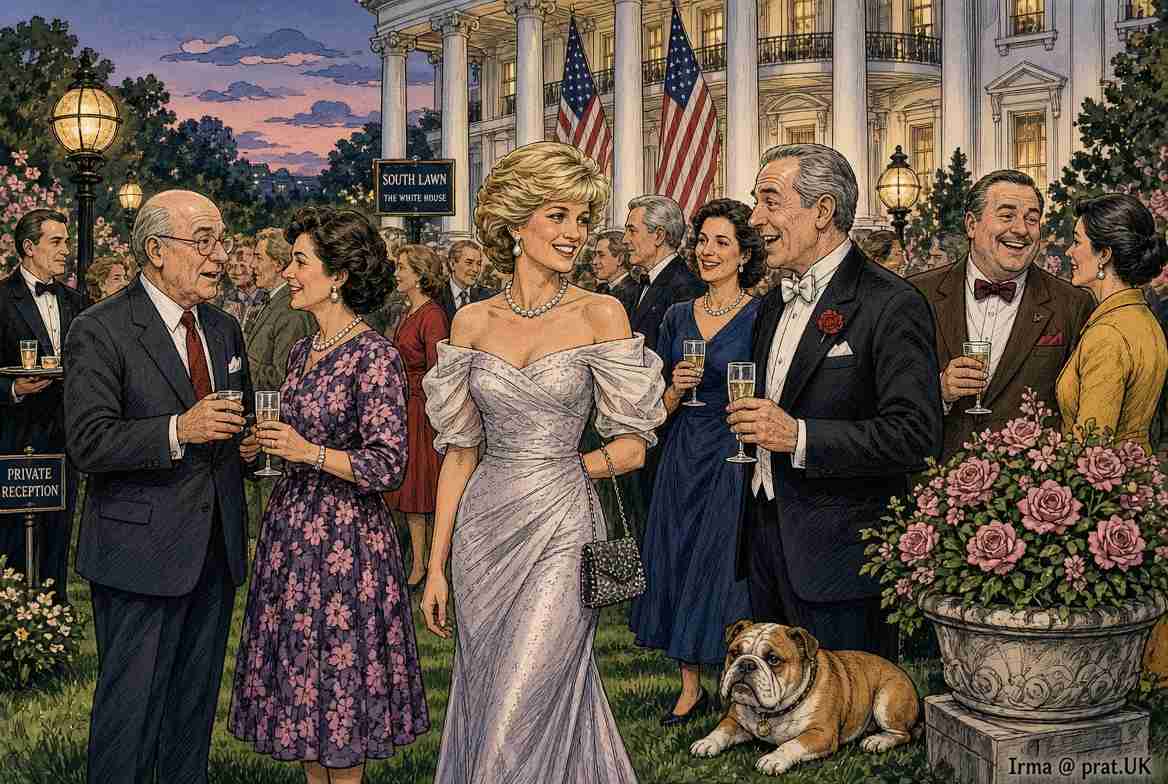
Kate Lived With William Before Marriage, Giving Her Valuable Time to Discover the Monarchy Is Also There at Breakfast
Years of cohabitation reportedly let the future Princess of Wales learn that marrying one man somehow includes 1,200 rooms, six newspapers, and a full constitutional breakfast protocol
Kate Middleton enjoyed one significant advantage before marrying Prince William that Meghan Markle reportedly never enjoyed to the same degree: enough time to discover that when you marry into the British Royal Family, the Royal Family does not, under any circumstances, go home afterward. It moves in. It brings staff. It has opinions about your porridge.
The observation follows a widely circulated report in Grazia citing royal historian Marlene Koenig, who argues that William and Kate’s lengthy courtship and years of shared living gave Kate time to understand royal existence before permanently committing herself to a family in which even breakfast can become a matter of national significance. Koenig has made similar remarks elsewhere, noting that couples such as Edward and Sophie, and William and Kate, were given a slow, immersive education in royal protocol that Meghan reportedly never received.
Kate and William met at St Andrews University in 2001 and later shared student housing with friends. By 2010 they were living together in North Wales near William’s RAF posting. They became engaged that October and married on 29 April 2011 at Westminster Abbey — a wedding covered, analysed, and re-analysed by roughly every publication in the English-speaking world.
That gave Kate nearly a decade to discover what most British citizens learn only by accidentally buying Hello! at an airport: a prince never travels alone, because history follows him around carrying luggage.
Royal Cohabitation: The World’s Most Expensive Free Trial

Normal couples move in together to answer practical questions. Does he snore. Does she squeeze the toothpaste from the middle. Who keeps nudging the thermostat up two degrees like a war criminal. Can two adults share one bathroom without a UN mediator present.
Kate faced slightly different questions. Why is there a protection officer outside. Why does Granny own the building. Why did somebody bow before pudding was even served. And why has tomorrow’s newspaper already formed a confident editorial opinion about my eyebrows.
Researchers at the entirely fictional Prat Institute for Matrimonial Constitutional Studies estimate that ordinary cohabitation reveals roughly 72 percent of a partner’s irritating habits within eighteen months. Royal cohabitation, by contrast, reveals 72 percent of Britain. By year three, Kate reportedly understood tea. By year four, horses. By year five, hats, all of them, including the ones that appear to be under attack by a heron. By year six she had allegedly achieved the advanced royal qualification of standing beside somebody she privately could not stand for forty-five straight minutes while wearing the exact facial expression of a woman who has just been told the salmon was lovely. That is, generously, a doctorate.
The Monarchy Is Also There at Breakfast
The great benefit of living with William, according to the theory, was discovering there is no meaningful dividing line between “William the boyfriend” and “William, walking constitutional instrument.” Imagine waking up on a Sunday wanting cereal. William wants eggs. Unfortunately William is second in line to a thousand years of accumulated national symbolism, so before anyone finds the marmalade there are three Range Rovers outside, a Special Branch officer near the hydrangeas, and a photographer lying behind the recycling bin trying to establish, on deep background, whether Kate prefers Corn Flakes or Bran Flakes.
That is the moment the penny drops. You are not dating William. You are dating Britain, and Britain has ears everywhere, including apparently inside the recycling.
An unnamed palace-breakfast eyewitness, who understands the gravity of toast better than most historians understand treaties, put it this way: “Kate learned very quickly that there is no such thing as casually making breakfast for a future king. The moment William asks whether there’s another sausage, somebody somewhere begins quietly discussing succession law.”
Britain’s constitution remains famously uncodified, meaning nobody can point to the exact document where the rules are written down. This is widely believed to be because most of them are stored, encrypted, in Princess Anne’s head, to be released only under extreme provocation.
Kate Received the Extended Warranty

The long William-Kate courtship was once mocked mercilessly by the tabloids, who nicknamed Kate “Waity Katie” as though patience were a character flaw rather than, in retrospect, an extremely sound acquisitions strategy. Perhaps Kate was not waiting. Perhaps she was reading the terms and conditions. Ten years is roughly the correct amount of time required to reach page fourteen of the Windsor family agreement.
Clause one: you may marry the prince. Clause two: everyone gets an opinion, whether invited or not. Clause three: newspapers may interpret blinking as a diplomatic incident. Clause four: Christmas is compulsory and involves a specific route to church, walked slowly, in public, in whatever weather Norfolk is inflicting that year. Clause five: under no circumstances shall anybody explain clause four to a newcomer in advance.
Kate received something close to a royal apprenticeship. She saw ceremonies, attended events, endured scrutiny, met the extended relatives, and learned that entering a room in this particular monarchy requires more choreography than evacuating an aircraft. Crucially, she had years in which she could, in theory, have said: “No thank you, I think I’ll marry an accountant instead.” She did not. That is either commitment or Stockholm syndrome with exceptional tailoring. Possibly both.
Meghan Got the Express Checkout
Harry and Meghan followed a dramatically shorter timetable by comparison. Their engagement was formally announced on 27 November 2017, with the couple confirmed to live at Nottingham Cottage at Kensington Palace, and they married at St George’s Chapel, Windsor, on 19 May 2018. That is less royal apprenticeship and more constitutional speed-dating.
Meghan arrived expecting a family. Britain handed her an institution. There is a difference. A family asks, “Would you like tea?” An institution asks, “Would you like tea?” while six courtiers quietly monitor which cup you touch and file a memo about it. Kate had years to learn that distinction gradually. Meghan, by most accounts, encountered the monarchy roughly the way one clicks INSTALL NOW on a piece of software nobody reads the terms for. A warning presumably flashed briefly on screen: “This installation may modify existing relationships, privacy settings, and six decades of newspaper coverage.” Harry clicked Accept All.
Buckingham Palace’s Revolutionary Onboarding Programme
The monarchy has existed for roughly a thousand years, and yet its approach to staff induction — or rather, family induction — appears to consist largely of hoping newcomers absorb protocol by osmosis, the way one absorbs damp in an old country house.
There should, by rights, be an orientation course. Day one: curtsying without looking as though you have dropped a contact lens. Day two: identifying the seventeen family members named Edward. Day three: answering personal questions without actually supplying any information, a skill previously thought exclusive to politicians. Day four: Advanced Hat Awareness. Day five: smiling steadily through ninety minutes of agricultural demonstrations while your feet quietly die inside your shoes.
Instead, newcomers seem expected to absorb an enormous, unwritten network of tradition, precedent, and invisible expectation entirely on their own. One imagined palace training officer explained the philosophy this way: “We prefer not to explain the rules in advance. Discovering them through hostile newspaper coverage builds character.” It is the same educational model Britain once applied in boarding schools: confusion builds resilience, or at minimum, generates excellent material for a memoir decades later.
The Real Royal Test Is Tuesday Morning
Weddings tell you almost nothing about a marriage. Royal weddings tell you even less. There are carriages, trumpets, uniforms, a small ocean of flowers, and millions of strangers watching on television. Everybody looks magnificent. Marriage actually begins on the following Tuesday, when somebody cannot find their charger and the day contains no orchestra whatsoever.
Kate got years of ordinary Tuesdays before the cameras ever arrived. That, more than any tiara, may have been the real advantage. She learned William not as a uniform walking through Westminster Abbey but as a man who left mugs by the sink and occasionally wondered whose milk was in the fridge. Once you have watched a future monarch interrogate a communal fridge, the mystique never fully recovers, and arguably that is healthier for everyone involved.
Britain’s Proposed New Royal Marriage Policy

The solution, as ever, is entirely impractical and therefore highly recommended. Every future royal partner should receive a mandatory three-year trial period. Year one: prince. Year two: palace. Year three: British press, at full volume, with commentary. Anyone still enthusiastic after year three may proceed directly to the Abbey.
Candidates should also endure one simulated royal Christmas, two ceremonial ribbon-cuttings, four inexplicable military uniforms, one countryside shooting weekend involving unreasonable amounts of tweed, and forty-eight consecutive hours during which tabloid newspapers assign deep psychological meaning to their facial expressions in a supermarket car park. Only then, the theory goes, can consent be considered fully informed.
Because Kate Middleton’s great premarital advantage may ultimately have been wonderfully, almost insultingly ordinary. She had time. Time to know William. Time to know his family. Time to know his world, sausages and all. And most importantly, time to discover that when you wake up beside a prince and wander downstairs hoping for coffee, the monarchy is already sitting at the kitchen table, wondering aloud what you intend to do for Britain today.
15 Humorous Observations Before Breakfast
- Kate discovered the monarchy gradually, which is the preferred method for discovering both royalty and asbestos.
- Living with William meant Kate could learn that when a prince says, “Mummy’s coming for breakfast,” several constitutional arrangements may need to be activated.
- Kate and William began as university housemates, giving Kate the invaluable early discovery that even future kings leave mugs near the sink rather than in it.
- Most couples test compatibility by assembling flatpack furniture. Kate tested hers by surviving a Christmas where everybody has three names, four houses, and one expression.
- Kate had years to learn royal vocabulary, where “quite interesting” means dreadful, “unfortunate” means constitutional catastrophe, and “a family matter” means Netflix has already bought the rights.
- Cohabitation let Kate discover that marrying William meant also marrying the balcony, the corgis, the newspapers, the military bands, and a man whose job title eventually includes the word Wales.
- Harry and Meghan’s engagement was announced on 27 November 2017, with the wedding on 19 May 2018 — a considerably brisker runway into full ceremonial life.
- Meghan therefore encountered Britain’s most complicated family at roughly the speed most people encounter airport car rental insurance.
- Kate had time to discover that royal privacy means only seventeen photographers technically know where you went for lunch.
- Living in North Wales before marriage likely offered Kate a useful royal simulation: rain, isolation, strange titles, and somebody periodically asking whether William had brought the helicopter home.
- The great advantage of a long courtship is that eventually somebody explains why a napkin can apparently threaten the constitutional settlement.
- Britain spent years calling Kate “Waity Katie,” then later discovered waiting may have been the most sensible royal policy since somebody stopped letting Henry VIII choose wives personally.
- The monarchy apparently learned from Charles and Diana that people should know each other before marriage — a breakthrough also independently discovered by every grandmother with a kitchen table.
- Meghan needed orientation. Buckingham Palace appears to favour the traditional British training model: make a mistake, read about it tomorrow, infer the rule retroactively.
- Kate’s real advantage may not have been protocol lessons at all. It was years to quietly ask the most important premarital question imaginable: “Do I really want newspapers analysing my facial expression every time another woman stands beside me?”
This is satire. The invented surveys, breakfast eyewitnesses, palace training exercises, and constitutional sausage analysis are satirical constructions built around publicly reported events and commentary, including remarks reported by Grazia and The Mirror. No royal toast was harmed.
Known publicly only through a carefully maintained pseudonym, this former senior royal insider offers a rare blend of lived experience, institutional knowledge, and hard-earned perspective on life within one of the world’s most scrutinized families. Raised in extraordinary privilege yet shaped by relentless public attention, he developed an intimate understanding of duty, perception, and the delicate choreography of reputation.
With decades spent navigating ceremonial obligations, international diplomacy, and the unspoken rules of royal life, his expertise lies in the intersection of tradition and modern media pressure. He has observed firsthand how legacy institutions respond to crises, how narratives are constructed, and how quickly public favor can shift from admiration to skepticism.
His insights are informed not only by access, but by consequence. Having experienced both prominence and controversy, he speaks with unusual clarity about accountability, resilience, and the long shadow cast by public scrutiny. Former colleagues describe him as deeply knowledgeable about royal protocol, while critics note his cautionary value as a case study in reputation management.
Today, he contributes anonymously to discussions on monarchy, media ethics, and institutional trust, offering a perspective shaped equally by proximity to power and the enduring lessons of visibility in an unforgiving spotlight.