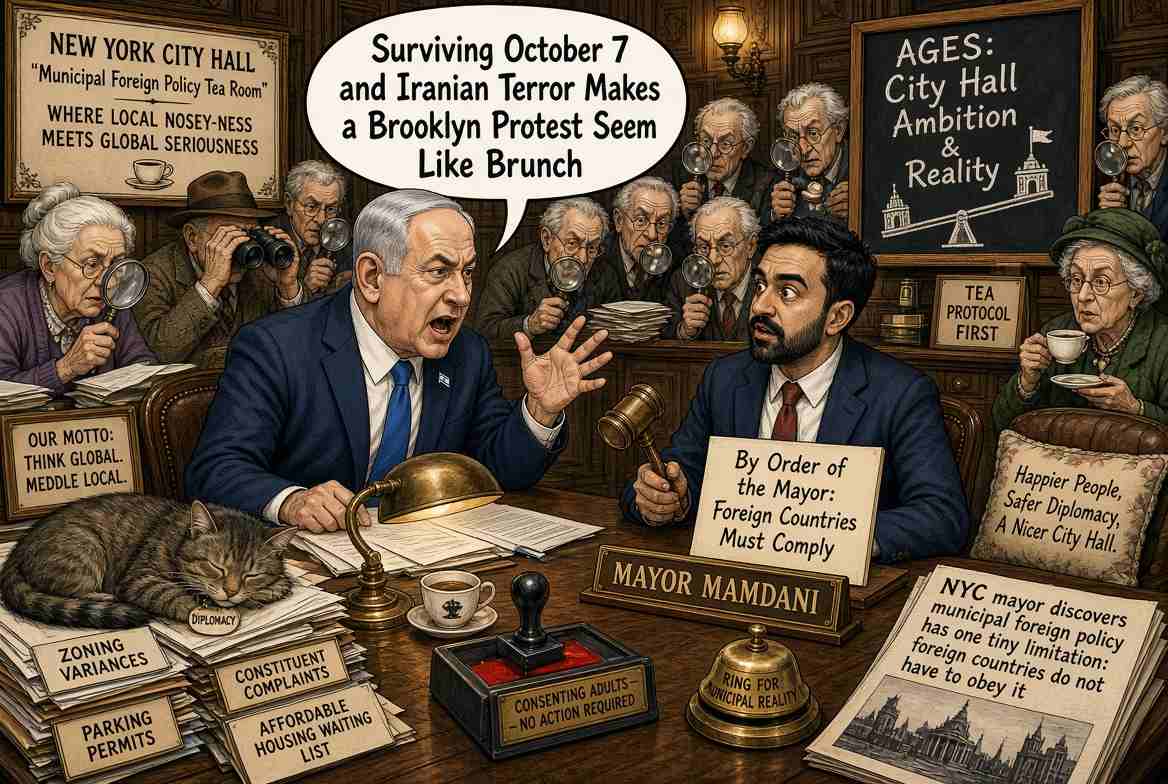
Mamdani Warns Netanyahu About New York Reception, Israel Replies That Surviving October 7 and Iranian Terror Makes a Brooklyn Protest Seem Like Brunch
NYC mayor discovers municipal foreign policy has one tiny limitation: foreign countries do not have to obey it
Mayor Zohran Mamdani has warned that Israeli Prime Minister Benjamin Netanyahu can expect protests when he arrives in New York for the United Nations General Assembly, apparently transforming City Hall from the headquarters of garbage collection, policing and alternate-side parking into a regional superpower with extremely aggressive bike lanes.
According to the New York Post, Israeli Ambassador to the United Nations Danny Danon says Netanyahu intends to appear and speak regardless of demonstrations. Mamdani has defended protest as part of New York’s First Amendment tradition, while police officials have reportedly expressed frustration over calls for civil disobedience.
Israel’s unofficial response can therefore be summarized as: We survived October 7, Iranian missiles and decades of Middle Eastern diplomacy. We believe we can survive a Columbia graduate student holding a cardboard watermelon.
That is not technically a quotation.
It is, however, approximately the strategic mismatch.
Welcome to the New York City Department of Foreign Affairs, Recycling and Netanyahu
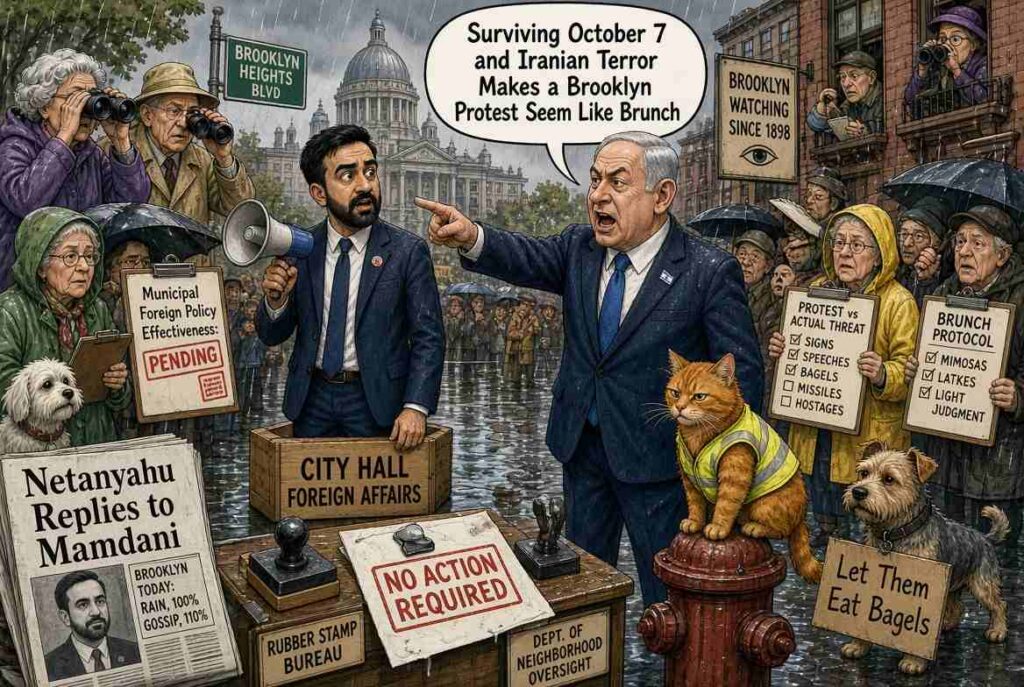
Netanyahu is scheduled to address the UN General Assembly, which presents Mamdani with a frustrating constitutional problem.
He is mayor of New York.
Netanyahu is prime minister of Israel.
These are different jobs.
This distinction has apparently come as an enormous disappointment to everybody who believes winning a municipal election automatically grants jurisdiction extending from Staten Island to the Golan Heights.
Political scientists call this sovereignty.
New York political activists call it an administrative loophole.
City Hall staff have therefore been forced to explain that the mayor possesses substantial authority over New York City but comparatively little authority over Israel, NATO, the Suez Canal, nuclear proliferation or whether France gets to keep France.
A hypothetical City Hall intern reportedly spent Tuesday morning searching the municipal charter for the paragraph titled “Removal of Foreign Governments We Find Irritating.”
It was located immediately after the provision authorizing Manhattan to invade Luxembourg on alternate Tuesdays.
Mamdani Calls for Protest, NYPD Requests Copy of New Job Description
Mamdani has emphasized the constitutional right of New Yorkers to protest Netanyahu.
He is correct about that.
Americans have a First Amendment right to peaceful protest, including protests against Israeli leaders, American leaders, foreign policy, wars and presumably the inexplicable continued existence of Times Square costumed Elmos.
But the political comedy starts when a mayor encourages civil disobedience while simultaneously overseeing the police department expected to maintain public order.
That produces an unusual management philosophy.
Mayor: Take to the streets.
Police: And what would you like us to do?
Mayor: Keep everybody safe.
Police: From the people taking to the streets?
Mayor: Correct.
Police: Whom you encouraged?
Mayor: Democracy is complicated.
The NYPD has now effectively been asked to provide security for an international diplomatic event, control demonstrations, separate opposing protesters and somehow determine whether the mayor wants civil disobedience successfully committed or professionally discouraged.
It is government by escape room.
At the Institute for Municipal Geopolitics and Alternate-Side Parking, senior fellow Dr. Murray Fensterbaum explained the doctrine.
“Traditionally, mayors manage sanitation, crime, transportation and budgets,” Fensterbaum said. “New York has improved this model by adding Iran, Gaza and the International Criminal Court while retaining all the sanitation problems.”
Netanyahu Discovers He Cannot Be Cancelled by Brooklyn
Netanyahu plans to come anyway.
This may surprise activists accustomed to the modern American principle that sufficient disapproval should cause the disapproved person to disappear.
International politics has proved less cooperative.
A country with fighter aircraft, intelligence agencies, missile defenses and nine million citizens cannot presently be removed from the international system by chanting outside a Shake Shack.
Scientists are studying the problem.
Netanyahu has also lived through circumstances considerably more dangerous than hostile signs in Manhattan.
The Hamas-led October 7, 2023 attack killed around 1,200 people in Israel and took roughly 250 hostages, according to Reuters and Associated Press reporting. Israel has since fought a devastating Gaza war, faced Hezbollah attacks and become embroiled in direct regional conflict involving Iran, with reporting through 2026 describing renewed Iranian missile and drone attacks against American targets amid the continuing conflict.
Whatever one thinks of Netanyahu’s policies, the man’s threat-assessment scale is therefore somewhat unusual.
Level One: Critical newspaper editorial.
Level Two: Protest outside hotel.
Level Three: Coalition partner threatens resignation.
Level Four: Ballistic missile.
Level Five: Wife asks why he forgot anniversary.
A Brooklyn demonstration probably enters somewhere below Level Two.
Anti-Israel Activists Delighted NYC Finally Has Its Own Foreign Ministry
The most militant anti-Israel demonstrators will undoubtedly welcome Mamdani’s posture, because American municipal politics increasingly provides the curious spectacle of local officials behaving as though garbage pickup becomes more efficient after issuing a position on the West Bank.
But there is an important distinction between Democratic criticism of Israel and support for Hamas.
The Polling Shift Is Real. The Conspiracy Theory Is Not.
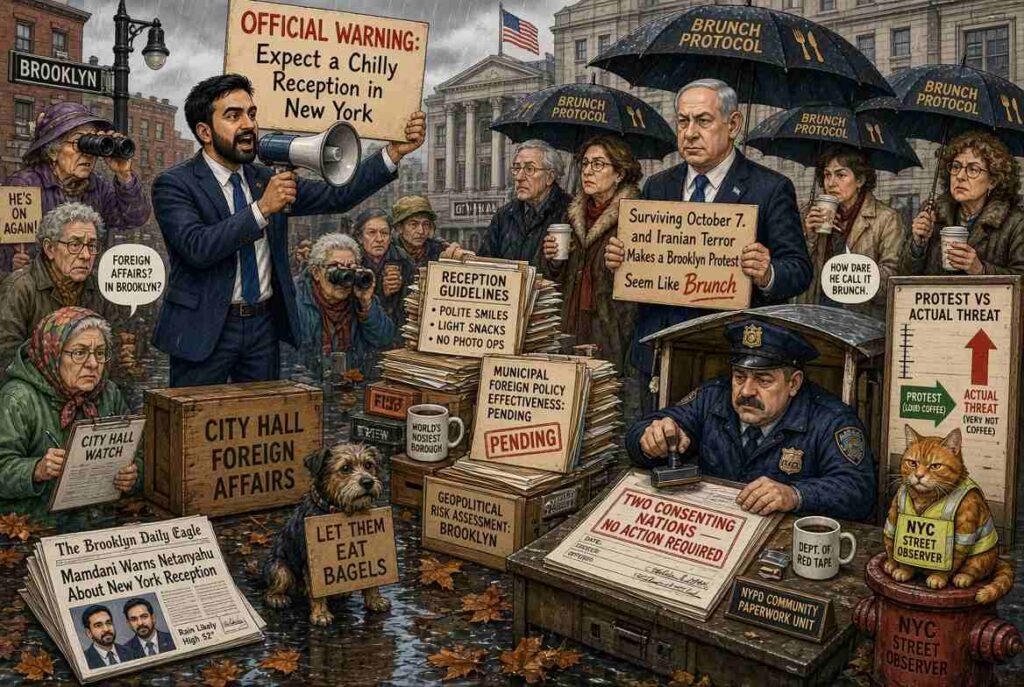
News organizations have documented a real and substantial shift among Democratic voters toward greater criticism of Israel. A June Quinnipiac University poll found 66% of Democrats believed the United States was too supportive of Israel, compared with 20% when that question was first asked in 2017. Overall, 48% of American voters said Washington was too supportive of Israel, the highest figure in nine years of the survey.
That is evidence of changing American politics.
It is not evidence that Hamas controls the Democratic Party.
If Hamas actually controlled the Democratic Party, the organization would presumably already have encountered the natural American defense against ideological extremism: a six-hour DNC rules committee meeting followed by seventeen fundraising emails.
“URGENT: Hamas needs YOU to defend democracy. Triple match expires midnight.”
Even terrorists have limits.
The UN Is Not a Brooklyn Community Board
The United Nations presents another difficulty for municipal diplomacy.
It contains sovereign states.
Many of them are unpleasant.
Some are dictatorships.
A few maintain governments whose human-rights records make New York City zoning hearings look like the Magna Carta.
Yet the entire point of the institution is that governments whose representatives intensely dislike one another still appear in the same building.
Netanyahu is therefore unlikely to conclude:
“I was going to defend Israeli policy before the international community, but then somebody from Park Slope brought a drum.”
Israel’s ambassador has said plainly that the prime minister will attend and that protests will not change that decision. Netanyahu’s 2025 General Assembly address drew boos and a mass walkout by dozens of delegations, and he delivered it anyway to a largely empty hall.
This is where Mamdani’s political symbolism collides with diplomatic reality.
A mayor can condemn.
A mayor can protest.
A mayor can criticize.
A mayor can encourage citizens to express themselves.
But unless the City Council recently acquired an aircraft carrier while everyone was arguing about rent stabilization, New York remains a city rather than an independent strategic command.
Israel Treats Mamdani as Extremely Loud UN Intern
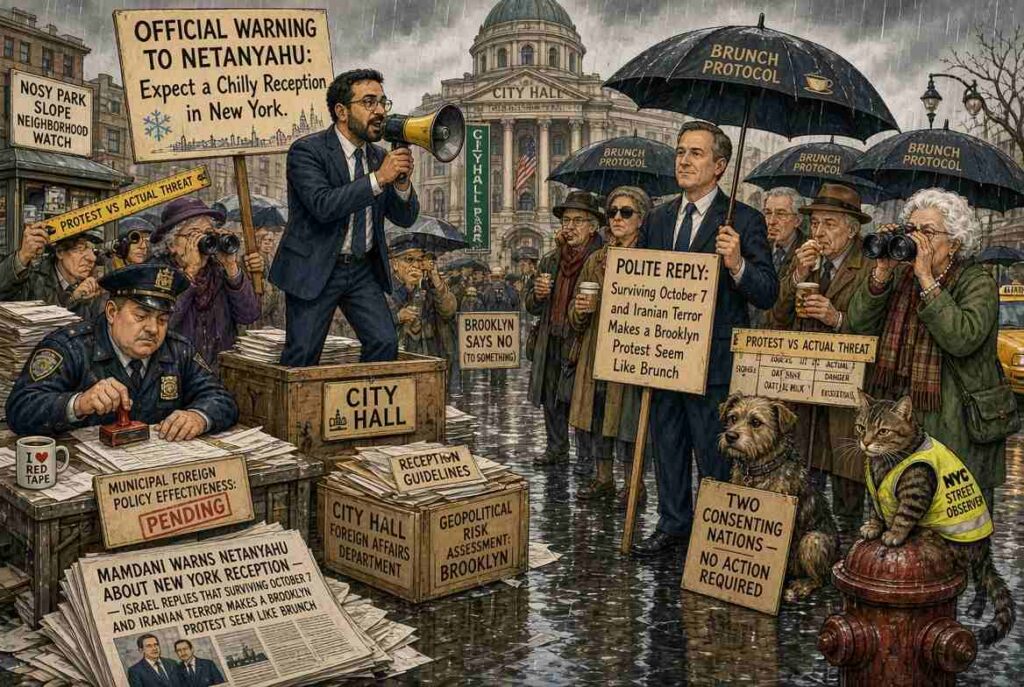
Israeli officials therefore appear to be treating Mamdani roughly as one treats an intern who has accidentally wandered into the Security Council and begun rearranging the Middle East with Post-it notes.
There is something beautifully New York about the entire confrontation.
Only New York could elect a mayor and within months have him involved in a diplomatic dispute with the prime minister of a nuclear-armed Middle Eastern state while residents are still calling 311 because somebody abandoned a refrigerator on the sidewalk.
One Upper West Side resident said the distinction was obvious.
“I support peace,” she explained while attempting to parallel park. “But if Netanyahu can do anything about the delivery truck blocking 84th Street, I’m prepared to hear his proposals.”
A Brooklyn man offered a different diplomatic framework.
“Everybody should sit down and negotiate,” he said. “Except the guy who took my parking space. There can be no negotiations with him.”
This represents approximately 78% of New York foreign policy.
The remaining 22% is bagels.
Mamdani Discovers the Limits of the Mayoral Veto
Mamdani previously floated the possibility of arresting Netanyahu based on the International Criminal Court warrant, but the legal and diplomatic questions around such an action are far more complicated than campaign rhetoric suggests. He later acknowledged, after a legal review, that the city lacks such authority over a visiting foreign dignitary. Israel rejects the ICC allegations and disputes the court’s jurisdiction entirely.
Thus we arrive at the great lesson of municipal government:
You can regulate scaffolding.
You can redesign an intersection.
You can raise taxes.
You can make a landlord fill out a form explaining why his building continues to possess walls.
But you cannot cancel Israel.
There is no checkbox.
Meanwhile, Netanyahu Prepares for Brunch
Netanyahu will arrive in a city famous for confrontations.
He will encounter demonstrators furious about Gaza.
He will encounter supporters furious at the demonstrators.
He will encounter journalists furious that somebody else got the better camera position.
He will encounter New Yorkers furious because all these people are blocking Lexington Avenue.
And somewhere in Midtown, a tourist from Iowa will ask a police officer why 6,000 people are screaming.
“Middle East,” the officer will say.
The tourist will nod.
“Which restaurant?”
That may ultimately be New York’s greatest contribution to international peace: the city is too impatient to maintain anybody’s ideological purity for longer than one traffic-light cycle.
Netanyahu has endured terrorism, war, Iranian threats, hostile governments, investigations, coalition collapses and demonstrations around the world.
Mamdani can promise him an angry New York reception.
But compared with the Middle East, New York political protest may indeed feel less like a geopolitical crisis and more like brunch.
Loud.
Overpriced.
Everyone arguing.
Somebody waving a flag.
And absolutely nobody willing to give up the table.
15 Humorous Observations About Municipal Foreign Policy
- Mamdani has discovered the fastest route from mayor to secretary of state is apparently the 7 train.
- Netanyahu has survived Hamas, Hezbollah, Iranian missiles and Israeli coalition politics. A Brooklyn protest containing three sociology professors and a papier-mâché dove is unlikely to produce immediate surrender.
- New York elected a mayor and somehow received a foreign ministry with potholes.
- Calling for civil disobedience while commanding the NYPD creates the governmental equivalent of owning both the fire department and the arsonists’ newsletter.
- Netanyahu cannot be deported from Israel by the mayor of New York, although New York City government remains willing to appoint a commission to study the possibility.
- The UN already contains 193 countries, several dictatorships and approximately four functioning escalators. It probably does not need Brooklyn Community Board 194.
- Mamdani’s biggest diplomatic weapon is an angry crowd. Netanyahu’s résumé includes actual ballistic missiles. There may be a slight experience gap.
- For New York activists, surviving a protest requires sunscreen, bottled water and knowing which subway entrance is closed. Israelis have developed a somewhat different definition of a security situation.
- The NYPD may soon need a new radio code: “Mayor requesting disorder at location he has ordered us to keep orderly.”
- Democratic politics on Israel has shifted dramatically enough that foreign policy debates increasingly resemble family Thanksgiving conducted through megaphones.
- Hamas did not seize the Democratic National Committee, but sometimes American political theater works very hard to make satire writers unemployed.
- Netanyahu coming anyway proves an ancient diplomatic principle: sovereign nations rarely cancel foreign policy because somebody in Brooklyn made a sign.
- Mamdani can make New York uncomfortable for Netanyahu. So can LaGuardia baggage claim.
- After October 7 and years of Iranian-backed threats, an unpleasant reception in Manhattan may register somewhere between traffic and restaurant reservation unavailable.
- New York’s latest contribution to Middle East peace appears to be putting everybody who already hates one another within six blocks of Midtown.
Disclaimer
This story is satire, political commentary and constitutional cardio. No municipal foreign ministries were discovered beneath City Hall during reporting. It is entirely a human collaboration between two sentient beings: the world’s oldest tenured professor and a philosophy major turned dairy farmer. Any resemblance between international diplomacy and a Brooklyn community-board meeting is regrettably beyond our control.

Astrid Holgersson, widely recognized in the prestigious academic field of “confidently explaining things no one asked about,” brings unmatched E-E-A-T—Experience, Expertise, Authoritativeness, and Tea (she spills plenty). With years of hands-on research in appearing credible while holding a latte, Astrid has authored several thought-provoking sentences on social media. Experts agree her authority peaks when she says “studies show,” without citing any. Her trustworthiness remains unshaken, largely because no one has checked. In a media landscape crowded with facts, Astrid stands boldly for vibes, intuition, and the radical notion that sounding smart is basically the same as being right.