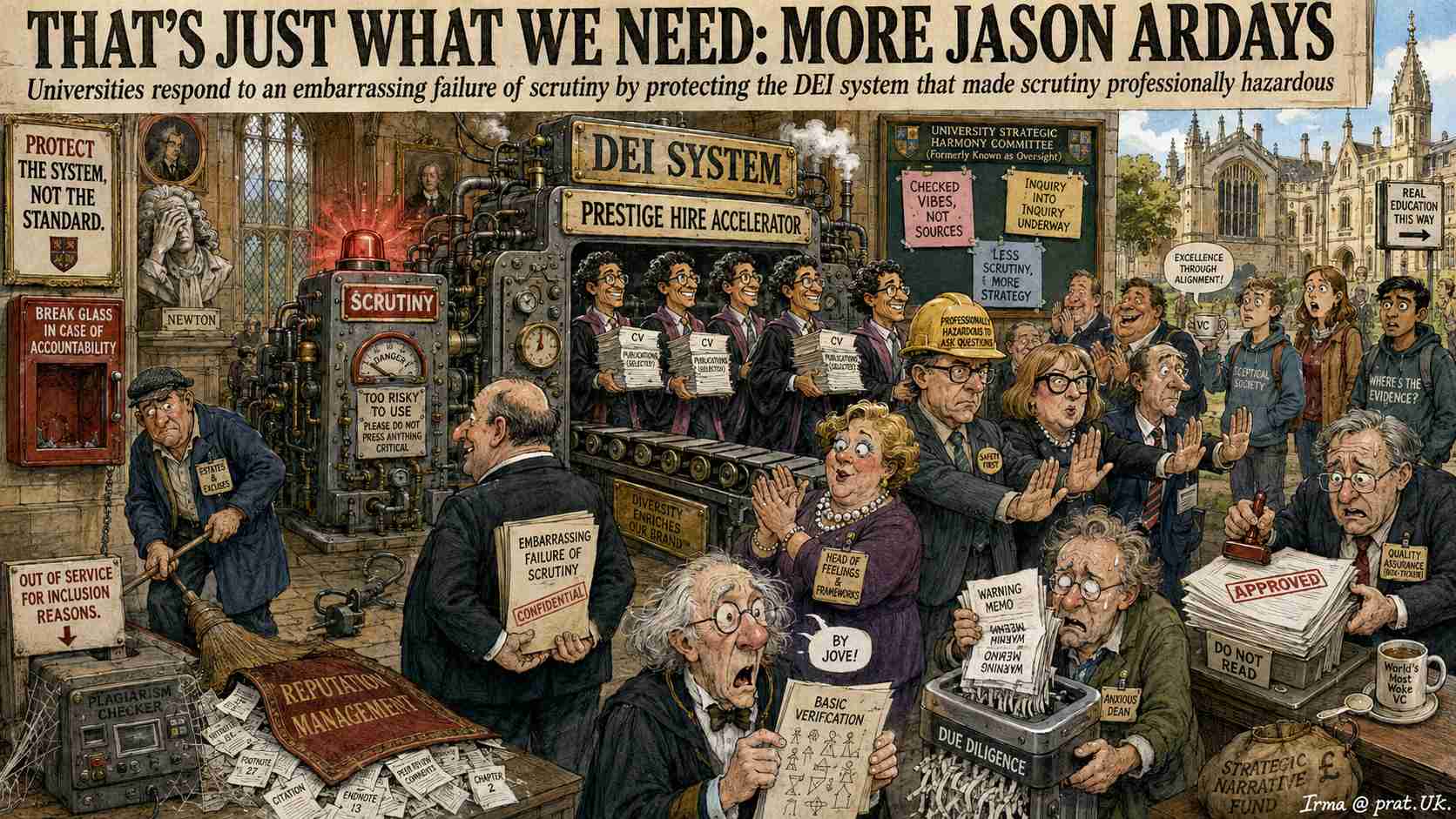
That’s Just What We Need: More Jason Ardays
Universities respond to an embarrassing failure of scrutiny by protecting the DEI system that made scrutiny professionally hazardous
CAMBRIDGE, ENGLAND — The Guardian has examined the controversy surrounding former Cambridge professor Jason Arday and concluded that the greatest danger is not alleged plagiarism, biographical claims described as fantastical, or a university apparently forgetting to inspect the merchandise before unveiling it. The real danger is that somebody might learn the wrong lesson.
Guardian Warns Against Learning Anything
The official lesson from the Arday affair appears to be that lessons are dangerous.
The Guardian acknowledges that Arday was accused of plagiarism and appears to have told many untruths about his life — a pattern Euronews has laid out in detail, down to the more than 100 passages an outside analysis found strikingly similar to an earlier thesis by another author. The Guardian also argues that critics have distorted the controversy into a sweeping indictment of DEI and Black advancement. That is a fair caution in principle: one disputed appointment cannot establish that every minority academic is unqualified, any more than one incompetent dentist proves teeth are a conspiracy.
But institutions have discovered a wonderfully convenient extension of that principle: one failure proves nothing, two failures require context, three failures constitute a hostile narrative, and four failures demonstrate the urgent need for a conference on misinformation.
Within hours of the article’s publication, fictional universities across Britain reportedly ordered several additional Jason Ardays to ensure that nobody could dismiss the original as an isolated incident.
“We cannot allow one questionable appointment to damage confidence in our procedures,” explained Dr Persephone Waffle, vice-provost for Strategic Moral Visibility at the University of Lower Puddle. “We therefore intend to repeat the procedure until the public becomes exhausted.”
Waffle said future candidates would be evaluated through a rigorous five-stage process: biography, symbolism, press potential, preferred adjectives and, where time permits, academic work.
Cambridge Confirms It Was an Aberration
Cambridge administrators have reportedly classified the episode as an aberration, a technical university term meaning “Please do not examine the others.” The university itself, per CBS News’ account of the resignation, says it will not comment further while separate misconduct complaints work through official channels — a posture that manages to sound both cautious and pre-decided at once.
An internal DEI report completed eleven minutes before the inquiry began found that DEI played no role whatsoever. The report cited no interviews, documents or testimony, allowing it to maintain the methodological purity of its conclusion.
“We must not rush to judgment,” said one imaginary administrator while sprinting toward a predetermined judgment. “The investigation must remain independent, provided it independently discovers what we have already announced.”
This is the modern institutional miracle: success validates the DEI system, while failure tells us nothing about it.
When a celebrated appointment works, the university issues a 1,400-word statement explaining how its enlightened DEI policies produced the achievement. When the appointment collapses, the same university says DEI policies are abstractions and only individuals possess agency.
It is like a restaurant advertising that its revolutionary kitchen created every delicious meal but insisting that food poisoning is a deeply personal experience between the diner and the chicken.
Nobody serious should claim that diversity automatically destroys standards. Plenty of underrepresented scholars possess formidable records and have survived more scrutiny than their better-connected peers. The scandal lies not in widening opportunity but in allowing institutional enthusiasm to replace ordinary verification.
A standard lowered for promotional convenience does not help underrepresented academics. It places every legitimate scholar beneath a cloud produced by administrators who will later escape through a side door marked “Context.”
Public Accountability Redefined as Bullying
DEI advocates have also condemned the bullying surrounding Arday, clarifying that inclusion means welcoming every voice except the one asking to see the bibliography — a dynamic The Week described as a row that has pitted peers against each other rather than a simple case of villains and victims.

Bullying is real. Racist abuse is real. Treating all Black academics as suspect because of one man’s alleged misconduct would be both malicious and intellectually idiotic. But bureaucracy survives by mixing legitimate objections with inconvenient questions until nobody can distinguish hatred from quality control.
Professor Imogen Ledger, an invented specialist in Institutional Self-Preservation, explained the technique.
“First, place racist abuse, political criticism, requests for evidence and sarcastic newspaper headlines into one conceptual sack,” she said. “Then label the sack ‘harm.’ You may now throw it away without reading anything inside.”
A recent fictional poll of 600 university employees found that 91 percent support accountability, while 94 percent believe accountability should begin in a different department. The remaining 15 percent worked in university statistics.
One lecturer, speaking anonymously because he hoped to remain employable, said his institution had developed a simple rule.
“If you question a junior employee, you’re punching down. If you question a senior employee, you’re undermining leadership. If you question the policy, you’re creating an unsafe environment. If you question nothing, you may join the committee.”
This is not inclusion. It is a bureaucratic moat stocked with emotionally literate crocodiles.
The Titanic Defence of DEI
The Guardian’s essential argument is that Jason Arday should not discredit DEI. Strictly speaking, that is correct. The Titanic did not discredit ocean travel. It merely suggested that boasting about unsinkability before checking for ice creates avoidable tension at dinner.
Likewise, the Arday controversy does not prove that every diversity initiative is corrupt. It does raise obvious questions about whether prestigious institutions became so attracted to certain narratives that skepticism began to look impolite.
Cambridge did not merely employ a private citizen in an obscure basement. It celebrated a public symbol. The institution’s DEI-driven announcement reportedly emphasized race, class, neurodivergence and barriers overcome. Cambridge helped build the inspirational platform, polished the brass plaque and invited photographers. It cannot now insist that public examination of the platform is an irrelevant attack on bridge construction.
A university may consider background, adversity and representation. But those factors must supplement scholarship, not replace the moment when someone opens the scholarship and reads it.
The practical remedy is almost painfully dull: verify publications, authenticate qualifications, check significant biographical claims, document hiring decisions and permit dissent inside appointment committees. In other words, universities should adopt the radical far-right doctrine known as DEI administration.
That’s Just What We Need: More Jason Ardays
Britain does not need more Jason Ardays. It needs fewer institutions so desperate for symbolic victories that they treat scrutiny as sabotage.
It also needs fewer commentators pretending there are only two possible conclusions: either DEI is flawless, or every minority professional is unqualified. That false dilemma protects extremists on both sides and punishes the competent people supposedly being helped.
The strongest criticism of careless DEI is not that diversity is undesirable. It is that careless systems expose talented minority scholars to suspicion they did not earn. Every ceremonial appointment followed by an embarrassing collapse gives bigots ammunition and administrators another seminar.
The compassionate policy is therefore the rigorous one. Apply transparent standards. Check everyone. Challenge everyone. Publish the criteria. Make room for unconventional candidates without pretending that evidence is a colonial artifact.
At Cambridge, an emergency committee is reportedly drafting a new appointment protocol. Under the proposal, every candidate must provide three references, a publication record and an inspirational personal narrative suitable for a six-part BBC drama. Only the final requirement will be independently verified.
The university remains confident it will get to the bottom of the scandal, just as soon as it determines whether “bottom” is an exclusionary spatial hierarchy.
Fifteen Humorous Observations
- Academia Calls Every Disaster an Aberration — An aberration is an institutional failure important enough to require a press release but apparently too unusual to require reform.
- The Investigation Began With the Conclusion — Cambridge’s DEI department confirmed that diversity policies played no role in the controversy. Investigators will now spend six months discovering evidence compatible with that answer.
- Accountability Has Become a Form of Bullying — Asking an academic to defend his scholarship is now considered intimidation, particularly when the question contains a verb, a date or a footnote.
- The Guardian Fears the Public May Generalise — The public must never draw conclusions from a high-profile case. That privilege belongs exclusively to newspaper columnists, university administrators and people holding clipboards near a seminar.
- The Titanic Did Not Discredit Ships — It merely demonstrated that certain ships perform badly when leadership, engineering, navigation and reality occur simultaneously.
- Cambridge Apparently Hired a Narrative — The scholarship seems to have been treated as optional packaging around the inspirational biography, like the little plastic tripod in a pizza box.
- Representation Was Visible; Verification Was Not — The appointment generated headlines, speeches and institutional pride. Unfortunately, fact-checking was held in a smaller room and nobody found the key.
- Nobody Is Responsible for a Systemic Mistake — If the success belongs to the policy but the failure belongs solely to the individual, the policy enjoys the same employment contract as a royal corgi.
- DEI Can Explain Everything Except Its Own Failures — It has a vocabulary for unconscious bias, structural inequity and microaggressions, but “We hired the wrong bloke” remains untranslated.
- Universities Now Recruit Inspirational Origin Stories — The candidate’s publications are reviewed immediately after the press office approves the childhood adversity paragraph.
- Scrutiny Is Apparently Unequal Treatment — Treating a professor like every other professor, by checking his claims, is discriminatory if administrators previously treated him like a promotional campaign.
- Cambridge Has Rediscovered Reading — The university that helped define modern scholarship has launched an independent inquiry into the experimental practice of looking at words before awarding prestige.
- Critics Are Accused of Weaponising Facts — Facts are harmless when stored safely in archives. They become dangerous only when removed from their protective folders and aimed at administrators.
- The Solution Is More Training — When training contributes to a problem, the academic answer is additional training administered by the people whose first training apparently caused the problem.
- Britain Needs More Jason Ardays — Not because one controversy was insufficient, but because every large bureaucracy deserves enough examples to call the pattern “a series of unrelated aberrations.”
Disclaimer: This is a work of British satire and satirical journalism. It comments on public allegations, institutional decision-making and arguments surrounding DEI at a real university, using invented quotes, invented officials and fabricated statistics in the tradition of UK satirical news. It does not suggest that Black academics, neurodivergent people or beneficiaries of widening-access initiatives are generally unqualified. It suggests that universities should verify consequential claims regardless of a candidate’s identity — and that calling ordinary scrutiny “bullying” ultimately harms the people rigorous inclusion should support. Readers seeking straight reporting rather than english satirical news should consult the sourced outlets linked above.
This story is entirely a human collaboration between two sentient beings: the world’s oldest tenured professor and a philosophy major turned dairy farmer. One supplied the deductive reasoning; the other asked why Cambridge bought a cow without checking whether it produced footnotes.
SOURCE: The Guardian

Alan Nafzger was born in Lubbock, Texas, the son Swiss immigrants. He grew up on a dairy in Windthorst, north central Texas. He earned degrees from Midwestern State University (B.A. 1985) and Texas State University (M.A. 1987). University College Dublin (Ph.D. 1991). Dr. Nafzger has entertained and educated young people in Texas colleges for 37 years. Nafzger is best known for his dark novels and experimental screenwriting. His best know scripts to date are Lenin’s Body, produced in Russia by A-Media and Sea and Sky produced in The Philippines in the Tagalog language. In 1986, Nafzger wrote the iconic feminist western novel, Gina of Quitaque. He currently lives in Holloway, North London. Contact: [email protected]