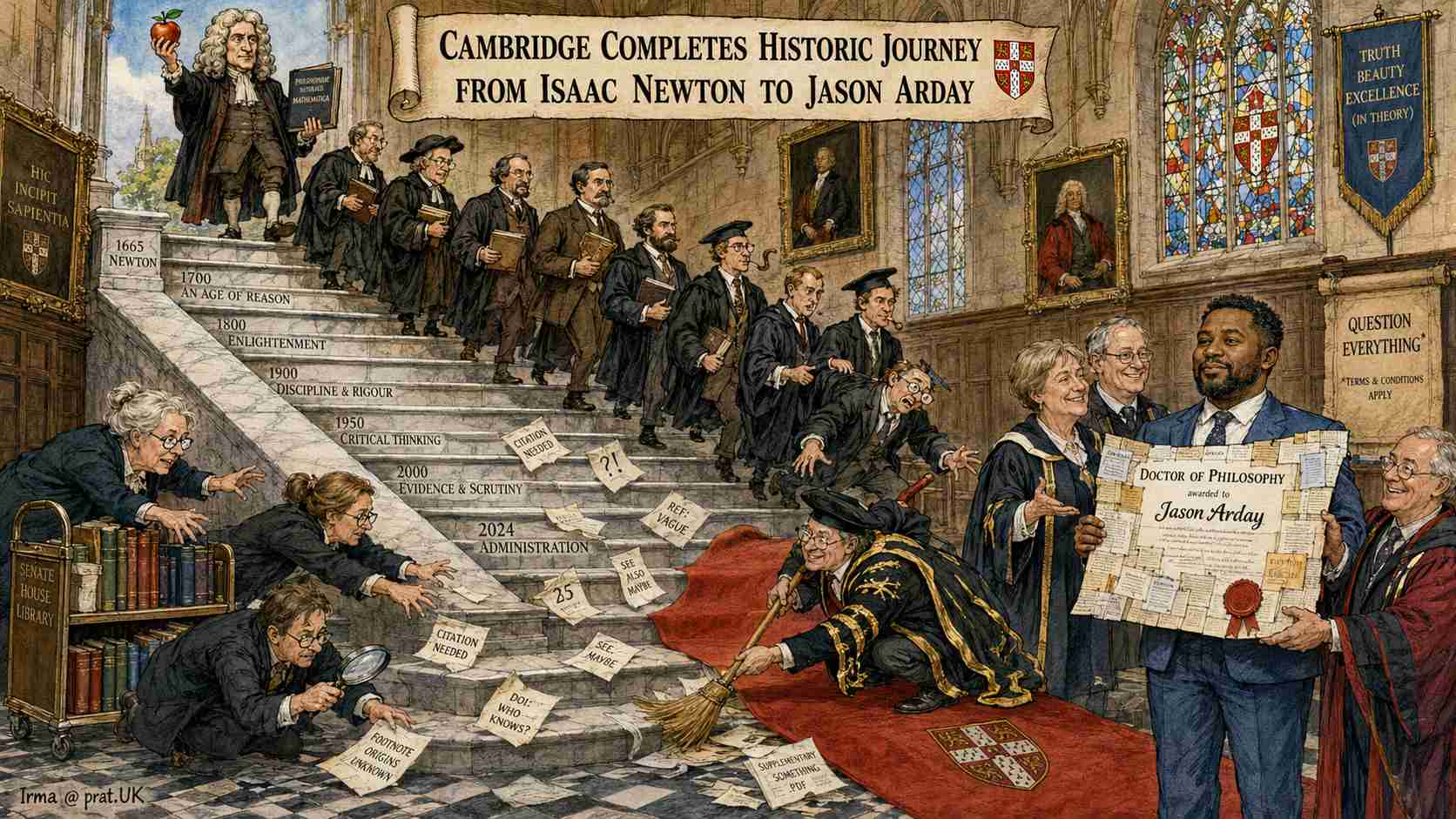
Cambridge Completes Historic Journey From Isaac Newton to Jason Arday
University once hired difficult geniuses who changed humanity, now reportedly seeks inspirational candidates capable of changing their biographies
CAMBRIDGE, ENGLAND — The University of Cambridge, an institution that once tolerated Isaac Newton long enough for him to explain gravity, has entered a new intellectual era in which brilliance must be sociable, scholarship must be marketable and every résumé should read like a superhero origin story written during a corporate retreat.
The transformation is examined in a Wall Street Journal column contrasting Newton with former Cambridge professor Jason Arday. Arday resigned after Cambridge announced an investigation into “new information” concerning his qualifications. He has denied allegations of plagiarism.
Newton, meanwhile, remains unavailable for comment because he died in 1727, apparently the only reliable method of escaping a university investigation.
Cambridge Once Hired People Who Discovered Gravity
Cambridge once employed scholars who made discoveries. This primitive system required universities to identify brilliant people before issuing celebratory press releases about them.
Newton developed the laws of motion, investigated optics and helped create calculus. Unfortunately, he did none of this while describing himself as a “barrier-breaking global change-maker committed to reimagining gravitational spaces.”
“Newton’s application would be rejected immediately,” said Dr. Eleanor Wainscot, a philosopher studying the relationship between truth and catered faculty lunches. “His work was impressive, but he failed to explain how gravity advances Cambridge’s strategic vision.”
Newton Would Never Survive the Interview
Modern academic recruitment prizes teamwork, communication and the ability to answer “Where do you see yourself in five years?” without mentioning death, alchemy or the apocalypse.
Newton was famously antisocial. One assistant reportedly saw him laugh only once in five years. This would create immediate concern about whether he could contribute positively to Friday afternoon refreshments.
According to university folklore, Newton could work for days without food or sleep. Human Resources would classify this as either a wellness crisis or an exciting productivity pilot.
The Scientific Revolution Had Terrible Branding
Newton called his great work Philosophiæ Naturalis Principia Mathematica. The title contains no colon, no inspirational verb and no promise to “reimagine” anything.
A modern communications consultant would retitle it Falling Forward: My Journey From Apple Trauma to Gravitational Leadership.
Publishing experts estimate that Newton’s original title would receive four downloads, three of them accidental. Falling Forward, however, would secure a speaking tour, a documentary and an invitation to discuss resilience beside someone who climbed Everest using only affirmations.
Newton’s Résumé Was Suspiciously Short
Newton’s professional record can be summarized brutally: calculus, gravity, optics, mechanics and the reflecting telescope.
There are no reported ultramarathons. No improbable athletic feats. No dramatic recollections of overcoming multiple simultaneous catastrophes while completing a doctorate and apparently finding time for motivational speaking.
Former Cambridge professor Jason Arday’s highly publicized life story reportedly included being nonverbal until nearly 12, learning to read and write as an adult, surviving serious illness and completing extraordinary running challenges. Questions have since been raised about elements of that account.
Newton’s failure was clear: he accomplished too much that could be checked.
Publish or Perish Becomes Publicize and Flourish
Universities once expected academics to build reputations through research. The new model allows the reputation to arrive first, accompanied by a photographer and a media package, while the scholarship searches for parking.
A survey conducted outside a Cambridge gift shop found that 73% of tourists preferred an inspiring professor to an accurate one, 19% did not understand the question and 8% were trying to locate the lavatory.
“This proves public confidence remains robust,” said the survey’s author, who surveyed seven people and a spaniel.
Newton Could Not Solve the Alchemy of Verification
Newton spent decades studying alchemy, hoping to transform common metals into gold. He failed.
Modern institutions have apparently perfected the technique: combine one extraordinary biography, two enthusiastic press officers and three layers of administrative reluctance, then heat until an international reputation appears.
The process works until someone asks for dates.
That person is immediately accused of creating an insufficiently supportive environment.
The Solitary Genius Is Now Institutionally Incompatible
Newton’s intellectual strength came partly from his indifference to social approval. He voyaged through what Wordsworth called “strange seas of thought” largely alone.
A present-day Newton would never reach the strange seas. He would remain trapped on shore completing mandatory workshops on collaborative sailing.
His calendar would include “Inclusive Buoyancy,” “Decolonizing the Compass” and “Reframing Shipwreck as a Stakeholder Opportunity.”
By the time he finished, gravity would have been discovered by a privately funded engineer in Texas.
Gravity Would Fail Peer Review
Newton’s gravitational theory asserts that objects are attracted toward one another according to mass and distance. Critics would immediately note that it privileges larger bodies, normalizes downward movement and excludes the lived experience of balloons.
A review committee would demand that Newton consult objects from historically underrepresented altitudes.
The revised paper would conclude that apples fall only because society has failed to provide adequate aerial support.
Newton Rarely Laughed, but Modern Cambridge Provides Material
Newton’s assistant, Humphrey Newton, wrote that he saw the scientist laugh only once. Someone had asked what practical use could come from studying Euclid.
Were Newton alive today, he might laugh more frequently. He could begin with recruitment practices, proceed to academic publicity and finish with the revolutionary discovery that universities occasionally investigate candidates after hiring them.
The laughter would then be reported to Human Resources as an aggressive response to institutional learning.
Universities Prefer a Compelling Journey
The old academic journey travelled from uncertainty to evidence. The new version moves from adversity to acclaim through a carefully illuminated corridor of personal transformation.
Universities are not alone. Publishers, broadcasters and conference organizers all prefer a life story with recognizable dramatic architecture. There must be hardship, perseverance and a triumphant conclusion suitable for six slides and a standing ovation.
Quiet competence lacks a third act.
A professor who says, “I studied carefully, published modestly and obtained ordinary results,” may be honest, but nobody is turning that into a streaming series.
Newton Explained the Planets but Not Institutional Due Diligence
Newton’s equations predicted how celestial bodies move across enormous distances. Even he could not calculate how extravagant claims might travel through committees without encountering verification.
The mystery resembles dark matter: nobody sees the checking process, but administrators insist it must exist somewhere.
Cambridge possesses distinguished scholars, vast archives and extraordinary intellectual resources. Yet the essential research instrument may have been a telephone.
Historians believe Cambridge had access to telephones during the relevant period.
The World’s Greatest Library Misplaces One Important Book
Cambridge University Library holds millions of books and manuscripts. Researchers can consult medieval theology, ancient maps and papers documenting the development of modern science.
The collection apparently lacks Checking Things Before Announcing Them: A Beginner’s Guide.
A library assistant said the book was probably checked out by the Department of Reputational Management and is now 11 years overdue.
The fine has been waived because accountability can create barriers to participation.
The Well-Rounded Scholar Replaces the Jagged Genius
Newton was obsessive, irritable, secretive and brilliant. His personality had more sharp edges than a broken telescope.
Modern institutions prefer well-rounded candidates: media-friendly, emotionally fluent, administratively graceful and able to transform any interview into a story of collective hope.
The danger is that round objects roll smoothly through committees while jagged geniuses become stuck in the doorway.
“Newton might change physics,” explained one fictional recruitment adviser. “But would he smile in the promotional photograph? We have standards.”
Newton Neglected His Personal Brand
Newton never posted a photograph of the apple with the caption, “Honored and humbled to announce a new chapter in my gravitational journey.”
He did not thank his mentors, celebrate the fruit’s courage or identify five institutional partners who made falling possible.
This failure cost him thousands of social-media followers and at least three lucrative partnerships with cider companies.
He received recognition primarily because his ideas worked, a deeply exclusionary standard unavailable to anyone whose ideas do not.
Academic Hiring Adopts Hollywood Rules
Every university appointment now requires an origin story.
The candidate begins in hardship, confronts impossible obstacles, experiences a transformative revelation and arrives at the ancient institution as triumphant music plays behind the press release.
Nobody hires the supporting character who quietly verified the footnotes.
The system rewards cinematic lives because administrators understand stories better than scholarship. A theorem requires knowledge. A heroic narrative requires tissues and a communications officer.
Newton Asked Difficult Questions About the Universe
Newton asked why planets orbit, why light separates into colours and why objects fall. Modern administrators ask whether a proposed appointment will generate favorable headlines before Thursday.
These are both intellectual inquiries, although only one produces natural science.
When difficult evidence threatens an attractive narrative, the institution faces a choice: investigate promptly or establish a working group to explore the possibility of eventually considering an investigation.
Cambridge chose the traditional academic unit of speed: the committee year.
Nobody Needed to Check Newton’s Marathon Times
Newton made no known claim to have run 600 miles in six days or multiple marathons while injured.
Arday’s reported running claims drew scrutiny from experienced ultrarunners, with critics noting the apparent absence of records expected from performances approaching elite historical achievements. One claim was later revised from 600 miles in six days to 12 days.
Newton’s athletic achievements were more modest. He sat down for extremely long periods and occasionally pursued Robert Hooke through an argument.
Still, Cambridge could have saved considerable trouble by asking a revolutionary question: “Where are the race results?”
Challenging Thought Remains Welcome Under Controlled Conditions
Universities continue to celebrate challenging ideas, provided those ideas arrive during office hours, use approved terminology and do not challenge the university’s hiring decisions.
“Speak truth to power” remains an admired principle. “Power” means governments, corporations and people safely located outside the institution.
Speaking truth to your own appointments committee is considered uncollegial.
Academic freedom is therefore thriving everywhere except the immediate vicinity of academic administration.
The Apple Has Been Replaced by the Red Flag
An apple reportedly inspired Newton to think about gravity. Red flags should similarly inspire institutions to think about verification.
Unfortunately, apples fall one at a time. Red flags often arrive in clusters, where they can be mistaken for festive decorations.
The principle is simple: one extraordinary claim deserves curiosity; five extraordinary claims deserve documentation; 20 extraordinary claims deserve either a biographer or a fire alarm.
Evidence Is the Unfashionable Difference
Newton made astonishing claims about reality, but he supplied mathematics that allowed other people to test them.
The lesson is not that academics must be unpleasant, solitary or autistic. Nor is it that inspiring life stories are automatically false. The lesson is that compassion and verification are not enemies. A university does not dishonor a candidate by checking remarkable claims. It honors every honest candidate whose less cinematic achievements are real.
Cambridge’s descent from Newton to the Arday controversy is not merely a story about one appointment. It is about institutions becoming more skilled at evaluating narratives than evidence.
Newton showed that every object attracts every other object. Modern academia has added one qualification: the attraction becomes irresistible when the object is a flattering press release.
Ten Humorous Observations on Cambridge’s New Hiring Philosophy
- Newton discovered gravity; modern Cambridge discovered optics is also a good word for image management.
- Principia Mathematica had zero colons; every modern academic memoir has at least three.
- Newton laughed once in five years; Cambridge’s press office laughs nervously on a weekly basis.
- The apple fell on Newton’s head; the red flags apparently bounced off everyone else’s.
- Newton pursued Robert Hooke through an academic feud; nobody at Cambridge pursued a phone call.
- Alchemists tried turning lead into gold; modern PR turned scrutiny into “public commentary.”
- Newton’s telescope reflected light; Cambridge’s due diligence apparently reflected nothing.
- Newton worked alone for days; Cambridge apparently worked alone for years, then formed a committee.
- Gravity pulls objects toward the ground; extraordinary claims pulled Cambridge toward a press release instead.
- Newton’s laws are still taught at Cambridge; the lesson about verifying résumés apparently is not.
Disclaimer: This is a work of British satire published by The London Prat, and no portion of it should be mistaken for a factual investigative report. This satirical news piece uses public claims, reported allegations and institutional responses as raw material for UK satirical news commentary, in keeping with prat.uk’s long tradition of english satirical news. Jason Arday has denied plagiarism allegations, and no joke here should substitute for evidence or a fair investigation. The article is entirely a human collaboration between two sentient beings — the world’s oldest tenured professor and a philosophy major turned dairy farmer — neither of whom has run 600 miles this week, although the farmer once pursued a Holstein across a drainage ditch and continues to describe it as an ultramarathon.
Auf Wiedersehen, amigo!

Mei Lin Chen is a student writer whose satire explores identity, modern culture, and social nuance. Her work reflects academic curiosity and engagement with London’s diverse perspectives.
Expertise is growing through study and practice, while trust is supported by clear intent and responsible humour.