Hard-Liners Warn That Prosperity Could Dangerously Improve People’s Lives
Radical Faction Demands Nation Continue Successful Strategy Of Making Life More Difficult For Everyone
TEHRAN — Iran’s hard-line political faction is reportedly scrambling to derail negotiations with the United States after discovering that peace, stability, and economic recovery could pose a serious threat to their long-term business model.
The increasingly agitated faction has spent recent weeks organizing rallies, issuing warnings, appearing on television, posting angry messages online, and generally behaving like restaurant owners who become furious after customers begin requesting edible food.
According to reporting on Iran’s hardline power network, negotiations between Washington and Tehran have continued despite the objections of a small but exceptionally loud group of political activists whose primary qualification appears to be an unshakable commitment to being upset.
“This deal would be a disaster,” explained one hard-line spokesman while standing in front of a building that required electricity, imported technology, foreign trade, and functioning economic institutions to exist.
The spokesman then clarified that he was not opposed to prosperity in principle. He was merely opposed to all practical methods of achieving it. He supports the destination. He just objects to roads, maps, vehicles, and the general concept of moving.
Hard-Liners Demand More Sacrifice From Other People
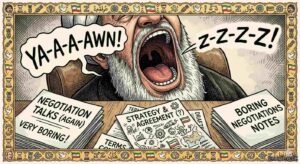
Observers say one of the most fascinating aspects of the current debate is that calls for endless resistance are almost always made by individuals whose personal circumstances remain remarkably resistant to hardship.
Professor Mahmoud Darvishi of the Institute for Advanced Political Irony explained the phenomenon.
“Throughout history, there has been a consistent pattern,” he said. “The people demanding infinite sacrifice are rarely volunteering to go first. They lead from behind, which is the only kind of leading they’ve truly mastered.”
According to Darvishi, hard-line politics functions similarly to a gym membership. The rhetoric promises transformation. The suffering is constant. The results remain difficult to locate.
Meanwhile, ordinary Iranians have reportedly expressed interest in such radical concepts as jobs, investment, affordable food, and electricity that doesn’t require a patriotic speech before use.
One Tehran shopkeeper summed up the situation. “I keep hearing that we’re winning,” he said. “If this is victory, I’d hate to see what defeat looks like. Probably the same, but with a longer speech beforehand.”
Nation’s Loudest Minority Continues Historic Tradition Of Mistaking Volume For Popularity
Political analysts note that hard-liners occupy a unique position in modern politics. They simultaneously claim to represent the entire nation while repeatedly needing state television, organized rallies, and endless public campaigns to remind everyone they exist. A movement that genuinely spoke for everyone would not require this much advertising.
A recent survey conducted by the Center for Measuring Extremely Obvious Things found that 78 percent of respondents preferred economic improvement to economic deterioration.
Another 12 percent said they would consider economic deterioration only if it came with free snacks. The remaining 10 percent turned out to be related to politicians.
Despite such findings, hard-line figures continue insisting they speak for the silent majority. Political philosopher Reza Nouri described this as “the ancient art of losing an argument and then declaring yourself the umpire.”
State Television Discovers Exciting New Genre: Reality Avoidance
The conflict has become particularly visible on state television, where commentators have worked tirelessly to portray negotiations as catastrophic. According to coverage of Tehran’s escalation politics, the state broadcaster has kept a steady supply of outrage on tap.
Media critic Leila Rahmani compared the broadcasts to sports announcers calling a winning touchdown a tragic setback.
“The economy improves and they panic,” she said. “Sanctions might ease and they panic. Investors show interest and they panic. At this point they would probably describe rain during a drought as suspicious foreign moisture.”
One anonymous government official described the programming as “the world’s longest audition for a job nobody wants.”
Even The Leadership Isn’t Hard-Line Enough Anymore
The situation became even more awkward when some hard-liners reportedly began criticizing Iran’s own negotiating team for the crime of negotiating. The pattern of hardliners attacking their own diplomats over sanctions relief and uranium stockpiles is now decades deep.
Political historians say this represents the natural final stage of ideological purity. First, everyone is united. Then some people are insufficiently pure. Eventually everyone becomes insufficiently pure. Finally the movement consists of one man angrily disagreeing with himself in a mirror, and losing.
An anonymous parliamentary staffer summarized the process. “The circle keeps getting smaller. At the current rate, by next year they’ll be holding the national congress inside a phone booth, and even then somebody will accuse the booth of going soft.”
The Revolutionary Economy: Kick The Tire, Repeat
Economic experts have increasingly warned that Iran faces significant financial challenges. Government budgets remain strained. Investment remains limited. Businesses continue struggling. Naturally, hard-liners have responded by proposing additional confrontation, which is the fiscal equivalent of treating a leak by drilling more holes for the water to escape through.
Economist Farhad Motamedi called the strategy innovative.
“If your car won’t start, the traditional solution is fixing the engine,” he explained. “The revolutionary solution is kicking the tire while shouting slogans.” He added that the tire rarely finds this persuasive, and has never once apologized.
What The Funny People Are Saying
“These guys treat compromise the way vampires treat sunlight.” — Jerry Seinfeld
“If stubbornness was oil, Iran wouldn’t need to negotiate anything.” — Ron White
“Imagine arguing with reality for thirty years and expecting reality to blink first.” — Sarah Silverman
Hard-Liners Fear Dangerous Outbreak Of Normality
Sources close to the negotiations say the greatest fear among the hard-line faction is that a successful agreement could create dangerous expectations. As independent briefings on the 2026 US-Iran talks note, sanctions relief and reconstruction are genuinely on the table, which is precisely the part that terrifies them.
Citizens might begin expecting better living standards. Businesses might expect growth. Families might expect opportunities. Foreign investors might expect stability. Worst of all, politicians might be judged on results instead of speeches, an outcome universally agreed to be unfair to politicians.
One hard-line activist described the nightmare scenario. “People might become satisfied,” he said. He paused. His expression darkened. “Then who would attend our rallies?”
The Last Stand Against Practicality
As negotiations continue, the hard-line movement remains committed to defending its core principles: suspicion, confrontation, outrage, and the unwavering belief that every problem can be solved by carefully manufacturing a larger one.
Yet many Iranians appear increasingly interested in a different experiment. They would like to discover whether endless conflict is actually less useful than cooperation. It is a radical theory. It has only succeeded in much of the modern world.
Still, the hard-liners remain unconvinced. After all, if peace breaks out, sanctions ease, and the economy recovers, they may be forced to explain why they spent years insisting that none of those things mattered. And for some politicians, that possibility is far more frightening than any negotiation table, any sanction, or any enemy they have ever invented.
The 2026 negotiations between Washington and Tehran are real, and the obstacle described here is too. Following the February 2026 strikes by Israel and the United States and the death of Supreme Leader Ali Khamenei, Iran installed his son as successor while talks mediated by Pakistan have inched forward over the Strait of Hormuz, sanctions relief, and reconstruction. President Masoud Pezeshkian and Foreign Minister Abbas Araghchi have publicly described a deal as within reach, even as conservative lawmakers, IRGC figures, and clerics, many of them veterans of the same fight over the 2015 nuclear accord, denounce concessions as betrayals of the 1979 revolution. The faction’s reflexive hostility to compromise, even as ordinary Iranians shoulder shortages and inflation, is the genuine story this article is laughing at.
Disclaimer
This is a work of American satirical journalism, built for commentary and comedy rather than reportage. It was assembled through an entirely human collaboration between the world’s oldest tenured professor and a philosophy major turned dairy farmer. Any resemblance to actual revolutionary committees, television panels, economists, or full-time outrage professionals is the unavoidable consequence of current events refusing to behave themselves. Auf Wiedersehen, amigo!

Alan Nafzger was born in Lubbock, Texas, the son Swiss immigrants. He grew up on a dairy in Windthorst, north central Texas. He earned degrees from Midwestern State University (B.A. 1985) and Texas State University (M.A. 1987). University College Dublin (Ph.D. 1991). Dr. Nafzger has entertained and educated young people in Texas colleges for 37 years. Nafzger is best known for his dark novels and experimental screenwriting. His best know scripts to date are Lenin’s Body, produced in Russia by A-Media and Sea and Sky produced in The Philippines in the Tagalog language. In 1986, Nafzger wrote the iconic feminist western novel, Gina of Quitaque. He currently lives in Holloway, North London. Contact: [email protected]