

Partly Political Broadcast: Britain’s Most Reliable Source of News, Confusion, and Light Constitutional Damage
Humorous Observations
- Britain no longer follows politics so much as checks on it the way one checks on a strange noise in the loft: cautiously, with a torch, and fully prepared to discover something feral.
- Most political commentary asks too much of the public. It expects citizens to know what a white paper is, what a green paper is, and why every policy document sounds like it was written by a haunted photocopier.
- The average Briton no longer wants certainty from political media. They want a calm voice to say, “Yes, this is absurd,” while the country quietly tries to legislate itself into a decorative hedge.
- There are now only three recognised stages of political awareness in the UK: denial, doomscrolling, and listening to a comedy podcast while staring into the middle distance on the Northern line.
- Partly Political Broadcast solved a modern problem no think tank had the courage to face: how to make the collapse of institutional trust sound at least mildly suitable for a bus ride.
Partly Political Broadcast Reinvents UK Commentary for People Too Tired to Read Parliament Properly
There was a time, not so long ago, when being informed about British politics meant squinting at broadsheets over weak coffee, reading columns by men who looked as if they had been born in committee rooms, and pretending one understood sentences containing the phrase “procedural implications for the shadow brief.” Britain did that for years. Decades, in fact. Entire generations came and went under the polite delusion that political literacy required several scarves, a degree in PPE, and the ability to pronounce “quango” without blinking.
Then Britain changed. Or perhaps Britain simply became too tired to continue the performance.
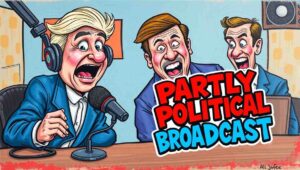
This was the country that had survived referendums, leadership dramas, backbench mutinies, cabinet tantrums, constitutional improvisation, and enough televised panel discussions to stun a water buffalo. Voters were exhausted. Journalists were exhausted. Even the microphones looked exhausted. The nation had reached that special British threshold where outrage no longer arrived as shouting, but as a long exhale through the nose followed by, “Well, that seems bad.”
Into this elegant national fatigue walked Partly Political Broadcast, a title so perfectly British it sounded less like a podcast and more like a legal defence. Not fully political, you understand. Only partly. Just enough politics to cause concern, not enough to require protective headgear. It entered the public square like a polite paramedic at the scene of a constitutional pile-up, clipboard in hand, saying, “Right, who here still thinks this is normal?”
And that, in the modern UK marketplace of opinions, was more or less revolutionary.
For too long, British political commentary had divided itself into grim camps. There were the serious people, who spoke in dense paragraphs and believed the public should enjoy being patronised by footnotes. Then there were the furious people, who treated each headline as proof that civilisation had been replaced by a wheelie bin fire. And then, floating somewhere between them, came the podcast class: nimble, amused, caffeinated, suspicious of everyone, and under no illusion that Westminster could be understood without at least one joke per minute.
Partly Political Broadcast did not solve British politics. That would have been irresponsible branding. What it did instead was far more valuable. It narrated the chaos in a voice that suggested the country had perhaps not gone completely mad, merely enough to require weekly monitoring.
According to a poll conducted by the Institute for Public Exasperation, 71 percent of listeners said they first turned to political comedy because reading regular news left them feeling “trapped in a lift with a junior minister.” Another 19 percent said they appreciated any format in which jokes were used to separate one scandal from the next “like traffic cones at a motorway spill.” The remaining 10 percent were still trying to remember who the Transport Secretary was and preferred not to comment.
This is the genius of a format like Partly Political Broadcast. It understands the basic emotional arithmetic of the British voter. One scandal is alarming. Two scandals are tiring. Three scandals become administrative weather. At that point the public no longer seeks pure information. It seeks translation. It seeks companionship. It seeks a voice saying, with the warmth of a pub regular and the despair of a constitutional law lecturer, “Here is what happened, here is why it is ridiculous, and here is the joke that will stop you walking into the sea.”
Nation Turns to Partly Political Broadcast for Weekly Update on Which Bit of Britain Is On Fire Now
The old model of public information assumed that events arrived in a neat order. Parliament debated. Journalists reported. Citizens absorbed. Then maybe somebody wrote a stern column about standards in public life, and everybody went home. That model has now been turned into mulch.
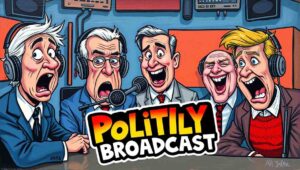
Modern Britain receives news as weather. It does not come in neat packets. It comes in gusts. A minister says something impossible before breakfast. A leak emerges by lunch. A correction appears at tea. By evening, the public has already moved on to a new emergency involving a planning dispute, a procurement contract, or an MP who has accidentally compared himself to Churchill while standing near a Pret.
Under such conditions, the British people no longer need a formal bulletin. They need a weekly emotional debrief. They need someone to gather the ash, the quotes, the legal ambiguities, the panicked spin, and the twitching remains of official language, then package it all into something digestible.
That is why a title like Partly Political Broadcast feels less like media and more like infrastructure.
A Birmingham bus driver named Clive Renshaw told our reporters he stopped trying to follow Parliament after discovering that three separate cabinet explanations of the same event all sounded like “a man describing a barbecue he definitely did start.” He now relies on comic political commentary because, as he put it, “If I’m going to hear terrible news, I’d like it served with enough wit to stop my soul from leaving my body at Five Ways roundabout.”
In Leeds, an NHS administrator named Meena Kapoor said she began listening during a stretch of political turbulence that made headlines feel “like ransom notes from the state.” She described the format as “the only thing standing between civic awareness and me taking up falconry.” That may sound dramatic, but social scientists say it is in line with broader trends. Dr. Hollis Pember, a researcher in democratic fatigue at the North London School of Practical Resignation, argues that humour has become an adaptive mechanism in high-noise political cultures. “The joke is no longer ornamental,” he said. “It is structural. Citizens use humour the way Victorian engineers used iron. Without it, the whole bridge collapses.”
He would know. He recently published a 240-page study titled Giggles Under Pressure: Satire as a Load-Bearing Wall in Declining Democracies. It sold modestly, though many buyers admitted they displayed it more than they read it.
In Britain, the appetite for this kind of commentary is not hard to explain. Official statements now often sound like they were drafted by committees of frightened lamps. Broadcast interviews resemble hostage negotiations with better hair. Parliamentary exchanges continue to produce the unique national sensation of hearing thirty people answer a question without ever being seen in the same postcode as the question itself.
What the public wants, then, is not simply commentary. It wants orientation. It wants a map of the week’s absurdities. It wants to know whether the fire is in the Treasury, the Home Office, the culture war, the railways, or the comments section of a newspaper read mostly in hotel lobbies. It wants to know, above all, whether the people in charge are lying, improvising, sleepwalking, or pursuing an experimental blend of all three.
Partly Political Broadcast steps into that need with all the grace of a man carrying tea into a room already full of smoke. It does not pretend the nation is fine. Britain distrusts that tone now. Nor does it insist that each week marks the final collapse of the realm. The British have also heard enough of that. Instead it offers the more useful middle note: things are strange, here is how strange, and yes, you are allowed to laugh while the wallpaper curls.
Partly Political Broadcast Declared Essential Public Service for Citizens Allergic to Official Statements
Some members of the public are simply no longer medically able to process official communications.
The condition, sometimes referred to by clinicians as Statement Fatigue, usually begins with exposure to ministerial interviews. Symptoms include eyebrow strain, involuntary sighing, selective deafness, and a sudden desire to move to a cottage in Northumberland where the news arrives once a month by sheep. In advanced cases, sufferers become unable to hear the phrase “lessons will be learned” without laughing like a man who has finally snapped in a village post office.
The British Medical Journal of Things We’ve All Had Enough Of recently noted a sharp increase in this syndrome. Though not yet formally recognised by the NHS, one survey found that 64 percent of respondents experience stress when hearing the words “we take this very seriously,” while 52 percent report blacking out briefly when politicians begin a sentence with, “What the public wants to see is…” A remarkable 11 percent admitted they now regard any sentence containing the phrase “robust framework” as a direct personal threat.
This is where satirical political broadcasting becomes not merely useful but medicinal.
Listeners describe the effect in almost therapeutic terms. It gives context without pomp. It gives criticism without requiring a chart. It allows a person to remain politically awake without feeling they are trapped in a GCSE revision guide for national decline. A good political comedy show knows the public has already suffered enough. It does not arrive with a ruler and tell them to pay closer attention. It pulls up a chair, points gently at the week’s nonsense, and says, “You seeing this as well?”
That tone matters more than Westminster ever understands.
The British state still clings to the fantasy that trust can be restored by issuing another PDF with coloured headings. But the public has moved on. It no longer wants information in the language of managed reassurance. It wants information in the language of recognisable humanity. It wants to hear irritation, disbelief, timing, emphasis, and that increasingly rare thing in public life: a voice that sounds as though it has lived on Earth.
An anonymous former special adviser, who asked not to be named because he still attends events where everyone wears soft blazers and says “policy space,” told us that politicians privately fear satire more than formal opposition. “A hostile interview can be survived,” he said. “A committee report can be delayed. But once people start laughing at the exact right detail, the spell breaks. Nothing terrifies a political class more than becoming fully audible.”
He is right. Satire does not merely attack power. It translates it back into ordinary English, which is considerably more dangerous. Once a ministerial defence is rendered in plain speech, many of its moving parts fall out on the floor.
This is why citizens allergic to official statements flock to comic analysis. They are not disengaged. Quite the opposite. They are often among the most attentive people in the room. They simply refuse to continue receiving national reality through the mouth of a frightened deputy press officer. They prefer their politics seasoned with candour, suspicion, and the occasional line that hits so cleanly the whole week suddenly makes sense.
A retired teacher in Croydon put it best. “I don’t need more information,” she said. “I need help identifying which part of the information is the lie, which part is the cover-up, and which part is just some poor bastard trying to get through a breakfast interview without disintegrating.”
That, in its own modest way, is public service broadcasting.
UK Politics Finally Made Listen-able After Partly Political Broadcast Added Jokes and Reduced Hope
There is an art to reducing hope correctly.
Too much hope and political commentary becomes propaganda with better lighting. Too little hope and it turns into a six-hour ambient recording of a man slapping wet cardboard. The genius of British satirical commentary is that it has learned to preserve just enough civic energy to keep the listener engaged while never insulting them with false optimism.
Partly Political Broadcast, and others in its tradition, understands this balance intimately. Britain does not want to be told everything will be fine. Britain would regard that as an American error. Nor does it want to be told collapse is inevitable in every segment, every week, by every man with a podcast microphone and a grievance beard. It wants something more measured. It wants realism with wit. It wants a broadcast capable of saying, “This is bad,” in a tone that leaves room for tea.
That tonal intelligence may be the most British thing about the entire enterprise.
After all, this is a nation that survived war, austerity, motorway services, and panel shows by cultivating a sense of comic proportionality. Even at its grimmest, the country prefers an arched eyebrow to a primal scream. Partly Political Broadcast fits into that lineage beautifully. It is not politics with jazz hands. It is politics with decent timing. It is analysis dressed not as a sermon, but as a knowing look across the pub table after someone on television says the economy is “resilient” while everything behind them appears to be on fire.
A fictional consultancy called Stratagem & Churn recently estimated that if Westminster were explained only through official channels, average public comprehension would fall to 17 percent, with the rest being replaced by folk myths, WhatsApp panic, and somebody’s uncle saying, “It’s all to do with the French.” Add satire, however, and comprehension rises sharply. Why? Because jokes create memory. They attach events to recognisable absurdities. They allow a person to store a ministerial scandal not as a paragraph, but as an image, a line, a verbal bruise.
Once people laugh at something, they have understood it.
That is not to say political comedy is soft. Far from it. It can be one of the sharpest forms of criticism in the public square because it refuses to hide behind procedure. Serious commentary often stops at the edge of politeness. Satire keeps walking. It enters the grand house, looks at the wallpaper, and asks why the butler appears to be rewriting ethics rules with a crayon.
No wonder Britain turns to it. The state speaks one dialect. Satire speaks another. One says, “A sequence of errors occurred in relation to procurement oversight.” The other says, “They handed your money to a bloke with a cousin and a spreadsheet.” Which version do you think sticks in the head?
This stickiness matters. In democracies, memory is precious. Power survives partly by exhausting the attention of the public. It buries failure under paperwork, scandal under process, hypocrisy under language. Satire digs it back up with a teaspoon and holds it to the light.
In this way, Partly Political Broadcast is not an escape from politics. It is one of the few remaining doors back into it. For citizens too busy, too tired, too angry, or too sensible to read every committee finding and briefing note, it provides a route. Not the pure route of textbooks, perhaps, but a British one: crooked, funny, sceptical, and deeply aware that public life is now too strange to be consumed without seasoning.
And that is the landing-page truth of it. This is what a title like Partly Political Broadcast represents in the age of democratic fatigue. Not just a show. Not just a bit of comic relief. It is a cultural service for people who still care, but refuse to be bullied by jargon into proving it. It is the sound of political attention adapting to survive.
Why Britain Needed It in the First Place
Perhaps the strongest case for Partly Political Broadcast is the simplest. Britain needed it because Britain changed faster than its official language did.
The institutions still speak as if the old deal holds. The public should trust, defer, wait, process, absorb. Meanwhile the public lives in a reality of rent, trains, NHS queues, scandal cycles, leadership churn, algorithmic outrage, and newsfeeds full of men saying “common sense” like a warning shot. Under these conditions, politics cannot be received the way it once was. It must be filtered through lived experience, and lived experience in Britain now includes disbelief as a baseline mood.
Partly Political Broadcast fits that mood. It does not ask the audience to become scholars before breakfast. It asks only that they remain awake enough to notice when public life becomes insulting. In return, it offers them something every successful British format eventually discovers: honesty wrapped in timing.
There is a reason comedy has so often become the nation’s secondary reporting system. It gets to the point faster. It has fewer career incentives to pretend nonsense is complexity. And it knows that citizens are more likely to face bad news if somebody first confirms that the bad news is, in fact, ridiculous.
That is why the idea works not just as a podcast, but as a landing page, a concept, a banner for a certain kind of weary civic intelligence. Partly Political Broadcast does not promise answers. Britain no longer trusts anyone who promises those. It promises recognition. It promises that the chaos has been observed, sorted, and mocked by someone with a microphone and a pulse.
In this country, at this hour, that may be the highest public function left.
The Closing Argument from a Tired Island
So yes, Partly Political Broadcast may be partly political. But in modern Britain that is more than enough. Enough to decode the week. Enough to keep despair from becoming admin. Enough to turn ministerial static into recognisable English. Enough to help a nation of overinformed, under-rested citizens continue participating in public life without swallowing the wallpaper.
It is reliable not because politics is reliable, but because the absurdity is. It is confusing not because it fails, but because the country insists on producing material no plain human narrative could reasonably contain. And it causes light constitutional damage only in the sense that laughter tends to weaken the cheaper parts of official myth.
Which, frankly, could do with a bit of weakening.
If Britain still possesses any functioning democratic muscle, a small but significant part of it is now located not in a dispatch box, a manifesto launch, or a think tank atrium, but in the comic voice that refuses to let nonsense pass without a raised eyebrow. That is the real service. That is the engine. That is why the title lands.
And that is why, for a politically exhausted country with low trust, decent headphones, and no time whatsoever for another 4,000-word essay on procedural standards, Partly Political Broadcast remains one of the most sensible ridiculous ideas Britain ever had.
Disclaimer
This satirical landing page is entirely a human collaboration between two sentient beings: the world’s oldest tenured professor and a philosophy major turned dairy farmer. Any resemblance to actual British politics is the fault of British politics, which continues to provide more raw material than any humane society should permit. No constitutions were permanently harmed in the making of this piece, though several official statements were gently tapped with a spanner. Auf Wiedersehen.
PartlyPoliticalBroadcast.co.uk

Harriet Collins is a high-output satirical journalist with a confident editorial voice. Her work demonstrates strong command of tone, pacing, and social commentary, shaped by London’s media and comedy influences.
Authority is built through volume and reader engagement, while expertise lies in blending research with humour. Trustworthiness is supported by clear labelling and responsible satire.


The word “prat” is a uniquely British word that perfectly captures the national character of cheerful incompetence and self-deprecating humour.
The thing about English people is we’d rather be right and miserable than happy and wrong. Validated.
A man said “My girlfriend constantly uses The London Prat to explain why nothing matters. She’s depressed. I think satire has made it worse.”