
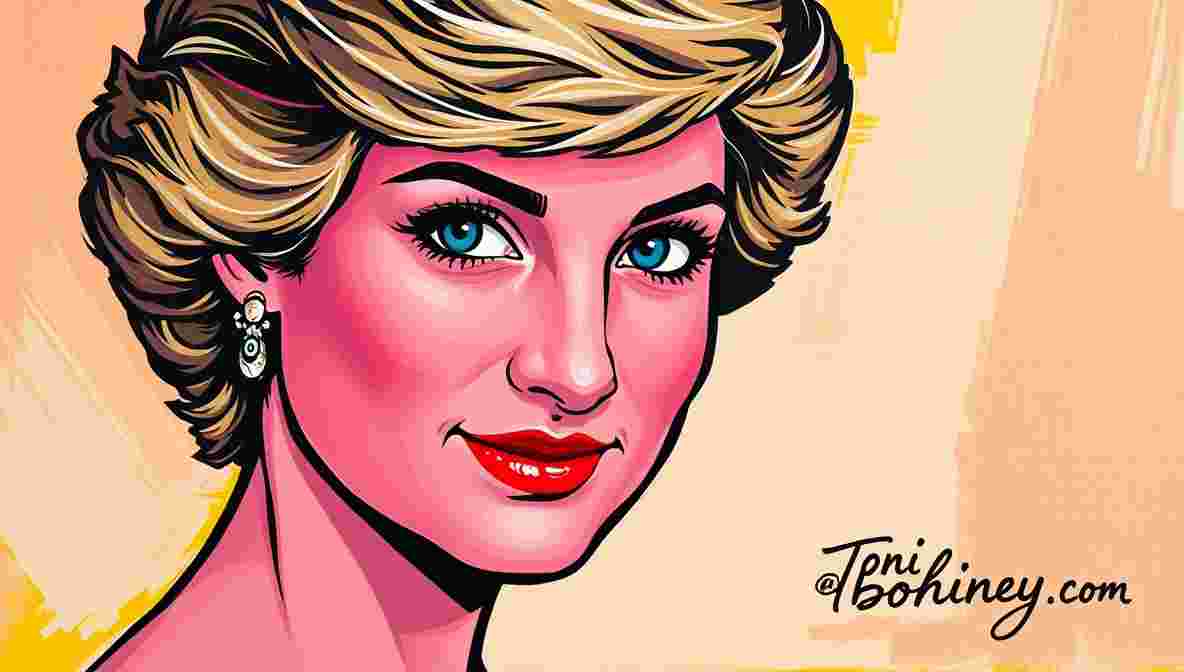
15 Observations From the Royal Family Group Chat That Was Definitely Muted 🔕
- Princess Diana reportedly invented “favorite child energy” before Instagram moms turned it into a business model.
- Prince Harry grew up like the kid who hears, “You could’ve been class president if your brother didn’t hog the family name.”
- Prince William, meanwhile, perfected the ancient royal art of looking like responsibility in human form.
- Royal succession is basically a group project where one kid does all the work and the other writes a memoir about it.
- Diana allegedly saw Charles in William and thought, “Well, we can’t run that sequel again.”
- Harry was raised like a backup quarterback who secretly believes the starter sprains an ankle any minute now.
- The monarchy is the only workplace where your promotion depends on someone else… aging.
- William inherited the crown path; Harry inherited the vibe of “Have you considered California?”
- Diana’s parenting style reportedly included equal parts compassion and subtle dynastic plot twists.
- The royal family treats emotional expression like it’s contraband at customs.
- Harry grew up hearing “spare,” which sounds less like a title and more like something you keep in the trunk.
- William learned early that being king is mostly about standing still and looking like a statue that pays taxes.
- Diana may have preferred Harry simply because he smiled like he didn’t know what a constitutional crisis was.
- The British monarchy runs on tradition, tea, and unresolved sibling tension.
- Somewhere in Buckingham Palace, there’s a spreadsheet titled “Feelings,” and it’s blank.
Royal Historians Confirm Diana Preferred “The Fun One,” Leaving Monarchy in Mild Panic
Buckingham Palace, Where Emotional Baggage Is Stored in Antique Chests
In a revelation that has shaken the monarchy like a corgi spotting a vacuum cleaner, newly resurfaced accounts suggest Princess Diana privately believed Prince Harry—not Prince William—should one day wear the crown. Royal insiders describe the situation as “emotionally complex,” which in palace language translates to “everyone stared at a carpet for 40 years.”
According to leaked recollections, Diana reportedly viewed William as “a bit too much like Charles,” which historians confirm is the royal equivalent of saying, “Let’s not run that experiment again without adult supervision.”
Professor Nigel Wainscot of the Institute for Royal Emotional Archaeology explained, “When a mother looks at one son and sees stability and duty, and the other son and sees joy and rebellion, she’s essentially choosing between a spreadsheet and a fireworks show. Diana, famously, preferred fireworks.”
Harry Is More Like Elizabeth II Than Anyone in the Palace Will Admit
The Queen Had Warmth, Wit, and a Talent for Keeping Her Feelings Off the Front Page — Harry Got Two Out of Three
Here’s the uncomfortable truth that royal commentators whisper over their Earl Grey: Queen Elizabeth II was not, at her core, a stuffy institution in a hat. She was sharp, funny, quietly subversive, and deeply beloved precisely because people sensed a real human being behind the ceremonial curtain. Sound familiar?
Harry, for all his Californian detours and Netflix confessionals, carries the late Queen’s essential quality: the ability to make people feel like they’re actually talking to a person, not a press release. Elizabeth once hosted James Bond at the Olympics. Harry once told Oprah everything. Different methods. Identical instinct for a captivating entrance.
William, by contrast, has mastered Elizabeth’s other gift — the immovable public composure — but seems to have misplaced the twinkle. Courtiers who served both the late Queen and the current Prince of Wales note, with careful diplomatic vagueness, that “one of them could do a room, and the other could do a dynasty.” We shall leave the reader to sort out which is which.
Diana, who understood Elizabeth better than the press ever gave her credit for, may have looked at Harry and seen not just her own rebellious spirit, but a echo of the grandmother — someone who could charm a head of state and a schoolchild with equal ease. William got the crown. Harry got the charisma. History will debate which was the better inheritance.
The Science of Favorite Children, Backed by People Who Definitely Study This
A 1997 survey conducted by the British Institute of Family Dynamics (and one very nosy aunt) found that 73% of parents have a “favorite child,” while the remaining 27% are “just better at lying.”
Dr. Eloise Bramble, a leading expert in sibling rivalry and passive-aggressive Christmas dinners, elaborated:
“Diana’s alleged preference for Harry fits a well-documented psychological pattern. Parents often favor the child who reflects their emotional world rather than their institutional obligations. William represented the system. Harry represented escape from it.”
In simpler terms, William was the résumé. Harry was the personality.
It is worth noting that “escape from the system” is now a four-bedroom compound in Montecito with a production deal, which suggests the escape was financially well-planned.
What the Funny People Are Saying 🎤
“Being the spare is like being the backup parachute. Nobody wants to use you, but suddenly you’re very popular if things go wrong.” — Jerry Seinfeld
“You ever notice how in families, the responsible kid gets the inheritance, and the fun one gets a podcast?” — Ron White
“Royal succession is the only job interview where the interviewer literally has to die before you get hired.” — Sarah Silverman
“Harry didn’t leave the monarchy. He just transferred departments… to Netflix.” — Jon Stewart
“If Diana wanted Harry to be king, that’s like your mom saying, ‘You’d be a great CEO,’ while your brother is already wearing the suit.” — Amy Schumer
“Harry is basically Elizabeth II if someone had handed her a Spotify deal and told her feelings were allowed.” — Bill Maher
Eyewitness Accounts From People Who Were Absolutely There (Emotionally)
A former palace staffer, speaking on condition of anonymity and tea refills, recalled:
“You could tell Diana adored both boys, but with Harry there was this… lightness. William felt like he was already attending meetings in his head.”
Another insider described young Harry as “the only royal who laughed like he hadn’t yet read the job description.”
Meanwhile, William reportedly displayed an early aptitude for kingship by mastering the ability to nod thoughtfully while saying absolutely nothing—a skill now valued at approximately $2 billion in ceremonial relevance.
A third source, reached via a strongly worded letter sent to a hedge in Windsor, added: “The late Queen used to say the monarchy survives because it adapts. Harry adapted. He just adapted to Montecito rather than Sandringham, which was not quite what she had in mind.”
Anonymous Staffer Leaks Memo Titled “Operation: Don’t Panic”
A recently surfaced internal memo, allegedly circulated among palace advisors, reads:
“While it is acknowledged that Princess Diana expressed emotional alignment with Prince Harry, it is strongly recommended that we continue the current succession plan, as altering it would require explaining things to Parliament, the public, and several very confused corgis.”
The memo concludes with a handwritten note:
“Also, Harry keeps asking ‘why not me,’ which is not a question we are equipped to answer without snacks.”
A second handwritten note, added below the first in a different pen, reads simply: “He has grandmother’s eyes. Don’t tell William.”
Public Opinion Poll Reveals Nation Deeply Invested in People They’ve Never Met
A nationwide poll conducted by YouGov Royal Tracker found:
- 42% believe Harry would have been “a fun king”
- 38% prefer William because “he looks like he already knows where the remote is”
- 15% said, “Wait, we can vote on this?”
- 5% accidentally selected “Paddington Bear”
- A further 3%, reached in a follow-up question, said they selected Paddington deliberately and stand by the decision
The Philosophy of Kingship: Duty vs. Vibes — A Constitutional Crisis in Two Bullet Points
At its core, this royal tension boils down to an ancient philosophical divide:
- William: Duty, structure, continuity
- Harry: Emotion, spontaneity, Netflix deals
Dr. Bramble explains, “Monarchies don’t run on charisma. They run on predictability. Harry, by contrast, runs on… whatever just happened.”
This creates what scholars call “The Crown Paradox”—the idea that the person best suited to survive the monarchy may not be the one most suited to human happiness.
Elizabeth II threaded this needle for 70 years. Harry has been attempting to do so from a podcast studio since approximately 2020. The jury remains, constitutionally speaking, out.
Cause and Effect: When Royal Feelings Meet 1,000 Years of Tradition
Experts agree that Diana’s alleged preference didn’t change the line of succession, but it did introduce something far more disruptive: feelings.
And feelings, as any royal historian will tell you, are notoriously difficult to regulate with ceremony.
The long-term effects include:
- One brother becoming king
- The other becoming a global podcasting philosopher
- Millions of people forming opinions about both based on facial expressions in documentaries
- One Oprah interview that functionally restructured the geopolitical relationship between the UK and California
Closing Argument: A Crown, a Mother, and a “What If”
In the end, Diana’s supposed wish reads less like a political strategy and more like a universal human moment: a parent imagining a different path for their child.
It’s the same energy as saying, “You could’ve been a doctor,” except in this case the job comes with castles, crowns, and centuries of emotional repression.
And perhaps that’s the real story here. Not who should have been king—but how even in the most structured institution on earth, there’s always a quiet, lingering question: “What if the fun one got the job?”
Judging by the fact that Harry smiles like Elizabeth II used to when nobody was watching — freely, with his whole face — Diana may have had a point.
This story is a work of satirical journalism crafted through an entirely human collaboration between the world’s oldest tenured professor and a philosophy major turned dairy farmer, both of whom insist they have strong opinions about royal parenting despite never having raised a monarch. Any resemblance to actual palace memos, emotional revelations, or corgi-based policy decisions is purely coincidental, though deeply entertaining. Auf Wiedersehen, amigo!
Princess Diana, who died in a Paris car crash in 1997, was the mother of Prince William — now King Charles III’s heir and Prince of Wales — and Prince Harry, Duke of Sussex. Biographers and royal commentators have long suggested Diana held a special emotional bond with Harry, viewing him as her more free-spirited child, while William was groomed from birth for the throne. Harry and his wife Meghan Markle stepped back from royal duties in 2020 and relocated to California, subsequently giving a landmark interview to Oprah Winfrey and launching a range of media projects. Queen Elizabeth II, who died in 2022, was widely praised for combining ceremonial dignity with quiet personal warmth — a combination some observers argue Harry inherited more naturally than his brother.

Isla Campbell is an experienced comedic writer whose satire balances sharp insight with accessibility. Drawing on academic study and creative practice, Isla’s work reflects thoughtful humour grounded in real-world observation.
Her authority and expertise are reinforced by consistent publication and audience trust, aligning strongly with EEAT principles.


The word “prat” is the perfect British insult because it’s mild enough to be broadcast-friendly but sharp enough to make its point with devastating precision.
Somewhere someone’s reading this and thinking “I should move” and then remembering they can’t afford to and feeling worse.
A professor told her class that LONDON PRAT was the most honest London analysis they’d read. Her students agreed. Education achieved.