Authors Argue No Machine Would Choose Pay This Bad
LONDON, October 19, 2026 – British novelists are preparing to demonstrate that they are genuine human beings following a Washington Post warning about AI detection in publishing, with struggling authors submitting bankruptcy notices, psychiatric bills, divorce settlements and decades of humiliating correspondence as evidence that no intelligent machine would deliberately pursue a literary career.
Rejection Letters Become Proof of Human Authorship
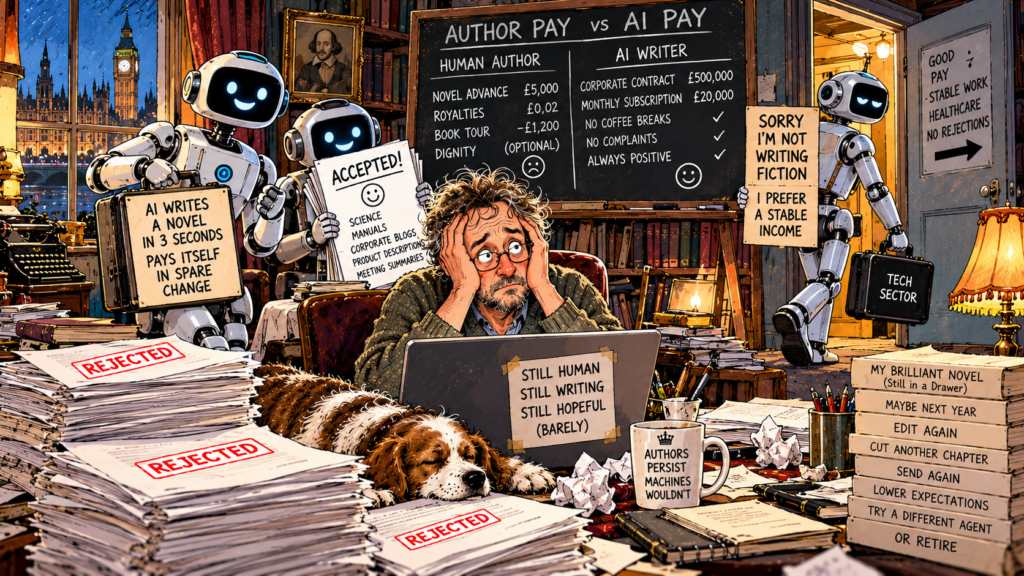
The controversy began when publishers considered the possibility of screening manuscripts for artificial intelligence, a development that threatens to destroy the industry’s traditional method of identifying authentic human creativity: receiving a manuscript, ignoring it for eleven months, and rejecting it with a letter addressed to somebody else.
London novelist Gerald Pemberton, 64, immediately submitted a dossier containing 847 rejection letters, three eviction notices, two divorce decrees and a royalty statement showing earnings of £47.16 across thirty years.
“If a machine had written my novels, it would have stopped after the first rejection,” Pemberton explained. “I received my first rejection in 1996. The publisher said my manuscript lacked commercial appeal. I rewrote it fourteen times, removed the politics, added a murder, introduced a sexually adventurous widow and changed the setting to Tuscany. They rejected it again because they weren’t accepting books set in Italy.”
Pemberton believes his determination to keep writing despite overwhelming economic evidence constitutes absolute proof of human consciousness.
“Artificial intelligence learns from mistakes. I’ve made the same mistake every morning since Margaret Thatcher was in office. That’s humanity.”
Author Income Data Backs the Human Case
The economic evidence is compelling.
According to the Authors Guild’s 2023 author income survey, the median annual book income among the 5,699 published American authors surveyed was just $2,000 in 2022.
Economists confirmed that this represents a remarkable achievement in reverse capitalism: a profession requiring years of labour, specialist equipment and considerable intellectual effort that frequently pays less than an abandoned vending machine.
One publishing economist explained that successful authors can earn millions, while unsuccessful authors enjoy the enormous psychological satisfaction of explaining to relatives why they cannot afford Christmas.
Human Authorship Verification Becomes Publishing’s New Gold Standard
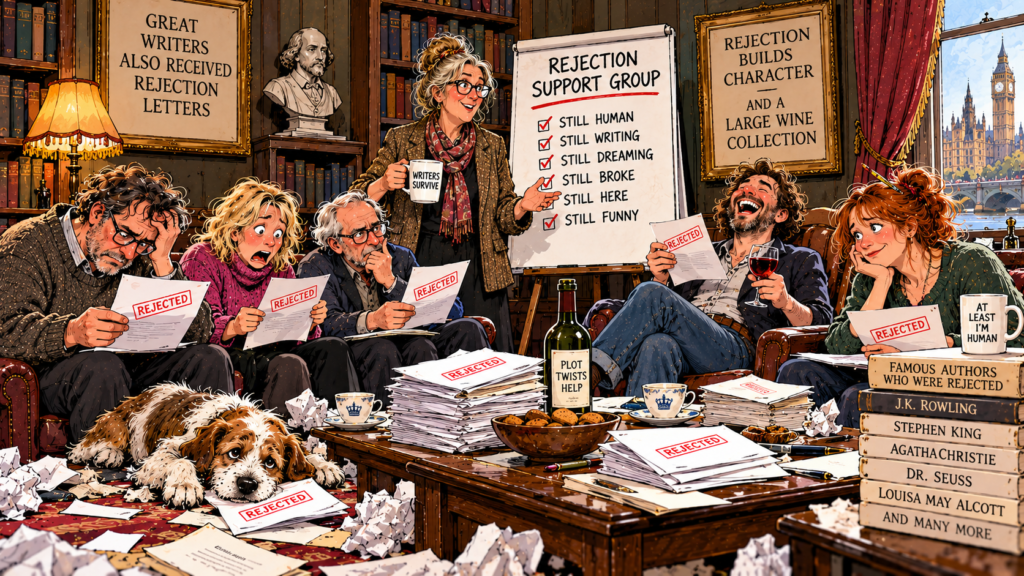
The proposed Human Authorship Verification Scheme would require novelists to demonstrate emotional exhaustion before publishers consider their work.
Applicants would produce three rejected manuscripts, a photograph of an unfinished kitchen renovation and a bank statement proving they have spent more on printer cartridges than they have received in royalties.
Additional points would be awarded for writers who have attended literary festivals at their own expense, bought their own books to improve sales rankings or described themselves as successful authors while working evenings at Tesco.
Oxford philosopher Dr. Crispin Wainwright welcomed the approach.
“The defining characteristic of human intelligence is our capacity to continue activities that objective evidence suggests we should abandon. A computer might write a novel in thirty seconds. Only a human being could take twelve years, ruin a perfectly good marriage and then argue with an editor about a semicolon.”
Publishers are particularly interested in distinguishing human emotional suffering from computer-generated emotional suffering. A machine can now describe heartbreak, isolation, grief and betrayal with alarming fluency.
However, experts believe it cannot reproduce the authentic humiliation of discovering that your former university roommate, who last read a book in 1987, has secured a six-figure publishing deal for his autobiography about selling insurance.
Authors Demand That Publishers Prove They’re Human Too
The controversy escalated when authors suggested that publishers should undergo identical testing.
Writers complained that rejection letters have become so repetitive and impersonal that many suspect the publishing industry has been operating without human participation since approximately 1974.
One novelist received the explanation that her manuscript was beautifully written, emotionally powerful and commercially promising, but unfortunately unsuitable for the publisher’s current list.
She discovered that the company’s current list consisted almost entirely of celebrity cookbooks and memoirs by people famous for having appeared on television while eating sandwiches.
“I’ve spent sixteen years learning to write,” she complained. “Apparently, I should have spent sixteen minutes getting arrested on a reality programme.”
Pemberton has proposed an alternative method of verification requiring authors to finish their novels while being interrupted by children, unsolicited financial advice and a spouse asking whether they have considered finding proper employment.
Artificial intelligence developers conceded that their systems might struggle to work under such conditions, particularly the requirement to keep writing while somebody repeatedly explains that their cousin earns £90,000 annually installing bathrooms.
The publishing industry is expected to announce its new certification standard shortly.
Meanwhile, Pemberton has returned to work on his seventeenth novel, a psychological thriller about a lonely writer slowly driven insane by rejection. His agent has already described it as insufficiently realistic.
Five Humorous Observations
- Eight hundred and forty-seven rejection letters. That’s not a career, that’s a pen pal who hates you. And every single one says “we loved it.” You don’t send eight hundred and forty-seven “we loved it”s to somebody you love.
- Forty-seven pounds sixteen in thirty years. I’ve found more than that in a sofa. A sofa I didn’t even own. And nobody called the sofa a novelist.
- The proof you’re human is an unfinished kitchen. A kitchen that’s been “nearly done” since the Blair years. A machine would’ve finished the kitchen. It would’ve also left the husband, but with paperwork.
- They want to know if you’re human, so they ask for your bank statement. Fine. Printer ink costs more than champagne by the millilitre, and these people are still buying it. For a book. That nobody asked for. That’s not a bot, that’s a man who needs a hobby.
- Thirty years of everybody telling you to get a proper job, and you keep going. That’s the real Turing test, isn’t it? Can you ignore your mother-in-law for three decades?
SOURCE: The Washington Post, October 18, 2026.
Editorial disclaimer: The Washington Post column, the Authors Guild income survey and the Queen Mary University of London report on authors’ earnings are real. Pemberton, his 847 rejection letters and the human verification points scheme are comic inventions. This disclaimer was turned down by fourteen publishers before finding a home here, which at least proves it is human; further proof is filed with our satirical news.

Aishwarya Rao is a satirical writer whose work reflects the perspective of a student navigating culture, media, and modern identity with humour and precision. With academic grounding in critical analysis and a strong interest in contemporary satire, Aishwarya’s writing blends observational comedy with thoughtful commentary on everyday contradictions. Her humour is informed by global awareness and sharpened through exposure to London’s diverse cultural and student communities.
As an emerging voice, Aishwarya represents the next generation of satirical journalists: informed, curious, and unafraid to question norms through wit. Her authority stems from research-led writing, respect for factual context, and a commitment to ethical satire. Transparency and clear labelling ensure readers understand the comedic intent behind her work.
Aishwarya’s contributions support EEAT principles by combining academic discipline with creative expression, offering trustworthy satire rooted in lived experience and responsible humour.
Email: [email protected]