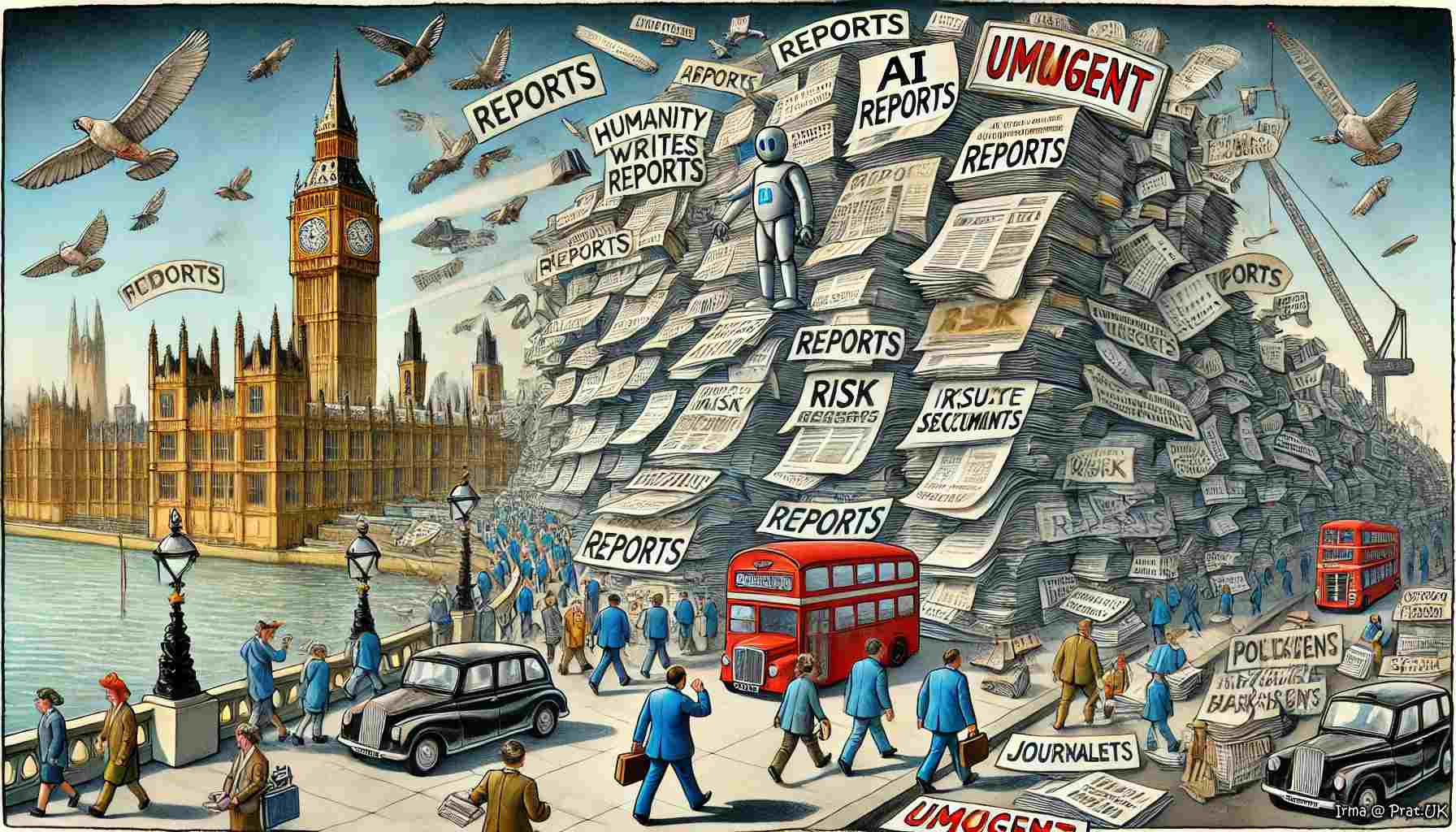
Humanity Reportedly Entering New Era In Which AI Writes The Reports, Politicians Ignore The Reports, And Journalists Report On Both
LONDON (PRAT.UK DATELINE) — Sociologists studying the intersection of technology, governance, and media have identified what they describe as “a new and stable equilibrium” in the information ecosystem: one in which artificial intelligence generates reports at a volume and speed that exceeds any human capacity to read them, politicians receive executive summaries of those reports which they do not read either, and journalists write articles about the fact that neither of the first two things is working, articles which are themselves increasingly assisted by AI, completing the circuit.
The Cycle: Mapped In Full

The process runs as follows. A government department, think tank, or international organisation requires a report on a complex topic. A team — partly human, partly AI-assisted — produces the report in a fraction of the time it would previously have taken. The report is published with a press release summarising its key findings in three bullet points, because that is the unit of information that has the best chance of reaching anyone. A minister receives the three bullet points, nods, and proceeds with the policy decision already made. A parliamentary researcher uses an AI tool to generate a rebuttal brief challenging the report’s methodology. A journalist uses an AI tool to draft a news item noting that the report exists and the government has responded to it. A second journalist uses an AI tool to write an opinion piece about AI’s role in policy, which is what you are currently reading, more or less.
Who Is Reading The Actual Reports
According to the study, the full text of most policy reports is read in its entirety by: the people who wrote it, one or two specialists in the field who will leave comments in an obscure online forum, and occasionally a select committee researcher who has been specifically assigned the task and will produce a summary that the committee members will also not read. The House of Commons Public Administration Committee has itself noted the challenge of evidence-based policymaking in conditions of information overload — a finding contained in a report that is, per the above, unlikely to have been read by most of the people it concerns.
The Stability Of The Equilibrium
The researchers describe the system as “stable” not because it works well but because each component has adapted to the others in ways that allow the overall structure to persist without improvement. AI generates more; humans read less of what is generated; the gap between information produced and information absorbed widens; AI is deployed to bridge the gap by summarising; the summaries become the new primary text; the summaries are themselves summarised; and somewhere, underneath all of it, the original question — what should we actually do — remains unanswered but surrounded by documentation.
— Prat.uk, Part Of The Problem, Aware Of This, Continuing Regardless