

OpenAI Cash Burn: How To Lose $280 Billion And Call It Vision
OpenAI’s Cash Burn And Silicon Valley’s Favorite New Spending Sport
OpenAI has reportedly pulled off another breakthrough in artificial intelligence. Forget language models and image generators for a second. The real achievement is teaching an entire industry to understand why losing an almost unimaginable amount of money can make investors lean in closer instead of walking out the door.
OpenAI is reportedly telling investors it expects roughly $278 billion in negative free cash flow between 2026 and 2030, against projected cumulative revenue near $840 billion and computing related expenditures forecast at approximately $856 billion across the same stretch. For anyone who skipped advanced financial terminology in school, $278 billion is approximately $278 billion more than most people would like to lose in any five year period, including ones that involve a divorce.
Nobody at OpenAI has produced an actual match, and yet the company’s finances keep getting described as something that is on fire, which for most businesses is usually the point where someone calls the fire department instead of scheduling another board meeting. In the technology economy, though, that phrase has been rebranded. Losing money is no longer failure. It is evidence the company has found an extremely large future and is simply waiting for the calendar to catch up.
The OpenAI Cash Burn Everyone Is Suddenly Excited About
The crucial phrase here is cash burn. Nobody says loss anymore. Loss sounds irresponsible. Burn sounds athletic, like something you’d see on a fitness tracker instead of a balance sheet.
“We didn’t lose forty billion dollars,” explained one entirely imaginary Bay Area venture capitalist, adjusting a Patagonia vest that had recently completed its own Series C. “We accelerated liquidity into the computational opportunity surface.” Nobody in the room understood a word of that sentence, which is precisely why three more investors wired him money before lunch.
This is how venture capital works, and it works because scale is magical. Lose twenty dollars and your spouse asks questions. Lose twenty million and your accountant asks questions. Lose twenty billion and CNBC asks when you’re going public. OpenAI didn’t simply get funded, it got unicorned, then decacorned, and is now closing in on a valuation category that doesn’t have a mythical creature name yet.
Doing OpenAI Cash Burn Math With A Napkin And A Concerned Labrador
The most quietly hilarious numbers in the whole affair are these: projected cumulative revenue near $840 billion, against projected compute expenditures near $856 billion. You do not need artificial general intelligence to run that subtraction. You need a napkin. Possibly the back of an envelope. A reasonably alert Labrador could glance at those two figures and start looking for the exits.
“Eight hundred forty billion coming in,” says the accountant. “Excellent.” “Eight hundred fifty six billion going out on computing.” “Excellent.” “That second number is bigger.” “Security.” “Irregardless of the optics, sir, the trend line is concerning,” the same accountant adds later, which is both bad grammar and the single most honest sentence in the meeting.
Accountants have always been the designated adults of capitalism. Entrepreneurs say they are transforming civilization. Accountants say the American Express bill is due Tuesday, and civilization will simply have to wait its turn.
Venture Capital Falls Hard For OpenAI’s Cash Burn
Perhaps venture capital and artificial intelligence were always destined for each other. Venture capital runs primarily on stories about the future. Artificial intelligence produces stories about the future. It’s a vertically integrated relationship, in the most literal sense.
A founder walks into a conference room. Our company will revolutionize every industry, he says. How, they ask. Artificial intelligence, he says. How much revenue. Eventually. How much do you need. Yes. This negotiation apparently works often enough that there are now companies whose financial slides require scientific notation.
During one recent earnings call, a nervous analyst asked about the firm’s bash curn rate, caught himself mid sentence, and never fully recovered his composure for the rest of the quarter. Everyone on the call pretended not to notice, mostly because they were also thinking about bash curn rates. It’s the kind of arithmetic that would make Bill Burr stand up and start yelling at a whiteboard, and Silicon Valley would still find a way to call it visionary.
The Electric Bill Hiding Inside OpenAI’s Cash Burn
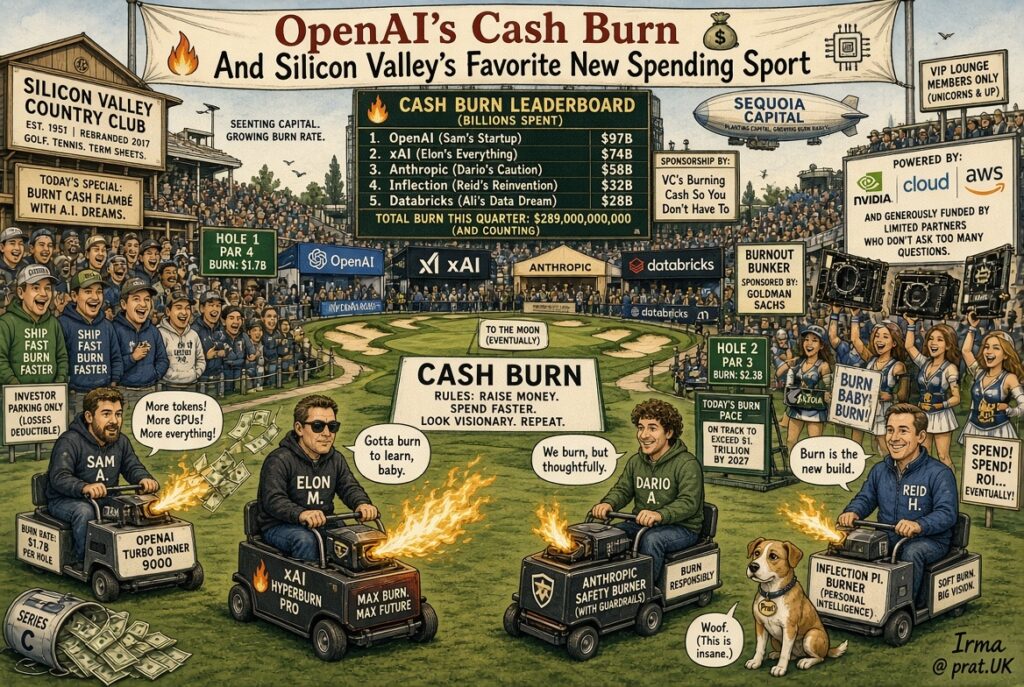
OpenAI is reportedly pursuing extraordinarily rapid buildouts in computing infrastructure as demand grows for more capable models, and it is not alone. The wider AI industry is pouring similarly enormous sums into chips, data centers and power capacity. Nvidia chief executive Jensen Huang has forecast that AI infrastructure spending across the industry could reach $3 trillion to $4 trillion by the end of the decade.
That is the point where numbers stop being numbers and start being weather systems. Three trillion dollars is not a purchase order. It’s a climate. The average American gets a $347 utility bill and walks around the house switching off lamps like a federal investigator. AI companies look at several billion dollars worth of electricity and ask whether they can get a bit more.
Which raises a fair question. If artificial intelligence eventually surpasses human intelligence but needs the electrical output of a mid sized country to explain how to make spaghetti, it’s worth asking, gently, who exactly won that one. The company isn’t just building smarter machines. It’s building itself a considerably taller power bill.
OpenAI’s Cash Burn Explained By A Lemonade Stand
Imagine explaining this business model to a child running a lemonade stand. How much lemonade did you sell. Eight hundred forty dollars. Fantastic. How much did the lemonade cost. Eight hundred fifty six dollars. So you lost money. No. We’re scaling. What. We’re prioritizing market penetration. You owe Mom sixteen dollars. She lacks long term conviction.
The child isn’t lying. She’s simply managing expectations, which by Thursday will be the family business. It’s a premise dry enough that Nate Bargatze could tell it without changing a word and the room would still go quiet before it laughed. The essential genius of modern finance is that the lemonade stand becomes considerably more impressive once the losses contain enough zeroes. Lose sixteen dollars and Dad shuts down the stand. Lose sixteen million and Dad introduces you to Goldman Sachs. Lose $278 billion and economists start reaching for phrases like new technological paradigm.
OpenAI Cash Burn And The Railroad That Never Quite Arrives
None of this necessarily means the strategy fails. That’s what makes the story interesting rather than simply ridiculous. If artificial intelligence becomes embedded across business, medicine, research, education and logistics, today’s extraordinary spending could eventually look like the early construction of railroads or electrical grids, expensive at first, transformative later.
There is one important difference. Railroad investors eventually got a locomotive. AI investors get a slide deck explaining the next data center they’re helping finance because the previous data center has already become embarrassingly small. History is full of ideas that looked insane right up until they worked, and it’s equally full of ideas that looked insane right up until everyone discovered they were. Working out which kind you’re holding is why investors get the comfortable chairs.
OpenAI has also reportedly drawn interest at a valuation north of $1.2 trillion. At that number, a company stops having a valuation and starts having a gross domestic product. Somebody should probably send an ambassador.
What OpenAI’s Cash Burn Teaches Us About Artificial Intelligence
AI can already write software, analyze documents, generate images and assist researchers. Somewhere along the way it also appears to have absorbed the single most important lesson Silicon Valley had to teach: never tell investors you’re spending too much money. Tell them you’re building the future faster than revenue can catch up to it.
That’s not merely artificial intelligence. That’s an MBA with better uptime. The real singularity may not arrive when a machine finally out thinks a human being. It may arrive the moment an AI walks into a venture capital meeting, puts up a single slide reading Projected Cash Burn: $278 Billion, and thirty people immediately ask whether the round is already oversubscribed. At that point, humanity can relax. The machines understand us completely. Unfortunately, they also have our credit card.
Fifteen OpenAI Cash Burn Observations Before The Money Disappears
- OpenAI may burn $278 billion through 2030, proving artificial intelligence has already mastered the most important human skill: spending money it expects to earn later.
- Venture capital is apparently the only profession where losing $280 billion can cause someone across the table to whisper, “Tell me more.”
- OpenAI reportedly expects around $840 billion in cumulative revenue while forecasting $856 billion in computing expenditures. Somewhere, subtraction is quietly clearing its desk.
- Ordinary businesses try to make revenue exceed expenses. Silicon Valley considers this unnecessarily traditional.
- Artificial intelligence was supposed to eliminate inefficient human behavior. Instead, humanity taught it fundraising.
- If a neighborhood restaurant announced it expected to lose $280 billion, the bank would repossess the breadsticks before dessert.
- In technology, however, sufficiently enormous losses become infrastructure investment.
- OpenAI is trying to build machines capable of reasoning while demonstrating that balance sheets remain a specialized branch of philosophy.
- The modern AI business model occasionally resembles buying a $60,000 tractor to sell seventeen tomatoes, except the tractor eventually becomes conscious and requests another tractor.
- Silicon Valley has perfected a fascinating linguistic trick: money is never lost. It is deployed, invested, burned, allocated, or strategically absorbed by the future.
- The phrase cash burn sounds much better than good Lord, where did $278 billion go.
- A company valued in the neighborhood of a trillion dollars can apparently say it needs enormous amounts of additional money without anyone asking why the trillion dollars cannot simply come inside and sit down.
- Nvidia and the broader computing infrastructure industry have discovered the greatest business model imaginable: sell shovels during a gold rush where the miners need a new shovel every six months.
- AI may eventually solve cancer, climate modeling and advanced mathematics, but first it apparently needs every electrical outlet west of the Mississippi.
- If OpenAI succeeds spectacularly, the spending will be remembered as visionary. If it does not, business schools will require students to study the case from a building named after Nvidia.
OpenAI, led by chief executive Sam Altman, has told investors it expects annual revenue to exceed $280 billion by 2030, a figure first reported by Bloomberg and echoed across CNBC, Reuters and other outlets covering the company’s fundraising and pre IPO planning. Nvidia chief executive Jensen Huang has separately forecast that AI infrastructure spending across the industry could reach $3 trillion to $4 trillion by the end of the decade. Financial Times and Reuters coverage of OpenAI’s compute and cash flow projections has put the company’s total spending commitments in the hundreds of billions of dollars through 2030, even as the company works toward a potential initial public offering that could value it above $1 trillion.
Sources
- Fortune: OpenAI Forecasts Its Revenue Will Top $280 Billion In 2030
- Sherwood News: OpenAI’s Planned Cash Burn Unlike Anything Ever Seen, Now Doubling It
- Fortune: Nvidia Forecasts Trillions In AI Infrastructure Spending By End Of Decade
- Financial Times: OpenAI’s Projected Cash Burn Through 2030
This is American satire, written as satirical journalism in the great tradition of American satirical news that exaggerates real financial reporting for comic effect. The venture capitalist in the Patagonia vest, the accountant, and the lemonade stand tycoon are satirical characters, not real people, created purely for American comedy.
Auf Wiedersehen, amigo!
For the British take on Silicon Valley’s spending habits, visit The London Prat.

Staff Writer at The London Prat


