

Royal Family Publishes Another Book and Acts Astonished When the Nation Opens It
A Monarchy That Survived the Black Death Has Finally Met Its Match: the Blurb
It is a truth universally acknowledged that a royal family in possession of a grudge must be in want of a publisher. The British monarchy — having endured plague, civil war, abdication, and at least three decades of Prince Philip at formal dinners — has now met an enemy it cannot simply ignore into submission: the index.
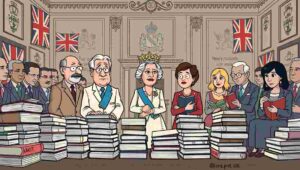
Betrayal: Power, Deceit and the Fight for the Future of the Royal Family by Tom Bower has arrived with all the subtlety of a trebuchet aimed at a gift shop. It portrays Prince Harry and Meghan Markle as somewhere between misunderstood idealists and two people who treated a thousand-year-old institution as the world’s most expensively catered vision board.
The couple have described the book as a “deranged conspiracy,” which, according to reports, is the royal equivalent of dog-earing every page. One does not call something deranged unless one has read it carefully enough to be personally offended by the footnotes.
The Firm Is Now a Publishing House With a Slight Constitutional Obligation on the Side
Royal insiders confirm that the palace’s greatest current anxiety is not republican sentiment, succession logistics, or the price of ceremonial ermine — it is the realisation that every principal in this drama has signed a separate book deal, and their release dates do not align. The Crown, which once governed through studied silence, now communicates primarily through the acknowledgements page.
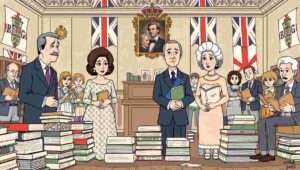
A leaked internal memo, composed in italic calligraphy on notepaper so crested it practically has opinions, reportedly reads: “Should this continue, the Crown may require a dedicated publishing schedule and a style guide.” This would make Britain the first constitutional monarchy in history to be governed by an editorial calendar — though, in fairness, it would explain quite a lot about the House of Lords.
As one historian, from a university whose ranking we shall charitably not mention, observed: “Historically, monarchies survived by saying nothing. Now they survive by saying everything — twice, with a foreword by a sympathetic journalist.” The divine right of kings has been quietly replaced by the right of first serialisation.
Charitable Appearances Now Require a Shot List and a Second Unit
Among the book’s more eyebrow-raising allegations is the claim that even charitable engagements have acquired a suspiciously cinematic quality — less spontaneous act of goodwill, more carefully graded colour palette. An eyewitness at a recent polo event described the scene with barely concealed admiration: “They didn’t simply arrive. There was a pause. A considered, emotionally loaded pause. It was giving West End second act, but with superior hat work.”
A member of the household staff, speaking on strict condition of anonymity and a pension review, added: “We used to organise events. Now we produce them. Last Tuesday I spent forty-five minutes in a meeting about whether a handshake read as ‘genuinely warm’ or ‘strategically warm.'” In the entire history of British public life, no handshake has previously required a brief.
A Mildly Baffled Public Responds in the Only Way It Knows: Forming an Orderly Queue of Opinions
A poll conducted outside a Greggs in Wolverhampton — a location chosen entirely at random and defended entirely without apology — found that 63% of Britons believe the royal feud has “outlasted Brexit, though with marginally less paperwork.” A further 21% believed the book was somehow energy-related. The remaining 16% were concentrating on their steak bakes and asked to be left out of it entirely.
One gentleman near Windsor, sensibly dressed for the weather and the times, offered what may prove the definitive British summation: “I don’t object to the drama. I simply feel it could be conducted more quietly. A strongly worded letter, perhaps. Sent second class.”
What the Funny People Are Saying
“The royals wanted privacy, so they each wrote a book. That’s not a retreat from public life — that’s a publicity tour with better postage.” — Jack Dee
“At this point the monarchy isn’t an institution, it’s a box set. We’re four series in, the plot makes no sense, and everyone’s still watching.” — Frankie Boyle
“I admire the efficiency of it — a thousand years of hereditary power, and they’ve monetised the arguments. That’s not a crisis, that’s a business model.” — Jimmy Carr
The Heir, the Spare, and the Narrative — All Currently Available in Hardback
The structural difficulty at the centre of all this is, at its root, a rights dispute. Everyone has their own version of events. Every version has a literary agent. Every literary agent has a release window. The book reportedly claims tensions predated the wedding significantly, with frictions between Meghan and senior members of the household becoming something of a recurring chapter — in both the figurative and contractual senses.
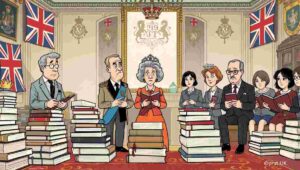
A behavioural psychologist, billing by the hour and making excellent use of every minute of it, noted: “When disagreement becomes a revenue stream, resolution becomes an act of financial self-sabotage.” The feud is not the problem. The feud is the product. The monarchy is merely the brand.
Silicon Valley Arrives Uninvited with a Subscription Tier and Absolutely No Self-Awareness
Sources confirm that several technology companies — constitutionally incapable of encountering a mess without attempting to disrupt it — have pitched the royal household on Royal+, a streaming platform on which subscribers choose their preferred version of history and pay monthly not to be confused by the others.
Proposed packages include “William’s Edition” (restrained, institutional, no visible emotion above a 3), “Harry’s Edition” (identical sequence of events, reframed as a personal reckoning with generational trauma), “Meghan’s Edition” (cinematography alone justifies the annual subscription), and “Anonymous Equerry DLC” (passive-aggressive footnotes, sold separately, discontinued after legal review). Early focus groups described the experience as: “Disorienting, emotionally costly, and somehow impossible to unsubscribe from.” Which is, of course, also a reasonable description of the monarchy itself.
The Crown Carries On — Reigning, If Not Quite Raining, Dignity Upon the Proceedings
Through all of it, the royal family maintains its core constitutional function: being seen in public whilst conducting what appears to be, beneath the surface, an extremely well-tailored argument with no resolution clause. The book touches on the structural problem of the “spare” — the secondary heir whose institutional purpose evaporates the moment the primary heir produces offspring — a predicament that no amount of investiture has ever satisfactorily addressed.
When your purpose is entirely symbolic and the symbol is no longer required, the options narrow sharply: dignified obscurity in a draughty estate, or a production deal. One of these comes with central heating.
Final Ruling: The Crown Is Now a Cinematic Universe and the Exit Signs Have Been Removed
The British monarchy is no longer simply an institution. It is an extended narrative franchise with spin-offs, origin stories, unreliable narrators, and an audience that claims total indifference while consuming every instalment within 24 hours of release. Somewhere in the deeper corridors of Buckingham Palace, a very senior member of staff is murmuring into their Earl Grey: “Just once. One scandal that doesn’t require a companion volume, a rebuttal edition, and a limited-run podcast series.”
They will not get their wish. The audiobook rights have already been optioned, the paperback is in production, and someone, somewhere, is pitching the musical.
This article is a work of satire and should be absorbed accordingly — ideally alongside a proper cup of tea and the particular brand of resigned amusement that the British have spent centuries perfecting. It emerges from the considered collaboration of the world’s oldest tenured professor and a philosophy major turned dairy farmer, both of whom believe the royal family would benefit enormously from a group chat titled “Perhaps Don’t Publish That.”
Auf Wiedersehen, amigo!

Alan Nafzger was born in Lubbock, Texas, the son Swiss immigrants. He grew up on a dairy in Windthorst, north central Texas. He earned degrees from Midwestern State University (B.A. 1985) and Texas State University (M.A. 1987). University College Dublin (Ph.D. 1991). Dr. Nafzger has entertained and educated young people in Texas colleges for 37 years. Nafzger is best known for his dark novels and experimental screenwriting. His best know scripts to date are Lenin’s Body, produced in Russia by A-Media and Sea and Sky produced in The Philippines in the Tagalog language. In 1986, Nafzger wrote the iconic feminist western novel, Gina of Quitaque. He currently lives in Holloway, North London. Contact: [email protected]


In British comedy, the prat is the character who provides the laughter by being completely oblivious to their own ridiculousness.
My gran asked why I laughed at council content. I said “England” and she understood.
Mechanism validates. Correct.