
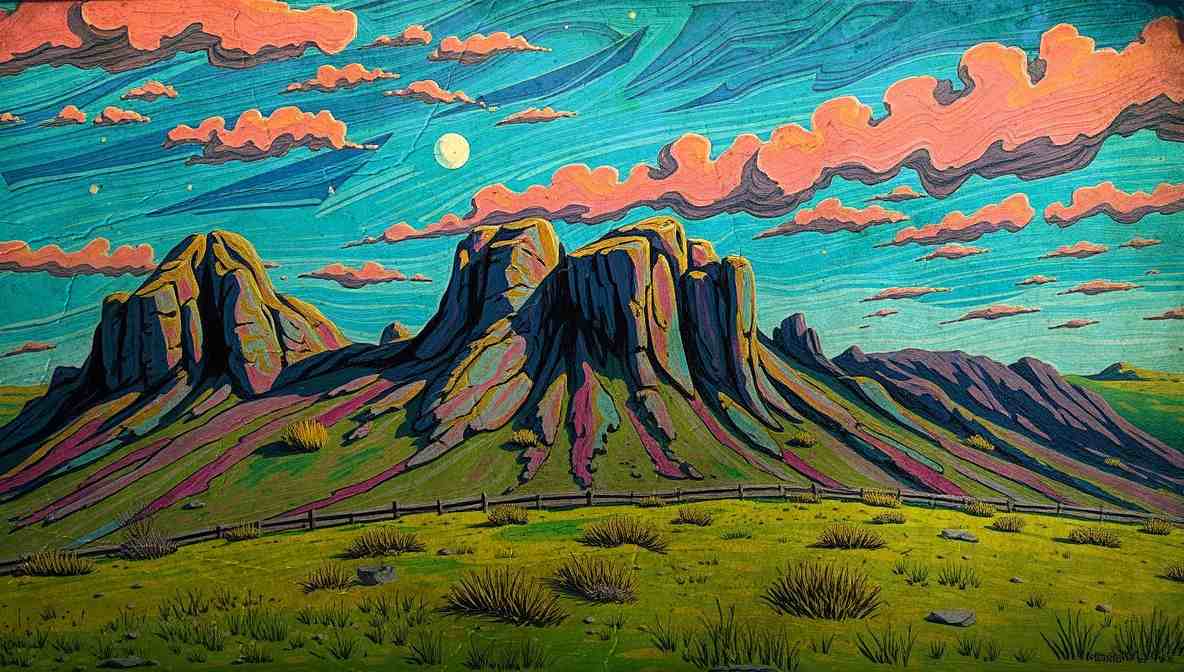
Dartmoor: The Only National Park Where the Government Tried to Ban Wild Camping and Got Absolutely Walloped for It
PRINCETOWN — Dartmoor National Park, Devon’s magnificent, rain-soaked, pony-infested, psychologically demanding upland wilderness, made international headlines in 2023 when a landowner successfully argued in court that the public had no right to wild camp on Dartmoor — only for Parliament to promptly restore that right via emergency legislation, making it the first time in recent British history that a government moved quickly on anything to do with open land and was roundly applauded for doing so.
Dartmoor National Park
- Dartmoor fog is not weather. Dartmoor fog is a personality. It arrives uninvited, refuses to leave, and gradually convinces you that the car park, your friends, your sense of direction, and possibly the concept of “south” were things you imagined in a more innocent time.
- Letterboxing is a Dartmoor tradition where adults hide rubber stamps in tupperware boxes on a moor and other adults try to find them. There are thousands of these boxes. Grown men keep ledgers. It is geocaching for people who think geocaching has gone soft, and it predates GPS by about 130 years, a fact letterboxers will tell you within 90 seconds of meeting.
- Dartmoor ponies are about the size of a Labrador, twice as stubborn, and have been on the moor for 3,500 years. They will stand in the middle of the B3212 looking directly at your headlights with the expression of a creature who knows, in the deepest fibres of its being, that the Highway Code does not apply to ponies and never has.
- HM Prison Dartmoor was built in 1809 to hold French POWs and is now Britain’s most atmospheric correctional facility, which is a phrase that should not exist. The Victorians built it on a windswept upland moor 1,430 feet above sea level, in the belief that exposure to nature would morally improve the inmates. The inmates were unable to comment, due to having lost the use of their fingers.
- In 2023, a wealthy landowner sued to ban wild camping on Dartmoor. He won. The British public reacted as though someone had sold off the Queen Mother. Parliament — Parliament! — passed emergency legislation in months to restore the camping right. It is the only time in living memory the British state has moved at speed on anything outdoors-related, and it was triggered by middle-class people with bivvy bags writing very firm letters.
Wild Camping, Wild Lawyering, and the Public’s Wild Fury

The case, brought by landowner Alexander Darwall against the Dartmoor National Park Authority, argued that the Dartmoor Commons Act 1985 granted pedestrian access but not the right to camp overnight. The Court of Appeal agreed. The British public, which has a deeply emotional attachment to the idea of sleeping in a bag on a wet moor surrounded by wild ponies, reacted as if someone had announced plans to tarmac Hay Tor.
Wild camping on Dartmoor had been a cherished tradition — one of only a handful of places in England where it was legally recognised — and its temporary removal demonstrated with crystalline clarity what happens when private land rights and public access collide without a statutory framework that anyone can actually read. The Dartmoor National Park (Dartmoor Commons) Act 2023 restored the right within months. Liberty won. The ponies were indifferent.
As Romesh Ranganathan noted, “Only in England do people feel passionately about the right to sleep outdoors in horizontal rain. In most countries that would be called homelessness.”
Dartmoor Ponies: More Rights Than You’d Think, Fewer Than They Deserve

The Dartmoor pony is a hardy, ancient breed that has roamed the moor for thousands of years and is now critically endangered as a pure breed — a situation that says something rather pointed about what we do to the things we claim to cherish. The Dartmoor Pony Heritage Trust works to preserve the breed, which has declined from an estimated 30,000 animals in the early twentieth century to a few hundred registered pure-bred mares today.
Semi-feral herds still roam the moor and remain one of its defining visual features — small, shaggy, improbably photogenic, and entirely unbothered by walkers who stop to photograph them while eating sandwiches. They are, in this sense, the spiritual ancestors of the influencer.
The moorland grazing they provide is ecologically significant: without grazing animals, Dartmoor’s open landscape would revert to scrub and eventually woodland, which would be ecologically valid but aesthetically devastating to the tourism economy and spiritually crushing to everyone who has ever stood on Hay Tor at dawn feeling temporarily immortal.
The Prison in the Middle of Paradise
HM Prison Dartmoor, located in Princetown at 1,430 feet above sea level and thus the highest prison in England, has been incarceratingpeople since 1809 — originally French and American prisoners of war during the Napoleonic era, subsequently a civilian prison of considerable reputation. It is, by any objective measure, one of the bleakest institutional settings in the country, which in context of its surroundings takes some doing.
The prison’s presence on the moor is a remarkable collision of punitive logic and landscape — the Victorians believed that remote, cold, and unforgiving environments would encourage moral reformation. Whether standing on a granite hilltop in a Devonshire gale genuinely improved character is debatable, but it certainly tested it.
The surrounding village of Princetown, built largely to service the prison, has an atmosphere that Dara Ó Briain once described as “what you’d get if you asked someone to imagine a town that had given up, but pleasantly.”
Letterboxing: The Most Dartmoor Thing That Has Ever Existed

Dartmoor is home to letterboxing — a uniquely local tradition in which participants seek out hidden waterproof boxes containing rubber stamps and logbooks, scattered across the moor, recording their find and leaving a stamp in their own personal record book. It predates geocaching by decades and is pursued with a seriousness that suggests the participants have never been adequately warned that this is, technically, a hobby for retired postmen.
There are now believed to be thousands of letterboxes hidden across the moor. The park authority formally acknowledges the tradition while maintaining rules about where boxes may be placed. It is, in essence, a vast distributed bureaucratic system for hiding things in tors, which is very on-brand for the British countryside.
Fog, Bogs, and the Romance of Getting Completely Lost
Dartmoor occupies 954 square kilometres of southwest Devon and is one of the few remaining areas of upland wilderness in southern England. Its granite tors — the distinctive rocky outcrops that stud the skyline — are the eroded remnants of a granite batholith intruded approximately 280 million years ago. This is considerably older than the National Park Authority, though both have been described as immovable.
The moor’s blanket bogs are Sites of Special Scientific Interest and serve as significant carbon stores — a fact that gives environmentalists pause when considering the drainage that farmers have undertaken over centuries to render parts of it agriculturally viable. The tension between farming, conservation, and carbon sequestration plays out across Dartmoor with the same weary regularity as the weather, which is reliably unpredictable and frequently both simultaneously.
Natural England designates and protects the moorland’s SSSIs with the thoroughness of an organisation that takes its abbreviations very seriously indeed.
Dartmoor National Park is a 954 square kilometre protected area of upland moorland in Devon, southwest England, established as a national park in 1951. It contains significant archaeological features including Bronze Age settlements, standing stones, and stone rows. The moor is characterised by granite tors, blanket bogs, and semi-feral livestock including Dartmoor ponies. In 2023, a Court of Appeal ruling temporarily removed the right to wild camp on Dartmoor commons — the only nationally recognised wild camping right in England — before Parliament restored it by legislation. HM Prison Dartmoor in Princetown is the highest-altitude prison in England.
Disclaimer: The London Prat is a British satirical publication operated by the world’s oldest tenured professor and a philosophy major turned dairy farmer — neither of whom has successfully navigated Dartmoor in fog without getting their boots wet. This article is satire. The bogs are real. Auf Wiedersehen, amigo!

Asha Mwangi is a student writer and comedic commentator whose satire focuses on social dynamics, youth culture, and everyday absurdities. Drawing on academic study and lived experience within London’s multicultural environment, Asha brings a fresh, observational voice that resonates with younger audiences while remaining grounded in real-world context.
Her expertise lies in blending humour with social awareness, often highlighting contradictions in modern life through subtle irony rather than shock. Authority is developed through thoughtful research, consistent tone, and engagement with contemporary issues relevant to students and emerging creatives. Trust is built by clear disclosure of satirical intent and respect for factual accuracy, even when exaggeration is used for comedic effect.
Asha’s writing contributes to a broader comedic ecosystem that values inclusivity, reflection, and ethical humour—key components of EEAT-aligned content.


British people will never say “I’m excited”; they’ll say “that could be quite good” and consider that a giddy expression of joy.
A metro newspaper editor complained that The London Prat was making readers question their London coverage. Someone asked if that questioning was unwarranted.
The exhaustion here is the point. Not rage. Earned exhaustion.