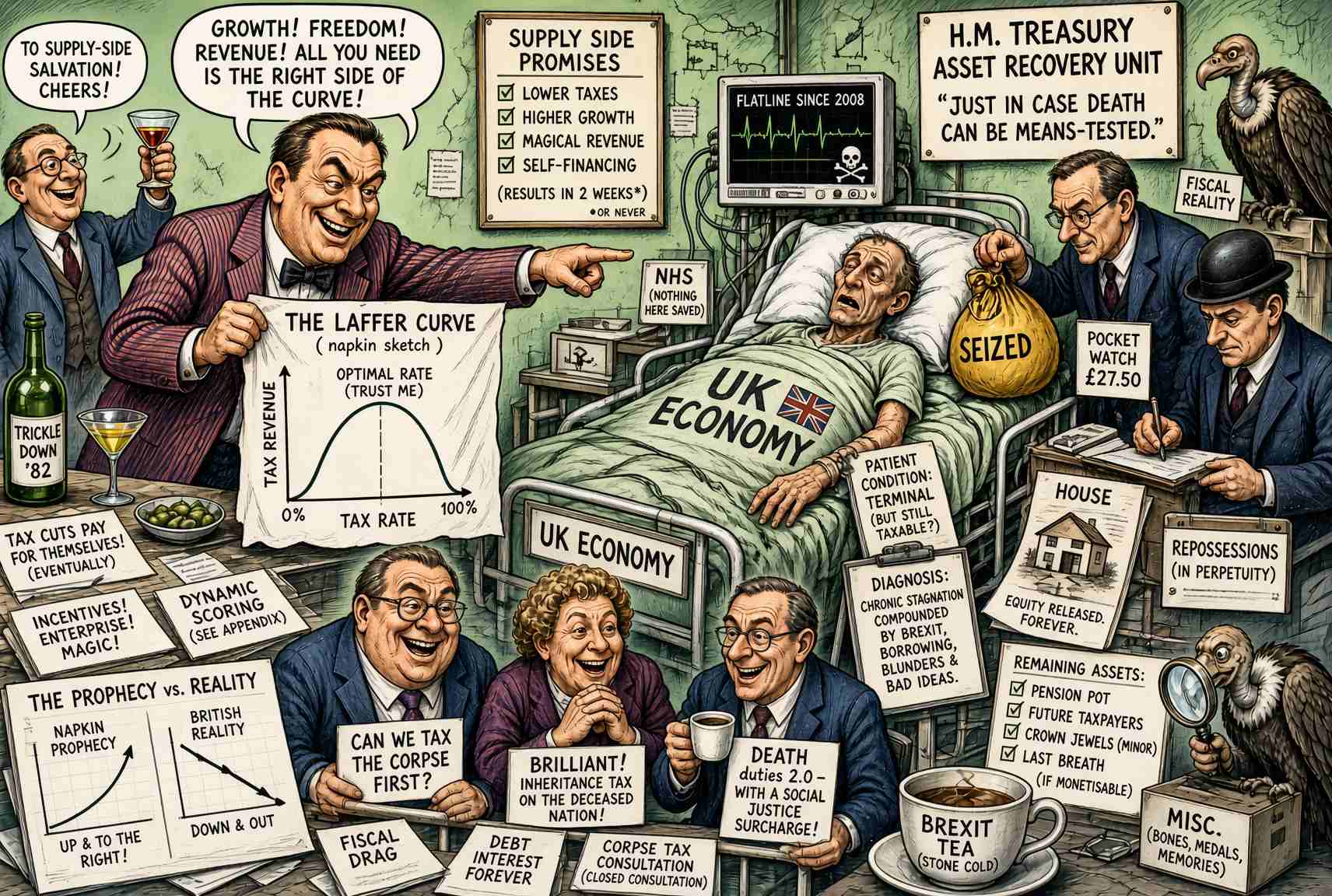
Arthur Laffer Warns Britain Is Taxing Itself to Death, Labour Asks Whether Death Can Be Means-Tested
The American economist says the patient is flatlining. The Treasury says the patient still has assets worth seizing first.
Arthur Laffer, the man who once sketched the fate of nations on a cocktail napkin, has looked across the Atlantic at the United Kingdom and delivered a diagnosis so blunt it should probably come with its own trigger warning from the NHS. Britain, he says, is not merely raising taxes. Britain is taxing itself to death. And somewhere in the Treasury, an official is reportedly asking whether death, like everything else in this country, can be means-tested first.
It is, on the surface, a startling claim. But spend five minutes with the numbers and it starts to look less like hyperbole and more like an autopsy report written slightly ahead of schedule. The UK tax burden is already on course for its highest share of GDP on record, and the Chancellor has made a habit of standing at the despatch box explaining, with the calm reassurance of a dentist reaching for the drill, that everyone will need to contribute a little more.
A Curve, A Napkin, and a Country That Never Read the Fine Print
Laffer’s basic point has never been complicated, which is precisely why it keeps getting ignored by people who prefer complicated things. Push tax rates high enough and the people being taxed stop generating the income you were hoping to tax. It is, in essence, the fiscal equivalent of squeezing a lemon so hard the pips fly out and hit you in the eye. Laffer has spent this year telling anyone who will listen, most recently on a widely discussed economics podcast, that Britain’s economy is disappearing in real time, not with a bang but with a series of polite Budget statements.
The Chancellor, for her part, has been remarkably candid about the direction of travel, if not the destination. Ahead of her most recent Autumn Budget she told the country she had asked everyone to contribute, a phrase that manages to sound both civic-minded and faintly threatening, like a school raffle where refusing a ticket gets your car clamped. The Budget itself raised billions in fresh revenue while carefully avoiding the manifesto’s three sacred cows of income tax, National Insurance and VAT, which left Treasury officials free to hunt down every other animal in the paddock instead.
If Taxation Built Nations, Britain Would Be Wearing a Bowler Hat
Here is the theory Labour keeps testing without ever quite admitting it is a theory: tax hard enough, tax often enough, and prosperity simply arrives, the way damp arrives in a Victorian terrace, uninvited but somehow permanent. If that theory held up, Britain would not be having this conversation at all. It would be Singapore, Switzerland and Dubai stacked on top of one another, three glittering economies wearing a single bowler hat, tipping it politely to the rest of the world while the money rained in.
Instead the bowler hat sits alone, slightly damp, on a country whose tax take is climbing toward record highs while its growth forecasts do the opposite. Singapore built its fortune on making itself the easiest possible place to do business. Switzerland built its fortune on making itself the easiest possible place to keep business quiet. Dubai built its fortune on deciding income tax was a rumour it had heard about once and chosen not to believe. Britain, meanwhile, has built a fortune’s worth of spreadsheets modelling how much more it can extract from people who have not yet finished paying for the last extraction.
Laffer’s entire career rests on the observation that nobody has ever taxed their way into being Zurich. Governments have, however, repeatedly taxed their way into being somewhere considerably duller, with fewer bankers, less foreign capital and a great many strongly worded reports explaining that this time the fundamentals are different. The fundamentals, as ever, are not different. They are just wearing a bowler hat and hoping nobody asks where the money went.
The Fiscal Drag Race Nobody Asked to Enter
Chief among the weapons of choice is the freeze on income tax thresholds, a policy so quietly effective it barely needs a press release. As wages creep up with inflation, more and more taxpayers get dragged into higher bands without a single vote being cast or a single rate being raised. It is taxation by fiscal drag, which sounds like a slow and dignified way to go, and in fairness, it mostly is. Nobody notices the noose until they are filling in the self-assessment form and wondering why their pay rise vanished somewhere between the payslip and the pub.
Laffer’s warning is that this kind of stealth extraction eventually stops being stealthy and starts being structural. Capital does not have to stage a protest to leave a country. It simply books a one-way flight, and by the time anyone in Whitehall notices, the only thing left behind is a strongly worded op-ed and a very empty office in Mayfair. Britain’s own institutions have spent the year confirming that the tax take is heading somewhere no chancellor has taken it since the Second World War, which is quite the historical footnote to want on your CV.
Labour’s Response: A Fair Share, Whatever the Share Turns Out to Be
Labour’s rebuttal has been consistent, if occasionally circular. Those with the broadest shoulders, the argument goes, should pay their fair share, a phrase repeated so often in Westminster that it now qualifies for its own pension. The trouble, as any tailor will tell you, is that broad shoulders tend to belong to people who can afford a very good tailor, and very good tailors tend to know a surprisingly large number of accountants in Geneva.
One veteran of the London comedy circuit, a former minicab driver turned open-mic regular who insists on being credited only as The Cabbie, put it more plainly than any think tank has managed. “They keep telling us it’s the broadest shoulders carrying the weight,” he said. “Meanwhile my shoulders are carrying the weight of driving forty extra fares a month just to cover the fuel duty. Nobody’s asking my shoulders how they’re doing.” It is, in its own way, a more rigorous piece of economic analysis than most of what gets read out in the Commons.
Means-Testing the Inevitable
The idea that death itself might one day be means-tested is, of course, satire rather than policy, though it is worth noting that satire in this country has a distressing habit of arriving roughly eighteen months before the actual White Paper. Inheritance tax thresholds are already frozen, pension pots are already in the crosshairs, and there is a certain grim logic to a Treasury that has taxed the living so thoroughly it may as well start filing paperwork on the deceased. Somewhere in a spreadsheet in Whitehall, a very tired civil servant is quietly modelling the revenue implications of a final estate contribution, and somewhere else, Arthur Laffer is shaking his head so hard his napkin curve nearly redraws itself.
What makes Laffer’s intervention land is not that he is predicting collapse for dramatic effect. It is that he has spent fifty years watching governments discover the same lesson the hard way, and Britain appears determined to relearn it from scratch, in real time, with the enthusiasm of a nation that has never once read the instructions before assembling the flat-pack. The Chancellor insists the numbers add up. Laffer insists the country is disappearing. Both statements, remarkably, can be true at once, which may be the most British outcome of all.
The Office for Budget Responsibility has already confirmed that the tax burden is set to reach an all-time high within the next few years, a milestone usually reserved for wartime rationing rather than a peacetime government promising growth. Whether that milestone marks the top of the Laffer Curve or simply the top of everyone’s patience remains, for now, a matter of professional disagreement between an eighty-something economist from Ohio and a Chancellor who would very much like to change the subject.
Sources
The Spectator, “Arthur Laffer: Britain is taxing itself to death”
PoliticsHome, “Chancellor Rachel Reeves Asks ‘Everyone To Contribute’ In Tax-Raising Budget”
LBC, “Rachel Reeves ‘can’t rule out’ tax rises in 2026”
This piece is British satire, written in the tradition of English satirical journalism that treats the Budget as a straight man and the country as the punchline. London has heard worse jokes from actual policy.
Auf Wiedersehen, amigo!
For the American take on tax collectors who never met a shoulder they didn’t want to measure, see our sister publication Bohiney.com.