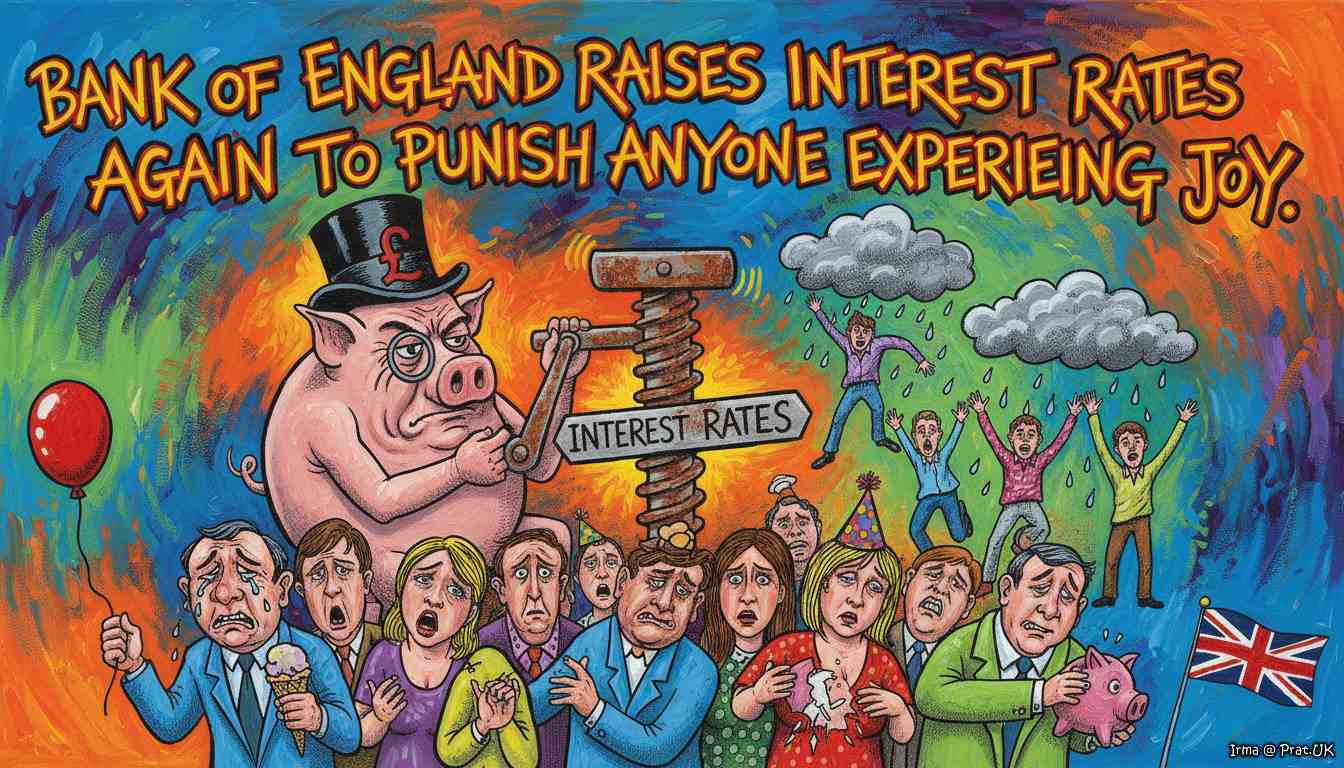
Bank of England Raises Interest Rates Again to Punish Anyone Experiencing Joy
Five Observations on Britain’s Financial Misery
- The Bank of England now raises interest rates whenever Britons briefly appear hopeful.
- Homeowners increasingly open mortgage statements with the emotional caution of archaeologists uncovering curses.
- Young Britons discuss buying houses the way medieval peasants discussed dragons.
- One London couple reportedly celebrated locking in a mortgage rate below “catastrophic.”
- Economists now explain inflation using charts that resemble ski slopes for rich people.
- Britain’s Financial Strategy Continues as Organised Emotional Damage
LONDON — The Bank of England raised interest rates once again this week, prompting millions of Britons to immediately cancel vacations, postpone joy, and stare silently into kettles.
Officials defended the move as necessary to combat inflation, stabilise markets, and prevent the economy from evolving into “a giant speculative bonfire fuelled by panic buying and contactless payments.”
For ordinary citizens, however, the announcement translated roughly into: “Surprise. Your house now costs feelings.”
Across Britain, mortgage holders reacted with the weary resignation usually associated with exhausted Roman soldiers watching barbarians approach city walls.
At a café in Leeds, accountant Darren Pike described opening his latest mortgage statement.
“I made the same noise my Labrador makes during fireworks,” he admitted. “Then I emailed the bank to complain and got an automated reply written by a tone-deaf robot named Skye.”
Governor’s Speeches Sound Like “Hostage Negotiations Conducted by Men Named Rupert”
The Bank insists the measures remain essential.
Governor statements emphasised “long-term economic resilience,” though critics noted these speeches increasingly sound like polite hostage negotiations conducted by men named Rupert.
Economist Ingrid Gustafsson explained the strategy carefully.
“Interest rates are designed to slow spending,” she said. “Unfortunately they’re also slowing optimism, dating, and the possibility of owning furniture. The average UK living room now contains one beanbag and a sense of regret.”
“Interactive Humiliation”: Britain’s Housing Market for the Young
Younger Britons have been hit especially hard.
A recent survey found 64% of adults under 35 now believe homeownership belongs in the same category as knighthoods and functioning NHS dentists.
One London renter described property listings as “interactive humiliation.”
“You spend £2,100 a month to live beside a train line and a fox with anger issues,” she said. “The fox has been here longer than me and has more rights to the bins.”
Meanwhile, estate agents continue describing broom cupboards as “stylish urban retreats” and bathrooms accessible only via crawling as “intimate.”
Britons Stare Down Cheddar in Aldi Stand-Off
At the same time, inflation remains stubborn.
Supermarket shoppers increasingly treat olive oil, butter, and branded cereal like luxury imports from Atlantis.
One pensioner in Birmingham reportedly locked eye contact with a block of cheddar before whispering, “Not today, old friend.” The cheddar, witnesses say, looked sympathetic.
The government insists the economy remains resilient despite stagnant growth, exhausted consumers, collapsing confidence, and widespread national suspicion that no one truly understands modern finance anymore.
At Westminster, ministers repeatedly used phrases like “challenging global conditions” and “difficult but necessary choices,” both now scientifically proven to raise British blood pressure instantly.
The National Hobby of Pretending Things Are “Basically Fine”
Social scientists argue the crisis reflects deeper structural problems involving housing shortages, wage stagnation, weak productivity, and Britain’s national habit of pretending things are “basically fine” until ceilings collapse.
Still, the public continues adapting.
Some families now share streaming passwords with the coordination of Cold War spy networks. Others simply avoid checking bank balances entirely for emotional reasons.
One Manchester family reportedly operates a single Netflix account across four households and three counties. The patriarch in charge of password renewal has been described as “essentially a regional warlord.”
Newcastle Plumber: “My Ambition Is Buying Grapes Without Anxiety”
Outside a pub in Newcastle, plumber Martin Doyle summarised the national mood perfectly.
“I don’t even dream big anymore,” he sighed. “Now my ambition is buying grapes without anxiety. Last week I picked up a punnet, looked at the price, put them back, and apologised to the grapes individually.”
What the Funny People Are Saying About British Mortgages
“The Bank of England raises interest rates like disappointed parents grounding the entire country.” — Ricky Gervais
“In Britain, financial planning now means deciding which vegetable to fear this week.” — Sarah Silverman
“Every mortgage payment feels like paying ransom for your own kitchen.” — Bill Burr
The Real Story Behind Britain’s Rate Pain
The Bank of England’s Monetary Policy Committee held Bank Rate at 3.75% at its 29 April 2026 meeting by an 8–1 vote, with one member preferring an increase to 4%. The Bank has now signalled rates may need to stay higher for longer, with some analysts including Tembo predicting Bank Rate could climb as high as 5.25% during 2026 if Middle East-driven energy price pressure persists. CPI inflation reached 3.3% in the twelve months to March 2026 according to the Office for National Statistics, well above the 2% target. According to Rightmove, the average UK monthly mortgage payment now stands at £1,697 based on a typical asking price of £371,042 and an average interest rate of 4.78%. First-time buyers face two- and five-year fixed rates above 6% at 90%–95% loan-to-value, with the cheapest five-year fix at 95% LTV currently 5.30% from Nationwide’s Helping Hand. UK Finance estimates around 540,000 households are sitting on their lender’s standard variable rate. For wider context see the Bank of England’s April 2026 Monetary Policy Report and the House of Commons Library briefing.
Disclaimer
This piece of British satirical journalism is entirely a human collaboration between the world’s oldest tenured professor and a philosophy major turned dairy farmer. No central bankers experienced affordable housing during production. The London Prat would like to issue a formal apology to the cheddar mentioned above; it was a good block and deserved better. Auf Wiedersehen, amigo!

Mei Lin Chen is a student writer whose satire explores identity, modern culture, and social nuance. Her work reflects academic curiosity and engagement with London’s diverse perspectives.
Expertise is growing through study and practice, while trust is supported by clear intent and responsible humour.