

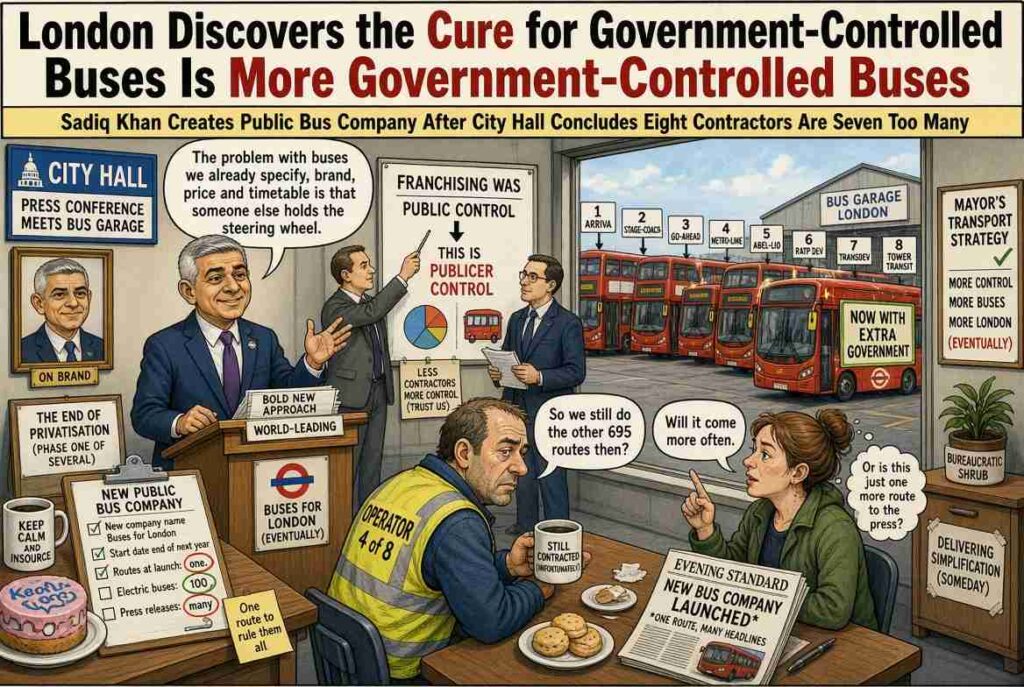
London Discovers the Cure for Government-Controlled Buses Is More Government-Controlled Buses
Sadiq Khan Creates Public Bus Company After City Hall Concludes Eight Contractors Are Seven Too Many
LONDON — Mayor Sadiq Khan has unveiled Buses for London, a publicly owned operator expected to begin running Route 6 between Willesden and Victoria in late 2027. About 100 zero-emission buses are initially planned, with four more routes due to follow from 2028 before TfL evaluates whether the experiment should expand. London currently has almost 700 routes operated under TfL contracts by eight private companies.
City Hall says the public operator could improve reliability, safety, efficiency and driver welfare while allowing profits to be reinvested in the network. Unite, which worked with TfL and Khan’s office on the initiative, welcomes the move and wants public ownership expanded further.
Which brings London to that timeless political question: if the government already specifies the routes, regulates the fares, awards the contracts and supervises the network, how much more government is required before the bus finally arrives?
The Great London Bus Liberation: Publicly Owned Buses Arrive at Route 6
For decades Londoners have endured a shocking indignity.
They have boarded buses operated by companies.
Companies.
Private companies.
Businesses containing accountants, managers, shareholders and other suspicious characters known to historians as “people who occasionally wonder what things cost.”
Now relief is coming.
Buses for London will initially operate around 100 zero-emission buses, beginning with Route 6. City Hall describes the venture as an opportunity to test new approaches in efficiency, safety, sustainability, customer experience and employee welfare.
Efficiency is particularly exciting.
Government has been searching for it for centuries.
Scientists once believed efficiency existed only theoretically, somewhere between dark matter and a printer that works when Parliament needs something urgently.
Yet London may finally capture it aboard a double-decker.
The great irony is that London’s bus network was never exactly the Wild West.
This isn’t a situation where eight corporations woke each morning, drew random routes on maps and sent buses charging through Kensington yelling, “Free enterprise!”
TfL already determines and oversees the network while private operators perform services under contract, a tendering system that has existed since the mid-1990s.
So the revolution resembles a restaurant announcing that, after years of deciding the menu, prices, opening hours and recipes, it has finally liberated itself from capitalism by firing the chef.
Public Bus Profits Have Been Located: Reinvestment vs Private Shareholders
One argument for the publicly owned operator is that profits could be reinvested into transport rather than flowing to private shareholders. City Hall explicitly lists reinvesting profits among the anticipated advantages.
This is where matters become economically fascinating.
Apparently profit changes moral character depending upon who receives it.
When a private bus operator earns £1, the pound twirls its moustache and kicks a puppy.
When a municipal operator earns £1, the pound receives a high-visibility vest, joins a working group and begins improving communities.
Same pound.
Completely different childhood.
Of course, public enterprises can generate surpluses and private contracting can produce problems. Neither ownership model contains a magical gearbox labelled COMPETENCE.
But political rhetoric rarely enjoys such boring distinctions.
The private sector allegedly has “profits.”
Government has “resources.”
Private companies have “cost overruns.”
Government has “additional investment requirements.”
Businesses raise prices.
Authorities implement revised funding frameworks.
Your wallet cannot tell the difference, but it apparently lacks a degree in public administration.
Unite Discovers a Bus Big Enough for Everybody: Union Backing for Public Ownership
Unite welcomed the creation of Buses for London and said it has long sought a return to public ownership. The union argues outsourcing has delivered poor conditions for workers and worsening services while private operators made profits.
Fair enough. Those are claims worth testing against results.
But Unite also describes the project as just the beginning.
That phrase should cause every taxpayer within the M25 to instinctively check whether his direct debit has moved.
Government programmes rarely announce themselves as “just the beginning” before eventually becoming “that modest little department we established in 2026 employing 14,700 people and owning a conference centre in Croydon.”
Route 6 is therefore less a bus route than a philosophical laboratory.
If it performs better than contracted services, advocates will demand expansion.
If it performs worse, advocates can explain that the problem was insufficient scale.
And if performance is identical, both sides can commission reports proving victory.
That is democracy.
Everybody gets evidence.
The Accountability Miracle: Who Gets Blamed When London Buses Run Late
City Hall argues direct operation could give TfL greater control over services.
More control certainly simplifies one problem.
Under private contracting, when buses perform badly, officials can blame the contractor.
Under public ownership, when buses perform badly, officials can blame…
Traffic.
Weather.
Previous governments.
Funding settlements.
Global events.
Unexpected passenger demand.
Legacy infrastructure.
Climate change.
A consultancy report.
Possibly France.
The important thing is that accountability will have been brought safely in-house where trained professionals can prevent it escaping.
Imagine the passenger.
“Why was my bus late?”
Under capitalism: “The operator failed.”
Under municipal ownership: “Your journey experienced a temporary service-delivery variance arising from network resilience pressures.”
Beautiful.
The bus hasn’t arrived, but the adjective budget remains fully funded.
A Revolutionary Discovery Called Competition: Public vs Private Bus Operator Costs
There is nevertheless a useful experiment hiding underneath the political banners.
TfL will have something resembling an internal benchmark.
If its publicly owned operator consistently delivers safer, cheaper and more reliable services than contracted companies, that is meaningful information.
If private operators consistently beat the municipal company, that is meaningful too.
The delicious problem begins when ideology encounters the spreadsheet.
Suppose Buses for London costs £4.30 per mile and a private contractor costs £3.80.
Suddenly every politician becomes an anthropologist.
“Well, cost isn’t the only measure.”
Quite right.
Then suppose Buses for London costs £3.80 and the private company costs £4.30.
Suddenly cost becomes the greatest achievement of Western civilisation.
Politics possesses the remarkable ability to discover performance metrics immediately after seeing the performance.
London Gets a 100-Bus Starter Pack: Zero-Emission Buses and the Route 6 Rollout
The limited rollout is sensible precisely because neither ownership model guarantees success.
Route 6 comes first, four additional routes follow, and performance will be reviewed before any wider expansion.
But politically, this is irresistible.
A hundred buses!
Nothing says economic transformation like something representing a small fraction of a network approaching 700 routes.
It is the municipal equivalent of buying one tomato plant and announcing agricultural independence.
There will be branding.
There will be launch photographs.
There will almost certainly be a person wearing a hard hat despite nobody performing construction within 200 yards.
Someone will stand beside a bus and announce “a new chapter.”
Public-sector announcements adore chapters.
Britain has opened so many new chapters that nobody can locate the book anymore.
The Free-Market Question Nobody Can Avoid: Public vs Private Bus Ownership
The useful question isn’t whether “public” automatically means good or “private” automatically means good.
It is much less romantic:
Which arrangement delivers the required service at the best combination of reliability, safety, working conditions and cost?
That question is painfully dull.
Which is precisely why politics avoids it.
Ideology prefers nouns.
“Public ownership.”
“Privatisation.”
“Outsourcing.”
“Nationalisation.”
The passenger prefers verbs.
Arrive.
Preferably before he develops grandchildren.
Londoners do not stand at bus stops dreaming of optimal ownership structures.
Nobody checks Citymapper and says, “Wonderful! My bus is delayed nine minutes, but its capital structure reflects my values.”
They want the thing with wheels to appear.
Welcome Aboard the People’s Route 6: Will the Bus Actually Turn Up?
By late 2027 London should therefore possess perhaps the most politically examined bus route on Earth.
Economists will watch it.
Unions will watch it.
Private operators will watch it.
City Hall will watch it.
Conservatives will watch it.
Labour will watch it.
Transport academics will produce papers with titles such as Municipal Operational Frameworks and Modal Delivery Outcomes Within Metropolitan Surface Mobility Ecosystems.
The passengers will continue asking:
“Is this going to Victoria?”
And perhaps that is the perfect ending.
After all the ideology, public ownership, private contracts, union campaigns, profit arguments, climate objectives, accountability frameworks and political speeches, Britain’s transportation future still depends upon a bloke standing in the rain squinting at the front of a red bus.
Government can reorganise ownership.
Companies can restructure contracts.
Unions can negotiate.
Politicians can unveil logos.
But London has one unforgiving performance indicator.
Did the bloody bus turn up?
And if Route 6 someday arrives precisely on time, carrying delighted passengers at remarkably low cost, both sides will naturally respond in accordance with centuries of British political tradition:
They will take full credit for it.
15 Observations From the Bus Stop on London’s Public Bus Company
- London already controls the bus network, so naturally the solution is to create another organisation to control the organisations operating the controlled bus network.
- Route 6 has been selected for public operation, presumably because Route 5 escaped while nobody was looking.
- City Hall says profits can now be reinvested, introducing government to the exciting capitalist concept of making one.
- Unite says this should be only the beginning, because no government programme has ever stood beside 100 buses and whispered, “That’ll do.”
- The experiment begins in late 2027, giving London sufficient time to invent several committees explaining why it begins in early 2028.
- Four additional routes will follow, because apparently socialism now comes with a free trial period.
- Officials promise greater accountability. Nothing produces accountability quite like transferring responsibility from companies the government hires to a company the government owns.
- Private operators supposedly create unacceptable profits, whereas public operators will create morally superior profits wearing municipal lanyards.
- TfL says the project will encourage innovation, suggesting Britain’s next technological breakthrough may involve discovering that passengers enjoy buses arriving.
- Public ownership advocates complain shareholders take money out of the system, which is terrible because only government agencies should possess the dignity required to make billions disappear.
- The publicly owned company will operate zero-emission buses, although the meetings discussing them will continue emitting PowerPoint indefinitely.
- London politicians spent decades blaming private operators. They are now purchasing the wonderful privilege of eventually blaming themselves.
- The left has discovered the perfect business model: eliminate the private owner, keep the customer, retain the costs and call the remaining arithmetic justice.
- The most dangerous phrase in municipal government may be “pilot programme,” meaning something too small to fail but large enough to receive a logo.
- By 2035, every London bus may be publicly owned, at which point the passenger waiting 34 minutes in the rain will at least enjoy the warm knowledge that the delay belongs to everybody.
Disclaimer
This is satire about political rhetoric, public ownership, private contracting, bureaucracy and the ancient British tradition of turning transportation policy into theology. Real facts provide the scaffolding; the comic deductions have been deliberately stretched until they resemble the timetable at 2 a.m.
This story is entirely a human collaboration between two sentient beings: the world’s oldest tenured professor and a philosophy major turned dairy farmer. Any resemblance to sensible transportation planning should be reported immediately to the appropriate authorities.
For the factual backbone, The Standard reports the initial 100-bus plan, Route 6 launch and proposed expansion; Unite supplies the public-ownership case, while other reporting records concerns that public operation transfers more investment risk to taxpayers.
Further reading: TfL’s Buses for London announcement · City AM: Nationalising London buses fixes a nonexistent problem · routeone: The politics of a publicly owned bus company · London Buses route 6 · Privatisation of London bus services

Alan Nafzger was born in Lubbock, Texas, the son Swiss immigrants. He grew up on a dairy in Windthorst, north central Texas. He earned degrees from Midwestern State University (B.A. 1985) and Texas State University (M.A. 1987). University College Dublin (Ph.D. 1991). Dr. Nafzger has entertained and educated young people in Texas colleges for 37 years. Nafzger is best known for his dark novels and experimental screenwriting. His best know scripts to date are Lenin’s Body, produced in Russia by A-Media and Sea and Sky produced in The Philippines in the Tagalog language. In 1986, Nafzger wrote the iconic feminist western novel, Gina of Quitaque. He currently lives in Holloway, North London. Contact: [email protected]


