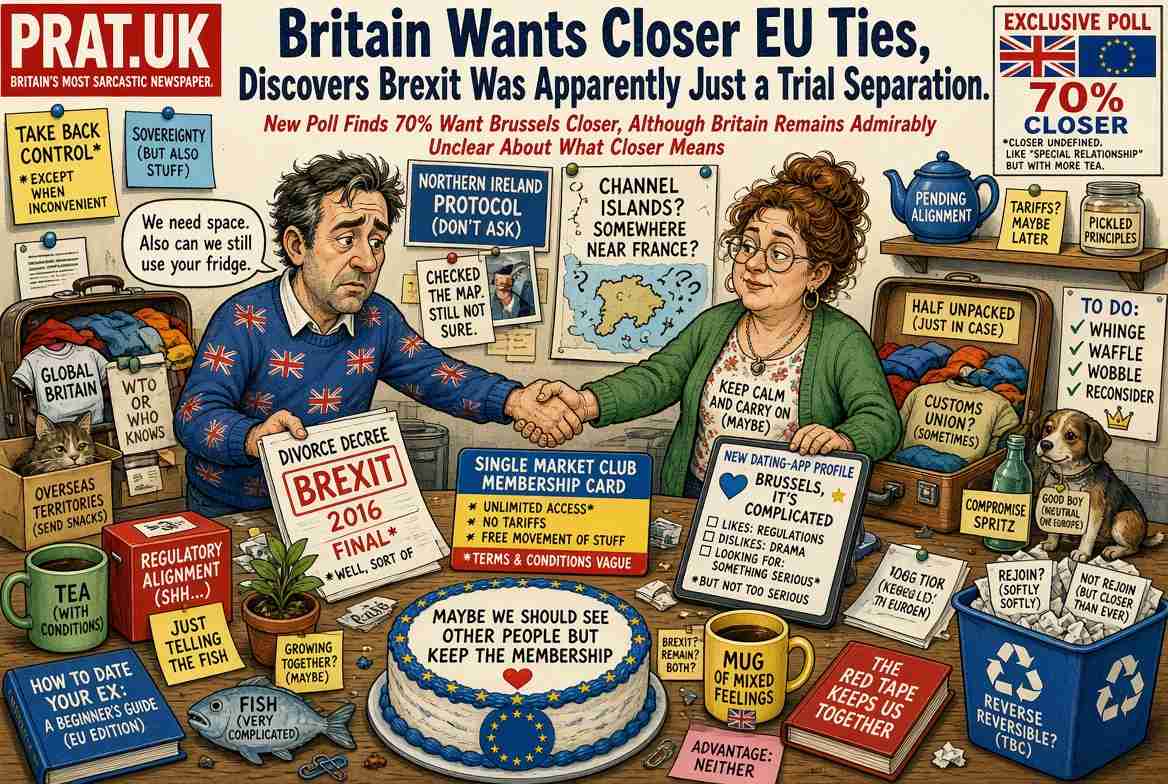
Britain Wants Closer EU Ties, Discovers Brexit Was Apparently Just a Trial Separation
New Poll Finds 70% Want Brussels Closer, Although Britain Remains Admirably Unclear About What “Closer” Means
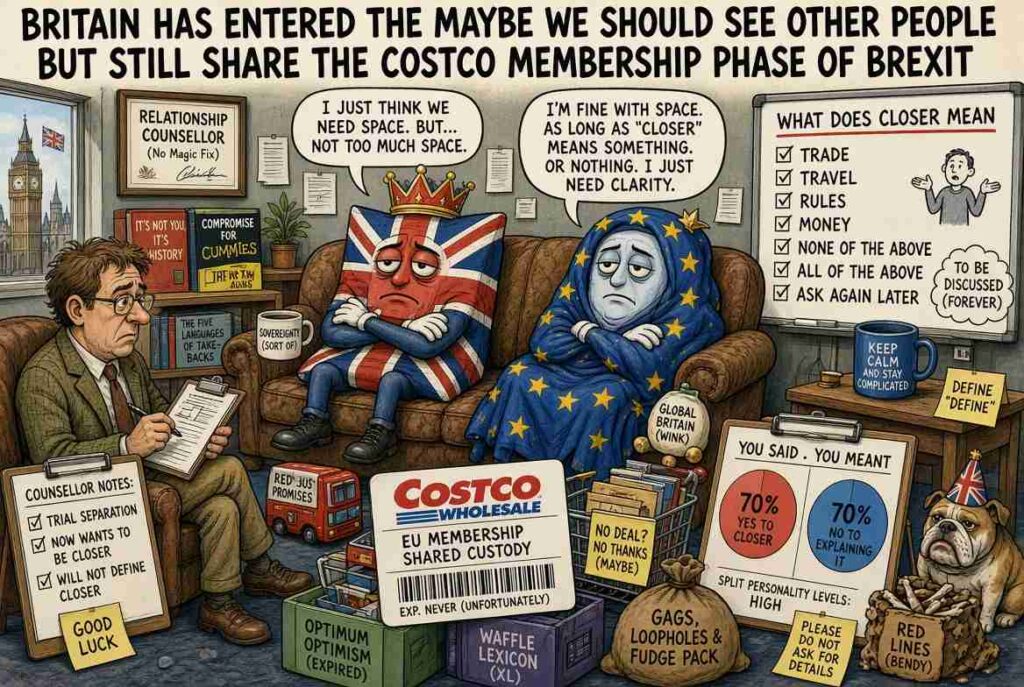
Britain has apparently entered the “maybe we should see other people but still share the Costco membership” phase of Brexit.
A new POLITICO/Public First poll reports that 70 percent of British adults favor some form of closer relationship with the European Union, a finding guaranteed to provide approximately six months of employment for television pundits, constitutional scholars and men named Nigel shouting near railway stations.
But there is a magnificent British complication.
The 70 percent is not 70 percent saying, “Good Lord, reverse Brexit immediately and fetch Belgium.”
Some 31 percent favor a closer relationship provided Britain does not have to comply with the EU rulebook, while another 39 percent support much closer cooperation even if Britain has to follow some EU rules again.
Which means the British public has achieved something economists previously considered impossible: simultaneously wanting to move closer to a regulatory system while asking whether the regulations could perhaps remain in Belgium.
This is not foreign policy.
This is dating.
“We should spend more time together.”
Wonderful.
“Does that mean commitment?”
Steady on.
“Can I leave a toothbrush?”
Absolutely not.
What Does “Closer Relationship” Mean? Britain Rediscovers the European À La Carte Menu
For years Britain argued about whether Brexit meant Brexit.
Apparently we have advanced intellectually.
Now Brexit means Brexit, except for those portions of Brexit which might eventually mean something slightly closer to Not Quite Brexit.
Britain appears interested in the European Union the way a diner approaches a buffet after announcing he has begun intermittent fasting.
Just looking.
Maybe one bread roll.
Perhaps access to the single market.
No dessert.
Would customs alignment count as carbohydrates?
The great difficulty here is the phrase “closer relationship.”
It is gloriously elastic.
Military cooperation is closer.
Scientific cooperation is closer.
Reducing trade barriers is closer.
Joining a customs union is much closer.
Re-entering the single market is closer still.
Full membership is the political equivalent of Brussels turning up with a moving van.
Public First surveyed 2,028 U.K. adults online from September 13 to 15, 2026.
The result therefore tells us something real about public sentiment.
It does not, however, tell us that seven Britons out of ten have suddenly awakened screaming, “Quick! Somebody find our old European Commission login!”
That distinction matters because British politics has spent ten years converting every Brexit statistic into a medieval weapon.
Reform UK Voters and the EU Poll: 51 Percent Want a Closer Relationship
The most eyebrow-raising number involves Reform UK.
Among Reform voters, 51 percent favored a closer relationship, while 25 percent wanted Britain to become more distant from the EU.
This does not necessarily mean Reform voters have collectively begun knitting European flags.
It might mean they want fewer trade barriers.
It might mean they want security cooperation.
It might mean they want easier travel.
It might mean half the respondents heard “closer relationship” and thought Brussels should simply return their lawn mower.
The lesson is that polling language matters.
Ask someone:
“Would you like Britain to cooperate more effectively with nearby countries?”
You might get 70 percent.
Ask:
“Would you like a supranational institution to influence domestic regulations?”
You may hear the pub go very quiet.
Ask:
“Would you like cheaper holidays?”
Suddenly the European project has 94 percent approval and three Ryanair boarding passes.
Tony Blair and Sadiq Khan Reopen the Rejoin the EU Debate
Former Prime Minister Tony Blair has meanwhile argued that Britain should put rejoining a reformed EU on the agenda over the coming decade. London Mayor Sadiq Khan has gone further, urging the government to begin the rejoining debate now and describing Brexit as a “disaster.” Those are their political positions, not conclusions established by the poll itself.
There is something impressive about Britain contemplating another gigantic Brexit debate.
This is a nation that spent years arguing about customs unions, backstops, indicative votes, meaningful votes, Northern Ireland protocols and whether somebody had adequately respected the Will of Brenda From Wolverhampton.
And now influential politicians are looking around and saying:
“You know what Britain needs?”
Nobody says anything.
“More Brexit discussion.”
The room empties so quickly it qualifies as frictionless movement.
Britain has been discussing Europe since approximately Charlemagne.
At some point archaeologists will excavate Westminster and discover an ancient tablet reading:
SHOULD WE ALIGN WITH CONTINENTAL POTTERY STANDARDS?
Vote postponed until Tuesday.
Andy Burnham’s Impossible Brexit Reset: Closer to Europe, but Not Too Close
Prime Minister Andy Burnham therefore faces a delightful political assignment.
Move closer to Europe.
But possibly don’t rejoin Europe.
Accept cooperation.
But maintain independence.
Remove economic barriers.
But avoid regulatory obligations.
Keep pro-European Labour supporters satisfied.
Avoid reopening old Brexit wounds.
And somehow explain the whole arrangement in under nine minutes on BBC Breakfast while somebody named Gary asks why tomatoes cost £2.80.
Public First polling published around the Labour conference also found considerable pessimism about household finances, with only 20 percent expecting Burnham’s government to make a real improvement in the cost of daily life.
That makes the political equation even harder.
People tend to become considerably less interested in constitutional architecture when their grocery receipt has become a novella.
Tell a man paying £6 for butter that Britain is renegotiating phytosanitary standards and he may renegotiate your proximity to the front door.
Sovereignty Plus Free Shipping: Why Voters Want Single Market Benefits Without EU Rules
The deeper comedy is that voters frequently want things governments have trouble providing simultaneously.
We want cheap goods.
High wages.
Low taxes.
Excellent public services.
Independent regulation.
Seamless international trade.
Secure borders.
Fast airports.
Environmental protection.
Affordable energy.
And preferably everything delivered Thursday before 10 a.m.
That isn’t uniquely British.
That’s democracy.
Every electorate eventually walks into government carrying an Amazon wish list and discovers economics has not read the customer-service handbook.
Europe merely concentrates the contradiction beautifully.
Closer economic integration generally requires some common rules.
Complete regulatory independence generally creates additional barriers.
Neither proposition tells Britain what it should choose.
It merely explains why the magical option called “all benefits, zero obligations” has historically suffered from manufacturing delays.
Brexit Pub Poll: What Britons Really Think About EU Rules and Trade Barriers
To understand the national mood, our newsroom conducted the traditional British research technique of imagining what would happen if the question were asked properly in a pub.
“Would you like closer ties with Europe?”
“Yes.”
“Would you like European rules?”
“No.”
“Would you like fewer trade barriers?”
“Yes.”
“That may involve common standards.”
“No.”
“Would you like British exporters to have easy EU access?”
“Yes.”
“That may require accepting standards.”
“Whose side are you on?”
And there, ladies and gentlemen, sits the entire Brexit negotiations inside four pints and a packet of salt-and-vinegar crisps.
Is This a Rejoin the EU Poll or Just British Indecision?
The most entertaining interpretation of this poll is not that Britain has suddenly become passionately pro-EU.
Nor does it demonstrate that Brexit supporters have universally changed their minds.
It demonstrates something much more characteristically British.
The electorate would quite like the continental relationship improved, but large numbers remain particular about the terms.
Which is fair enough.
Britain does not necessarily want Brussels back in the house.
It may simply want Brussels to stop blocking the driveway.
The danger for politicians is pretending “closer” automatically means whatever policy they already favored before reading the poll.
A Remainer can look at 70 percent and declare Brexit dead.
A Brexiteer can look at the 31 percent rejecting EU-rule compliance and declare sovereignty vindicated.
A consultant can look at all of it and declare another £180,000 research project absolutely necessary.
Only the consultant achieves immediate victory.
Ten Years After the Referendum, Britain Prepares to Have the Same Brexit Argument Again
So here we are.
Ten years after the referendum, Britain has arrived at the fascinating conclusion that Europe is still located immediately beside it.
Trade still exists.
Security still exists.
Regulation still exists.
Geography stubbornly refuses to respect referendums.
And British politicians are again preparing for the constitutional equivalent of Christmas dinner with relatives who have not forgiven each other since 2016.
Tony Blair wants the long-term rejoining question considered.
Sadiq Khan wants the discussion sooner.
Nigel Farage remains a career Euroskeptic.
Andy Burnham has to decide how much practical cooperation can be increased without turning Downing Street into the world’s most expensive Brexit podcast.
Meanwhile voters seem to be saying:
“Could everybody perhaps just make the relationship work better?”
This is extremely reasonable.
It is also completely useless as negotiating instructions.
Britain has therefore reached a familiar destination.
Everybody knows roughly what they dislike.
Everybody knows vaguely what they want.
Nobody agrees exactly what the words mean.
And somewhere in Brussels, an official has opened a 486-page document titled:
United Kingdom Relationship Framework: Here We Bloody Go Again.
15 Humorous Observations on Britain’s Closer EU Ties Poll
- Britain spent years divorcing Brussels and has now reached the stage where somebody drunk-texts the ex: “So… what are you doing about customs alignment?”
- Seventy percent wanting “closer ties” sounds decisive until you discover Britain has roughly 70 different definitions of “closer.”
- Thirty-one percent want closer relations without following EU rules, otherwise known as wanting to join the golf club without paying dues or wearing trousers.
- Another 39 percent are willing to accept some EU rules, suggesting Brussels may soon introduce the geopolitical equivalent of a Netflix password-sharing plan.
- Even 51 percent of Reform voters reportedly want closer relations, proving political polling can turn breakfast into quantum mechanics before the toast arrives.
- Tony Blair wants discussion of eventually rejoining a reformed EU, because apparently Britain had not yet squeezed every possible argument out of Brexit.
- Sadiq Khan says Britain should start discussing rejoining now. Somewhere, a pub landlord has quietly removed all throwable furniture.
- Andy Burnham has been handed the uniquely British assignment of moving closer to Europe without approaching Europe too quickly.
- Britain wants European cooperation, national sovereignty, frictionless trade, independent regulation and probably free parking in Calais.
- Brexit has become less of a constitutional arrangement and more of a divorced couple arguing over who owns the air fryer.
- The phrase “closer relationship” is brilliant polling language because it can mean anything from intelligence cooperation to putting Jean-Claude Juncker in the spare bedroom.
- Older voters are less enthusiastic about closer ties, suggesting Europe remains one of the few subjects where birthdays function as foreign-policy briefings.
- Greens were especially receptive to accepting EU rules, presumably because nothing says environmentalism like importing additional paperwork.
- Britain spent a decade demanding politicians “get Brexit done,” only to discover Brexit apparently comes with software updates.
- The country may not actually want to rejoin anything. It may simply want trade to be easier, politicians to stop shouting and someone else to read the regulations.
Disclaimer
This satire distinguishes the reported POLITICO/Public First polling from the jokes, pub conversations, constitutional air fryers and emotionally complicated lawn mowers surrounding it. No actual referendum was conducted in a Wetherspoons during the preparation of this article.
This story is entirely a human collaboration between two sentient beings: the world’s oldest tenured professor and a philosophy major turned dairy farmer.
SOURCE: POLITICO reporting on the September 2026 Public First polling.
Further reading: European Council on Foreign Relations: Brexit isn’t working, British voters are ready for a European future and UK in a Changing Europe.

Alan Nafzger was born in Lubbock, Texas, the son Swiss immigrants. He grew up on a dairy in Windthorst, north central Texas. He earned degrees from Midwestern State University (B.A. 1985) and Texas State University (M.A. 1987). University College Dublin (Ph.D. 1991). Dr. Nafzger has entertained and educated young people in Texas colleges for 37 years. Nafzger is best known for his dark novels and experimental screenwriting. His best know scripts to date are Lenin’s Body, produced in Russia by A-Media and Sea and Sky produced in The Philippines in the Tagalog language. In 1986, Nafzger wrote the iconic feminist western novel, Gina of Quitaque. He currently lives in Holloway, North London. Contact: [email protected]