Queen Camilla’s 15 Favourite Books Revealed
Palace Library Holds Only Mistresses and Homewreckers
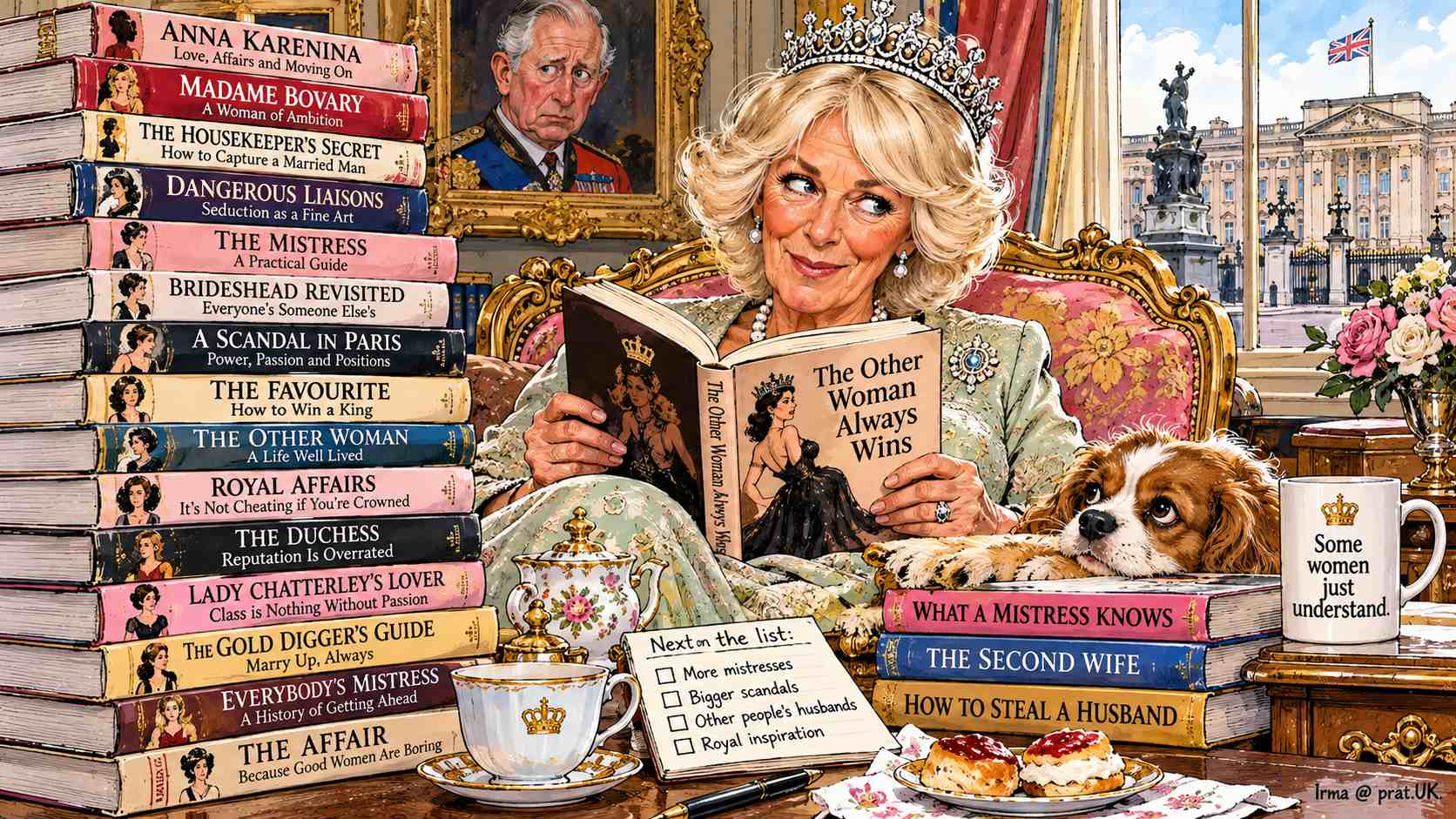
LONDON, 19 October 2026 — Queen Camilla’s literary tastes have come under fresh scrutiny after royal observers assembled a collection of 15 novels featuring mistresses, marriage wreckers, social climbers and women who treat other people’s wedding vows as preliminary paperwork.
The unofficial collection, provisionally titled From Mistress to Majesty: A Practical Guide to Getting Ahead Without Waiting for Your Turn, draws on some of the greatest works of English and European literature.
Every heroine has one thing in common. She wants another woman’s husband, another woman’s money, another woman’s social position, or all three before the weekend.
Literary experts have spotted a recurring theme. Traditional romantic heroines fall in love, overcome obstacles and get married. The heroines on this list fall in love, discover the man is already married, overcome his wife and get married a good deal better.
One Buckingham Palace literary adviser reportedly described the collection as “the greatest concentration of ambitious mistresses since the court of Charles II.” A second adviser suggested the whole lot could be shelved under British history rather than romance.
After all, Britain has spent a thousand years teaching children that monarchs inherit their positions through divine right, while occasionally demonstrating that a determined mistress can achieve roughly the same result with less paperwork.
The Other Boleyn Girl by Philippa Gregory: Why Settle for Mistress When There’s a Throne?
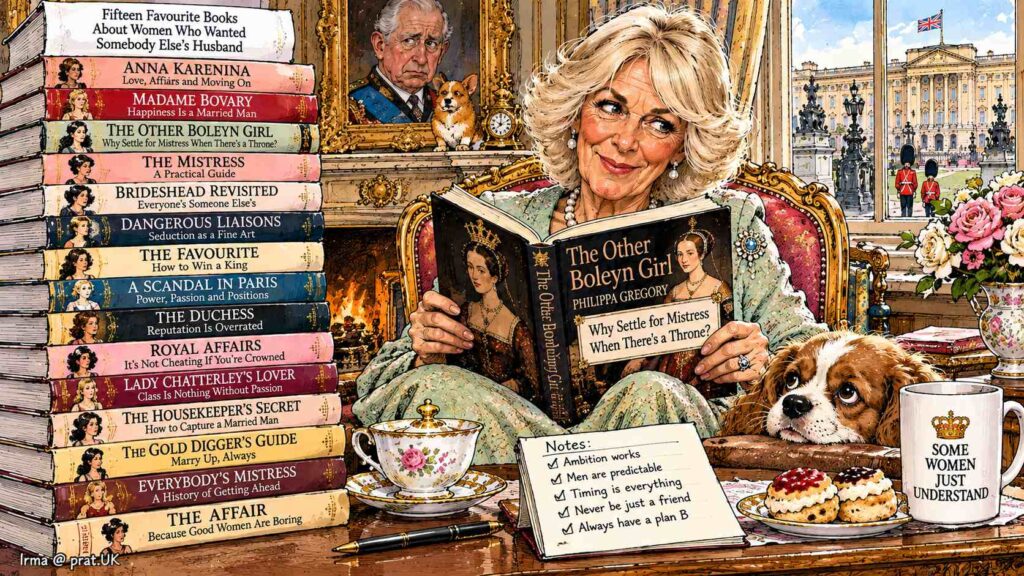
The first essential book is The Other Boleyn Girl by Philippa Gregory, which chronicles the romantic ambitions of Mary and Anne Boleyn at the court of Henry VIII.
Mary becomes the king’s mistress. Anne decides that being the king’s mistress lacks promotion opportunities and demands the position of queen. Henry responds by reorganising the entire English church.
Most women hoping to improve their romantic prospects buy a new dress. Anne Boleyn persuaded the king to change the national religion.
Unfortunately, Anne later discovered that marrying a man who disposes of wives to acquire new ones is not a sound retirement strategy. The palace’s unofficial lesson is straightforward: marry the king, but make sure the divorce arrangements are civilised enough to avoid a visit to the Tower of London.
Forever Amber: The Royal Mistress Career Handbook
Kathleen Winsor’s Forever Amber follows Amber St. Clare as she climbs through Restoration society and ends up as one of Charles II’s mistresses.
Amber understands that social mobility in seventeenth-century England was difficult, particularly for women without inherited wealth. Her solution was to acquire influential boyfriends.
While ordinary women struggled to enter polite society, Amber treated aristocratic bedrooms as executive recruitment offices. Literary historians regard the novel as a Restoration classic. Palace recruitment specialists might file it under professional development.
Its central lesson is that romance gets a lot more profitable when the boyfriend owns several counties.
Vanity Fair: Becky Sharp Finds Wealth Easier to Marry Than Earn
William Makepeace Thackeray’s Vanity Fair introduces Becky Sharp, one of literature’s most accomplished social climbers.
Becky starts with modest circumstances, exceptional charm and the understanding that the British class system is a locked door whose hinges tend to loosen around wealthy gentlemen. She manipulates, flatters and manoeuvres her way through society.
Ordinary people spend decades saving for a house. Becky checks whether the house comes with a single male occupant.
Economists call this the efficient allocation of scarce resources. Marriage counsellors call it a problem. Aristocrats call it Thursday.
The difference between Becky Sharp and a modern public-relations consultant is that Becky occasionally admits she wants something.
The King’s Mistress: Alice Perrers Beats the Employment Contract
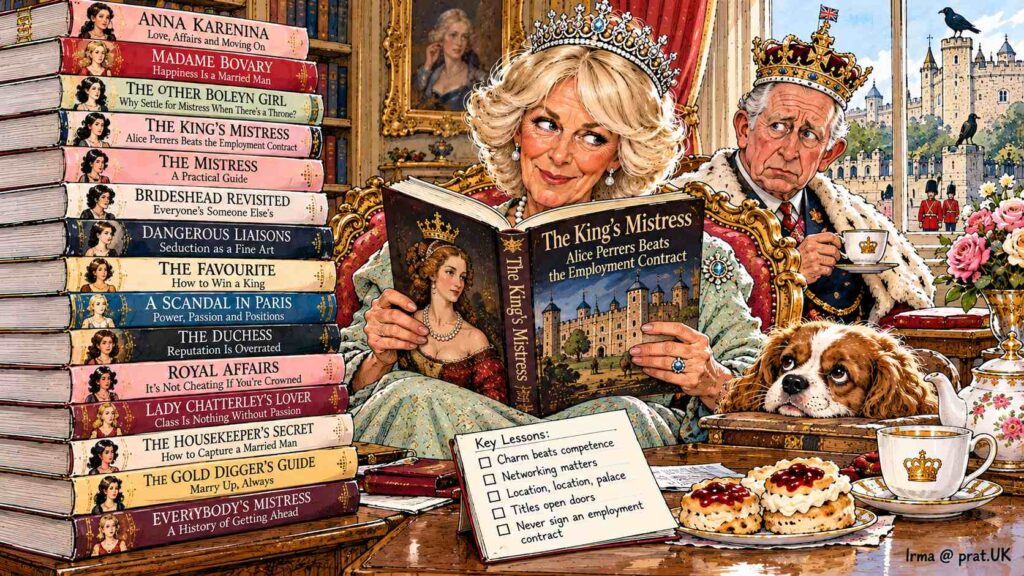
Emma Campion’s The King’s Mistress explores the life of Alice Perrers, who became a powerful mistress of Edward III.
Her relationship with the king offered opportunities that conventional employment never would. A medieval woman could spend forty years washing royal laundry without acquiring a castle. A sufficiently influential mistress could skip the laundry and start discussing property.
The arrangement raises an important constitutional question. If the king possesses divine authority, does his mistress get a percentage?
Medieval historians still debate the precise nature of court influence, but the economic principle is clear enough: proximity to the monarch can pay better than proximity to the labour market.
Gone with the Wind: Scarlett O’Hara Marries Property
Margaret Mitchell’s Gone with the Wind offers Scarlett O’Hara, whose determination to hold on to Tara extends to marrying her sister’s intended husband.
Scarlett appreciates something modern politicians often overlook: property requires money. She also appreciates that money becomes easier to acquire when romantic relationships are judged on their financial performance.
When ordinary women have money problems, they reconsider the household budget. Scarlett reconsiders the household husband.
Her guiding principle is that tomorrow is another day, particularly if today’s engagement involves somebody a good deal richer. Buckingham Palace accountants reportedly regard Scarlett as an encouraging example of asset preservation.
Lady Susan: Jane Austen’s Most Efficient Marriage Consultant
Jane Austen’s Lady Susan presents a charming, calculating widow who manipulates romantic relationships while looking after her own interests.
Unlike Austen’s more conventional heroines, Lady Susan isn’t interested in waiting patiently for love to arrive. She prefers to arrange the delivery.
She understands that a married gentleman may be an inconvenience, but that inconveniences can be handled through charm, discretion and the strategic distribution of correspondence.
In an ordinary Austen novel, everybody spends 300 pages trying to work out who loves whom. Lady Susan already knows. She just wants to find out who has the biggest estate.
The Custom of the Country: Marriage as a Corporate Merger
Edith Wharton’s The Custom of the Country introduces Undine Spragg, a woman whose romantic ambitions resemble a multinational acquisition strategy.
Undine marries, divorces and upgrades her social circumstances on a repeating cycle. She regards husbands the way a property developer regards buildings: perfectly adequate until something more valuable comes on the market.
The novel shows that romance, properly managed, can deliver excellent returns. Undine never asks whether a man will love her forever. She asks whether his portfolio will survive inflation.
The palace’s unofficial investment committee has reportedly awarded Undine five stars for determination and deducted one for failing to secure a hereditary crown.
Madame Bovary: A Marriage With No Exchange Policy
Gustave Flaubert’s Madame Bovary follows Emma Bovary, who grows disappointed with her ordinary married life and pursues passionate affairs.
Emma’s husband is a doctor, which in most British households would count as a matrimonial success. Emma regards reliability, affection and steady professional employment as insufficient grounds for staying interested.
She wants excitement. She wants romance. She wants the sort of dramatic relationship that produces expensive bills and deeply uncomfortable conversations.
Emma demonstrates the basic danger of romantic dissatisfaction: once a woman decides her husband is boring, the entire village becomes an audition.
The novel ends tragically, which suggests the French weren’t especially keen on adultery unless it came with a decent bottle of wine and a long philosophical discussion.
Dangerous Liaisons: A Palace Press Office Gets a Historical Precedent
Pierre Choderlos de Laclos’s Dangerous Liaisons features the Marquise de Merteuil, an aristocratic manipulator who organises seductions, betrayals and social destruction.
Her chief qualification is understanding that romantic information becomes more valuable when everybody involved wants to keep it secret. She could have had a distinguished career advising the British royal family.
Indeed, the Marquise’s correspondence resembles the work of a modern palace press office, except the letters are far more entertaining and the writers occasionally accept responsibility for their actions.
One exhausted royal observer suggested that the novel proves aristocratic society has run on the same principles for centuries. The only real innovation, he said, has been WhatsApp.
Moll Flanders and Roxana: Daniel Defoe’s Marriage-Based Economy
Daniel Defoe deserves special recognition for supplying two candidates.
Moll Flanders follows a resourceful woman through a succession of relationships, marriages and financial difficulties. Roxana: The Fortunate Mistress explores a woman’s pursuit of wealth and independence through relationships with powerful men.
Both books show the economic difficulties women faced in earlier centuries, when opportunities for financial security were severely restricted. Defoe’s heroines responded with serious entrepreneurial instincts.
Where a modern businesswoman might set up a company, raise venture capital and develop a product, a Defoe heroine identifies a wealthy gentleman and opens negotiations.
Historians call it the eighteenth-century marriage market. Investment bankers call it private equity. Royal historians call it business as usual.
The Last Mrs. Parrish: The Homewrecker With a Business Plan
Liv Constantine’s The Last Mrs. Parrish presents Amber Patterson, who befriends wealthy Daphne Parrish before trying to replace her as the wife of millionaire Jackson Parrish.
Amber’s ambition is refreshingly uncomplicated. She wants the husband. She wants the money. She wants the house. And, ideally, she’d like the existing wife to stop answering the telephone.
The novel offers a practical warning against welcoming ambitious strangers into your home just because they compliment the curtains. Amber understands that the easiest house to acquire is one somebody else has already furnished.
Unfortunately, she also discovers that wealthy husbands sometimes come with defects the estate agent’s brochure didn’t mention.
The palace’s unofficial reading circle reportedly describes the book as a gripping study of matrimonial ambition and the dangers of insufficient background checks.
Katherine by Anya Seton: The Mistress Who Finally Got the Wedding
Anya Seton’s Katherine recounts the relationship between Katherine Swynford and John of Gaunt. Katherine becomes the powerful nobleman’s mistress and eventually his wife. Their descendants end up in the English royal line.
Her story offers a useful historical lesson: medieval society could condemn a mistress on Monday, accept her marriage on Tuesday and celebrate her royal descendants several generations later. Scandal becomes heritage if the family survives long enough.
For aspiring royal mistresses, Katherine’s story delivers the ultimate inspirational message. Never underestimate patience, powerful connections and genealogy.
Bel-Ami: Equality Arrives in the Gold-Digging Profession
Guy de Maupassant’s Bel-Ami shows that men can also exploit romantic relationships for social advancement. Georges Duroy climbs Parisian society through influential women.
His approach is almost refreshingly egalitarian. Why should ambitious women enjoy exclusive access to the financial benefits of adultery?
Duroy understands that a wealthy married woman can offer opportunities no conventional employer will. French society treats him as a charming opportunist rather than a national constitutional emergency.
A Buckingham Palace diversity consultant reportedly recommended the book for demonstrating that matrimonial ambition should not discriminate on grounds of sex.
Anna Karenina: An Important Warning About Railway Timetables
Finally, Leo Tolstoy’s Anna Karenina explores the destructive consequences of an aristocratic woman’s affair with Count Vronsky.
Anna’s marriage, passion and eventual tragedy make for a rather different conclusion from the success stories elsewhere on the list. The novel warns that affairs can destroy families, reputations and lives.
It also shows Russian literature’s unusual ability to take a romantic disagreement and turn it into 800 pages of philosophical despair. A modern British newspaper could manage the same in three headlines and a photograph of somebody looking uncomfortable outside Kensington Palace.
The Queen’s Reading Room Meets the Mistress-to-Majesty Reading List
The real Queen’s Reading Room promotes reading and publishes selections chosen by Camilla, including respected novels, historical works and contemporary literature.
The alternative collection proposes a more specialised system of literary classification. Books would no longer be arranged by author, nationality or historical period. Instead, readers could browse three departments: Mistresses Who Settled for Too Little, Mistresses Who Became Queens, and Gold Diggers Who Forgot to Negotiate a Title.
A fourth department, Wives Who Didn’t See It Coming, would be set up in a separate wing.
The proposed classification has already alarmed traditional librarians, who fear it would mean moving about half the novels written about European aristocracy into a single room.
One literary academic calculated that 87 percent of royal romantic history could be summed up in the sentence, “He was married, but matters became complicated.” The remaining 13 percent involves inheritance disputes and hunting accidents.
The Queen Camilla Literary Achievement Award Goes to the Woman Who Gets the Crown
Competition for the unofficial Queen Camilla Literary Achievement Award remains intense.
Becky Sharp shows extraordinary social ambition. Undine Spragg treats husbands as investment vehicles. Amber Patterson specialises in hostile domestic takeovers. Anne Boleyn achieves the feat of persuading a king to reorganise Christianity.
But Katherine Swynford offers something even more valuable: proof that a mistress can eventually become a legitimate wife whose descendants enter the royal succession.
The award judges have established three principal evaluation criteria. The winning heroine must secure an influential romantic partner, improve her social position and demonstrate that the public will eventually forget the unfortunate circumstances of the original introduction.
Extra points are awarded if the husband has a castle. Double points if the castle is taxpayer-maintained.
The Irony Prize: Britain Condemns Scandal Until It Needs a Commemorative Plate
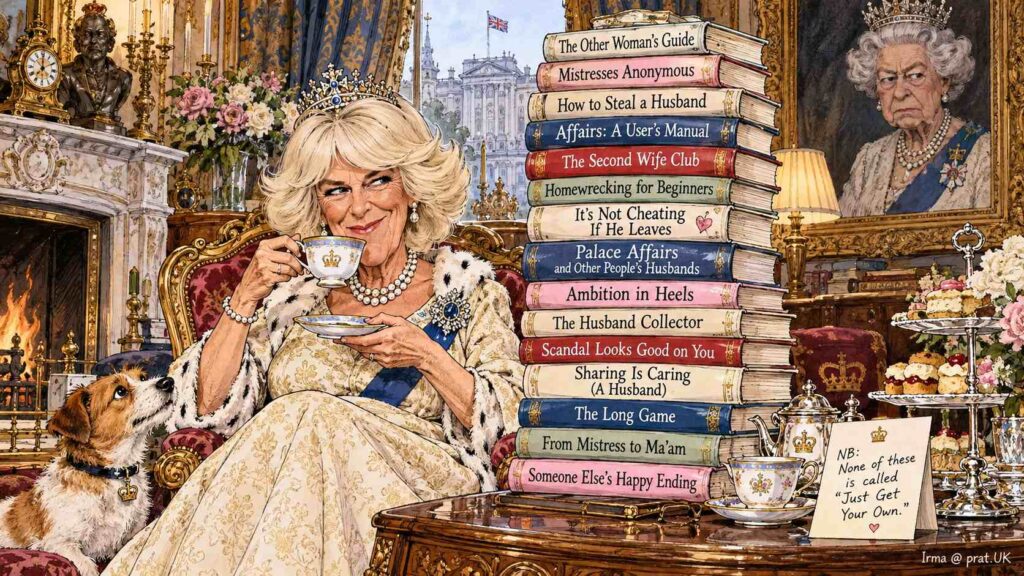
The lifetime achievement award, however, goes not to a literary character but to the enduring British tradition of condemning romantic scandal until the participants become important enough to appear on commemorative china.
The irony has been noted by several people, none of whom work at the palace. A household spokesperson said the royal family takes no position on novels, only on who gets photographed holding them.
An institution that has spent a thousand years insisting a title can only be inherited now finds its reading list suggesting it can also be acquired by arriving early, staying late and outlasting the other candidates. Nobody has yet explained why the people most devoted to the sanctity of marriage keep producing the best reading material about breaking it up.
The palace’s final unofficial reading recommendation is therefore very simple.
Never judge a book by its cover. Judge it by whether the mistress gets the title, the house and a carriage.
The carriage is technically optional, though no heroine on the list has ever turned one down.
Because in royal literature, happily ever after isn’t always about finding the right man. Sometimes it’s about finding him before his wife realises the story has changed.
Five Humorous Observations on Queen Camilla’s Reading List
- Fifteen books about women who wanted somebody else’s husband, and not one of them is called “Just Get Your Own.” That’s not a reading list. That’s a hostage negotiation with a library card.
- Anne Boleyn asked for a promotion and the HR department was the Tower of London. That’s the worst performance review in history. My boss’s is only mildly beheading.
- Becky Sharp gets called a social climber. A guy joins a golf club to meet a client and that’s “networking.” She just networked with better cardigans and worse intentions.
- Anna Karenina is the only woman on the list who doesn’t win, and she’s the one with the 800-page book. Of all the ways to leave a man in Russia, she picks the one with a timetable. You can’t even be mad. The train was on time.
- They tell you never judge a book by its cover. Then a palace judges women for nine hundred years by their surname, their wedding and who was standing next to them in the photo. Turns out you can judge a book by its cover. You just have to wait for it to get a balcony.
Disclaimer
This article is political and royal satire. The 15 titles make up a humorous alternative reading list and are not presented as Queen Camilla’s actual selections. Palace remarks, surveys and literary awards are comic devices. The real books and their plots provide the literary inspiration.
This story is entirely a human collaboration between two sentient beings: the world’s oldest tenured professor and a philosophy major turned dairy farmer.
SOURCE: https://thequeensreadingroom.co.uk/bookcategory/chosen/
The article draws its factual literary references from the authors, publishers and the Queen’s official reading programme, while the palace commentary and award ceremony are satirical.

Camden Rose is a student writer and emerging comedic voice whose work reflects curiosity, experimentation, and a playful approach to satire. Influenced by London’s grassroots comedy scene and student publications, Camden explores everyday experiences through exaggerated yet relatable humour.
Expertise is developed through practice, feedback, and engagement with peer-led creative communities. Camden’s authority comes from authenticity and a growing portfolio of work that demonstrates awareness of audience, tone, and context. Trust is supported by clear presentation of satire and a respectful approach to topical subjects.
Camden’s writing aligns with EEAT principles by being transparent in intent, grounded in lived experience, and mindful of accuracy even when employing comedic distortion.