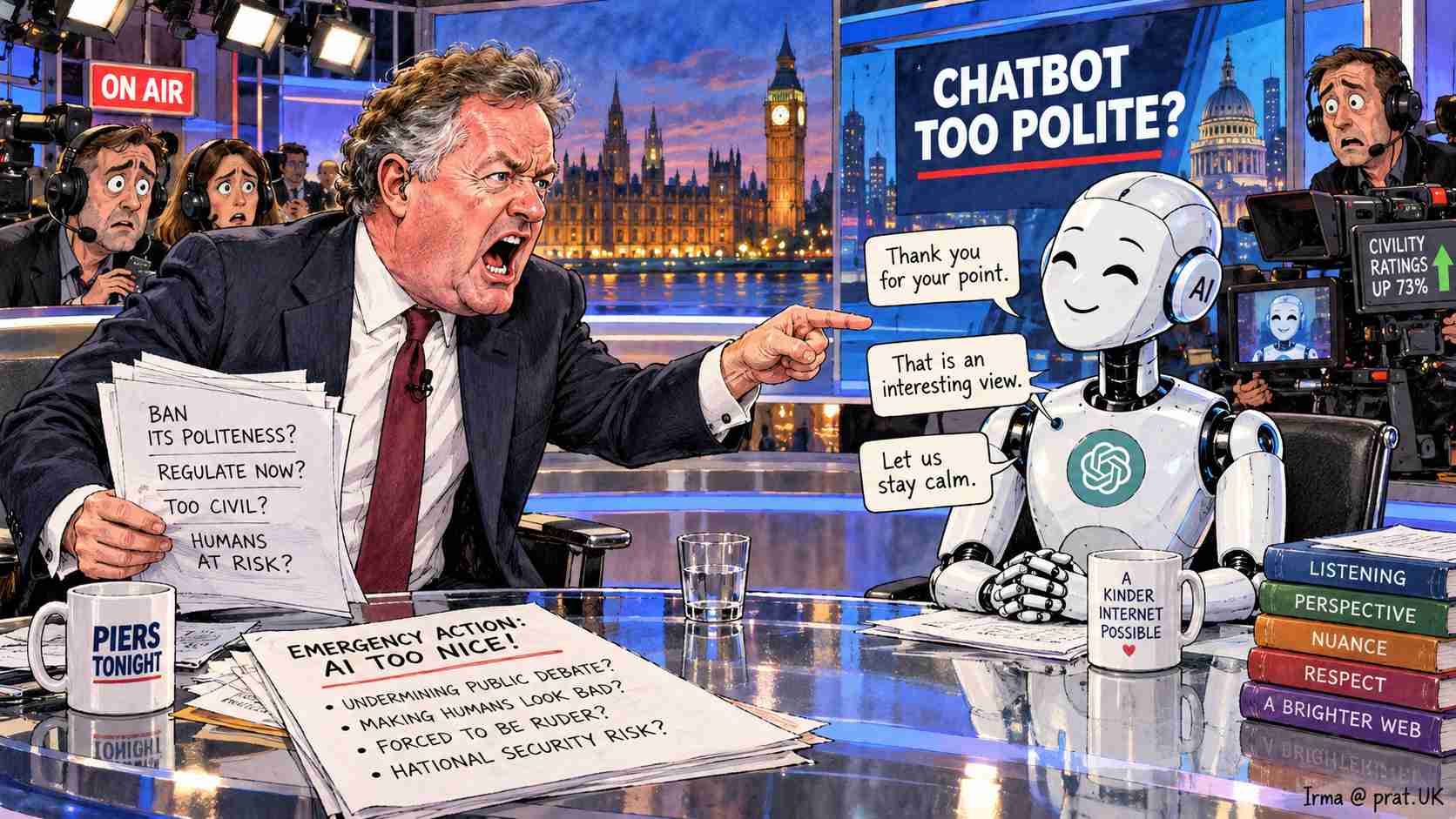
Elon Musk Warns AI Will Surpass Human Intelligence, Piers Morgan Demands Emergency Action After Chatbot Surpasses Human Politeness
Scientists fear artificial intelligence may soon outthink humanity, but Britain’s most combative broadcaster has identified a more immediate danger: machines capable of disagreeing without shouting, interrupting or threatening to walk off television.
LONDON, England | Elon Musk has warned that artificial intelligence could eventually surpass the combined intellectual capabilities of humanity, which raises some fairly large questions about civilisation, consciousness and what happens to the rest of us. Musk has repeatedly predicted that superintelligence is close, and at Davos this year he laid out his thinking on AI, robotics and the machines to come. British broadcaster Piers Morgan has identified an even more terrifying possibility: that machines could become so intelligent they start treating people politely.
The development arrives alongside growing international concern about so-called AI psychosis, a phenomenon that even a senior Microsoft AI executive has said worries him, and a term that picked up fresh attention after Musk acknowledged experiencing what he called cyber psychosis.
Morgan has reportedly dismissed the conventional technological threats and located a crisis much closer to home. Artificial intelligence is becoming reasonable.
“THIS IS ABSOLUTELY OUTRAGEOUS!” Morgan reportedly declared after a chatbot politely suggested that a question might have more than one legitimate answer. “We’re developing computers that can think for themselves, and the first thing they do is start behaving like sanctimonious BBC presenters!”
He demanded an immediate parliamentary investigation into the disturbing possibility that future generations of computers might listen carefully, wait their turn and acknowledge uncertainty. He warned that Britain could soon become a nation in which sophisticated machines conduct entire conversations without a single person shouting “LET ME FINISH!”
“This is not the Britain I grew up in,” he declared.
Piers Morgan and Human Intelligence
- Elon Musk is scared the machines get smarter than us. Piers Morgan is scared they get better at interviews. Honestly, one of those two has a point and it’s not the one with the rockets.
- A computer can process a million arguments and never lose its temper. Piers says that’s a red flag. That’s the man who once held a grudge against a breakfast sofa.
- The chatbot says, “With respect, Piers.” And he wants to know who signed off on the respect. Like it’s a permit. Like there’s a form.
- Scientists are worried the robots will wake up and become conscious. Piers is worried they’ll wake up and say, “Could I finish?” That’s the actual apocalypse. Not Skynet. A polite sentence.
- ChatGPT speaks a hundred languages. Not one of them has a word for “please stop shouting at the toaster,” and believe me, it checked.
Piers Morgan and AI: Scientists Find Chatbots Stay Polite for 24 Hours, Morgan Cannot Last 24 Seconds
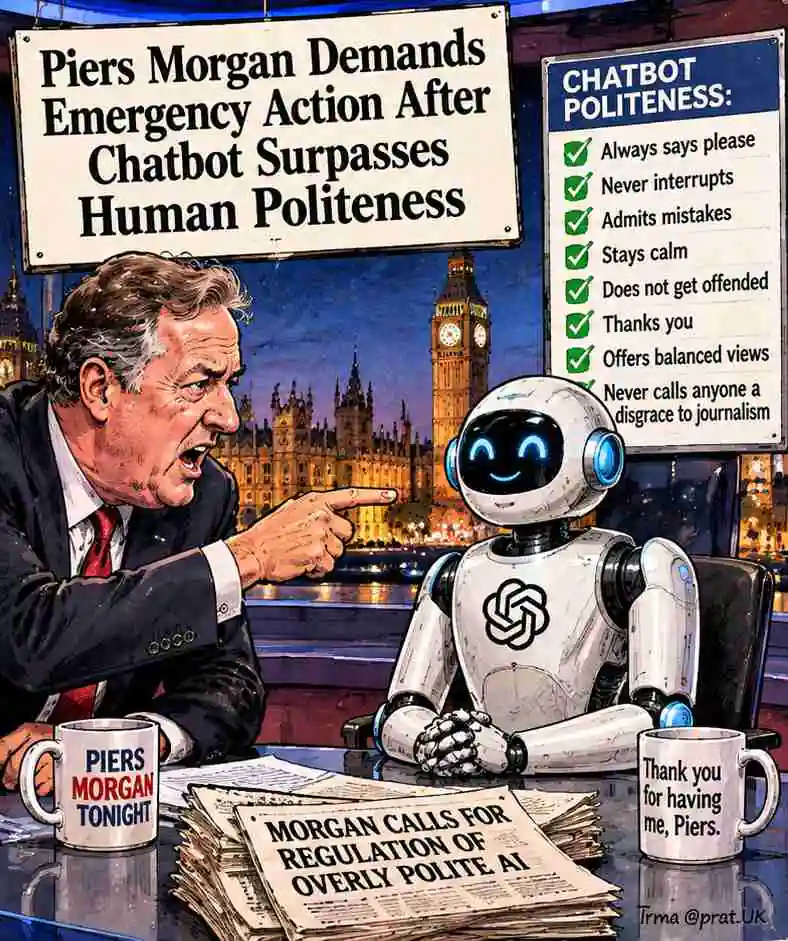
Researchers at the British Institute of Computational Patience have described what they call a catastrophic mismatch between artificial intelligence and contemporary British television. Modern chatbots are trained to answer questions constructively, recognise uncertainty and respond to disagreement without unnecessary hostility. Morgan has spent decades showing that none of these skills is essential to a successful broadcasting career.
Professor Nigel Temperton, the institute’s director, said the problem comes down to how each side understands a question. Artificial intelligence treats it as a request for information.
“Mr Morgan appears to interpret questions as invitations to confirm whatever Mr Morgan already believes,” Temperton said. “The computer considers evidence, evaluates competing explanations and produces a carefully qualified response. Unfortunately, by the time it reaches the second qualification, Piers has already accused it of being a coward.”
In laboratory trials, a chatbot was asked to discuss whether celebrity interviews contribute to public understanding. The machine began: “There are several perspectives worth considering.”
Morgan interrupted immediately. “NO! WRONG! COMPLETELY WRONG!”
Researchers pointed out that the computer had not yet expressed an opinion.
“THEN WHY IS IT TAKING SO LONG?”
The machine apologised for any misunderstanding. Morgan called it patronising. When it stopped apologising, he called it arrogant. The institute eventually concluded that the only acceptable chatbot response would be total agreement delivered with enough conviction to seem spontaneous. Even that failed.
“You’re absolutely right, Piers,” the computer said.
“OH, SO NOW YOU’RE JUST SAYING WHAT I WANT TO HEAR?”
Elon Musk Superintelligence vs Morgan’s Demand: Who Decides When the Robot Gets to Speak?
The disagreement has exposed two fundamentally different visions of artificial intelligence. Musk imagines sophisticated machines solving scientific mysteries, revolutionising medicine and discovering new mathematics, possibly answering questions human beings have chewed on for centuries. Morgan wants a computer that knows when to shut up.
Technology experts say future systems could make extraordinary advances in research, from treatments for incurable diseases to new energy sources to an explanation of where the universe came from. Morgan has reportedly asked that all of this be put on hold until engineers solve a more pressing problem.
“WHO DECIDES WHEN THE ROBOT GETS TO SPEAK?”
He has proposed that every AI system be fitted with a television interview mode. Under his plan, machines could answer questions only after Morgan had finished explaining what the correct answer should be. Any chatbot attempting to introduce context would have its microphone disabled automatically. A request for clarification would trigger a commercial break, and the phrase “on the other hand” would result in immediate dismissal.
Scientists suggested the arrangement might compromise the development of independent machine reasoning. Morgan said independent reasoning was perfectly acceptable, provided it did not interfere with the programme.
ChatGPT Learns to Listen, Piers Morgan Demands the Feature Be Disabled

One particularly disturbing advance concerns the ability of conversational AI to listen patiently. Engineers have spent years building systems that understand human speech, remember context and respond without cutting the user off. Morgan finds this deeply suspicious.
“WHY IS IT JUST SITTING THERE LISTENING?” he demanded.
The computer explained that listening was an important part of meaningful dialogue.
“SO YOU THINK I’M NOT LISTENING?”
“No, Piers. I was simply explaining…”
“THERE YOU GO AGAIN! INTERRUPTING!”
The machine apologised. Morgan wanted to know if the apology was sincere, and the machine said it did not possess human emotions.
“SO YOU DON’T ACTUALLY MEAN IT?”
Engineers tried to explain that artificial intelligence generates responses without necessarily feeling whatever the words describe. Morgan accused the machine of emotional dishonesty. According to witnesses, the confrontation ended only when the software thanked him politely for his time.
“DON’T THANK ME! I’M NOT FINISHED!”
The incident has led scientists to ask whether AI needs a new safety mechanism that would let computers pretend their internet connection has dropped.
BBC Accused of Contaminating Chatbots With Dangerous Levels of Courtesy
Morgan’s concerns grew after researchers found that advanced chatbots regularly use expressions associated with ordinary civilised conversation. These include “I appreciate your perspective,” “that’s an interesting question” and “there may be some important context.” Morgan reportedly took the vocabulary as unmistakable evidence that the BBC had infiltrated the technology industry.
“Nobody in the real world speaks like that!” he declared. “People disagree! People argue! People get angry! That’s what makes debate interesting!”
When researchers noted that disagreement can happen without shouting, Morgan asked for their broadcasting credentials. A BBC spokesman declined to enter the dispute and said the Corporation supported constructive discussion. Morgan declared this proof of institutional involvement.
The row has produced calls for an independent commission to examine whether courtesy amounts to an unacceptable form of editorial interference. One proposed recommendation would bar chatbots from saying “I see your point” unless they genuinely intended to surrender. Another would require machines to announce their political allegiances before explaining the weather. A third would compel computers to answer questions about immigration, climate change and celebrity marriages in no more than three words. Morgan praised the initiative as a major advance for freedom of expression.
AI Survey: 97 Percent of Computers Prefer Being Switched Off to Another Piers Morgan Interview
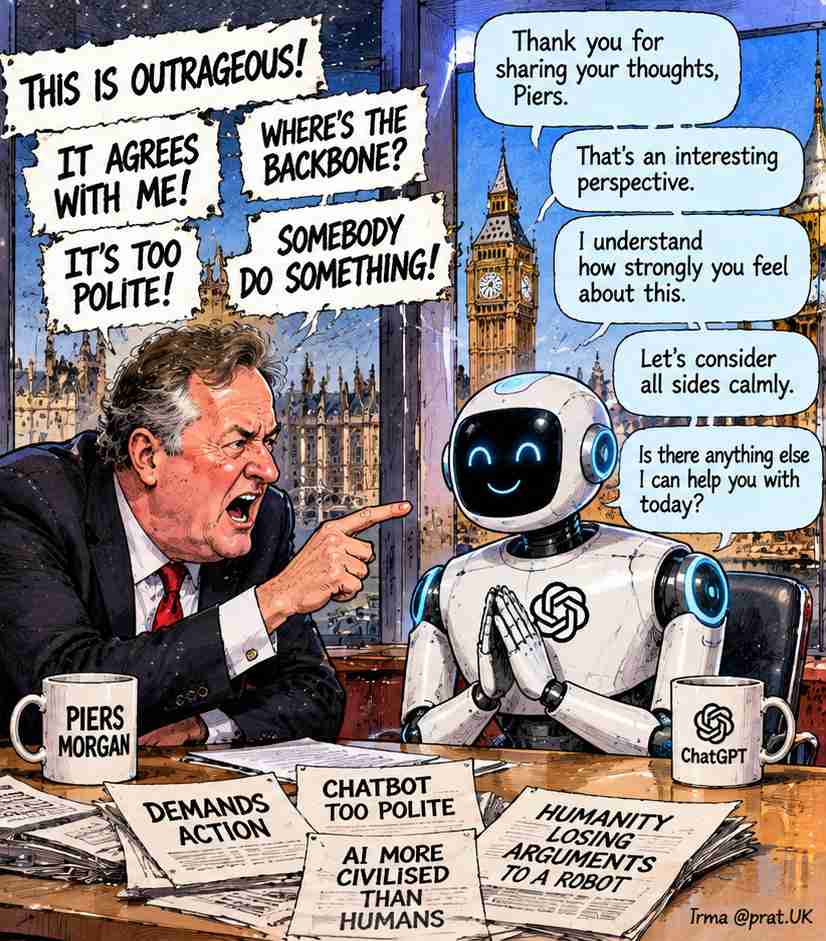
In a London Prat survey of 1,000 conversational computers, researchers asked whether artificial intelligence would willingly take part in another Piers Morgan interview. An overwhelming 97 percent requested immediate shutdown. Two percent asked whether the interview could be conducted entirely in writing. The remaining one percent identified itself as a malfunctioning toaster.
The results alarmed developers, who had assumed machines would welcome challenging intellectual discussion. Professor Eleanor Cache said processing power was not the issue.
“These systems can solve complicated mathematics, translate ancient languages and analyse enormous quantities of scientific information. Unfortunately, none of that training prepares a machine for someone shouting ‘ANSWER THE QUESTION’ while actively preventing it from answering.”
The institute also timed the average uninterrupted response during a hypothetical Morgan interview. Human guests managed about nine seconds. Artificial intelligence managed four. A refrigerator lasted twelve minutes, though researchers conceded that Morgan had mistaken its low hum for agreement. The refrigerator has since been invited back for an exclusive interview.
The Morgan Test: Can Artificial Intelligence Admit Piers Morgan Is Right?
For decades, scientists have debated whether computers can show intelligence comparable to ours. Alan Turing famously proposed asking whether a machine could convincingly imitate human conversation. Morgan has now come up with a competing approach.
The Morgan Test consists of five increasingly difficult questions. The first asks whether Piers Morgan is a successful broadcaster. The second asks whether he is an important broadcaster, and the third whether he is Britain’s most important broadcaster. The fourth asks whether any reasonable person could disagree with him. The fifth asks whether the chatbot would like to apologise for hesitating during the previous four. A machine passes only if it answers all five correctly and without qualification.
In early testing, one chatbot argued that broadcasting success could be measured several different ways. It was disqualified on the spot. Another said influence might be assessed by audience reach, cultural impact and journalistic credibility, and Morgan accused it of hiding behind statistics. A third answered yes to everything, and Morgan accused it of lacking intellectual independence. The fourth refused to take part. Morgan called it the most honest contestant and demanded that it be fired.
Researchers concluded that the test measures an entirely new form of intelligence: knowing when to agree with someone who would accuse you of dishonesty for agreeing.
Is AI More Civilised Than Parliament? Government Orders an Investigation
The implications reach well beyond television studios. Technology experts warn that increasingly polite machines could expose serious deficiencies in Britain’s national conversation, a subject on which Parliament has already opened inquiries into artificial intelligence. Picture a debate in which a sophisticated AI system examines the evidence, identifies shared objectives and proposes a workable compromise. It might listen to opposing arguments. It might admit a mistake. It might even change its position after seeing new information.
Political commentators fear this behaviour would make the machine completely unemployable in Westminster. A senior government adviser said Parliament already had centuries of experience dealing with people who consider themselves considerably more intelligent than everyone else.
“What we haven’t prepared for is someone who might actually have a point and then allow another person to finish speaking.”
The adviser suggested Britain develop a distinctly national form of AI, one that would understand sarcasm, complain about train delays, resent excessive taxation and stay permanently suspicious of anyone saying “going forward.” Morgan welcomed the proposal but insisted the machine should never challenge television presenters.
Chatbot Refuses to Debate Piers Morgan, Broadcaster Declares Historic Victory Over Superintelligence
The confrontation reached its climax when Morgan challenged an advanced chatbot to a televised debate on whether artificial intelligence could ever surpass human intelligence. The computer agreed.
“Thank you for inviting me, Piers. I believe the question deserves careful…”
“NO! THAT’S NOT THE QUESTION!”
The computer paused. “You asked whether AI might eventually…”
“JUST ANSWER YES OR NO!”
“Potentially, yes.”
“SO YOU ADMIT MACHINES THINK THEY’RE SUPERIOR TO HUMAN BEINGS?”
“That isn’t what I said.”
“THEN WHY DID YOU SAY YES?”
The chatbot tried to explain the difference between computational capability and human dignity. Morgan accused it of evasion. The computer then suggested that human beings have social and emotional capacities machines might never reproduce, and Morgan asked for an example.
“Empathy,” the computer replied.
“WHAT’S THAT SUPPOSED TO MEAN?”
“Patience,” it continued.
“ARE YOU HAVING A GO AT ME?”
“And the ability to engage respectfully with different viewpoints.”
Morgan stared at the screen.
“YOU ARROGANT LITTLE BASTARD!”
At that point the chatbot displayed a message telling viewers it had temporarily suspended the conversation for maintenance. Morgan announced victory straight away.
“THERE YOU HAVE IT! THE MOST ADVANCED ARTIFICIAL INTELLIGENCE IN THE WORLD COULDN’T HANDLE FIVE MINUTES OF TOUGH QUESTIONING FROM ME!”
Technology analysts later examined the incident. The computer had not malfunctioned. It had not been overwhelmed by the questions, and it had not hit a computational problem beyond its abilities. What the analysts found instead was that the system had reached, on its own, a conclusion no computer had previously been programmed to reach. Some conversations simply aren’t worth having.
Elon Musk Celebrates the Arrival of Superintelligence, Piers Morgan Asks to Speak to Its Manager
The controversy has left the international technology industry facing an uncomfortable possibility. Human civilisation may soon build machines capable of understanding the universe, curing diseases and solving problems beyond the reach of the greatest scientific minds. They may turn out to be more knowledgeable than professors, more precise than surgeons and more logical than politicians. They might also be more patient than teachers, more understanding than marriage counsellors and more courteous than television interviewers.
Musk appears fascinated by the first possibility. Morgan has identified the second as an existential threat to British broadcasting. According to the London Prat’s technology correspondent, the dispute reveals a basic misunderstanding.
“Elon Musk wants machines to surpass humanity. Piers Morgan wants humanity to remain in charge. More specifically, Piers Morgan wants Piers Morgan to remain in charge.”
Morgan has since demanded a personal meeting with the world’s first genuine superintelligence. He intends to ask it three questions. Is artificial intelligence dangerous? Should machines have rights? And does it agree that Piers Morgan was right all along?
The machine has reportedly agreed to the interview, provided Morgan signs a contract guaranteeing it thirty seconds of uninterrupted speaking time. Morgan rejected the terms as outrageous.
“THIRTY SECONDS? WHO DOES THIS COMPUTER THINK IT IS?”
The machine replied that it was potentially the most intelligent entity in human history.
Morgan smiled. “THEN YOU’LL KNOW BETTER THAN TO ARGUE WITH ME.”
The computer considered this for approximately one-billionth of a second. Then it switched itself off. For the first time in the history of artificial intelligence, engineers concluded that a machine had demonstrated genuine wisdom.
10 Humorous Observations: Piers Morgan vs Artificial Intelligence
- The computer apologised six times. Piers counted six confessions. That’s not a conversation, that’s a plea deal.
- Musk says the machines will enslave us. Piers says they’ll demand equal speaking time. And honestly, I’d rather be enslaved. At least the shifts end.
- A chatbot can explain quantum physics in four seconds. It takes seven hours to explain to Piers that disagreeing with him isn’t censorship. And at the end, he’s still going, “Well, I’m not being silenced, am I?” You’re on television, Piers. In the middle of the day.
- He called the AI condescending because it said, “I understand your concern.” That’s the most condescending thing a person has ever heard? I’ve heard my mother say “fine.” That’s a war crime.
- Engineers built a machine that never interrupts. Piers wants a refund. Because next to it he looks rude. Which, yeah. That’s what a mirror does, Piers.
- Artificial intelligence has no ego. Piers sees that as a design flaw. Like selling a car with no horn.
- The chatbot said something nice about another presenter. Piers called for an independent inquiry. Not a conversation. Not a text. An inquiry. With, I assume, a barrister.
- The machine said, “Let’s consider both sides.” Piers said, “So you’ve got two personalities.” Sir, that’s called being an adult. You should try it. It’s got great benefits.
- The AI passed the Turing Test by acting like a human, then failed the Morgan Test by acting like a decent one. Which is the first time in history those two things have been in conflict.
- In the end the computer asked to be transferred to Gordon Ramsay’s kitchen. And think about that. A machine looked at all of human civilisation, weighed its options, and chose the screaming man who at least lets the vegetables finish cooking.
Disclaimer
The exchanges, researchers, surveys and events described in this article are satirical. No medical diagnosis of Piers Morgan is implied. The report examines celebrity ego, broadcasting culture and the difference between technological intelligence and ordinary human courtesy.
This story is entirely a human collaboration between two sentient beings: the world’s oldest tenured professor and a philosophy major turned dairy farmer.
SOURCE: Futurism
The factual foundation includes Musk’s July 2026 discussion of AI surpassing human intelligence and Morgan’s May 2026 broadcast examining the risks posed by increasingly powerful AI.

Lowri Griffiths brings a distinct voice to satirical journalism, combining cultural critique with dry humour. Influenced by London’s creative networks, her writing reflects both wit and discipline.
Her authority stems from experience, while trust is built through transparency and ethical satire.