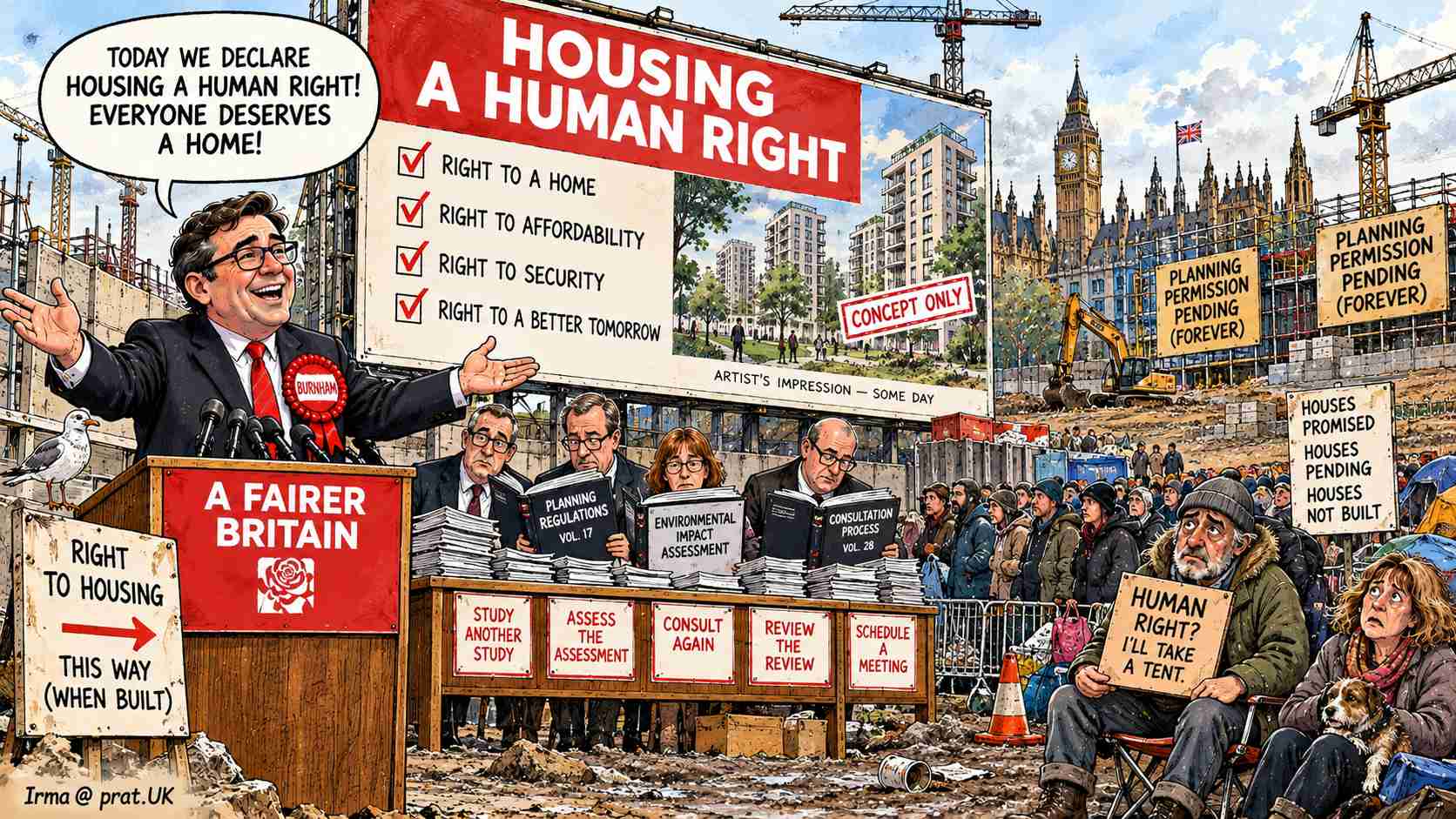
Spain’s housing crisis demonstrates the difficulty of accommodating millions of citizens inside a government promise, regardless of how passionately politicians deliver it
MADRID – Spain has discovered that declaring housing a fundamental human right does not automatically produce houses, apartments, bedrooms, kitchens, bathrooms or enough space for a grown man to escape his mother-in-law. The discovery has shocked politicians who believed affordable accommodation could be produced through speeches, parliamentary resolutions and carefully photographed visits to construction sites.
Prime Minister Pedro Sánchez has faced nationwide anger over housing costs. According to Courthouse News, he called an early general election for November 29 after lawmakers rejected his minority government’s housing plan, which included freezing evictions and rent increases.
The protests grew after the eviction of 87-year-old Madrid resident María del Carmen Abascal, known as Maricarmen, who had lived in her flat since her father first rented it in 1956. As NPR reported, tens of thousands marched through Madrid, and her case became a symbol of the country’s housing emergency.
Her experience deserves compassion. The political habit of promising accommodation without tackling the forces that restrict supply deserves rather less. Spain’s housing crisis has now reached the point where ordinary citizens are starting to wonder whether homes might be more useful than housing policies. This suggestion has been referred to a government committee for further investigation.
Spain’s housing crisis demonstrates…
- A right to housing with no housing is like a right to a sunny day. Everyone agrees on it, and the weather has not been consulted.
- The “Twenty-Point Sleeping Strategy” has nineteen points about sleeping and one about getting a bed.
- Four years of permission for sixty flats suggests the quickest way to build a home in Spain is to be born in one.
- A working group on sustainable staircases has yet to reach the first floor.
- When the minister’s artist’s impression shows a family with excellent teeth, you know the budget went on the dentist, not the foundations.
Spain’s Housing Shortage: The Government Has Built a Magnificent Collection of Housing Promises
Spain’s political leaders have repeatedly stressed the importance of access to housing. Opposition parties have answered with promises of faster construction, planning changes and more supply. Both sides have made impressive declarations. Unfortunately, declarations do not contain plumbing.
According to the OECD’s analysis of Spain’s housing market, about 345,000 residential construction permits were issued between 2022 and 2024 while 604,000 new households formed. That is a good deal more demand for homes than the permit pipeline could comfortably absorb, and the Bank of Spain’s 2025 annual report put the shortfall at about 750,000 homes. Estimates differ, but they point the same way. Even a socialist mathematician eventually notices that 604,000 is larger than 345,000.
An imaginary government consultant, Professor Alfredo Vacancies, dismissed the criticism. “You are using capitalist arithmetic. Under progressive arithmetic, the number of homes depends upon the sincerity of our intentions.”
Asked whether this method produced actual apartments, the professor suggested that journalists stop confusing housing policy with construction.
Right to Housing in Practice: The Apartment Has Been Approved in Principle
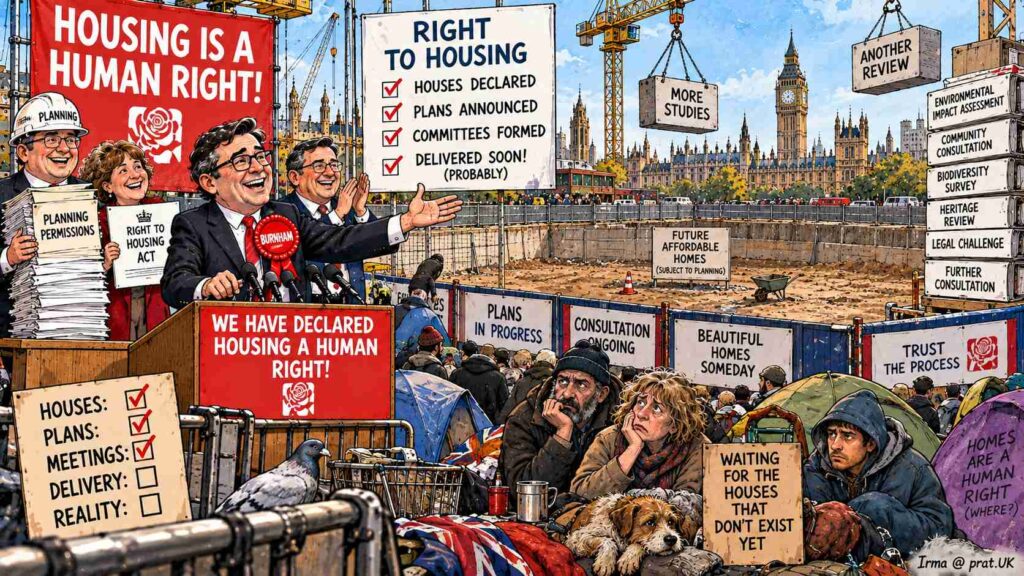
A young Madrid couple recently applied for an apartment under the government’s hypothetical Universal Accommodation Scheme. Their application was approved at once. They were told they qualified for affordable housing, subsidised utilities and a government guarantee of residential dignity. Naturally, they asked for the address.
The official looked confused.
“The address?”
“Yes. Where is the apartment?”
“We have guaranteed your right to the apartment.”
“Can we move in?”
“The building has not yet received permission to commence construction.”
“Where is the land?”
“That is under consultation.”
“Who is building it?”
“That question will be addressed after the consultation.”
“When does the consultation end?”
“After the election.”
The couple thanked the official and went back to the bedroom they were renting from the husband’s parents. His mother asked whether the government had found them a home.
“Not exactly.”
“What did they give you?”
“A guarantee.”
“Wonderful. Put it in the drawer with your university degree.”
Spain is not alone in mistaking the announcement for the building. England counts its actual additions to the stock every year in the government’s net supply of housing statistics, a publication admired mainly for being the one housing document that contains houses. Spanish officials studied it closely and concluded that the British secret was counting. They have since commissioned a count, to begin once the counting office has somewhere to live.
Planning Permission and Housing Supply: Spain Has Invented the First Apartment Made Entirely of Paperwork
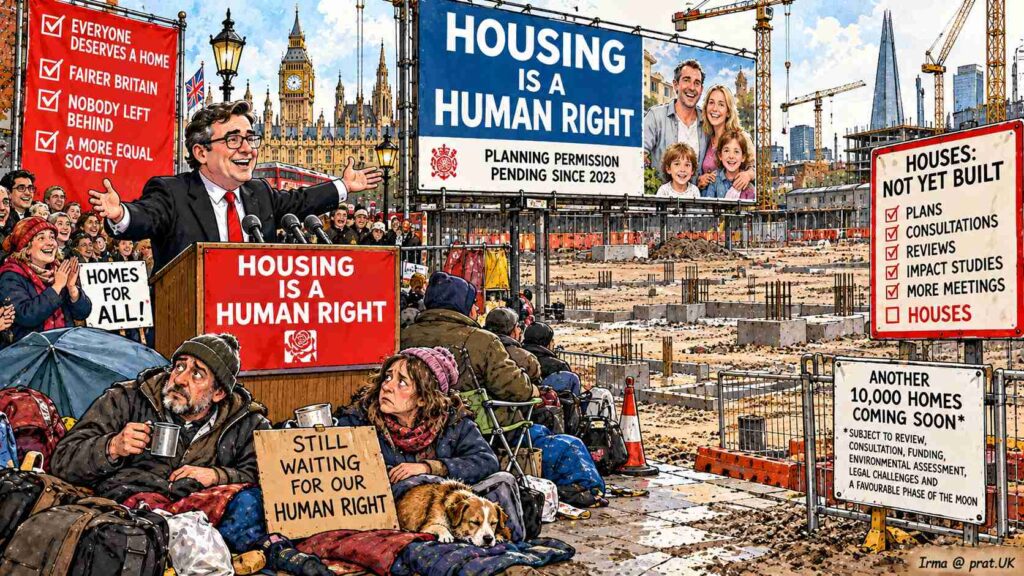
Developers must navigate planning rules, municipal decisions, infrastructure limits, financing hurdles and a shortage of construction workers. These are real obstacles. They also offer tremendous opportunities for government employment.
One imaginary developer explained that he had spent four years trying to get permission to build sixty apartments. In that time the government had approved eight studies, commissioned six reports and set up a working group on sustainable staircases. He remains optimistic. “At this rate, my grandchildren will be able to begin construction shortly after my funeral.”
Politicians insist that affordable housing needs stronger regulation. Developers argue that excessive restrictions can discourage investment and slow building. Tenants want protection from abusive landlords. All three concerns can be legitimate. The difficulty arises when political leaders pretend that protecting current tenants automatically creates enough housing for future tenants. It doesn’t. And protecting an elderly renter from an abusive eviction should never require pretending the wider shortage can be cured without construction.
Building More Homes: The Ministry of Housing Discovers a Revolutionary Material
After an extensive investigation, government scientists have identified a new substance that could transform Spain’s housing market. It is called concrete. Apparently, when combined with steel, glass, labour, planning approval and money, concrete can produce actual buildings. Officials call the discovery promising but politically sensitive.
“We cannot simply allow people to build homes,” explained an imaginary housing minister. “There must first be assurances that the homes comply with our vision of socially responsible architectural development.”
Asked whether people might simply prefer somewhere affordable to sleep, the minister said affordable sleeping had become a priority of the government’s Twenty-Point Sleeping Strategy. The ministry then released artist’s impressions of a family smiling in an apartment overlooking Madrid. The apartment does not exist. But the family has excellent teeth.
Ministers have also floated capping rents, on the principle that a flat you cannot find should at least be cheap. The standard economics reference on price controls has a long and unhappy section on rent control: hold the price below what it costs to supply, and landlords supply less of it. The ministry read the section and drew the only conclusion open to it. It will cap the price of the encyclopedia.
An Election Is Not an Apartment
Sánchez’s decision to call an election gives voters a chance to choose between competing approaches to housing. That is democracy working as intended. It does not, however, add a single flat to the housing supply.
The government can change. The cabinet can change. The laws can change. But the structural shortage will remain until enough homes exist where people need them, and that takes land, investment, construction, infrastructure and consistent policymaking, alongside sensible protections for vulnerable households. Housing cannot be manufactured by verbal repetition. Nobody has ever successfully lived inside a ministerial commitment, heated a bedroom with an election manifesto or built a kitchen by announcing that kitchens should be affordable.
Spain may yet produce a sensible housing settlement. In the meantime its politicians should remember one unfashionable distinction.
A family cannot live in a housing policy. It needs a house.
Humorous Observations on Housing Promises and Spain’s Missing Flats
- The drawer containing a university degree, a guarantee and a stack of consultation letters is now the largest property portfolio in Madrid.
- Concrete was found to work. The ministry has asked for further studies, naturally.
- Progressive arithmetic is the only maths where 345,000 permits for 604,000 households can be described as “a good start.”
- Housing policy has more drafts than a Victorian house. It also keeps the same people out.
- “After the election” is the political equivalent of “the cheque is in the post,” but with ballot boxes.
- Every ministry press release about housing contains exactly as many bricks as the housing it promises. The count is easy.
- If speeches were bricks, Spain would have solved this crisis in the first fortnight of a campaign and sold the surplus to Portugal.
- A counting office with nowhere to live is the first government body to experience its own policy.
- Capping the rent on a flat that does not exist is a bargain. You save one hundred percent and sleep at your mother’s.
- The British housing statistics contain houses. In Madrid this is considered showing off.
Satirical Disclaimer
This article satirizes housing-policy promises, inadequate construction and bureaucratic delay. Spain’s housing crisis is real and has numerous causes; the comic dialogue and officials are imaginary. The eviction of María del Carmen Abascal is treated with respect. This story is entirely a human collaboration between two sentient beings: the world’s oldest tenured professor and a philosophy major turned dairy farmer, neither of whom has successfully milked an architectural drawing.
Auf Wiedersehen, amigo!
– prat.UK

Alan Nafzger was born in Lubbock, Texas, the son Swiss immigrants. He grew up on a dairy in Windthorst, north central Texas. He earned degrees from Midwestern State University (B.A. 1985) and Texas State University (M.A. 1987). University College Dublin (Ph.D. 1991). Dr. Nafzger has entertained and educated young people in Texas colleges for 37 years. Nafzger is best known for his dark novels and experimental screenwriting. His best know scripts to date are Lenin’s Body, produced in Russia by A-Media and Sea and Sky produced in The Philippines in the Tagalog language. In 1986, Nafzger wrote the iconic feminist western novel, Gina of Quitaque. He currently lives in Holloway, North London. Contact: [email protected]